

IMG_20260620_144503095_BURST0011.jpg
Inflammatory dis order of breast
Reading File
The image shows a chapter from what appears to be Robbins Pathology (with KD Tripathi also open), specifically the table of contents for the breast chapter. The "Inflammatory Disorders" section lists: Acute Mastitis, Squamous Metaplasia of Lactiferous Ducts, Duct Ectasia, Fat Necrosis, Lymphocytic Mastopathy, and Granulomatous Mastitis - all at page 946-947.
Searching sources...
Finding Sources
Finding Sources
Finding Sources
Reading File
Reading File
Finding Sources
Finding Sources
Reading File
Finding Sources
Finding Sources
I found Robbins Pathology (the textbook in the image). Let me read that section directly.
Reading File
Finding Sources
Reading File
Reading File
I need to go back and get the Duct Ectasia, Fat Necrosis, Lymphocytic Mastopathy, and Granulomatous Mastitis sections from Robbins.
Reading File
I now have all the content needed from Robbins Pathology. Let me fetch the key diagrams from the textbook to enrich the answer.
Loading Image
Loading Image
I now have all the content from Robbins Pathology. Here is the complete, detailed answer:
Inflammatory Disorders of the Breast
(From Robbins, Cotran & Kumar - Pathologic Basis of Disease, Chapter 23, p. 946-947)
Inflammatory diseases of the breast are rare - accounting for less than 1% of breast symptoms. They are caused by infections, autoimmune disease, or foreign body-type reactions to extravasated keratin or secretions. Inflammatory breast cancer clinically mimics inflammation and must always be excluded in a female presenting with an erythematous swollen breast.
1. Acute Mastitis
Etiology & Setting: Occurs almost exclusively during the first month of breastfeeding (lactational mastitis). Cracks and fissures in the nipple act as the portal of entry for:
- Staphylococcus aureus (most common) - leads to localized single/multiple abscesses
- Streptococci (less common) - causes spreading cellulitis
Clinical features: Breast erythema, pain, tenderness, and fever. Initially one duct system/sector is involved; if untreated, the infection can spread to the entire breast.
Treatment: Appropriate antibiotics + continued expression of milk. Surgical drainage is only rarely required.
2. Squamous Metaplasia of Lactiferous Ducts
(also called: Recurrent subareolar abscess / Periductal mastitis / Zuska disease)
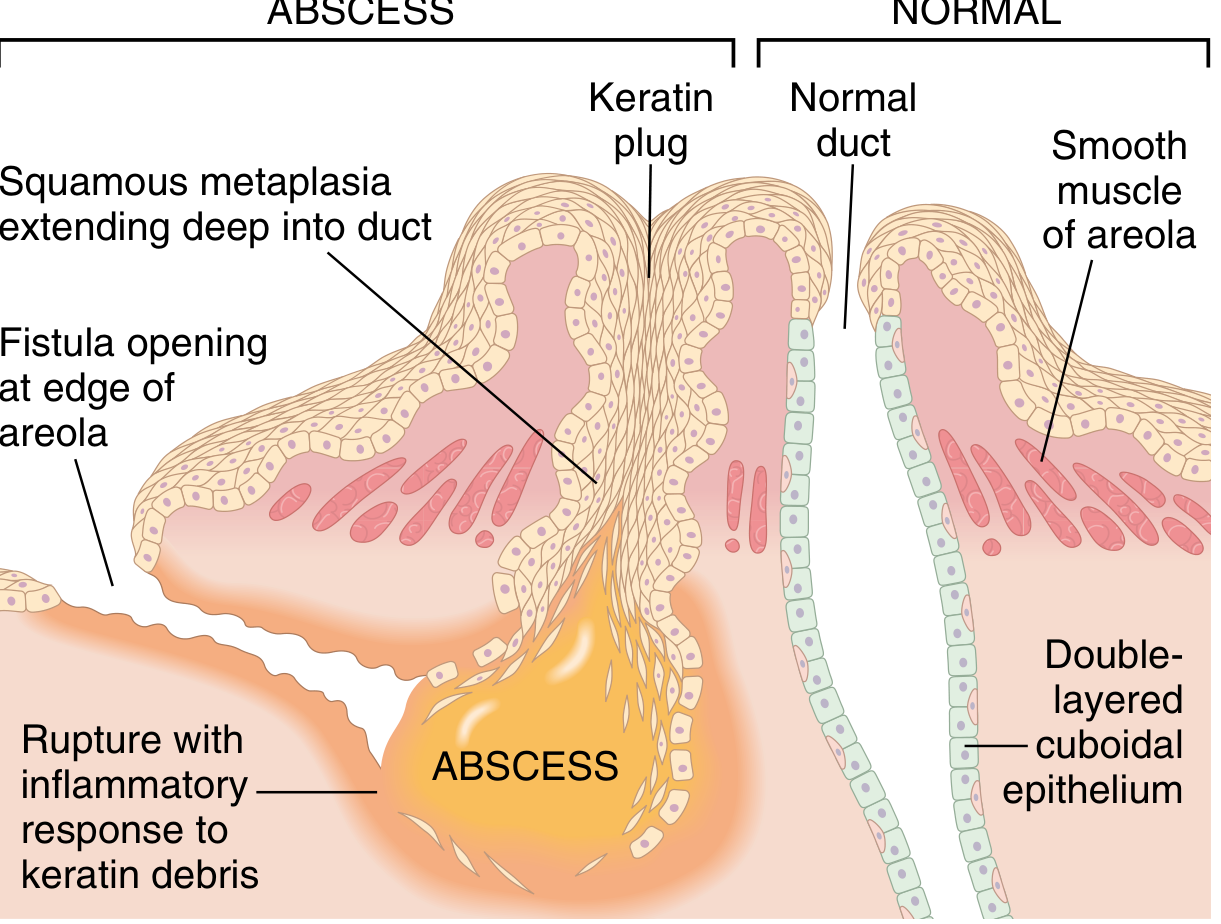
Pathogenesis: Keratinizing squamous metaplasia extends deep into the nipple duct past the normal squamocolumnar junction. Shed keratin is trapped, plugging the duct → dilation → rupture → intense chronic granulomatous inflammatory response to keratin spilling into periductal tissue.
Key association: >90% of affected individuals are smokers. Tobacco-associated relative vitamin A deficiency alters ductal epithelial differentiation.
Clinical features:
- Painful erythematous subareolar mass mimicking a bacterial abscess
- Recurrent fistula tract that burrows under the nipple smooth muscle and opens at the edge of the areola
- Nipple inversion due to traction from scarring
Treatment: En bloc surgical removal of the involved duct and fistula tract (simple incision and drainage alone leads to recurrence). Antibiotics if secondary bacterial infection is present.
3. Duct Ectasia
Age/Setting: 5th-6th decade of life, multiparous females. NOT associated with cigarette smoking (distinguishes it from squamous metaplasia).
Clinical features:
- Palpable periareolar mass
- Thick, white nipple secretions
- Occasional skin retraction
- Pain and erythema are uncommon
- Can mimic invasive carcinoma clinically and radiologically
Morphology:
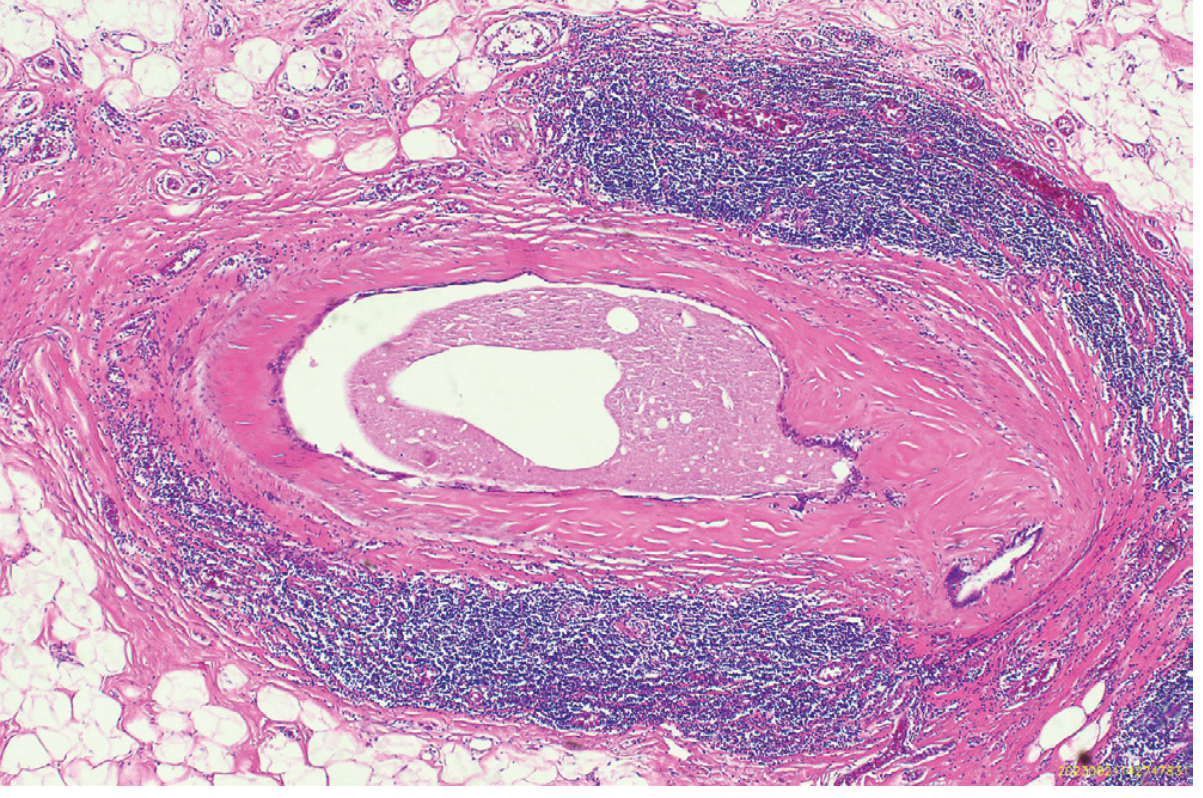
- Ectatic (dilated) ducts filled with inspissated secretions and numerous lipid-laden macrophages
- Duct rupture triggers chronic periductal/interstitial inflammation (lymphocytes, macrophages, plasma cells)
- Granulomas may form around cholesterol deposits
- Subsequent fibrosis produces an irregular mass with skin and nipple retraction
4. Fat Necrosis
Etiology: ~50% have history of breast trauma or prior surgery. The rest may be spontaneous (no identifiable cause).
Clinical features: Closely mimics cancer - presents as:
- Painless palpable mass
- Skin thickening or retraction
- Mammographic densities or calcifications
Morphology (evolving stages):
| Stage | Findings |
|---|---|
| Acute | Hemorrhagic, central liquefactive necrosis with neutrophils + macrophages |
| Subacute | Proliferating fibroblasts + chronic inflammatory cells surround the area |
| Late | Giant cells, calcifications, hemosiderin appear; lesion replaced by scar or encircled by fibrous tissue |
| Gross | Ill-defined, firm, gray-white nodules with small chalky-white foci |
5. Lymphocytic Mastopathy (Sclerosing Lymphocytic Lobulitis)
Clinical features: Single or multiple hard palpable masses or mammographic densities. Dense collagenized stroma may make needle biopsy difficult.
Morphology:
- Atrophic ducts and lobules with thickened basement membranes
- Surrounded by a lymphocytic infiltrate
- Densely collagenized stroma
Key associations:
- Type 1 diabetes (diabetic mastopathy) - most common
- Hashimoto thyroiditis
- Hypothesized to have an autoimmune basis
Clinical significance: Must be distinguished from breast cancer.
6. Granulomatous Mastitis
Causes:
- Systemic granulomatous diseases - granulomatosis with polyangiitis, sarcoidosis, tuberculosis
- Idiopathic granulomatous lobular mastitis - occurs only in parous females; granulomas closely associated with lobules and may contain lipid vacuoles surrounded by neutrophils
- Cystic neutrophilic granulomatous mastitis - similar histology; often caused by lipophilic Corynebacteria
- Localized infections - mycobacteria or fungi (rare; mainly in immunocompromised patients or around breast prostheses/nipple piercings)
Treatment: Antibiotics and sometimes corticosteroids.
Summary Table
| Condition | Age/Setting | Key Feature | Clinical Mimic |
|---|---|---|---|
| Acute Mastitis | Lactating women | S. aureus/streptococci | Abscess |
| Squamous Metaplasia | Smokers | Keratin plug → fistula | Abscess, nipple inversion |
| Duct Ectasia | 5th-6th decade, multiparous | White nipple discharge | Carcinoma |
| Fat Necrosis | Post-trauma/surgery | Chalky-white necrosis | Carcinoma |
| Lymphocytic Mastopathy | DM type 1 / Hashimoto | Dense collagenized stroma | Carcinoma |
| Granulomatous Mastitis | Parous females | Lobule-centered granulomas | Infection/abscess |
Key exam point: Duct ectasia, fat necrosis, and lymphocytic mastopathy can all mimic invasive carcinoma clinically and radiologically - biopsy is often required for definitive diagnosis.
- Robbins, Cotran & Kumar - Pathologic Basis of Disease, p. 946-947
- Schwartz's Principles of Surgery 11th Ed., p. 577
This is a shared conversation. Sign in to Orris to start your own chat.