
From standard books general properties of viruses
I'll start by reading the medical library skill, then search for virology content from standard textbooks.
Reading File
Now let me search the library for virology content in parallel.
Finding Sources
Finding Sources
Found key sections. Let me read all relevant content in parallel.
Reading File
Reading File
Reading File
Good - got the Jawetz general properties section. Now let me get more detail on virus structure, classification, and replication from the same chapter.
Reading File
Finding Sources
Excellent content coming in. Let me read more of this chapter to get the full picture on structure, symmetry, and replication.
Reading File
Let me now get the classification/structure/symmetry content from the key offset range I missed earlier (3167-3284).
Reading File
I now have rich content from Jawetz. Let me fetch the virus structure diagram and also get content on viral replication from the same book.
Loading Image
Finding Sources
I now have comprehensive content. Let me compile the full detailed answer from all the Jawetz content collected.
General Properties of Viruses
(Source: Jawetz, Melnick & Adelberg's Medical Microbiology, 28th Ed., Chapter 29)
1. Definition and Size
Viruses are the smallest infectious agents, ranging from about 20 to 300 nm in diameter. They contain only one kind of nucleic acid (either RNA or DNA) as their genome. The complete, mature, extracellular virus particle is called the virion.
Key distinguishing features:
- They are obligate intracellular parasites - they replicate only inside living host cells and are metabolically inert outside cells
- They are parasites at the genetic level - the viral nucleic acid directs the host cell's biosynthetic machinery to produce viral components
- They contain no ribosomes, no mitochondria, and no metabolic enzymes of their own (unlike bacteria)
2. Structural Components (Virology Terminology)
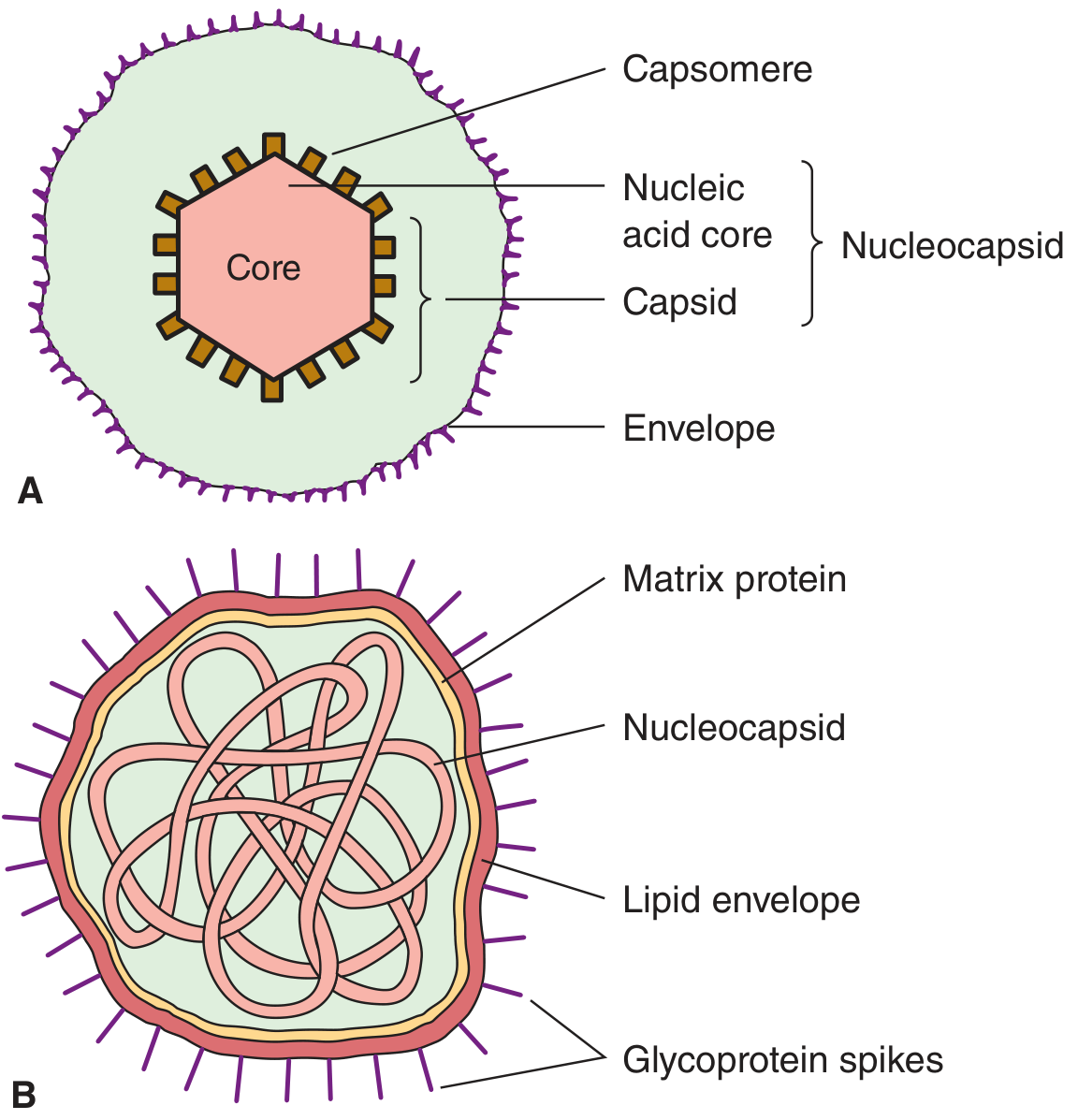
| Term | Definition |
|---|---|
| Capsid | The protein shell/coat that encloses and protects the nucleic acid genome |
| Capsomeres | Morphologic units visible under electron microscopy on the surface of icosahedral virions; represent clusters of polypeptides |
| Nucleocapsid | The protein-nucleic acid complex (capsid + enclosed genome) |
| Envelope | A lipid-containing membrane surrounding some virions, acquired by budding through a host cell membrane during maturation |
| Peplomers | Virus-encoded glycoprotein projections (spikes) exposed on the surface of the envelope |
| Virion | The complete, extracellular virus particle (= nucleocapsid alone in simple viruses; nucleocapsid + envelope in complex viruses) |
| Structural unit (protomer) | The basic protein building block of the capsid; usually a collection of more than one non-identical polypeptide subunit |
| Defective virus | A virus particle that is functionally deficient in some aspect of replication |
3. Genome (Nucleic Acid)
- Each virus contains only one type of nucleic acid - either DNA or RNA, never both (exception: during certain replication strategies like retroviruses/hepadnaviruses)
- The genome may be:
- Single-stranded (ss) or double-stranded (ds)
- Linear or circular
- Positive-sense, negative-sense, or ambisense (for RNA viruses)
- Segmented (multiple separate RNA segments, e.g., influenza) or non-segmented
- Genome size ranges from ~1.7 kb (parvoviruses) to ~375 kbp (poxviruses)
- The nucleic acid carries all information necessary to direct the host cell to synthesize virus-specific macromolecules for producing viral progeny
4. Capsid Symmetry
A. Icosahedral Symmetry
- The capsid is built in the shape of an icosahedron (20 equilateral triangular faces, 12 vertices)
- The number of capsomeres is characteristic for each virus family (e.g., 32 in parvoviruses, 252 in adenoviruses, 162 in herpesviruses)
- Examples: adenovirus, poliovirus, herpesviruses, papillomaviruses
B. Helical Symmetry
- Capsomeres and nucleic acid are wound together in a helical/spiral arrangement
- Results in a rod-shaped or filamentous nucleocapsid
- Examples: influenza virus (negative-strand RNA), rabies virus, paramyxoviruses
C. Complex Symmetry
- Some large viruses (e.g., poxviruses) have complex coats that do not conform to either icosahedral or helical symmetry
- Poxviruses have a brick-shaped morphology with complex internal membranes
5. Envelope vs. Non-Enveloped (Naked) Viruses
| Feature | Enveloped Viruses | Naked (Non-enveloped) Viruses |
|---|---|---|
| Outer layer | Lipid bilayer derived from host membrane | Capsid only |
| Ether/detergent sensitivity | Sensitive (disrupts lipid envelope) | Resistant |
| Environmental stability | Less stable (fragile) | More stable (survive drying, acid) |
| Transmission | Usually require close contact/secretions | Can spread via fomites, fecal-oral routes |
| Examples | HIV, influenza, herpes, rabies | Poliovirus, adenovirus, HAV, parvovirus |
The envelope contains virus-encoded glycoproteins (peplomers) that are critical for:
- Attachment to host cell receptors
- Immune evasion
- Membrane fusion (entry)
6. Viral Replication - Overview
During the replicative cycle:
- Attachment (Adsorption) - Virion binds to specific receptors on the host cell surface via surface proteins or glycoproteins
- Penetration/Entry - The virion or its nucleic acid enters the cell (by endocytosis, membrane fusion, or direct injection)
- Uncoating - The capsid is removed, releasing the nucleic acid into the appropriate cellular compartment
- Biosynthesis - The viral genome directs synthesis of:
- Viral nucleic acid (genome replication)
- Viral proteins (structural + non-structural)
- Assembly - Numerous copies of viral nucleic acid and coat proteins assemble to form new nucleocapsids (the capsid assembles around the genome)
- Release - New virions are released by:
- Lysis of the host cell (naked viruses)
- Budding through host cell membrane (enveloped viruses - acquiring their envelope in the process)
7. Classification of Viruses
The basis for classification includes:
- Virion morphology - size, shape, type of symmetry, presence/absence of peplomers, membranes
- Genome properties - type of nucleic acid (DNA/RNA), size, strandedness (ss/ds), linear/circular, sense (+/-/ambisense), number of segments, nucleotide sequence, %GC content
- Genome organization and replication - gene order, open reading frames, strategy of replication, cellular sites of replication and assembly
- Viral protein properties - number, size, amino acid sequence, modifications (glycosylation, phosphorylation, myristoylation), functional activities (transcriptase, reverse transcriptase, neuraminidase)
- Antigenic properties - serologic relationships detected by neutralization, hemagglutination inhibition, complement fixation
- Physicochemical properties - molecular mass, buoyant density, pH stability, thermal stability, susceptibility to physical and chemical agents
- Biologic properties - natural host range, mode of transmission, vector relationships, pathogenicity, tissue tropisms
Taxonomy: Virus families end in -viridae; genera end in -virus
8. Summary Table: Major Animal Virus Families (Infecting Humans)
| Nucleic Acid | Symmetry | Envelope | Family | Size (nm) | Examples |
|---|---|---|---|---|---|
| DNA ss | Icosahedral | Naked | Parvoviridae | 18-26 | Parvovirus B19 |
| DNA ds circular | Icosahedral | Enveloped | Hepadnaviridae | 40-48 | Hepatitis B |
| DNA ds | Icosahedral | Enveloped | Herpesviridae | 150-200 | HSV, VZV, CMV, EBV |
| DNA ds | Complex coat | Resistant | Poxviridae | 230×400 | Smallpox, Vaccinia |
| RNA ss(+) | Icosahedral | Naked | Picornaviridae | 22-30 | Poliovirus, HAV, Rhinovirus |
| RNA ss(+) | Icosahedral | Naked | Caliciviridae | 35-40 | Norovirus |
| RNA ss(-) segmented | Helical | Enveloped | Orthomyxoviridae | 80-120 | Influenza A, B |
| RNA ss(-) | Helical | Enveloped | Paramyxoviridae | 150-300 | Measles, Mumps, RSV |
| RNA ss(-) | Helical | Enveloped | Rhabdoviridae | 70×170 | Rabies |
| RNA ds segmented | Icosahedral | Naked | Reoviridae | 60-80 | Rotavirus |
| RNA ss(+) diploid | Icosahedral | Enveloped | Retroviridae | 80-100 | HIV, HTLV |
9. Special Properties of DNA vs. RNA Viruses
DNA Viruses (Medical Microbiology 9e, Box 36.7)
- DNA is not transient or labile
- Many establish persistent/latent infections (e.g., herpesviruses)
- DNA genomes reside in the nucleus (except poxviruses, which replicate in cytoplasm)
- Viral DNA resembles host DNA for transcription and replication
- Gene transcription is temporally regulated: early genes encode DNA-binding proteins and enzymes; late genes encode structural proteins
- DNA polymerases require a primer to replicate the genome
RNA Viruses
- RNA is more labile and mutation-prone
- Positive-sense RNA (+ssRNA) can act directly as mRNA and be immediately translated
- Negative-sense RNA (-ssRNA) must carry an RNA-dependent RNA polymerase (transcriptase) in the virion
- RNA viruses have a higher mutation rate (no proofreading) leading to quasispecies and antigenic drift/shift
- Most RNA viruses replicate in the cytoplasm; exceptions include influenza (nuclear) and retroviruses
10. Evolutionary Origin of Viruses
Two main theories exist:
- Cellular origin: Viruses may be derived from DNA or RNA components of host cells that became able to replicate autonomously - essentially "escaped genes" that evolved independently. Some viral sequences are related to portions of cellular genes.
- Degenerate parasite theory: Viruses may be degenerate forms of intracellular parasites. Poxviruses, being so large and complex, might represent evolutionary products of some cellular ancestor.
11. Host Range and Effects on Host
- The host range of a given virus may be broad or extremely limited (determined by receptor specificity and intracellular factors)
- Viruses infect organisms from mycoplasmas and bacteria (bacteriophages) to algae, all higher plants and animals
- Effects of viral infection on cells may range from:
- No visible effect
- Cytopathic effects (CPE) - rounding, lysis, inclusion bodies, multinucleated giant cells
- Transformation/immortalization (oncogenic viruses)
- Cell death (necrosis or apoptosis)
- Jawetz, Melnick & Adelberg's Medical Microbiology, 28th Ed., Chapter 29 (pp. 419-420)
- Medical Microbiology, 9th Ed. (Murray et al.), Box 36.7-36.8
This is a shared conversation. Sign in to Orris to start your own chat.