
Can there be Urine retention due to Mental Stress?
Yes, mental stress can cause urinary retention. The bladder is under both autonomic and voluntary control, and psychological stress disrupts this balance - sympathetic activation (the "fight or flight" response) inhibits bladder contraction while increasing urethral sphincter tone, making it harder to void.
Searching sources...
Reading File
Searching the Web
urinary retention mental stress psychological causes mechanism
Finding Sources
Finding Sources
Searching PubMed
urinary retention psychogenic stress anxiety
Finding Sources
Reading File
Searching PubMed
psychological stress lower urinary tract dysfunction
Finding Sources
Reading Article
PMID: 34387005
Reading Article
PMID: 35388285
Finding Sources
Finding Sources
Finding Sources
Reading File
Reading File
Now I have comprehensive information to give a thorough answer. Let me also fetch the neural control diagram for visual clarity.
Loading Image
Yes, absolutely. Mental stress can cause urinary retention - this is a well-recognized clinical entity called psychogenic urinary retention. Here is a full explanation:
Psychogenic (Stress-Induced) Urinary Retention
The Short Answer
Tintinalli's Emergency Medicine explicitly lists "psychosexual stress" and "acute anxiety" as recognized psychogenic causes of acute urinary retention, alongside neurogenic, obstructive, infectious, and operative causes. (Tintinalli's Emergency Medicine, Table 92-2)
The Neural Mechanism - Why This Happens
To understand how stress causes retention, you need to understand normal bladder control:
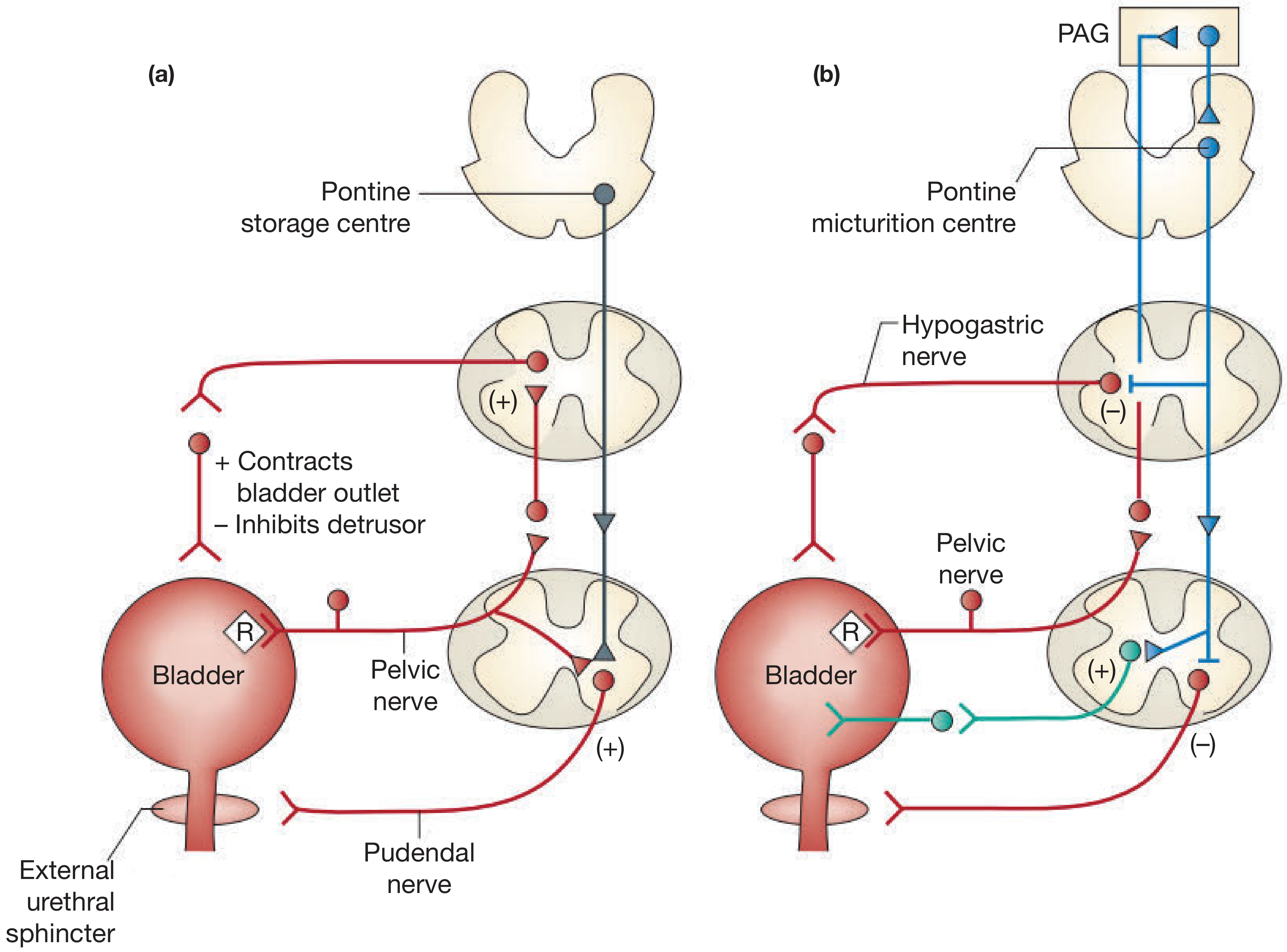
The micturition cycle and its neurological control. (a) Storage phase - sympathetic dominance keeps the outlet contracted and detrusor relaxed. (b) Voiding phase - the pontine micturition centre activates parasympathetic outflow and inhibits sympathetic outflow to allow voiding. (Bailey & Love's Surgery, Fig 83.2)
Normal Bladder Physiology
The bladder operates on a sympathetic-parasympathetic switch:
| Phase | Dominant System | What Happens |
|---|---|---|
| Filling / Storage | Sympathetic (L1-L3) | Detrusor relaxes (β2 receptors); internal sphincter contracts (α1 receptors) |
| Voiding | Parasympathetic (S2-S4) | Detrusor contracts; internal sphincter relaxes |
The external urethral sphincter (skeletal muscle) is under voluntary control. The entire reflex is coordinated by the Pontine Micturition Centre (PMC), with the cerebral cortex providing higher inhibitory or permissive control. (Costanzo Physiology 7th Ed.)
During storage, the pontine storage centre actively keeps the bladder outlet contracted via the pudendal nerve (external sphincter) and via sympathetic pathways (internal sphincter). Voiding requires the PMC to switch off this inhibition and activate parasympathetics.
How Mental Stress Disrupts This
Mental/psychological stress activates the fight-or-flight (sympathetic) response, which directly opposes voiding in at least 3 ways:
-
Heightened sympathetic tone - noradrenaline release causes detrusor muscle relaxation (via β2) and sphincter contraction (via α1), essentially locking the bladder in "storage mode" even when it is full.
-
Cortical over-inhibition of the PMC - the cortex and limbic system can suppress the pontine micturition centre. Anxiety and stress activate the amygdala and prefrontal cortex in ways that block the "permission signal" needed to trigger voiding.
-
Voluntary sphincter guarding - anxiety causes involuntary tightening of the pelvic floor and external sphincter (the same mechanism as "shy bladder" in public restrooms), which physically prevents urine flow.
A 2021 review in the International Journal of Urology (Shimizu et al., PMID 34387005) confirmed that psychological/mental stress induces changes at multiple levels - the lower urinary tract tissues, peripheral nerves, and central nervous system - and that the brain contains both "pro-micturition" and "anti-micturition" molecules that stress can shift toward the anti-micturition state.
Types of Stress-Related Urinary Retention
| Type | Description |
|---|---|
| Acute anxiety/panic | Sudden stress (trauma, fright, panic attack) triggers intense sympathetic discharge that blocks voiding |
| Psychosexual stress | Stress or trauma related to sexuality or intimacy - recognized distinct subtype |
| Paruresis ("shy bladder") | Inability to void in public or social settings - a mild form of functional retention |
| Post-traumatic | Following sexual assault or traumatic events - can cause prolonged retention |
| Chronic psychological stress | Long-term stress can persistently exacerbate lower urinary tract dysfunction (Gao & Rodríguez, PMID 35388285) |
Key Clinical Points
- Diagnosis of exclusion - always rule out obstructive causes (BPH, stricture), neurological causes (MS, spinal cord lesion), and drugs (anticholinergics, opioids, decongestants) first.
- No anatomical lesion is found on imaging or cystoscopy.
- Urodynamics may show reduced detrusor pressure during attempted voiding or pelvic floor dyssynergia (the sphincter fails to relax when the detrusor contracts).
- More common in women and in patients with a history of anxiety disorders or psychological trauma.
- Can respond to behavioural therapies, biofeedback, pelvic floor physiotherapy, and treatment of the underlying anxiety.
Summary
Mental stress causes urinary retention by driving the autonomic nervous system into a sustained sympathetic (storage) state, suppressing the pontine voiding reflex through cortical inhibition, and causing involuntary pelvic floor guarding. This is not just theoretical - it is a listed clinical diagnosis in emergency medicine textbooks and is the subject of active research into the brain-bladder axis.
This is a shared conversation. Sign in to Orris to start your own chat.