
Generate me notes on Enzymes biochemistry for BDS first year students
Reading File
Now let me search the library for enzyme biochemistry content.
Finding Sources
Finding Sources
I can see there are biochemistry textbooks. Let me search specifically in the biochemistry books for enzyme topics relevant to BDS first year.
Finding Sources
Finding Sources
Now let me read the key enzyme sections from Lippincott's Biochemistry (most relevant for BDS first year) and Basic Medical Biochemistry in parallel.
Reading File
Reading File
Reading File
Reading File
Excellent! I have rich content. Let me also fetch the key images and read the regulation/coenzyme section.
Reading File
Loading Image
I now have comprehensive content to write thorough BDS first-year enzyme notes. Let me also fetch a couple more key diagrams and read about coenzymes/cofactors.
Reading File
Loading Image
I now have excellent content. Let me fetch two more important diagrams (Michaelis-Menten curve and pH optimum) and read the coenzymes section.
Loading Image
Reading File
I now have all the content needed to write comprehensive BDS first-year enzyme notes. Let me compile them now.
ENZYMES - Biochemistry Notes for BDS First Year
Source: Lippincott's Illustrated Reviews: Biochemistry, 8th Ed. | Basic Medical Biochemistry, 6th Ed.
1. OVERVIEW
Virtually all reactions in the body are mediated by enzymes - protein catalysts that increase the rate of biochemical reactions without being consumed or permanently altered in the process. Enzymes selectively direct metabolic events and are essential for life. Without enzymes, most biochemical reactions would not occur quickly enough to have physiologic importance.
Key point for BDS: Enzymes are critical in oral biochemistry - salivary amylase (ptyalin) begins starch digestion; proteases and nucleases function in the oral cavity; alkaline phosphatase is a marker in bone metabolism relevant to dental/alveolar bone.
2. NOMENCLATURE
A. Recommended (Common) Name
- The suffix "-ase" is attached to the substrate name: e.g., glucosidase, urease, lipase
- Some include a description of action: e.g., lactate dehydrogenase (LDH), adenylyl cyclase
- Some retain trivial names: trypsin, pepsin (no clue to reaction from name alone)
B. Systematic Name (IUB Classification)
The International Union of Biochemistry divides all enzymes into 6 major classes:
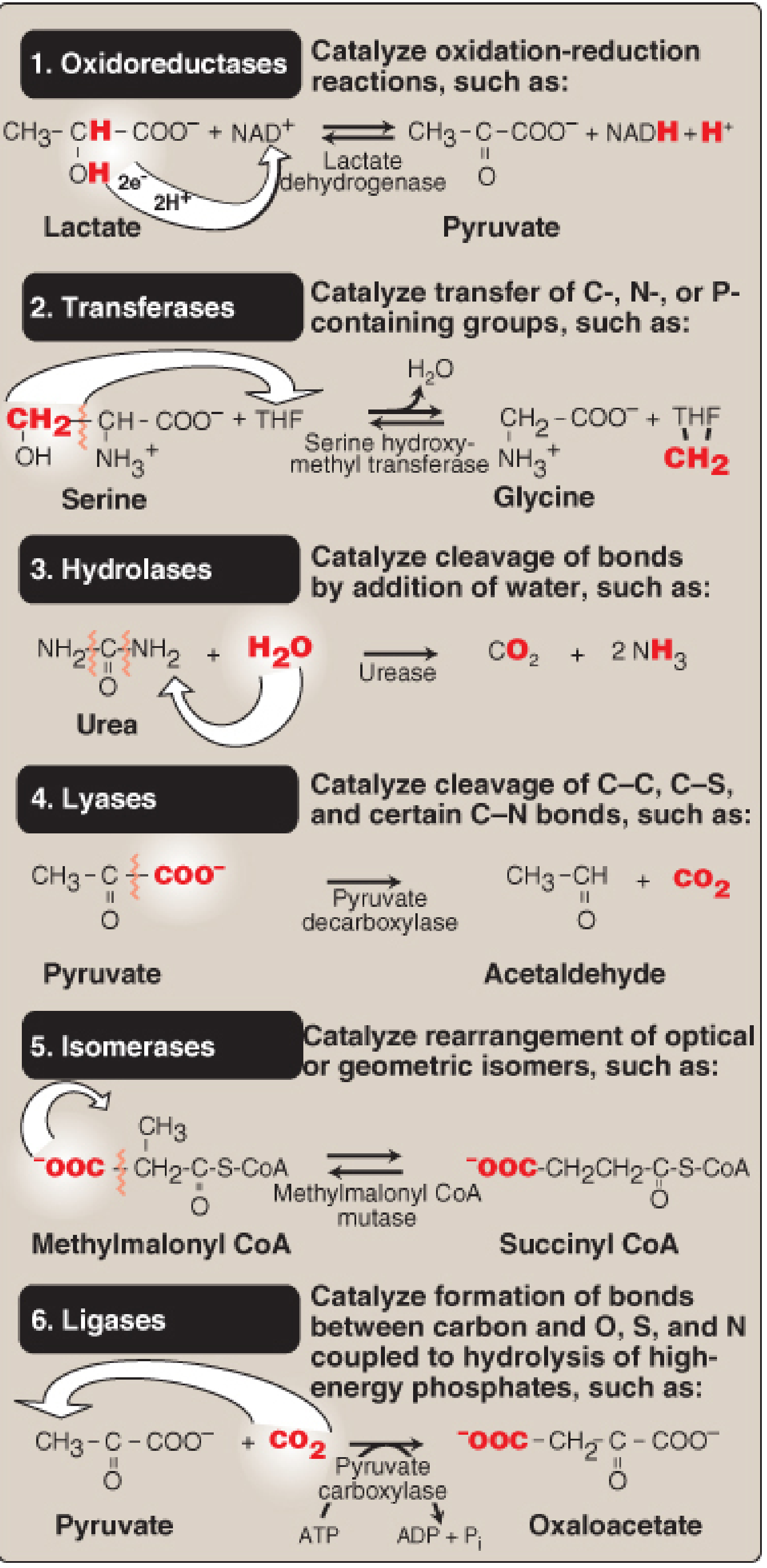
| Class | Action | Example |
|---|---|---|
| 1. Oxidoreductases | Oxidation-reduction (redox) reactions; transfer of electrons/hydrogen | Lactate dehydrogenase (LDH) |
| 2. Transferases | Transfer of C-, N-, or P-containing groups from one molecule to another | Serine hydroxymethyl transferase |
| 3. Hydrolases | Cleavage of bonds by addition of water (hydrolysis) | Urease, pepsin, lipase |
| 4. Lyases | Cleavage of C-C, C-S, and certain C-N bonds (non-hydrolytic, non-oxidative) | Pyruvate decarboxylase |
| 5. Isomerases | Rearrangement of optical or geometric isomers | Methylmalonyl CoA mutase |
| 6. Ligases | Formation of bonds between C and O, S, or N coupled to ATP hydrolysis | Pyruvate carboxylase |
Memory trick: "Old Tigers Hunt Large Impala Lions" = Oxidoreductases, Transferases, Hydrolases, Lyases, Isomerases, Ligases
3. PROPERTIES OF ENZYMES
A. Active Site
- Enzymes contain a special pocket or cleft called the active site, formed by protein folding
- Active site amino acid residues participate in substrate binding and catalysis
- The substrate binds the enzyme forming an enzyme-substrate (ES) complex
- This binding causes a conformational change - the induced fit model - converting ES to enzyme-product (EP) complex, which then dissociates to free enzyme + product
B. Efficiency
- Enzyme-catalyzed reactions proceed 10³ to 10⁸ times faster than uncatalyzed reactions
- Turnover number (k
cat): Number of substrate molecules converted to product per enzyme molecule per second = typically 10² to 10⁴ s⁻¹
C. Specificity
- Enzymes are highly specific - they interact with one or very few substrates
- They catalyze only one type of chemical reaction
- The set of enzymes within a cell determines which reactions occur in that cell
D. Holoenzymes, Apoenzymes, Cofactors, and Coenzymes
| Term | Definition |
|---|---|
| Holoenzyme | Complete, active enzyme = apoenzyme + nonprotein component |
| Apoenzyme | Protein part of the enzyme alone (inactive without cofactor/coenzyme) |
| Cofactor | Inorganic metal ion required (e.g., Zn²⁺, Fe²⁺, Mg²⁺, Cu²⁺) |
| Coenzyme | Small organic molecule (e.g., NAD⁺, FAD, CoA); transiently binds enzyme |
| Prosthetic group | Coenzyme permanently bound to enzyme (e.g., FAD in succinate dehydrogenase) |
Important: Coenzymes are commonly derived from vitamins. NAD⁺ contains niacin (Vit B3); FAD contains riboflavin (Vit B2); CoA contains pantothenic acid (Vit B5).
E. Location within the Cell
- Enzymes are compartmentalized in specific organelles for efficient pathway organization:
- Cytosol: glycolysis, fatty acid synthesis, pentose phosphate pathway
- Mitochondria: TCA cycle, electron transport chain, β-oxidation
- Nucleus: DNA replication/repair enzymes
- Lysosomes: hydrolytic enzymes (hydrolases) - important in lysosomal storage diseases
F. Ribozymes
- Some RNA molecules can catalyze reactions (e.g., affecting phosphodiester and peptide bonds)
- These are called ribozymes - much less common than protein enzymes
4. MECHANISM OF ENZYME ACTION
A. Energy Changes During Reaction
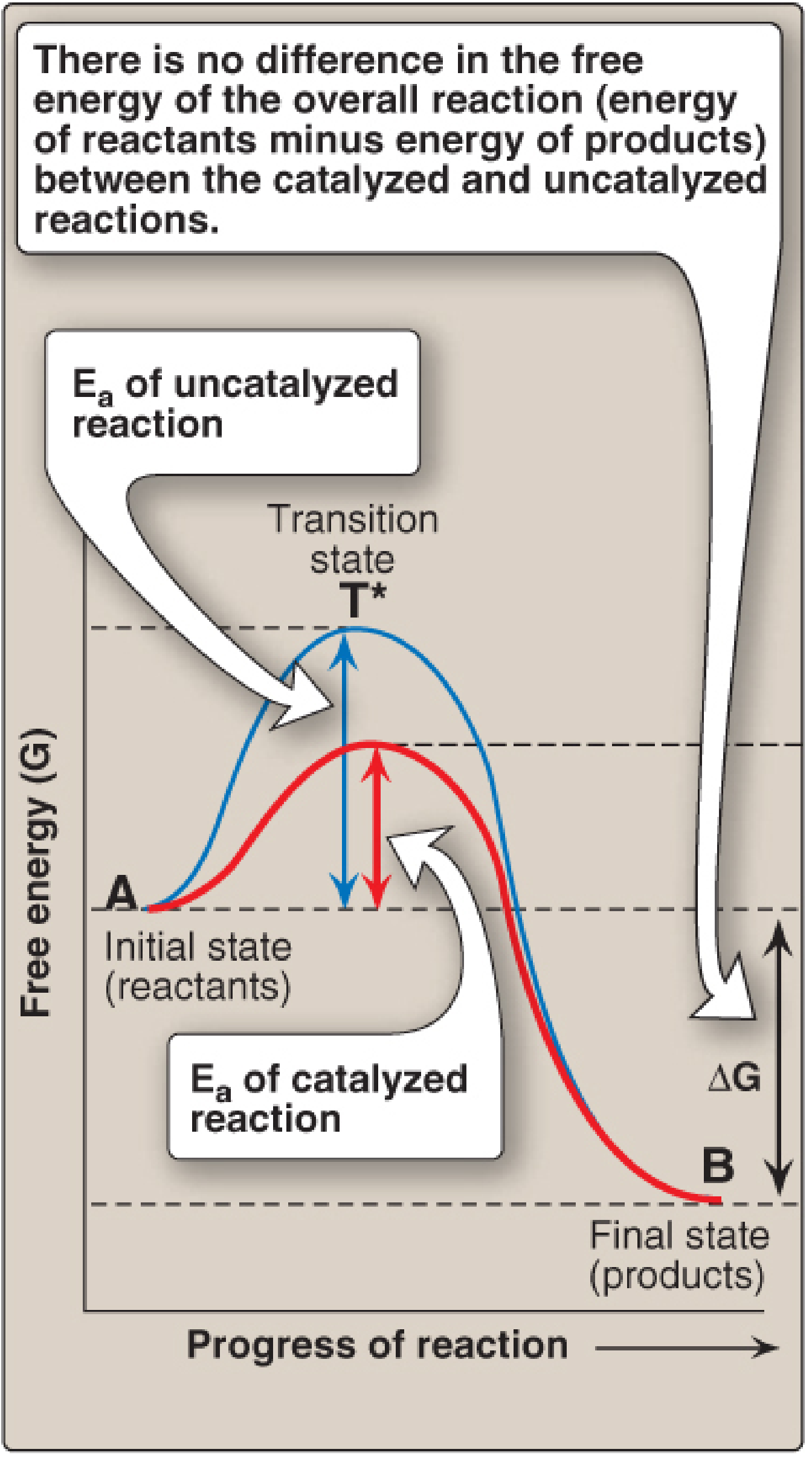
- All chemical reactions have an energy barrier between reactants and products
- This barrier is the activation energy (E
a): the energy difference between reactants and the transition state (T)* - a high-energy, short-lived intermediate - Enzymes lower the E
aby providing an alternate reaction pathway, allowing more molecules to react at physiologic conditions - Enzymes do NOT change the free energy (ΔG) of reactants or products, nor the equilibrium of the reaction - they only accelerate the rate at which equilibrium is reached
B. Active Site Chemistry - How Enzymes Catalyze Reactions
-
Transition-state stabilization: The active site acts as a flexible template that binds the substrate and initiates its conversion to the transition state. Enzymes bind the transition state more tightly than the substrate, lowering E
a. -
Acid-base catalysis: Amino acid residues (e.g., histidine) at the active site donate or accept protons to facilitate catalysis.
-
Covalent catalysis: Nucleophilic residues (e.g., serine, cysteine) form transient covalent bonds with the substrate, providing a reactive intermediate.
-
Metal ion catalysis: Metal ions (e.g., Zn²⁺ in carbonic anhydrase) stabilize negative charges, orient substrates, or participate directly in redox reactions.
5. FACTORS AFFECTING ENZYME ACTIVITY
A. Substrate Concentration [S]
- As [S] increases, reaction velocity (v₀) increases until a maximum is reached
- Michaelis-Menten enzymes: Plot of v₀ vs. [S] gives a hyperbolic curve
- Allosteric enzymes: Show a sigmoidal (S-shaped) curve (similar to O₂-hemoglobin binding)
B. Temperature
- Velocity increases with temperature (more molecules have sufficient energy to reach transition state)
- Above the optimum temperature (~37-40°C for human enzymes), velocity decreases due to denaturation
- Thermophilic bacteria found in hot springs have enzyme optima around 70°C
C. pH
- Optimum pH varies per enzyme - reflects the pH at which it normally functions:
- Pepsin (stomach): optimum pH ~2
- Trypsin (intestine): optimum pH ~8
- Alkaline phosphatase (bone, liver): optimum pH ~9-10
- Salivary amylase (oral cavity): optimum pH ~6.7-7.0
- pH affects: (1) ionization state of active-site residues, (2) substrate ionization, (3) enzyme structure (extreme pH causes denaturation)
6. ENZYME KINETICS (Michaelis-Menten)
A. The Michaelis-Menten Equation
$$v_0 = \frac{V_{max} \times [S]}{K_m + [S]}$$
- v₀ = initial reaction velocity
- V
max= maximum velocity (when all enzyme active sites are saturated with substrate) - [S] = substrate concentration
- K
m(Michaelis constant) = [S] at which v₀ = ½ Vmax
B. Significance of Km
| K | Meaning |
|---|---|
| Low K | High affinity of enzyme for substrate (reaches ½ V |
| High K | Low affinity (needs more substrate to reach ½ V |
C. Lineweaver-Burk Plot (Double-Reciprocal Plot)
- A straight-line plot of 1/v₀ (y-axis) vs 1/[S] (x-axis)
- y-intercept = 1/V
max - x-intercept = -1/K
m - Useful for determining kinetic constants and identifying type of inhibition
7. ENZYME INHIBITION
Any substance that decreases the velocity of an enzyme-catalyzed reaction is an inhibitor.
A. Irreversible Inhibition
- Bind via covalent bonds to the enzyme
- Cannot be reversed by dilution
- Example: Lead (Pb²⁺) forms covalent bonds with cysteine (-SH) groups, inhibiting ferrochelatase (heme synthesis) - clinically seen in lead poisoning
- Organophosphates (e.g., nerve agents, some pesticides) irreversibly inhibit acetylcholinesterase
B. Reversible Inhibition
Bind through non-covalent bonds; activity recoverable upon dilution.
| Feature | Competitive | Non-Competitive |
|---|---|---|
| Binding site | Same as substrate (active site) | Different site from substrate (allosteric) |
| Effect on V | Unchanged | Decreased |
| Effect on K | Increased (apparent) | Unchanged |
| Overcome by | Increasing [S] | Cannot be overcome by increasing [S] |
| Lineweaver-Burk | Lines intersect on y-axis (same 1/V | Lines intersect on x-axis (same -1/K |
| Clinical example | Statins inhibit HMG-CoA reductase; Methotrexate inhibits dihydrofolate reductase | Heavy metals (Hg²⁺) |
BDS relevance: Methotrexate (used in oral cancer/lichen planus) is a competitive inhibitor of dihydrofolate reductase, blocking folate metabolism in rapidly dividing cells. Many antibiotics act as enzyme inhibitors.
8. ENZYME REGULATION
The rates of most enzymes respond to changes in substrate concentration. Specialized regulatory enzymes respond to additional mechanisms:
A. Allosteric Regulation
- Allosteric enzymes do NOT follow Michaelis-Menten kinetics; regulated by effectors binding at sites other than the active site
- Always multi-subunit proteins
- Positive effectors: increase enzyme activity
- Negative effectors: decrease enzyme activity
- Show a sigmoidal v₀ vs. [S] curve (cooperative binding)
Types of allosteric effectors:
- Homotropic effectors: Substrate itself acts as effector (cooperative binding, e.g., hemoglobin + O₂)
- Heterotropic effectors: A different molecule acts as effector (e.g., feedback inhibition)
Feedback (product) inhibition: End product of a pathway inhibits an early enzyme in the pathway. Example: End product G inhibits enzyme at step D→E. This prevents overproduction and conserves energy.
B. Covalent Modification
- Enzymes can be activated or inactivated by phosphorylation (addition of phosphate group by kinases)
- Phosphorylation can turn enzymes on or off depending on the enzyme
- Example: Glycogen phosphorylase is activated by phosphorylation; glycogen synthase is inactivated by phosphorylation
C. Zymogens (Inactive Precursors)
- Some enzymes are synthesized as inactive forms called zymogens (or proenzymes)
- Activated by proteolytic cleavage when and where needed
- Examples:
- Pepsinogen → Pepsin (in stomach, activated by HCl and pepsin itself)
- Trypsinogen → Trypsin (in small intestine, activated by enteropeptidase)
- Prothrombin → Thrombin (blood coagulation cascade)
- Chymotrypsinogen → Chymotrypsin
- Purpose: Protects the cell from self-digestion (especially important for digestive enzymes and blood clotting enzymes)
D. Regulation of Enzyme Quantity
- Increased synthesis (induction): Cells can produce more enzyme in response to physiologic signals (e.g., liver enzymes induced by drugs)
- Decreased synthesis (repression): Cells can reduce enzyme production
- Increased degradation: Enzyme levels can be reduced by targeted protein degradation
9. ISOENZYMES (ISOZYMES)
- Isoenzymes are multiple forms of an enzyme that catalyze the same reaction but differ in:
- Amino acid sequence (encoded by different genes)
- Physical, chemical, and immunological properties
- Tissue distribution and kinetic properties
- Clinical significance: Measurement of specific isoenzymes is used in diagnosis
| Isoenzyme | Subunits | Distribution | Clinical use |
|---|---|---|---|
| LDH-1 (H₄) | 4 Heart (H) | Heart, RBCs | Elevated in myocardial infarction |
| LDH-5 (M₄) | 4 Muscle (M) | Liver, skeletal muscle | Elevated in liver disease |
| CK-MB | M+B | Heart muscle | Specific marker for MI |
| CK-MM | M+M | Skeletal muscle | Elevated in muscle damage |
| CK-BB | B+B | Brain | Elevated in brain injury |
| Alkaline phosphatase | - | Bone, liver, intestine, placenta | Bone/liver disease diagnosis |
BDS Relevance: Alkaline phosphatase isoenzymes are particularly relevant in dentistry - bone isoform is elevated during active bone formation (e.g., during alveolar bone remodeling, fracture healing). Acid phosphatase is found in osteoclasts.
10. PLASMA ENZYMES - DIAGNOSTIC SIGNIFICANCE
Normally, intracellular enzymes are found in plasma only in very small amounts. When cells are damaged, enzymes leak into the bloodstream - measured for diagnosis.
| Enzyme | Normal tissue | Elevated in |
|---|---|---|
| AST (Aspartate aminotransferase) | Liver, heart, muscle | Hepatitis, MI, muscle disease |
| ALT (Alanine aminotransferase) | Liver (most specific) | Hepatitis, liver disease |
| LDH | Heart, liver, RBCs | MI, hemolysis, liver disease |
| CK (CPK) | Heart, skeletal muscle, brain | MI, muscular dystrophy |
| Amylase | Pancreas, salivary glands | Acute pancreatitis, mumps |
| Lipase | Pancreas | Acute pancreatitis (more specific than amylase) |
| Alkaline phosphatase (ALP) | Bone, liver | Bone disease, cholestasis |
| Acid phosphatase | Prostate, osteoclasts | Prostate cancer, Paget's disease |
11. CLINICALLY IMPORTANT ENZYME CONCEPTS FOR BDS
Salivary Amylase (Ptyalin)
- Secreted by parotid, submandibular, and sublingual glands
- Begins starch digestion in the mouth; cleaves α-1,4 glycosidic bonds in starch
- Optimum pH ~6.7-7.0 (oral environment)
- Inactivated by stomach acid (pH 2)
Alkaline Phosphatase in Dentistry
- Produced by osteoblasts - marker of osteoblastic activity
- Elevated in: Paget's disease of bone, hyperparathyroidism, healing fractures, alveolar bone remodeling
- Useful marker for monitoring jaw bone diseases
Lysozyme (Muramidase)
- Present in saliva, tears, mucus
- Hydrolyzes β-1,4 glycosidic bonds between NAM and NAG in bacterial cell walls
- First line of defense against oral bacteria
Matrix Metalloproteinases (MMPs)
- Zinc-dependent endopeptidases
- Degrade extracellular matrix components (collagen, elastin, proteoglycans)
- Important in periodontal disease - elevated MMPs degrade periodontal ligament and alveolar bone matrix
- Doxycycline (sub-antimicrobial dose) inhibits MMPs - used in periodontal therapy
QUICK REVISION SUMMARY
| Topic | Key Point |
|---|---|
| Definition | Protein catalysts; speed reactions without being consumed |
| 6 Classes | Oxidoreductases, Transferases, Hydrolases, Lyases, Isomerases, Ligases |
| Active site | Pocket where substrate binds; induced fit model |
| Cofactor | Metal ion (Zn²⁺, Fe²⁺, Mg²⁺) |
| Coenzyme | Small organic molecule (NAD⁺, FAD); derived from vitamins |
| Apoenzyme | Protein part alone (inactive); + cofactor = holoenzyme |
| E | Enzymes lower activation energy; do NOT change equilibrium |
| K | [S] at ½ V |
| Competitive inhibition | ↑ apparent K |
| Non-competitive inhibition | ↓ V |
| Allosteric enzymes | Sigmoidal curve; regulated by effectors at allosteric site |
| Zymogens | Inactive precursors (pepsinogen, trypsinogen, prothrombin) |
| Isoenzymes | Same reaction, different forms; used for organ-specific diagnosis |
Notes compiled from: Lippincott's Illustrated Reviews: Biochemistry, 8th Ed. (Ferrier) | Basic Medical Biochemistry: A Clinical Approach, 6th Ed. | Harper's Illustrated Biochemistry, 32nd Ed.
This is a shared conversation. Sign in to Orris to start your own chat.