
Reddish round patches surrounding the private are
Reading File
Finding Sources
Finding Sources
Searching the Web
reddish round patches groin genital area causes tinea cruris erythrasma
Based on dermatology references and correlating with the description, here's the differential for round, reddish patches around the groin/genital area:
Most likely: Tinea cruris ("jock itch")
A dermatophyte fungal infection (usually Trichophyton rubrum or Epidermophyton floccosum) that classically presents as:
- A well-marginated, annular (ring-shaped) reddish plaque with a raised, scaly border
- Starts in one groin fold, often spreading down the inner thigh, sometimes becoming bilateral but usually asymmetric
- Central clearing as it expands outward - giving the "round patch" appearance
- Typically spares the penis/scrotum (helps distinguish it from candidiasis)
- Often itchy, worse with heat/sweating, common in athletes, obesity, tight clothing, diabetes
- (Fitzpatrick's Dermatology, Vol. 1-2; DermNet NZ)
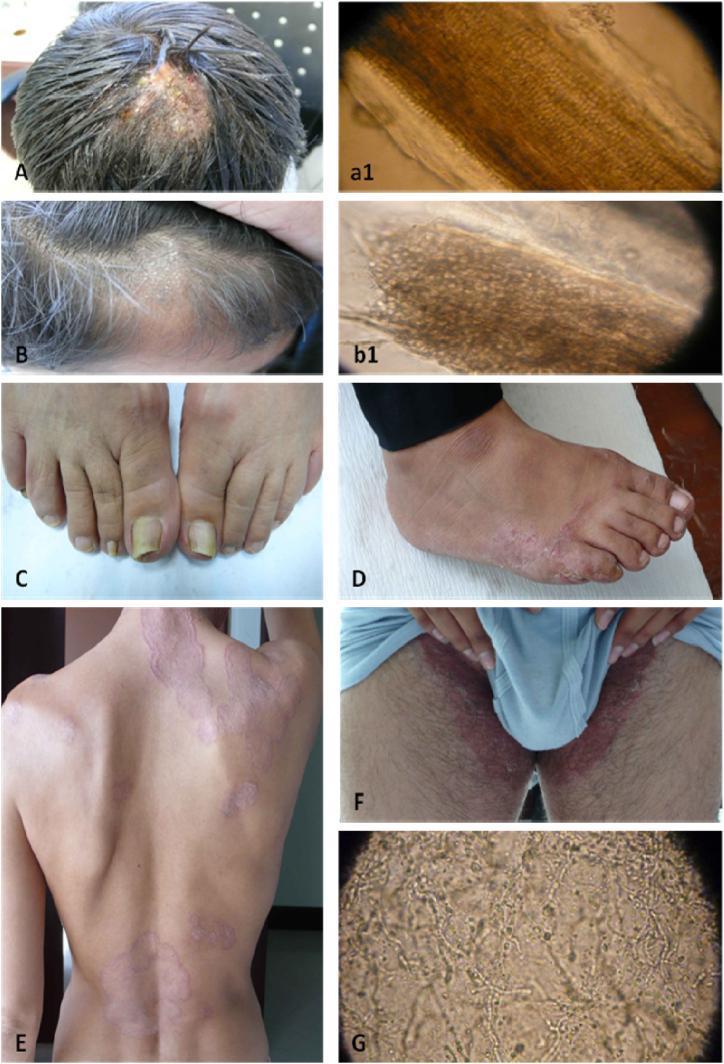
Key mimics to rule out
| Condition | Distinguishing feature |
|---|---|
| Erythrasma (bacterial, Corynebacterium minutissimum) | Reddish-brown, flatter patches, fine wrinkled scale, less itchy, less-defined leading edge than tinea. Glows coral-red under Wood's lamp - the key diagnostic test. Antifungals won't work since it's bacterial. |
| Candidal intertrigo | Beefy-red, moist patches WITH satellite pustules at the margins; often involves scrotum/vulva (unlike tinea) |
| Flexural (inverse) psoriasis | Vivid red, well-demarcated, uniformly scaling plaques, usually no central clearing, may have psoriasis elsewhere (scalp, nails) |
| Simple intertrigo/chafing | Diffuse redness from friction/moisture in skin folds, no advancing scaly border |
What helps narrow it down
- Itch + advancing scaly ring + spares genitals → favors tinea cruris
- Little/no itch + brown-red + Wood's lamp coral fluorescence → favors erythrasma
- Involves scrotum/vulva + satellite lesions → favors candida
Practical next step
A simple KOH scraping (fungal) or Wood's lamp exam (bacterial fluorescence) by a clinician can distinguish these quickly, because treatment differs completely - antifungal creams (e.g., terbinafine, clotrimazole) for tinea, topical/oral antibiotics (e.g., erythromycin, clindamycin) for erythrasma, and antifungal + keeping the area dry for candida. Using the wrong cream (e.g., antifungal for erythrasma) is a very common reason these patches "won't clear."
I don't have details of exactly how long this has been present, whether it's itchy, or whether one or both groin folds/genital skin itself is involved - if you can share that, I can narrow this down further. If it doesn't improve with a week of an OTC antifungal, or if it's expanding, painful, blistering, or associated with fever, it's worth having it examined in person and confirmed with a Wood's lamp or skin scraping rather than guessing.
What about clotrimazole
Finding Sources
Finding Sources
Searching the Web
clotrimazole cream jock itch tinea cruris dosage how to use
Clotrimazole is a good first-line choice if this is genuinely a fungal cause (tinea cruris or candidal intertrigo), but it won't work if it turns out to be erythrasma (bacterial) — that's the key caveat.
What it is and how it works
Clotrimazole is a topical imidazole antifungal. It disrupts the fungal cell membrane by inhibiting ergosterol synthesis, which increases membrane permeability and causes leakage of intracellular contents, degradation of nucleic acids, and suppressed cell respiration - ultimately killing or inhibiting the fungus (Fitzpatrick's Dermatology; Katzung's Pharmacology).
Spectrum
It's active against:
- Dermatophytes (Trichophyton, Epidermophyton, Microsporum) - covers tinea cruris, tinea corporis, tinea pedis
- Candida - covers candidal intertrigo/cutaneous candidiasis
- Reported cure rates of 60-100% in dermatophytosis and 80-100% in cutaneous candidiasis (Fitzpatrick's Dermatology)
It does not cover erythrasma, since that's caused by Corynebacterium minutissimum, a bacterium - antifungals are ineffective there and you'd need a topical or oral antibiotic (erythromycin/clindamycin) instead.
How to use it (1% cream, OTC - e.g. Lotrimin AF, Canesten)
- Apply a thin layer to the affected area and the immediately surrounding skin (fungus often extends beyond the visible edge)
- Twice daily for tinea cruris
- Continue for 2 weeks, even if it looks better sooner - stopping early is the most common reason for relapse
- Wash and dry the area thoroughly before application; keep the groin dry and wear loose, breathable underwear during treatment
- Wash hands before and after application
What to expect / red flags
- Improvement is expected within the 2-week course. If there's no improvement by 2 weeks, or it's worsening, that points away from tinea and toward erythrasma, candida, or psoriasis - see a clinician rather than continuing the same cream longer.
- If it also involves the scrotum/vulva heavily with pustules at the edges, candida is more likely - clotrimazole still works there, but keeping the area dry matters even more since moisture drives candida growth.
Side effects / precautions
Generally very well tolerated since minimal systemic absorption occurs topically. Possible local effects: burning, stinging, itching, or redness at the application site (hypersensitivity/irritant reaction). Avoid contact with eyes; don't use near open flame if using a spray/solution form (flammable vehicle in some formulations). Oral/vaginal formulations have their own separate dosing not relevant here.
If in 1-2 weeks there's no real improvement, it's worth having a clinician confirm the diagnosis (KOH scrape or Wood's lamp) before switching products, since treating erythrasma or psoriasis with more antifungal cream just wastes time.
This is a shared conversation. Sign in to Orris to start your own chat.