
Ards treatmy
I'll look up ARDS treatment from the medical library right away.
Searching sources...
Reading File
Now let me search the medical library and PubMed simultaneously for ARDS treatment.
Finding Sources
Searching PubMed
"acute respiratory distress syndrome" AND treatment
Finding Sources
Finding Sources
Good - I found the key sections. Let me read the detailed treatment content from Fishman's and Murray & Nadel's.
Reading File
Reading File
Reading File
Reading File
Reading File
Reading File
I now have comprehensive content. Let me also grab the prone positioning and pharmacological sections, plus the ECMO info.
Reading File
I now have all the content I need. Let me also fetch the treatment intensity diagram from the textbook.
Loading Image
I now have everything needed for a thorough answer. Here is the full ARDS treatment overview:
ARDS Treatment
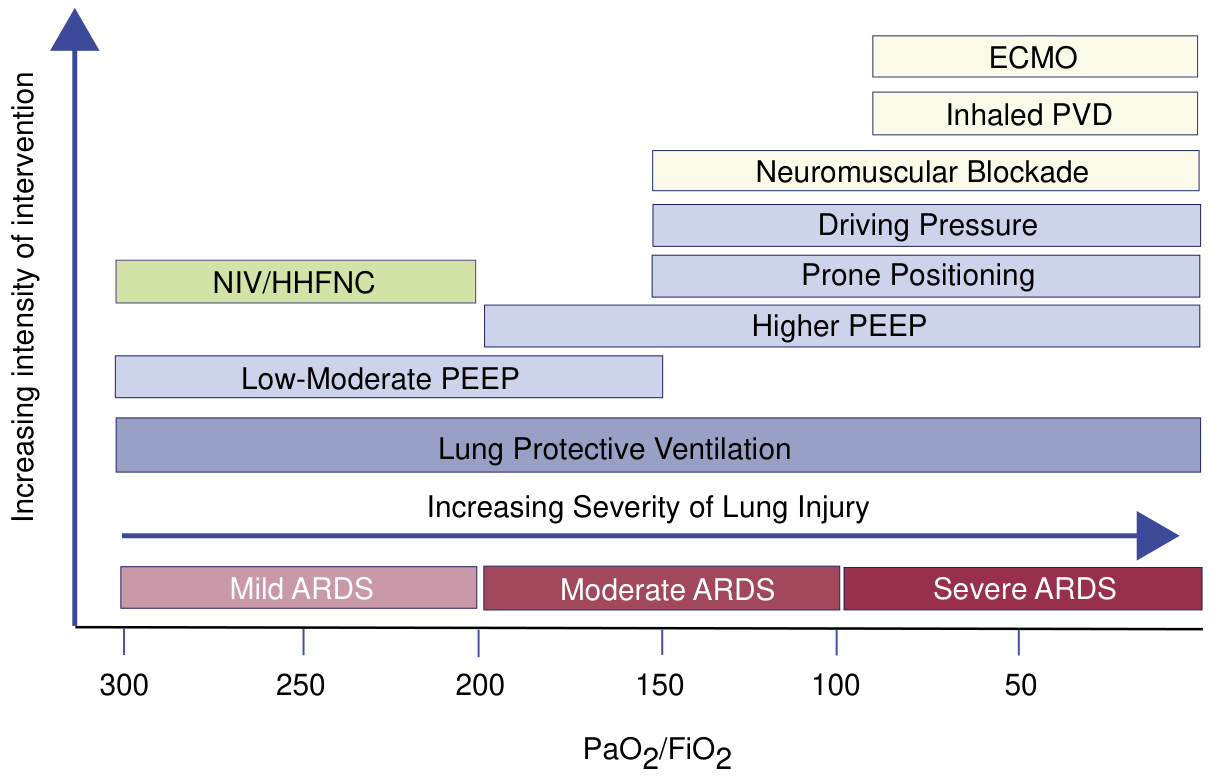
Berlin Classification (Severity)
| Severity | PaO2/FiO2 | PEEP required |
|---|---|---|
| Mild | 200-300 mmHg | ≥ 5 cm H2O |
| Moderate | 100-200 mmHg | ≥ 5 cm H2O |
| Severe | < 100 mmHg | ≥ 5 cm H2O |
Mortality ranges from 20-50% depending on severity. The diagram below shows how treatment intensity escalates with worsening ARDS:
Step 1: Treat the Underlying Cause
The first priority is identifying and treating the precipitating cause. Common treatable causes include:
-
Infectious: sepsis, bacterial/viral/fungal pneumonia, SARS-CoV2, PCP, miliary TB
-
Non-infectious: diffuse alveolar hemorrhage, drug toxicity, aspiration, transfusion (TRALI), fat embolism, pancreatitis
-
Fishman's Pulmonary Diseases and Disorders, p. 2499
Step 2: Lung Protective Ventilation (ALL severity levels - cornerstone of care)
The landmark ARDSNet ARMA trial established this as standard of care:
| Parameter | Target |
|---|---|
| Tidal volume | 6 mL/kg predicted body weight (PBW) (can reduce to 4 mL/kg) |
| Plateau pressure | ≤ 30 cm H2O |
| SpO2 target | 88-95% |
| PaO2 target | 55-80 mmHg |
| FiO2 | Lowest possible (keep < 0.7 ideally) |
| pH | 7.30-7.45 |
PBW formula: Men = 50 + 2.3 × (height in inches - 60); Women = 45.5 + 2.3 × (height in inches - 60)
Start at 6-8 mL/kg PBW, reduce by 1 mL/kg every 2 hours to reach 6 mL/kg. If plateau pressure > 30 cm H2O, reduce in 1 mL/kg steps (minimum 4 mL/kg).
- Current Surgical Therapy 14e, p. 1577-1578
Step 3: PEEP Titration
PEEP recruits collapsed alveoli, reduces V/Q mismatch, and maintains functional residual capacity.
FiO2/PEEP table (low PEEP strategy - ARMA protocol):
| FiO2 | 0.3 | 0.4 | 0.5 | 0.6 | 0.7 | 0.8 | 0.9 | 1.0 |
|---|---|---|---|---|---|---|---|---|
| PEEP | 5 | 5-8 | 8-10 | 10 | 10-14 | 14 | 14-18 | 20-24 |
For moderate-to-severe ARDS, a higher PEEP strategy is used (PEEP 8-24+ cm H2O depending on FiO2). Both under- and over-PEEP are harmful. Note: the ART trial showed high-pressure recruitment maneuvers (to 45 cm H2O) increased 28-day mortality - use caution.
Step 4: Permissive Hypercapnia
When tidal volumes must be kept low, CO2 retention is accepted. The resulting respiratory acidosis can be buffered with sodium bicarbonate or tromethamine (THAM). Avoid in traumatic brain injury (worsens ICP).
Step 5: Conservative Fluid Management
Avoid fluid overload. The FACTT trial supports conservative fluid management - it reduces duration of mechanical ventilation and ICU stay without worsening organ failure. Diuretics should be considered when CVP > 4 with ongoing hypoxemia, after confirming adequate perfusion.
Step 6: Prone Positioning (moderate-severe ARDS, PaO2/FiO2 < 150)
The PROSEVA trial showed a 28-day mortality benefit (16% vs 33%) with prone positioning for at least 16 hours/day in severe ARDS (PaO2/FiO2 < 150). Mechanism: more homogeneous ventilation, reduced dorsal atelectasis, improved V/Q matching.
Step 7: Neuromuscular Blockade (moderate-severe, early)
Cisatracurium infusion for 48 hours (ACURASYS trial data) was associated with reduced mortality and barotrauma in moderate-severe ARDS. The benefit is thought to come from abolishing patient-ventilator dyssynchrony and reducing P-SILI (patient self-inflicted lung injury). The larger ROSE trial (2019) did not confirm a mortality benefit with routine use - current practice reserves it for refractory dyssynchrony.
Salvage Strategies (Refractory/Severe ARDS)
Inhaled Pulmonary Vasodilators
- Inhaled nitric oxide (iNO) and inhaled prostacyclin (epoprostenol/iloprost) improve short-term oxygenation by selective pulmonary vasodilation (redirect blood to ventilated alveoli), reduce RV afterload
- Do NOT reduce mortality or duration of ventilation in RCTs
- Indication: life-threatening hypoxemia refractory to all other measures, or as bridge to ECMO/transport
Recruitment Maneuvers
- Transient increases in transpulmonary pressure (e.g., sustained inflation at 40 cm H2O for 2 min) to open collapsed alveoli
- Must be followed by sufficient PEEP to maintain recruitment
- Evidence for benefit is weak; high-pressure RMs (to 45 cm H2O) increased mortality in the ART trial
High-Frequency Oscillatory Ventilation (HFOV)
- Uses very small tidal volumes at high frequency to maintain mean airway pressure
- Large RCTs (OSCAR, OSCILLATE) showed no benefit and possible harm - no longer routinely recommended
Extracorporeal Membrane Oxygenation (ECMO)
- Venovenous (VV-ECMO) for severe ARDS failing all conventional therapy
- Allows near-total lung rest with adequate gas exchange
- CESAR trial: transfer to ECMO-capable center improved survival
- EOLIA trial: stopped early for futility of primary endpoint, but secondary outcomes suggested benefit in the most severe cases
- COVID-19 ARDS: survival ~50%, though run times are often prolonged
- Main complications: bleeding (GI bleed, ICH), thrombosis, circuit failure
Corticosteroids
- Meta-analyses (including a 2024 meta-analysis - PMID 39165240) suggest benefit particularly in early, prolonged ARDS and in COVID-ARDS
- Dexamethasone 20 mg/day for 5 days then 10 mg/day for 5 days (DEXA-ARDS trial protocol)
- Avoid when septic cause is not controlled; avoid in late fibroproliferative phase (>14 days per older data)
Pharmacological Agents - Summary of Evidence
A 2024 network meta-analysis (PMID 39809198) found that among commonly studied drugs:
- Neuromuscular blocking agents and inhaled vasodilators improve oxygenation short-term
- Mesenchymal stem cell transplantation is under investigation
- No pharmacological agent has robustly reduced mortality across all ARDS populations - supportive ventilatory management remains the only proven survival benefit
General ICU Supportive Care
| Measure | Goal |
|---|---|
| Sedation/analgesia | Adequate comfort, minimize over-sedation (ABCDEF bundle) |
| Nutrition | Early enteral feeding within 24-48 h |
| DVT prophylaxis | Pharmacologic + mechanical |
| Stress ulcer prophylaxis | PPI or H2 blocker |
| Head-of-bed elevation | 30-45° to reduce VAP |
| Spontaneous awakening/breathing trials | Daily when improving |
- Fishman's Pulmonary Diseases and Disorders, p. 2499-2501
- Current Surgical Therapy 14e, p. 1577-1580
Quick Reference: When to Escalate
| Clinical Trigger | Action |
|---|---|
| PaO2/FiO2 < 200 | Higher PEEP, prone position |
| PaO2/FiO2 < 100 or refractory hypoxemia | NMB, inhaled vasodilators, consider ECMO referral |
| Plateau pressure > 30 cm H2O despite TV 6 mL/kg | Reduce to 4-5 mL/kg, accept hypercapnia |
| Persisting hypoxemia on all the above | ECMO at specialized center |
Role of lasxi in ards
Lasix (furosemide) in ARDS is used as part of conservative fluid management - reducing pulmonary edema without worsening perfusion. Let me pull the detailed evidence from the textbooks.
Searching sources...
Finding Sources
Finding Sources
Searching PubMed
furosemide "acute respiratory distress syndrome" fluid management
Reading File
Reading File
Excellent detail from both textbooks. Here is a thorough answer:
Role of Lasix (Furosemide) in ARDS
Rationale - Why Consider a Diuretic?
ARDS is characterized by increased alveolar-capillary permeability, leading to protein-rich pulmonary edema. Unlike cardiogenic pulmonary edema, this edema is not driven by elevated hydrostatic pressure alone - it is a leak-type edema. However, even in ARDS, reducing intravascular volume and hydrostatic pressure can lessen the degree of flooding in already-injured alveoli, improving gas exchange and lung compliance.
The Core Principle: Conservative Fluid Management
Furosemide in ARDS is used as a tool to achieve a conservative (negative/euvolemic) fluid balance, not as a primary treatment.
The landmark FACTT trial (ARDSNet, NEJM 2006) compared liberal vs conservative fluid strategies in 1000 ARDS patients:
| Parameter | Conservative Strategy | Liberal Strategy |
|---|---|---|
| Goal | Lower intravascular pressure | Higher intravascular pressure |
| Tool used | Diuretics (including furosemide) + fluid restriction | Fluids + vasoactive agents |
| Ventilator-free days | Significantly more | Fewer |
| ICU-free days | Significantly more | Fewer |
| Oxygenation | Better | Worse |
| Dialysis/shock rates | No increase | - |
| 60-day mortality | No significant difference | - |
Conclusion: Conservative fluid management with diuretics is safe and beneficial in ARDS - it improves oxygenation and shortens ventilator time, even though mortality benefit was not demonstrated.
- Murray & Nadel's Textbook of Respiratory Medicine, p. 3154
When to Give Furosemide in ARDS
Per current textbook guidance:
"Diuretic therapy should be considered in patients with hypoxemia and a central venous pressure (CVP) greater than 4. A careful assessment of adequacy of perfusion and cardiac performance should be completed before initiation of diuresis, and reassessment should be continued while diuresis is ongoing."
- Current Surgical Therapy 14e, p. 1578
Triggers for furosemide use:
- Ongoing hypoxemia with signs of fluid overload
- CVP > 4 cm H2O
- After confirming no active shock or inadequate perfusion
Furosemide + Albumin Combination
A small RCT studied albumin + furosemide infusion over 5 days in ARDS (mostly trauma patients):
- Produced a significant improvement in oxygenation and decrease in heart rate
- No improvement in mortality (study was underpowered)
- A follow-up study showed the oxygenation benefit was primarily due to albumin, not furosemide
- Mechanism: albumin raises oncotic pressure, reducing fluid leak into alveoli; furosemide helps offload volume
A meta-analysis confirmed a beneficial effect on oxygenation but not mortality for this combination.
- Murray & Nadel's Textbook of Respiratory Medicine, p. 3154
What Furosemide Does NOT Do in ARDS
| Claim | Evidence |
|---|---|
| Reduces mortality | Not demonstrated - FACTT showed no mortality benefit |
| Fixes the underlying leak | No - does not repair the alveolar-capillary barrier |
| Safe in all ARDS patients | No - contraindicated if patient is in shock or hypovolemic |
Practical Cautions
- Do not give furosemide if the patient is hemodynamically unstable or in shock - worsening perfusion overrides the benefit of fluid removal
- Monitor renal function - ARDS patients often have concurrent AKI; aggressive diuresis can worsen it
- Target euvolemia, not dehydration - the goal is to minimize excess fluid, not create a volume deficit
- In ECMO patients, fluid management goals may be subordinate to optimizing ECMO flows (per Current Surgical Therapy 14e)
- Even in pediatric ARDS, diuretics are used when fluid overload coexists, though with more caution
Summary
Furosemide plays a supportive, adjunctive role in ARDS as part of a conservative fluid management strategy. Its main benefit is reducing pulmonary edema burden, improving oxygenation, and shortening time on the ventilator. It does not treat the underlying lung injury and carries real risk if given inappropriately in a patient who is volume-depleted or in shock. The decision to diurese should be made with hemodynamic assessment and ongoing monitoring - not given reflexively.
This is a shared conversation. Sign in to Orris to start your own chat.