
Mnemonics and flowchart and diagrams for chemistry of carbohydrates in biochemistry for bds students
Reading File
Now let me search the medical library for carbohydrate chemistry content relevant to BDS students.
Finding Sources
Finding Sources
Finding Sources
Finding Sources
Finding Sources
Reading File
Reading File
Finding Sources
Reading File
Finding Sources
Reading File
I now have comprehensive information from the textbooks. Let me fetch some of the key diagrams and compile the full answer.
Loading Image
Loading Image
Loading Image
Loading Image
I now have all the key diagrams and textbook content. Let me compile the complete, well-organized answer with mnemonics, flowcharts, and the textbook images.
Chemistry of Carbohydrates - BDS Biochemistry Study Guide
Source: Tietz Textbook of Laboratory Medicine, 7th Ed. (Chapter 35)
MASTER MNEMONIC: "ALL KINGS PREFER DEFINITELY HEXOSE"
Aldehyde or ketone + polyhydroxy = Carbohydrate definition
Living organisms use D-configuration almost exclusively
Linkage between sugars = glycosidic bond (loss of H₂O)
Ketose = carbonyl NOT at end (e.g. Fructose)
Pyranose = 6-membered ring; Furanose = 5-membered ring
Reducing sugars have a free anomeric -OH (glucose, galactose, maltose, lactose) --- Sucrose is NON-reducing
D-sugars: -OH on C5 is on the RIGHT in Fischer projection
Hexoses are the most biologically important (6 carbons)
Equilibrium in solution = mutarotation (α ⇌ β)
XEH= Example: glucose 36% α, 64% β at equilibrium
1. CLASSIFICATION FLOWCHART
                        CARBOHYDRATES
                (Polyhydroxy aldehydes/ketones)
                            |
         ___________________↓___________________
        |                   |                   |
  MONOSACCHARIDES     OLIGOSACCHARIDES     POLYSACCHARIDES
  (1 sugar unit)      (2–10 units)         (>10 units)
        |                   |                   |
   By carbonyl:      DISACCHARIDES:         HOMOPOLYSACCHARIDES:
   Aldose (CHO        Maltose (Glc-Glc)      Starch (amylose +
    at C1)            Lactose (Gal-Glc)      amylopectin)
   Ketose (C=O        Sucrose (Glc-Fru)      Glycogen
    at C2)                                   Cellulose
        |
   By carbon #:      HETEROPOLYSACCHARIDES:
   Triose  (C3)       Hyaluronic acid
   Tetrose (C4)       Heparin
   Pentose (C5)       Chondroitin sulfate
   Hexose  (C6)
   Heptose (C7)
Mnemonic for carbon series: "Three Tiny Penguins Have High Hats"
Tri - Tetr - Pent - Hex - Hept
2. ALDOSE vs KETOSE - QUICK MNEMONIC
"ALD-end, KET-middle"
- ALDose = aldehyde = END of chain (C1)
- KETose = ketone = MIDDLE of chain (C2)
Key examples:
| Sugar | Type | Carbons |
|---|---|---|
| Glucose | Aldohexose | 6 |
| Galactose | Aldohexose | 6 |
| Mannose | Aldohexose | 6 |
| Fructose | Ketohexose | 6 |
| Ribose | Aldopentose | 5 |
Mnemonic: "GGMF" = "Good Girls Make Fudge"
Glucose (Aldo), Galactose (Aldo), Mannose (Aldo), Fructose (Keto)
3. FISCHER PROJECTION - D vs L SUGARS
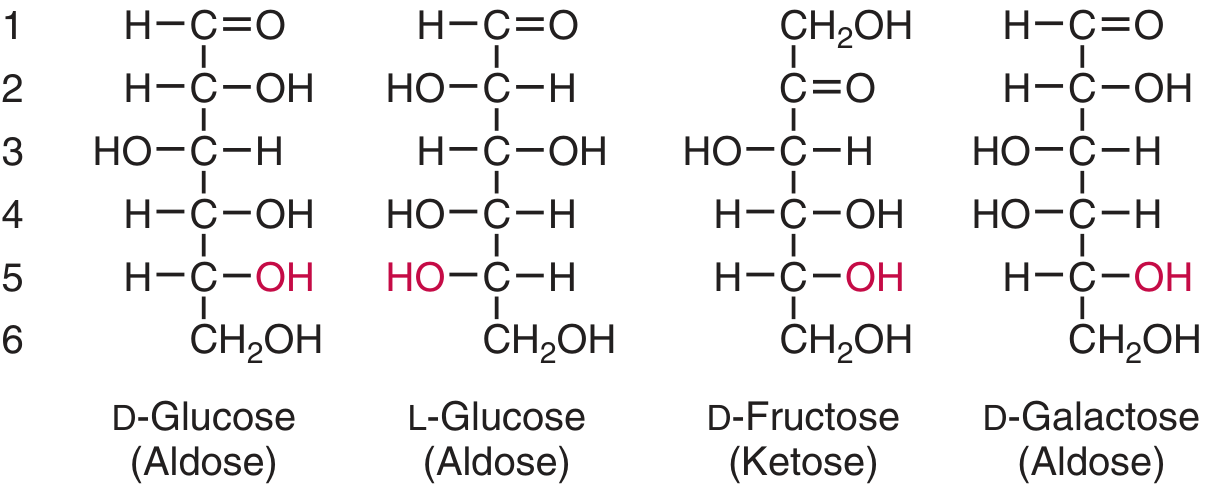
Mnemonic: "DROIT = D = RIGHT"
- D-sugars: -OH on the penultimate carbon (C5 in hexose) is on the Right
- L-sugars: -OH is on the Left
4. RING STRUCTURES - PYRANOSE vs FURANOSE
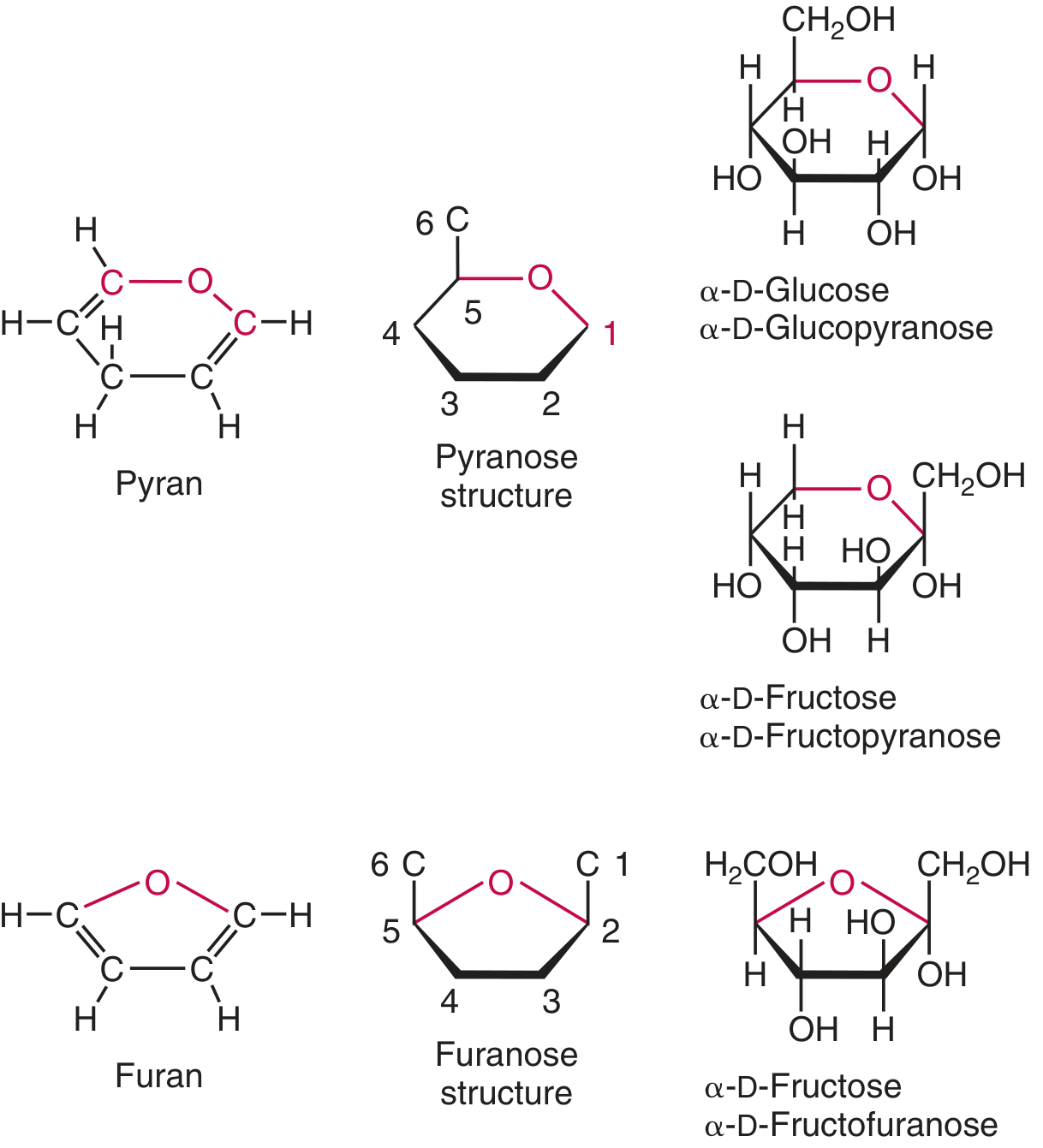
Mnemonic: "PY-6, FU-5"
- Pyranose = 6-membered ring (like pyramid with 6 sides in your mind)
- Furanose = 5-membered ring (Funny five)
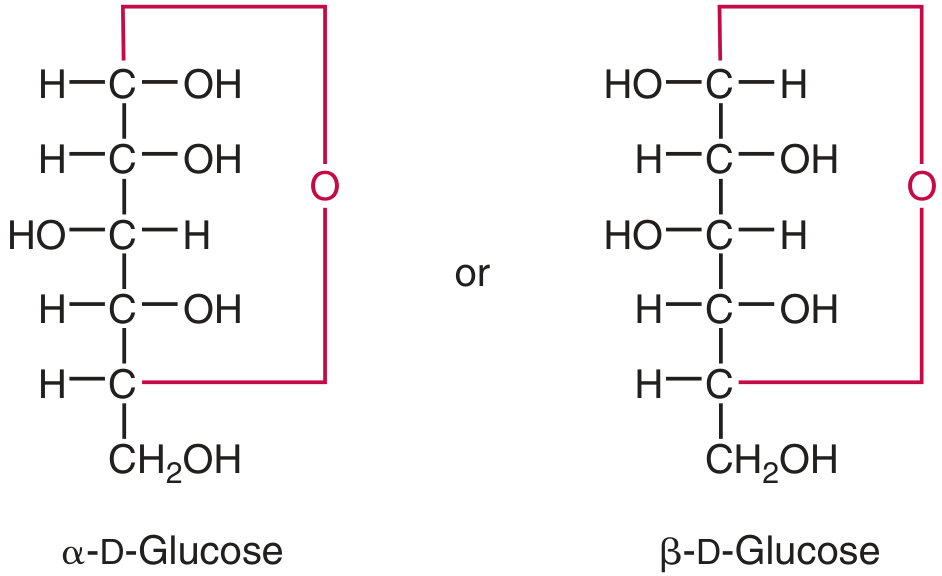
Alpha vs Beta - Mnemonic: "ALPHA is Below, BETA is aBove"
In Haworth formula:
- α = -OH at anomeric carbon is below the ring plane
- β = -OH at anomeric carbon is above the ring plane
5. MUTAROTATION FLOWCHART
  α-D-Glucose (+113°)
        ↕  (mutarotation in aqueous solution)
  Open-chain aldehyde form (trace amount)
        ↕
  β-D-Glucose (+19.7°)

  EQUILIBRIUM: 36% α ← ——————————————→ 64% β
  Final specific rotation = +52.5°
Mnemonic: "Mutarotation = Mu-ta-ro-ta-tion = Mix Till Rotation Reaches 52.5"
6. α vs β GLUCOSE (Hemiacetal Ring)
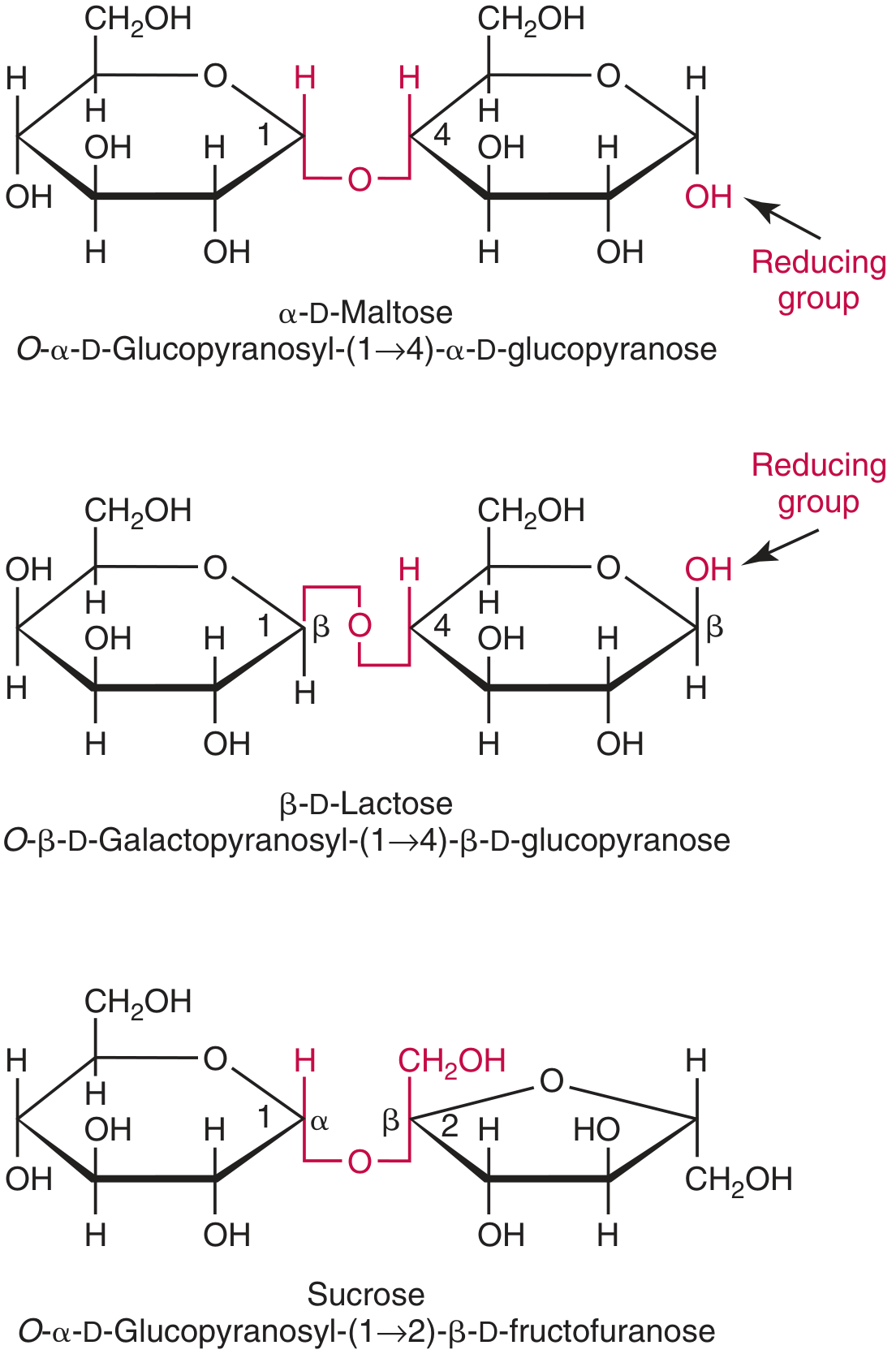
7. DISACCHARIDES - "MLS" MNEMONIC
"Mango Lasts Sweet"
| Disaccharide | Components | Bond | Reducing? |
|---|---|---|---|
| Maltose | Glucose + Glucose | α(1→4) | YES |
| Lactose | Galactose + Glucose | β(1→4) | YES |
| Sucrose | Glucose + Fructose | α(1→2)β | NO |
Why is sucrose non-reducing? Both anomeric carbons are involved in the glycosidic bond, leaving no free -OH to reduce Cu²⁺.
Mnemonic: "Sucrose is Special - BOTH ends bonded"
8. REDUCING SUGARS - MNEMONIC
"MALL Reduces - Sucrose Does NOT"
- Maltose - reducing
- All monosaccharides (glucose, fructose, galactose) - reducing
- Lactose - reducing
- Lactulose - reducing
- Sucrose - NON-reducing (no free anomeric carbon)
Why do reducing sugars reduce?
Free aldehyde → enol → enol anion in alkaline solution → reduces Cu²⁺ (cupric) → Cu⁺ (cuprous)
This is the basis of Benedict's and Fehling's tests
9. POLYSACCHARIDES COMPARISON TABLE
| Feature | Starch (Amylose) | Starch (Amylopectin) | Glycogen | Cellulose |
|---|---|---|---|---|
| Source | Plants | Plants | Animals/Humans | Plants |
| Linkage | α(1→4) | α(1→4) + α(1→6) | α(1→4) + α(1→6) | β(1→4) |
| Branching | None | Every 24-30 C | Every 8-12 C | None |
| Digestibility | YES | YES | YES | NO |
Mnemonic: "SAGC" = "Starch And Glycogen Coil, Cellulose Can't"
- Starch/Glycogen: α-linkage = digestible, forms helical coils
- Cellulose: β-linkage = NOT digestible (humans lack β-glucosidase)
10. DIGESTION & ABSORPTION FLOWCHART
DIETARY STARCH/GLYCOGEN
        ↓ Salivary amylase (mouth)
  Intermediate dextrins + Maltose
        ↓ (Acid pH of stomach STOPS amylase)
        ↓ Pancreatic amylase (small intestine)
  Oligosaccharides + Maltose
        ↓ Disaccharidases (intestinal mucosa)
     Maltase → Glucose + Glucose
     Lactase → Glucose + Galactose
     Sucrase → Glucose + Fructose
        ↓ Active transport
  Absorbed into portal circulation
        ↓
  LIVER (glucose homeostasis)
Mnemonic: "SaMPLE = Salivary, Mucosa, Pancreas, Liver, Enterocytes"
11. GLYCOPROTEINS - O-LINKED vs N-LINKED
Mnemonic: "O-SiT, N-ASK"
- O-linked: to Serine / Threonine (-OH group)
- N-linked: to Asparagine (-NH₂ group = Keto group side chain nitrogen)
Functions of carbohydrate chains: regulate protein lifespan, cell-cell recognition, targeting of secreted proteins (antibodies, hormones, coagulation factors).
12. QUICK REVISION: KEY NUMBERS TO REMEMBER
| Parameter | Value |
|---|---|
| α-D-glucose specific rotation | +113° |
| β-D-glucose specific rotation | +19.7° |
| Equilibrium mixture rotation | +52.5° |
| Equilibrium ratio α:β | 36% : 64% |
| Amylopectin branch interval | every 24-30 carbons |
| Glycogen branch interval | every 8-12 carbons |
| Reducing power of disaccharide vs 2 monosaccharides | ~40% |
Mnemonic for rotations: "ALPHa has 113, BETA is boring 19.7, MIX gives 52.5"
13. DENTAL RELEVANCE (BDS-specific)
Sucrose and dental caries - FLOWCHART:
Sucrose (dietary)
    ↓ Streptococcus mutans
    ↓ (uses glucosyltransferase)
Lactic acid + Glucan (sticky plaque matrix)
    ↓
Demineralization of enamel (HAP)
    ↓
DENTAL CARIES
- Sucrose is the most cariogenic sugar because it has BOTH glucose AND fructose available for bacterial fermentation, AND the glucan forms the adhesive plaque matrix.
- Cellulose (fiber) is NOT cariogenic - no α-glucosidase in mouth.
- Xylitol (sugar alcohol) - non-fermentable by S. mutans, used in sugar-free gum.
14. OVERALL MASTER FLOWCHART
CARBOHYDRATES
      |
      ├── MONOSACCHARIDES ──── By C: Triose/Tetrose/Pentose/Hexose/Heptose
      |         |                By carbonyl: ALDOSE (end) / KETOSE (middle)
      |         |                By config: D (OH right) / L (OH left)
      |         |                Ring form: PYRANOSE (6) / FURANOSE (5)
      |         |                Anomers: α (below) / β (above)
      |         |
      ├── DISACCHARIDES ──── Maltose (Glc-Glc, α1→4, REDUCING)
      |                       Lactose (Gal-Glc, β1→4, REDUCING)
      |                       Sucrose (Glc-Fru, α1→2β, NON-REDUCING)
      |
      └── POLYSACCHARIDES ── Starch (α-links, digestible, plant storage)
                              Glycogen (α-links, highly branched, animal)
                              Cellulose (β-links, NOT digestible, structural)
                              Glycosaminoglycans (e.g. hyaluronic acid, heparin)
Sources: Tietz Textbook of Laboratory Medicine, 7th Ed., Chapter 35 (Chemistry of Carbohydrates, pp. 1127-1130)
This is a shared conversation. Sign in to Orris to start your own chat.