
Treatment of 3X3cm abscess in thigh
Reading File
Finding Sources
Searching PubMed
skin abscess incision drainage antibiotic treatment
Reading File
Finding Sources
Reading File
Reading File
Reading File
I now have comprehensive information. Here is a structured treatment guide for a 3×3 cm thigh abscess:
Treatment of a 3×3 cm Thigh Abscess
Overview
A 3×3 cm abscess is a moderate-sized, fluctuant collection. At this size, conservative measures (warm compresses, antibiotics alone) are insufficient — incision and drainage (I&D) is the treatment of choice. Antibiotics are usually unnecessary after adequate I&D unless there is surrounding cellulitis or the patient is immunocompromised.
— Pfenninger and Fowler's Procedures for Primary Care, 3rd ed.
Step-by-Step I&D Procedure
Equipment needed:
- 1–2% lidocaine with sodium bicarbonate (to reduce sting), 25–30g needle
- Povidone-iodine or alcohol prep
- No. 11 scalpel blade
- Curved hemostats
- Iodoform gauze (¼–½ inch wide, up to 24 inches for this cavity size)
- 4×4 gauze, dressing, culture swab
Technique:
- Prepare the skin with povidone-iodine or alcohol.
- Field block anesthesia — infiltrate the perimeter of the abscess, not into the cavity. Local anesthetics work poorly in the acidic environment inside the abscess; more volume than usual may be needed.
- Incise with a no. 11 blade — make the incision wide enough (typically ~1 cm) to prevent premature closure. Follow skin lines where possible. Premature closure is the most common cause of recurrence.
- Culture — aspirate or swab from inside the cavity (not the surface skin) before expressing pus, especially if the patient is immunocompromised or the infection is recurrent.
- Express all pus with external digital pressure. Explore the cavity with hemostats and break down any internal septa or walled-off pockets.
- Pack the cavity with iodoform gauze — leave a small "tail" protruding for drainage. Apply antibiotic ointment over the gauze tail to prevent the outer dressing from sticking.
- Packing management:
- For a cavity this size, leave the wick in place for ~4 weeks, advancing it every few days (cut off ~2 inches at a time) to allow healing from the inside out.
- First packing change at 5–7 days to reduce purulence and check wound progress.
- Sterile dressing over the area; change several times daily.
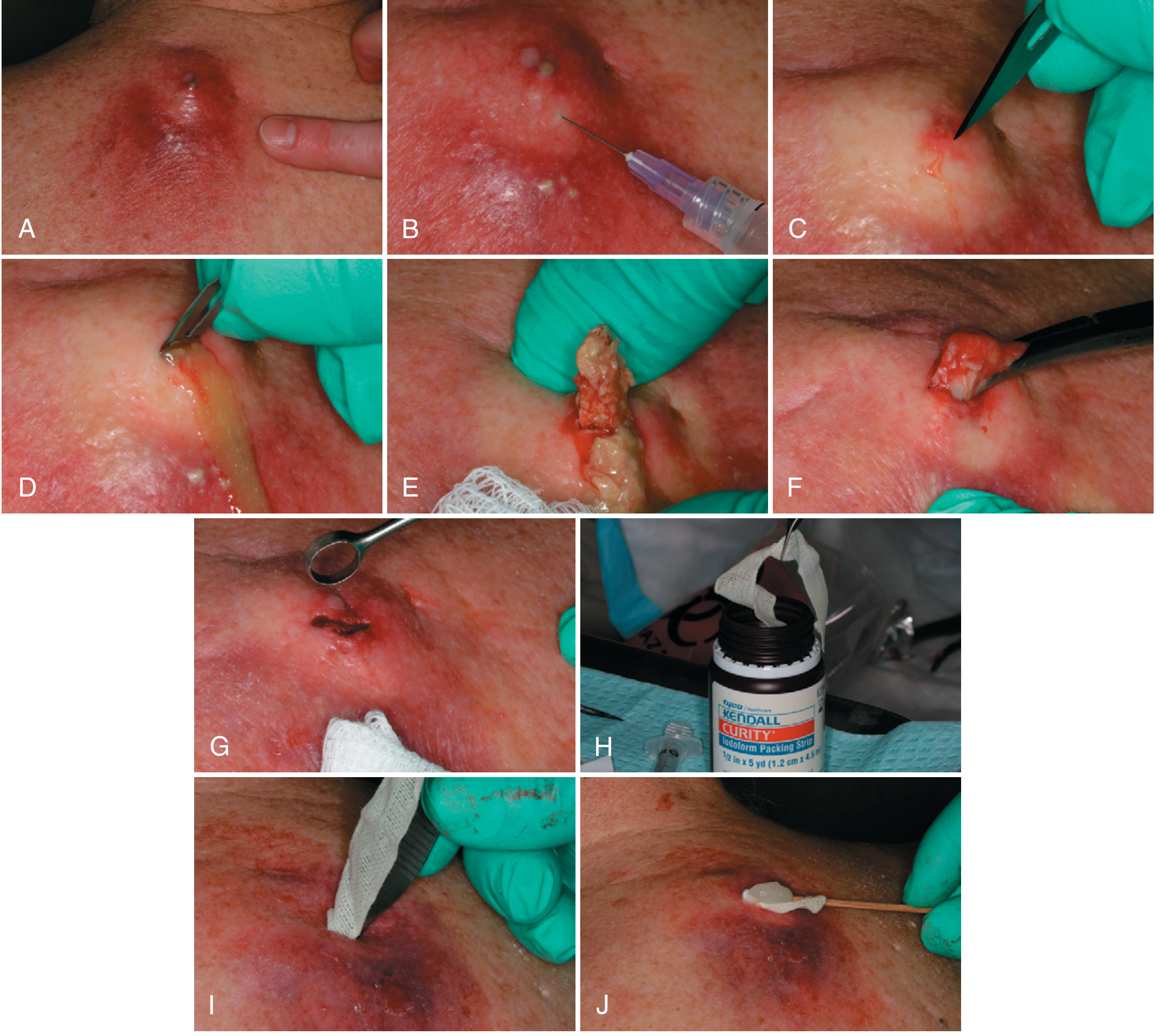
Antibiotics
| Situation | Recommendation |
|---|---|
| Uncomplicated abscess, no cellulitis | Not needed after adequate I&D |
| Surrounding cellulitis | Add antibiotic covering S. aureus |
| Immunocompromised / diabetic | Consider antibiotics + send culture |
| Recurrence after I&D | Send culture/sensitivity; consider MRSA coverage |
MRSA coverage options (community-associated): trimethoprim-sulfamethoxazole, clindamycin, doxycycline, or rifampin — guided by local resistance patterns and culture results.
Pathogen Context
- Most common: Staphylococcus aureus (including community-MRSA, now the leading pathogen in ED presentations)
- Less common: Streptococcus spp., gram-negative organisms, anaerobes (particularly in perineal/groin abscesses)
Warning Signs Requiring Reassessment
Instruct the patient to return immediately for:
- Re-accumulation of pus
- Fever and chills
- Increasing pain, redness, or swelling
- Red streaks (lymphangitis) near the abscess
When to Escalate
- Failure to improve after I&D → suspect deep tissue extension; may need IV antibiotics, hospitalization, or surgical debridement
- Recurrence → culture for MRSA; adjust antibiotics accordingly
- Possible complications: cellulitis progression, septicemia, fistula formation, osteomyelitis (rare at thigh site)
— Pfenninger and Fowler's Procedures for Primary Care, 3rd ed., pp. 176–178
Its kind of painfull red hot firm swelling
The description — painful, red, hot, firm swelling — is clinically important. Firm (non-fluctuant) means pus has not yet fully localized. This changes management significantly.
Finding Sources
Finding Sources
Reading File
Finding Sources
Reading File
This changes the picture. Here's the updated assessment:
Revised Assessment: Firm, Non-Fluctuant Swelling
What This Means Clinically
A firm (non-fluctuant) swelling — even with redness, heat, and pain — indicates that pus has not yet localized into a drainable collection. This is cellulitis / early pre-suppurative stage, not a mature abscess ready for I&D.
"An area of induration alone with no fluctuance indicates isolated cellulitis and is treated with antibiotics and warm compresses." — Textbook of Family Medicine, 9th ed.
Do NOT incise a firm, non-fluctuant swelling — there is no pus pocket to drain, and premature I&D yields nothing and risks unnecessary trauma/scarring.
Immediate Management
| Measure | Detail |
|---|---|
| Warm compresses | 15–20 min, 3–4× daily — promotes localization and may facilitate spontaneous pointing |
| Antibiotics | Required at this stage |
| Elevation of the limb | Reduces edema and inflammation |
| Analgesia | NSAIDs (also reduce inflammation) or paracetamol |
Antibiotic Choice
Target organism is S. aureus (MRSA must be considered):
Oral (mild–moderate):
- Clindamycin — good MRSA coverage
- TMP-SMX (co-trimoxazole) — effective for community MRSA
- Cephalexin / Dicloxacillin — if MRSA unlikely
IV (moderate–severe or systemic signs):
- Cefazolin or Ceftriaxone
- Vancomycin — if MRSA suspected or severe
Duration: Typically 5–7 days for uncomplicated cellulitis; reassess at 48–72 hours.
Monitoring — Reassess in 48–72 Hours
Watch for these changes:
| Sign | Meaning | Action |
|---|---|---|
| Swelling becomes soft/fluctuant | Pus has localized → now a mature abscess | Proceed with I&D |
| Spreading redness, fever, rigors | Progressing cellulitis / sepsis | Escalate to IV antibiotics / hospital |
| Red streaks proximally | Lymphangitis | Urgent IV antibiotics |
| No improvement at 48–72h | Consider deeper infection, MRSA, or necrotizing fasciitis | Imaging (USS/MRI) + surgical review |
Ultrasound — Useful Here
Bedside ultrasound is very helpful in this scenario:
- Abscess → hypoechoic fluid-filled cavity (confirms pus present, guides I&D)
- Cellulitis → "cobblestoning" pattern (no drainable collection)
This is especially useful when examination is equivocal — a firm swelling may still contain a small central pocket not palpable on exam.
Summary
| Stage | Exam Findings | Treatment |
|---|---|---|
| Pre-suppurative (now) | Firm, indurated, hot, red | Antibiotics + warm compresses |
| Mature abscess | Fluctuant, "pointing" | I&D + packing |
Monitor closely — if it softens and becomes fluctuant over the next 2–5 days, it is ready for I&D as described previously.
— Textbook of Family Medicine 9e; Rosen's Emergency Medicine
This is a shared conversation. Sign in to Orris to start your own chat.