
Parts of tibial component in TKA
Reading File
The tibial component in TKA consists of a metal tray (tibial baseplate/platform) and a polyethylene insert. Let me search the library for detailed coverage.
Searching sources...
Finding Sources
Finding Sources
Finding Sources
Finding Sources
Reading File
Reading File
Reading File
Reading File
Reading File
Finding Sources
Finding Sources
Reading File
Reading File
Loading Image
I now have comprehensive information from the textbooks. Let me compile the full answer.
Parts of the Tibial Component in Total Knee Arthroplasty (TKA)
The tibial component in TKA is a modular construct - this is now the standard design. It consists of two main sub-parts: the metal tibial baseplate (tray) and the polyethylene (PE) insert. An optional stem may be added.
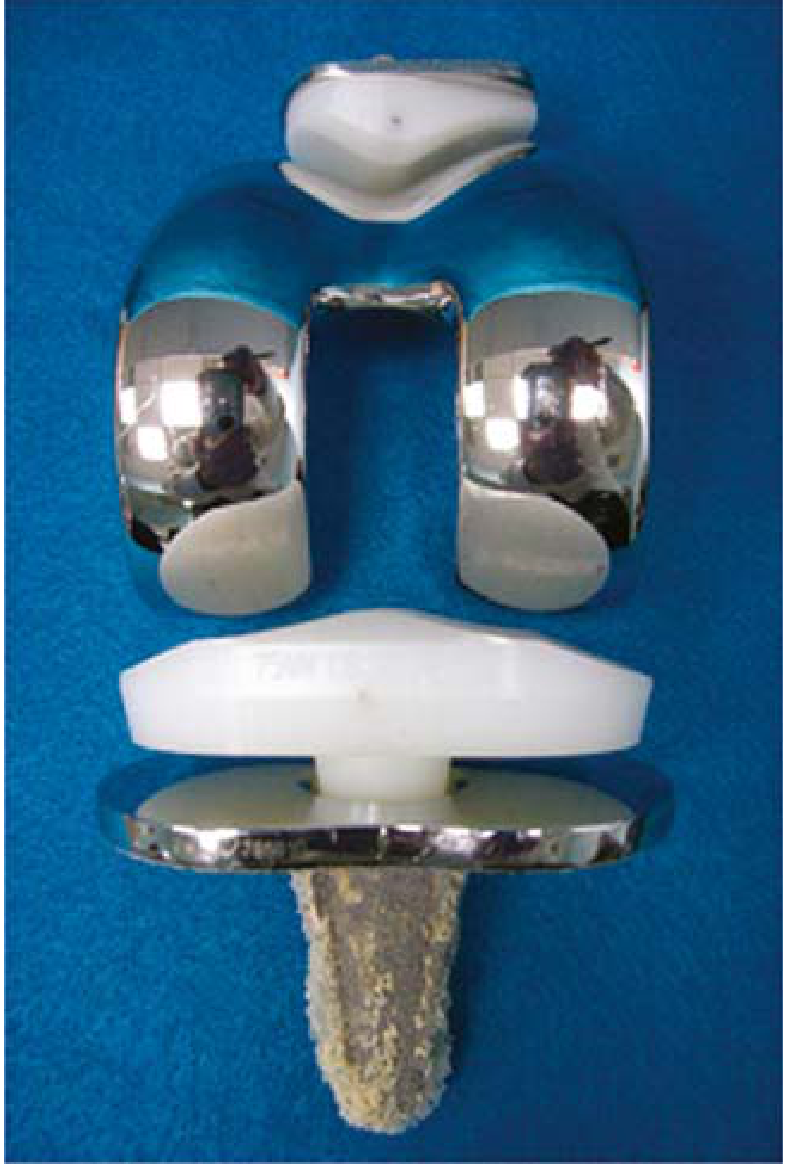
Retrieved primary TKA showing the tibial rotating platform. The PE bearing (white, with yoke) sits above the polished metal tibial baseplate with its stem.
1. Tibial Baseplate (Metal Tray/Platform)
This is the metal component that sits directly on the resected tibial surface. It has several sub-parts:
a. Platform Surface (Superior Surface)
- The flat or slightly contoured upper surface that interfaces with the PE insert.
- In fixed-bearing designs, the PE insert locks onto this surface via a locking mechanism.
- In mobile-bearing (rotating platform) designs, the surface is polished so the PE insert can rotate freely on it.
b. Undersurface (Bone-Contact Surface / Inferior Surface)
- Contacts the resected tibial plateau.
- In cemented designs: PMMA cement is applied to this surface in the sticky/initial phase.
- In cementless designs: covered with a 3D-printed porous ingrowth surface (e.g., Triathlon, Stryker) to allow bony ingrowth.
c. Fixation Elements on the Undersurface
| Element | Purpose |
|---|---|
| Central stem / keel | Main fixation peg that goes into the tibial canal; distributes load; prevents rotation |
| Peripheral pegs | Secondary fixation; spiked press-fit pegs in cementless designs provide added stability |
| Screws (in cementless designs) | Multiple screws (e.g., Profix, Smith & Nephew) through screw holes in the tray provide initial stability while bony ingrowth occurs |
The tibial tray is implanted first during cementation technique. PMMA cement is pressurized into the tibial keel and cancellous bone surface. - Campbell's Operative Orthopaedics 15th Ed 2026
2. Polyethylene (PE) Insert / Tibial Bearing
The PE insert is the articulating surface that sits atop the metal tray and interfaces with the femoral component.
a. Articular Surface (Superior)
- Articulates with the femoral condyles.
- Geometry varies by design:
| Design | PE Profile | PCL Status |
|---|---|---|
| Cruciate-retaining (CR) | Relatively flat or shallow dish | PCL retained |
| Deep-dish / high-congruent | Built-up anterior aspect, prevents femoral roll forward | PCL retained or sacrificed |
| Posterior-stabilized (PS) | Has a central tibial post | PCL sacrificed |
| Constrained condylar knee (CCK) | Enlarged central post constrained within femoral box | PCL sacrificed |
| Rotating platform | Rotates on polished baseplate; has a yoke that inserts into the baseplate | PCL sacrificed |
b. Central Tibial Post (in PS and CCK designs)
- The PS design has a central polyethylene post that engages with the femoral cam mechanism, driving femoral rollback during flexion.
- In the CCK design, this post is enlarged and constrained against the medial and lateral walls of a deepened femoral central box, providing varus-valgus stability.
- A small amount of varus-valgus toggle is permitted in CCK (not completely rigid).
c. Backside (Inferior) Surface
- Interfaces with the metal tray's locking mechanism.
- Micromotion at this interface can cause backside PE wear, which generates particulate debris and leads to osteolysis - a key disadvantage of modular designs.
- Locking mechanisms (clips, tabs, dovetails depending on brand) secure the PE insert to the metal tray but do not completely eliminate micromotion.
3. Optional Stem Extension
- Can be attached to the tibial (and/or femoral) tray.
- Used when additional fixation or load transfer is needed:
- Previous high tibial osteotomy (HTO) with distorted anatomy
- Revision TKA
- Medial bone loss/compromise
- Severe deformity
- Can be press-fit (cementless) or cemented.
- An offset stem may be used to accommodate deformity (e.g., medially offset stem after HTO).
Design Variants Summary
| Tibial Design | Key Feature | Bearing Type |
|---|---|---|
| Modular metal tray + PE insert | Standard; allows isolated PE exchange | Fixed or mobile |
| All-polyethylene tibia (APT) | No metal backing; cemented only; nonmodular; economical | Fixed (monoblock) |
| Rotating platform | PE rotates on polished metal tray; PE has a yoke | Mobile-bearing |
| Monoblock metal-backed | PE pressed onto metal at factory; no backside wear | Fixed |
Modularity: Advantages and Disadvantages
- Advantage: Allows isolated polyethylene bearing exchange (without full revision) when the tray is well-fixed but the PE is worn.
- Advantage: Greater intraoperative flexibility.
- Disadvantage: Backside PE wear due to micromotion between tray and PE backside; more osteolysis than monoblock designs.
- All-PE tibia: no backside wear, economical, but technically harder to cement; wear and aseptic loosening rates are similar to modular designs. - Miller's Review of Orthopaedics 9th Ed
Sources:
- Campbell's Operative Orthopaedics 15th Ed 2026 - Component Design, Component Fixation, Technique 8.11
- Miller's Review of Orthopaedics 9th Edition - Modularity in Primary TKA, All-Polyethylene Tibia, Rotating Platform sections
This is a shared conversation. Sign in to Orris to start your own chat.