
Interior of the skull
Reading File
Finding Sources
Searching Images
interior of skull base cranial fossae anatomy
Finding Sources
Loading Image
Reading File
Searching Images
cranial fossae foramina bones internal skull base labeled diagram
Reading File
Loading Image
Reading File
Loading Image
Reading File
Loading Image
Loading Image
Here is a comprehensive overview of the interior of the skull based on Gray's Anatomy for Students.
Overview
The floor of the cranial cavity is divided into three stepped fossae — anterior, middle, and posterior — each progressively deeper and each accommodating specific brain structures and transmitting distinct neurovascular bundles.
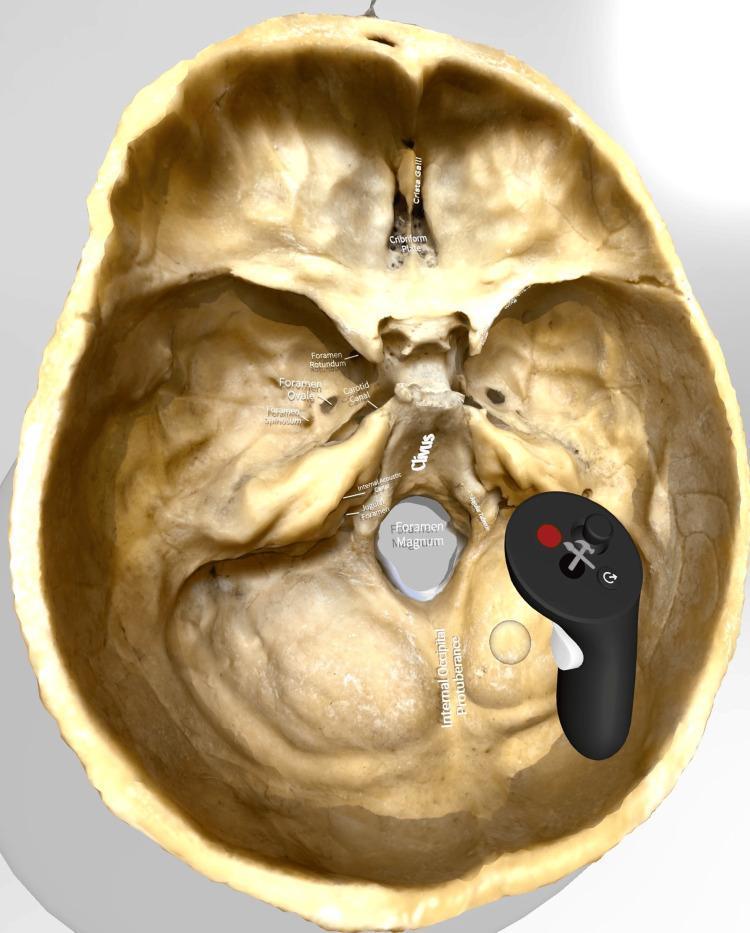
1. Anterior Cranial Fossa
Bones: Frontal (anterior & lateral floor), ethmoid (midline), and sphenoid — body + lesser wings (posterior floor).
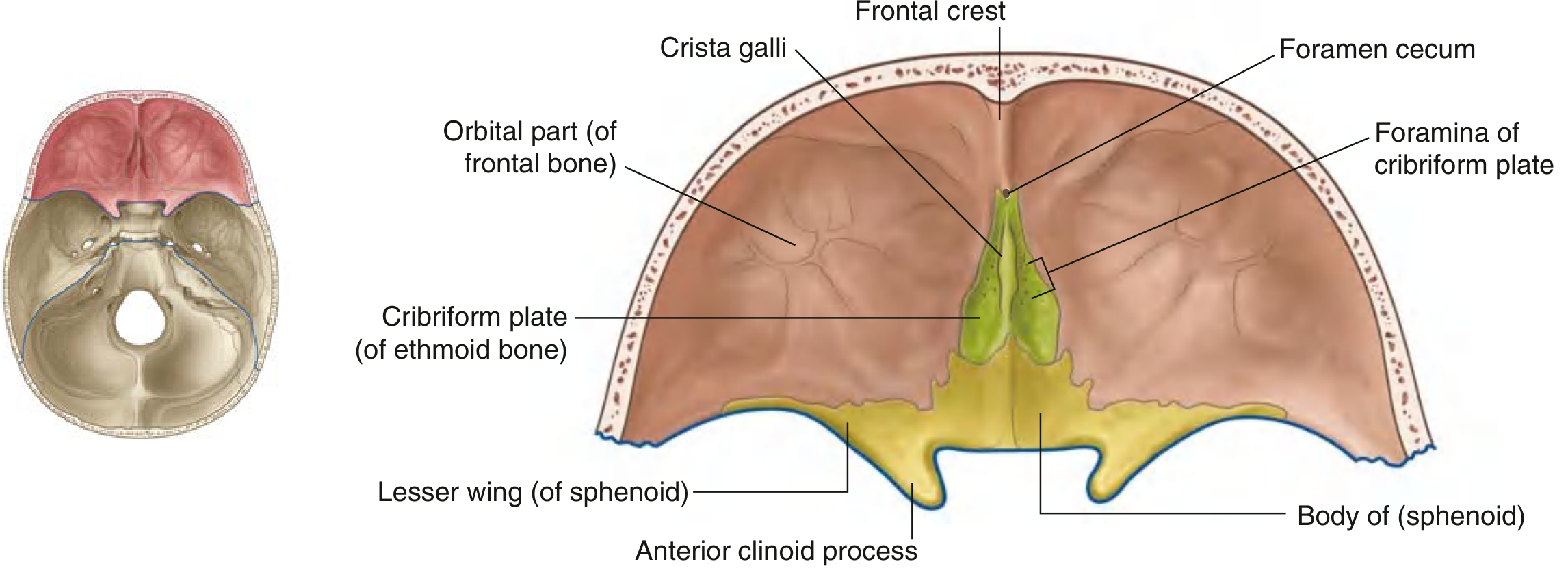
Key features:
- Frontal crest — midline anterior bony ridge; attachment for the falx cerebri
- Foramen cecum — between frontal and ethmoid bones; may transmit emissary veins to the superior sagittal sinus
- Crista galli — midline ethmoid projection; falx cerebri attachment
- Cribriform plate — sieve-like; transmits olfactory nerve [CN I] fibers from nasal mucosa to olfactory bulb
- Orbital plates of frontal bone — thin; also form the roof of the orbit
- Lesser wings of sphenoid — form the posterior boundary; end medially as anterior clinoid processes (tentorium cerebelli attachment)
Contents: Frontal lobes of the cerebral hemispheres sit in this fossa, which lies above the nasal cavity and orbits.
2. Middle Cranial Fossa
Bones: Body and greater wings of the sphenoid, squamous and petrous parts of the temporal bone.
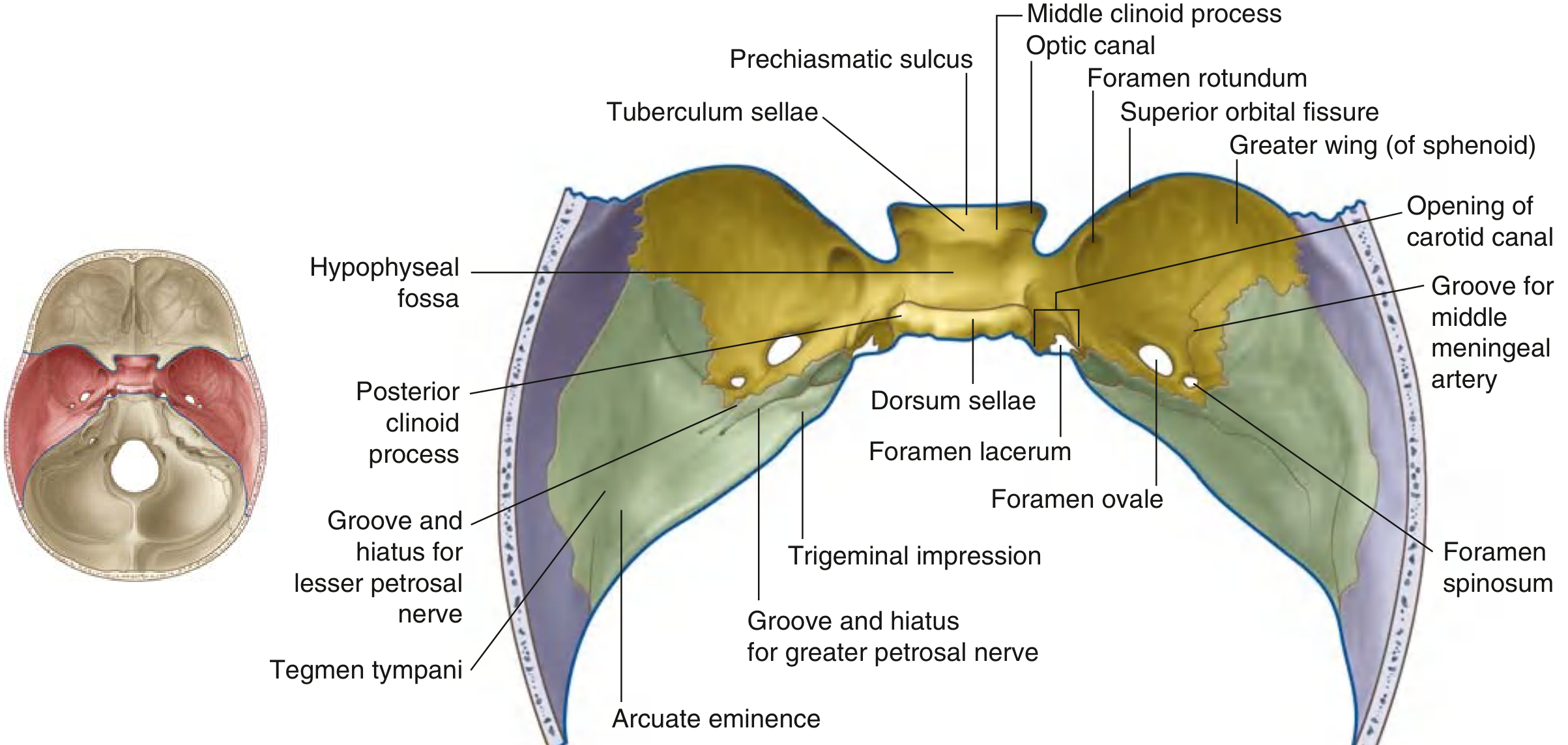
Key features:
| Structure | Detail |
|---|---|
| Sella turcica | Hypophyseal fossa (contains pituitary gland); bounded anteriorly by tuberculum sellae and posteriorly by dorsum sellae with posterior clinoid processes |
| Prechiasmatic sulcus | Groove between optic canals; marks the anterior boundary with the anterior fossa |
| Optic canal | In lesser wing; transmits CN II + ophthalmic artery |
| Superior orbital fissure | Between greater and lesser sphenoid wings; transmits CN III, IV, V₁, VI + ophthalmic veins |
| Foramen rotundum | Transmits CN V₂ (maxillary nerve) → pterygopalatine fossa |
| Foramen ovale | Transmits CN V₃ (mandibular nerve) + lesser petrosal nerve → infratemporal fossa |
| Foramen spinosum | Transmits middle meningeal artery (groove visible on inner skull surface) |
| Carotid canal opening | Internal carotid artery enters the cranium here |
| Foramen lacerum | Filled by fibrocartilage in life; internal carotid artery passes over it |
| Hiatus for greater petrosal nerve | On anterior petrous surface |
| Hiatus for lesser petrosal nerve | Also on anterior petrous surface |
| Arcuate eminence | Raised area on petrous bone overlying the superior semicircular canal |
| Tegmen tympani | Thin bony roof of the middle ear cavity |
Contents: Temporal lobes of the brain.
3. Posterior Cranial Fossa
The largest and deepest fossa. Bones: Primarily occipital and temporal (petrous/mastoid parts), with minor contributions from sphenoid and parietal.
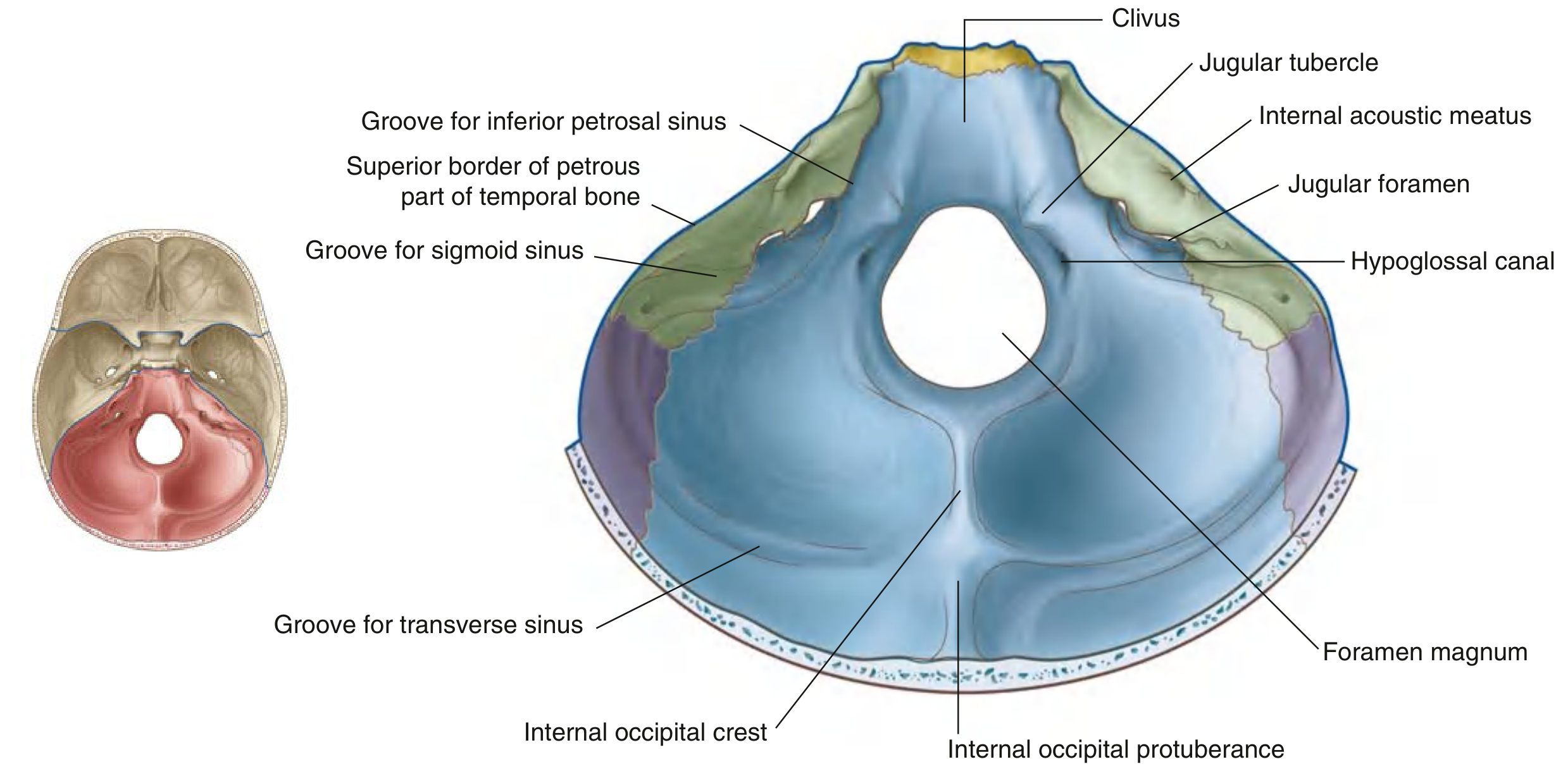
Key features:
| Structure | Contents |
|---|---|
| Foramen magnum | Brainstem/spinal cord junction; vertebral arteries; spinal roots of CN XI; meninges |
| Clivus | Slope of sphenoid + basilar occipital bone rising from foramen magnum; supports the pons and medulla |
| Internal acoustic meatus | CN VII (facial), CN VIII (vestibulocochlear) + labyrinthine artery |
| Jugular foramen | CN IX, X, XI; sigmoid sinus → internal jugular vein; inferior petrosal sinus |
| Hypoglossal canal | CN XII + meningeal branch of ascending pharyngeal artery |
| Condylar canal | Emissary vein |
| Groove for inferior petrosal sinus | Between basilar occipital and petrous temporal bone |
| Groove for sigmoid sinus | Leads to jugular foramen |
| Groove for transverse sinus | Runs along posterior occipital bone at internal occipital protuberance |
| Internal occipital protuberance | Central posterior landmark; convergence of venous sinuses |
| Internal occipital crest | Midline ridge; attachment for falx cerebelli |
Contents: Brainstem (midbrain, pons, medulla) and cerebellum.
Summary Table: Foramina and Transmissions
| Foramen | Fossa | Contents |
|---|---|---|
| Foramen cecum | Anterior | Emissary veins (nasal → sagittal sinus) |
| Cribriform foramina | Anterior | CN I (olfactory nerve fibers) |
| Optic canal | Middle | CN II + ophthalmic artery |
| Superior orbital fissure | Middle | CN III, IV, V₁, VI + ophthalmic veins |
| Foramen rotundum | Middle | CN V₂ |
| Foramen ovale | Middle | CN V₃ + lesser petrosal nerve |
| Foramen spinosum | Middle | Middle meningeal artery |
| Foramen magnum | Posterior | Spinal cord, vertebral arteries, CN XI spinal roots |
| Internal acoustic meatus | Posterior | CN VII, VIII + labyrinthine artery |
| Jugular foramen | Posterior | CN IX, X, XI; sigmoid & inferior petrosal sinuses |
| Hypoglossal canal | Posterior | CN XII |
Gray's Anatomy for Students, pp. 1002–1005
This is a shared conversation. Sign in to Orris to start your own chat.