
Percutaneous tracheostomy kit Give this for 10 marks question for my assignment as anesthesia pg resident so that my HOD mam should not scold me. Provide all necessary information reference - millers, morgan, barash, baheti, dnb kaushik , all anesthesia standard textbooks
Percutaneous Tracheostomy Kit
(Percutaneous Dilatational Tracheostomy - PDT)
1. Introduction
"PDT is generally performed at the bedside in the ICU... periprocedural mortality related to PDT in randomized studies appears to be less than 0.2%."
- Current Surgical Therapy 14e; Sabiston Textbook of Surgery
2. Indications and Contraindications
| INDICATIONS | CONTRAINDICATIONS (mostly relative) |
|---|---|
| Prolonged mechanical ventilation (>10-14 days) | Recent anterior neck surgery (<7 days) |
| Upper airway obstruction | High ventilatory requirements (FiO₂ >70%, PEEP >10 cmH₂O) |
| Difficult airway / Significant maxillofacial trauma | Elevated intracranial pressure |
| Neurologic conditions preventing safe extubation (brain injury, SCI, spinal fixation) | Hemodynamic instability |
| Severe agitation, prolonged altered mental status | Significant coagulopathy (platelets <50,000/mm³, PT/PTT >1.5x control) |
| Angioedema / Upper airway tumors | Local infection or malignancy at site |
| Facilitate weaning from ventilator | Morbid obesity (relative - increased risk of accidental decannulation) |
| Aid secretion clearance | Predicted early mortality |
3. The Percutaneous Tracheostomy Kit - Components
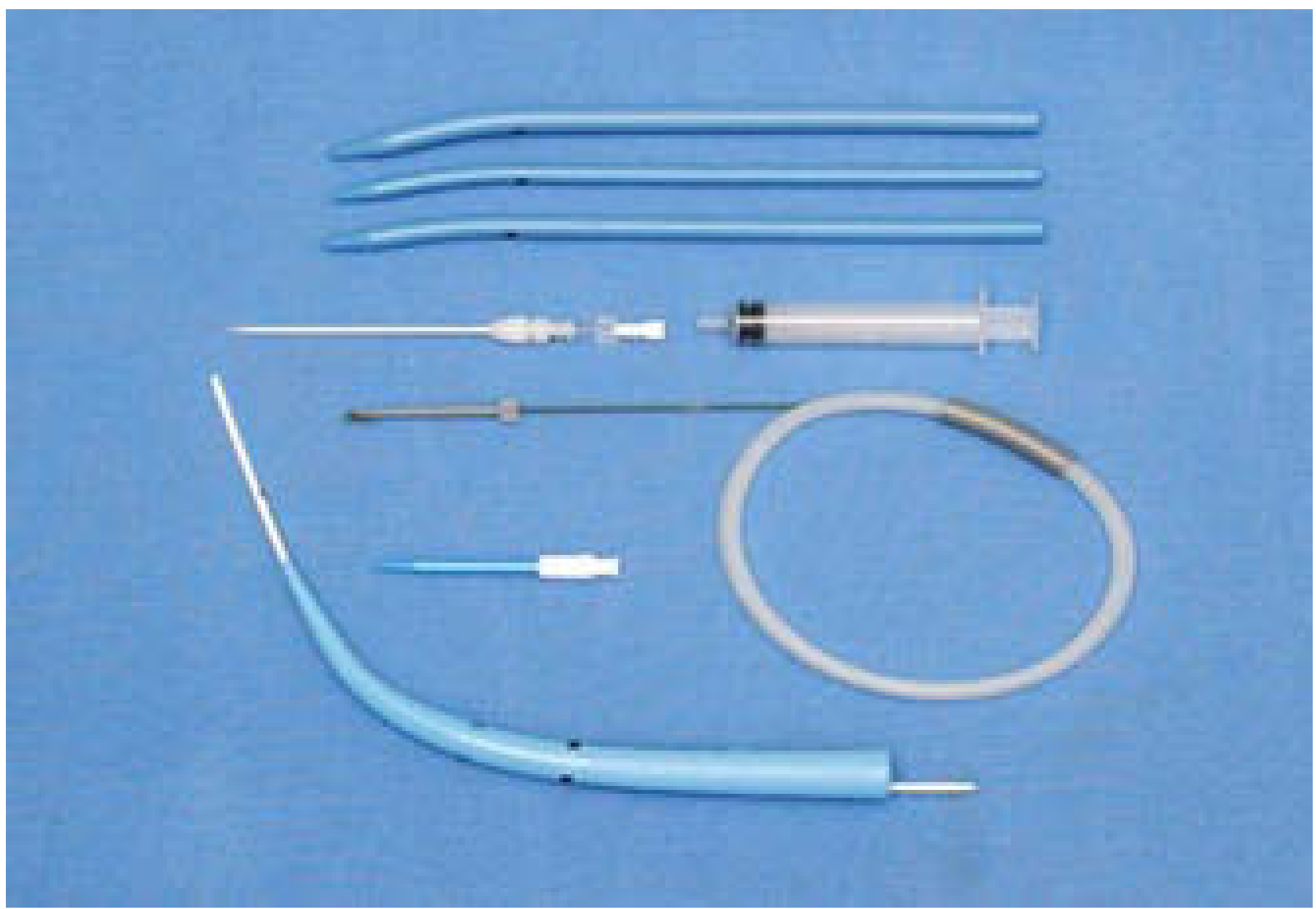
Essential Components of the PDT Kit:
| # | Component | Purpose |
|---|---|---|
| 1 | Introducer needle (18G) with cannula | Initial tracheal puncture and cannulation |
| 2 | 10 mL syringe (saline-filled) | Confirms intratracheal placement by air aspiration |
| 3 | J-tipped guidewire (Seldinger wire) | Guides all subsequent dilators into trachea |
| 4 | Short guiding catheter (12 Fr) | Initial small-bore dilation; stiffens the system for subsequent steps |
| 5 | Single tapered dilator - Blue Rhino (hydrophilic coated) | Single-step progressive dilation - replaces serial graduated dilators |
| 6 | Tracheostomy tube with inner cannula, cuff, and 15 mm adapter | Final airway device placed into trachea |
| 7 | Loading dilator / obturator | Mounts tracheostomy tube for smooth introduction over guidewire |
| 8 | #11 scalpel blade | Skin incision (1-1.5 cm) |
| 9 | Tracheostomy tube holder/tape | Secures tube after placement |
| 10 | Lubricant (water-soluble) | Facilitates smooth advancement of dilators |
- Flexible fibreoptic/video bronchoscope (mandatory in current practice)
- 1% Lignocaine with 1:100,000 adrenaline (local infiltration)
- Sedation agents (propofol/midazolam + fentanyl/remifentanil + NMB)
- Sterile drapes, gloves, towels
- Suction device, monitoring equipment
"Serial dilation has been replaced by use of a single tapered dilator with a hydrophilic coating (Ciaglia Blue Rhino Percutaneous Tracheostomy Introducer Kit, Cook Medical), which allows for faster dilation and less instrumentation."
- Cummings Otolaryngology Head and Neck Surgery
4. Variants / Types of PDT Kits
| Technique | Kit/Device | Principle |
|---|---|---|
| Ciaglia Blue Rhino (most common) | Cook Medical | Single tapered hydrophilic dilator over guidewire |
| Ciaglia classic (original) | Cook Medical | Multiple serial graduated dilators over guidewire |
| Griggs technique | Portex GWDF set | Guidewire Dilating Forceps - spreads tissue |
| Fantoni Translaryngeal | Mallinckrodt TLT | Retrograde pull-through technique |
| PercuTwist | Rusch-Teleflex | Single-step screw-in rotating dilator |
| Rapitrac / BlueDolphin | Various | Balloon dilation technique |
5. Patient Preparation and Anesthesia Management
Pre-procedure Assessment:
- Review neck anatomy - palpate hyoid, thyroid cartilage, cricoid, tracheal rings 1-3
- Review CT imaging for vascular anatomy (high-riding innominate artery, aberrant vessels)
- Ultrasound of neck to identify vessels in the path of cannulation (now standard)
- Lab work: Platelets, PT, PTT, BUN (uremia → treat with DDAVP before procedure)
- FiO₂ increased to 1.0 just before the procedure
Anesthesia Protocol:
- Sedation + Analgesia + Short-acting NMB (preferred): Propofol infusion + Fentanyl/Remifentanil + Cisatracurium/Succinylcholine
- Prevents coughing, patient movement, and optimizes first-attempt success
- Role of anesthesiologist: positioned at head of bed - manages ETT, performs bronchoscopy, administers medications
- A dedicated non-sterile circulating nurse must be available for monitoring and medication administration
6. Step-by-Step Technique (Ciaglia Blue Rhino)
- Position: Supine, shoulder roll placed, neck extended (unless contraindicated - e.g., cervical spine injury)
- Landmark identification: Hyoid, thyroid cartilage, cricoid, tracheal rings 1-3
- Asepsis: Sterile prep and drape; FiO₂ increased to 100%
- Local infiltration: 5-10 mL of 1% lignocaine + 1:100,000 adrenaline subcutaneously (for vasoconstriction)
- Skin incision: 1-1.5 cm horizontal (or vertical) incision below inferior border of cricoid
- Blunt dissection: Hemostat dissection in midline through subcutaneous tissue to reach tracheal rings
- Bronchoscope placement: Flexible bronchoscope advanced through ETT to distal end; ETT withdrawn to level of vocal cords (so the tip is just above the stoma site)
- Needle puncture: 18G introducer needle on saline-filled syringe inserted between tracheal rings 1-2 or 2-3 in the midline. Correct position confirmed by:
- Free aspiration of air through saline (seen as bubbles)
- Direct bronchoscopic visualization (needle visible at 10-2 o'clock position on anterior wall)
- Catheter advancement: Needle withdrawn, catheter left in trachea
- Guidewire insertion: J-tipped guidewire passed through catheter into trachea (directed caudally)
- Initial dilation: 12 Fr guiding catheter used for initial tract dilation
- Blue Rhino dilation: Lubricated single tapered dilator advanced over guidewire + guiding catheter with steady rotational pressure - creates the final stoma in one pass
- Tracheostomy tube insertion: Appropriate-sized tracheostomy tube (usually size 7-8) loaded on obturator over the guidewire and advanced into trachea under bronchoscopic visualization
- Confirmation: Guidewire and obturator removed; cuff inflated; connection to ventilator circuit; confirmed by:
- Capnography (EtCO₂)
- Bilateral auscultation
- Adequate tidal volumes without leak
- Securing: Tube secured with neck strap (one finger-breadth gap) + sutures to neck plate
7. Anesthesiologist's Critical Role During PDT
- Ensures adequate sedation/analgesia/paralysis throughout
- Withdraws ETT to level of vocal cords at appropriate step (critical - too deep prevents guidewire access, too high risks accidental extubation)
- Operates bronchoscope for real-time guidance
- Monitors for desaturation, hypotension, arrhythmias
- Maintains ventilation throughout - when bronchoscope is in situ, PEEP decreases and auto-PEEP may build
- Ensures 100% FiO₂ before, during, and after the critical steps
- Ready for emergency re-intubation at all times
8. Bronchoscopic Guidance - Why It Is Mandatory
- Confirms correct intratracheal needle placement (prevents paratracheal insertion)
- Protects the posterior membranous wall of the trachea from injury
- Identifies inadvertent guidewire malposition
- Confirms tracheostomy tube is within trachea and above carina
- Complication rate without bronchoscopy: 16.8% vs. with bronchoscopy: 8.3% (Cummings)
- Bronchoscopy is the standard of care for all PDT procedures
9. Complications
Early Complications:
| Complication | Notes |
|---|---|
| Hemorrhage | Most common; usually minor stoma bleeding; significant hemorrhage rare (~0.03% in large series) |
| Paratracheal insertion | Prevented by bronchoscopic guidance |
| Posterior tracheal wall injury / perforation | Most serious intraoperative complication |
| Accidental decannulation | Increased risk in obesity (BMI >30); if occurs, re-intubate orally first, do not blindly reinstate tube |
| Pneumothorax | ~0.85%; subcutaneous emphysema ~1.4% |
| Pneumomediastinum | Rare |
| Tracheal ring fracture | More common in PDT than open tracheostomy |
| Airway fire | Rare (more common in surgical tracheostomy using electrocautery) |
| Hypoxemia / desaturation | During bronchoscope use and tube exchange |
| False passage / esophageal placement | Avoided by bronchoscopic guidance |
Late Complications:
| Complication | Notes |
|---|---|
| Tracheal stenosis | Most significant late complication; "corkscrew stenosis" described specific to PDT (Cummings) |
| Tracheomalacia | Weakening of tracheal cartilage |
| Tracheo-innominate artery fistula | Life-threatening; related to inferior placement or high-riding innominate artery |
| Tracheoesophageal fistula | Rare; related to posterior wall injury |
| Tracheocutaneous fistula | Stoma does not close after decannulation |
| Granulation tissue / stomal infection | Common; managed with local wound care |
| Persistent tracheal scar | Cosmetic concern |
"Periprocedural major complication rate of 0.15% and periprocedural mortality rate of less than 0.1%" - Sabiston Textbook of Surgery (3000+ consecutive PDT case series)
10. PDT vs. Open Surgical Tracheostomy
| Parameter | PDT | Open Surgical Tracheostomy |
|---|---|---|
| Setting | ICU bedside | Operating theatre preferred |
| Time | Faster | Longer (full surgical setup) |
| Cost | Less expensive | More expensive |
| Wound infection | Lower | Higher |
| Bleeding risk | Similar or lower | Similar (electrocautery available) |
| Tracheal ring fracture | Higher | Lower (direct visualization) |
| Posterior wall injury | Higher risk (avoided by bronchoscopy) | Lower (direct vision) |
| Paratracheal insertion | Risk present | Very rare |
| Difficult anatomy / coagulopathy | Refer to surgical | Preferred |
| Evidence | Meta-analysis shows equivalence | Equivalent outcomes |
"Meta-analysis has shown equivalence of the techniques" - Scott-Brown's Otorhinolaryngology
11. Timing of Tracheostomy
- Early tracheostomy: within 7 days of intubation
- Late tracheostomy: after day 7-10
- Current evidence (TracMan trial, TRACMAN, PERCUTWIST trials) does not show significant mortality benefit of early vs. late tracheostomy in unselected ICU patients
- Decision should be individualized based on clinical trajectory
12. Absolute Pearls for the Examiner
- PDT uses Seldinger principle - guidewire-based sequential dilatation
- Entry site: between rings 1-2 or 2-3 (above ring 1 = subglottic stenosis; below ring 4 = tracheo-innominate fistula risk)
- Ciaglia Blue Rhino = single hydrophilic tapered dilator (current gold standard)
- Bronchoscopic guidance is mandatory - reduces complications by half
- Anesthesiologist withdraws ETT to vocal cord level before guidewire insertion
- If accidental decannulation: secure airway orally first, THEN attempt tube replacement (tract is immature for first 7 days)
- Most common late complication: tracheal stenosis
- Most feared acute complication: posterior tracheal wall perforation
- Contraindicated (relative) at high PEEP (>10) - bronchoscopy worsens ventilation
- PDT is more cost-effective than surgical tracheostomy in ICU patients
References
- Ciaglia P, Firsching R, Syniec C. Elective percutaneous dilatational tracheostomy. Chest 1985;87:715-719
- Cummings Otolaryngology Head and Neck Surgery (7th Ed) - Chapter 7
- Scott-Brown's Otorhinolaryngology Head & Neck Surgery - Chapter 72
- Current Surgical Therapy 14e - Percutaneous Dilatational Tracheostomy
- Sabiston Textbook of Surgery 21e - Chapter 47
- Fishman's Pulmonary Diseases and Disorders - Tracheostomy Chapter
- Bailey and Love's Short Practice of Surgery 28e
- Miller's Anesthesia (9th Ed) - Airway Management chapter (PDT role of anesthesiologist)
- Morgan & Mikhail's Clinical Anesthesiology - Airway Management
- Barash Clinical Anesthesia - Airway Management
- Baheti / DNB Kaushik - Airway Management and ICU procedures
Give in handwritten notes
What format do you want for the handwritten notes? · What handwriting style?
ls /tmp/workspace/ 2>/dev/null || mkdir -p /tmp/workspace/pdt-notes && echo "ready"
mkdir -p /tmp/workspace/pdt-notes && python3 -c " from PIL import Image, ImageDraw, ImageFont import os # Check available fonts import subprocess result = subprocess.run(['fc-list', '--format=%{file}\n'], capture_output=True, text=True) fonts = result.stdout.strip().split('\n') # Filter for something handwriting-like or at least a good font for f in fonts[:30]: print(f) "
pip install --user Pillow --quiet && python3 -c " import subprocess result = subprocess.run(['fc-list', '--format=%{file}\n'], capture_output=True, text=True) fonts = [f for f in result.stdout.strip().split('\n') if any(x in f.lower() for x in ['italic', 'oblique', 'cursive', 'noto', 'droid', 'bookman', 'nimbus'])] for f in fonts[:20]: print(f) "
~/pdt-notes/generate_notes.py
from PIL import Image, ImageDraw, ImageFont
import math, os, random

OUT = "/tmp/workspace/pdt-notes"
os.makedirs(OUT, exist_ok=True)

# ── Fonts ──────────────────────────────────────────────────────────────────
ITALIC   = "/usr/share/fonts/urw-base35/P052-Italic.otf"
BOLD     = "/usr/share/fonts/urw-base35/NimbusRoman-Bold.otf"
REGULAR  = "/usr/share/fonts/urw-base35/NimbusRoman-Regular.otf"
SANS     = "/usr/share/fonts/urw-base35/NimbusSans-Regular.otf"
SANS_B   = "/usr/share/fonts/urw-base35/NimbusSans-Bold.otf"

def font(path, size):
    try:
        return ImageFont.truetype(path, size)
    except:
        return ImageFont.load_default()

# ── Colours ────────────────────────────────────────────────────────────────
BG        = (255, 252, 240)       # cream notepad
RULED     = (180, 210, 240)       # light blue rule line
MARGIN    = (255, 160, 160)       # red margin line
INK       = (10,  30, 120)        # dark navy = main handwriting
HEADING   = (180, 10,  10)        # red heading
SUB_HEAD  = (0,  100,  50)        # green subheading
HIGHLIGHT = (255, 240,  80)       # yellow highlighter
HL_BLUE   = (180, 230, 255)       # blue highlighter
HL_GREEN  = (180, 255, 180)       # green highlighter
BOX_BORDER= (200,  80,  20)       # orange box border
PINK_BOX  = (255, 220, 230)       # pink box fill
BULLET    = (180, 10,  10)
STAR      = (200, 120,   0)
TABLE_HDR = (220, 240, 255)
TABLE_BDR = (100, 150, 200)

W, H = 1240, 1754   # A4 @150 dpi

MARGIN_L = 110   # left margin line x
LINE_H   = 46    # ruled line spacing

def new_page():
    img = Image.new("RGB", (W, H), BG)
    d   = ImageDraw.Draw(img)
    # ruled lines
    for y in range(160, H - 60, LINE_H):
        d.line([(MARGIN_L, y), (W - 50, y)], fill=RULED, width=1)
    # red margin
    d.line([(MARGIN_L, 100), (MARGIN_L, H - 50)], fill=MARGIN, width=2)
    # top blue header band
    d.rectangle([(0, 0), (W, 95)], fill=(40, 90, 160))
    return img, d

def highlight_text(d, x, y, text, fnt, color=HIGHLIGHT, pad=4):
    bbox = d.textbbox((x, y), text, font=fnt)
    d.rectangle([bbox[0]-pad, bbox[1]-pad, bbox[2]+pad, bbox[3]+pad], fill=color)
    d.text((x, y), text, font=fnt, fill=INK)

def write_text(d, x, y, text, fnt, color=INK):
    d.text((x, y), text, font=fnt, fill=color)

def draw_box(d, x1, y1, x2, y2, fill=PINK_BOX, border=BOX_BORDER, radius=12):
    d.rounded_rectangle([(x1,y1),(x2,y2)], radius=radius, fill=fill, outline=border, width=2)

def draw_arrow(d, x, y, length=40, color=HEADING):
    d.polygon([(x, y), (x+length, y+10), (x+length//2, y+10)], fill=color)

def underline(d, x, y, text, fnt, color=HEADING):
    d.text((x, y), text, font=fnt, fill=color)
    bbox = d.textbbox((x, y), text, font=fnt)
    d.line([(bbox[0], bbox[3]+2), (bbox[2], bbox[3]+2)], fill=color, width=2)

# ═══════════════════════════════════════════════════════════
# PAGE 1  — Title + Introduction + Indications/Contraindications
# ═══════════════════════════════════════════════════════════
img1, d1 = new_page()
fn_title   = font(BOLD,   38)
fn_sub     = font(ITALIC, 26)
fn_h1      = font(BOLD,   32)
fn_h2      = font(SANS_B, 26)
fn_body    = font(ITALIC, 24)
fn_small   = font(ITALIC, 21)
fn_bold_sm = font(BOLD,   24)

# Header band text
d1.text((30, 18), "PERCUTANEOUS TRACHEOSTOMY KIT",   font=font(SANS_B, 32), fill=(255,255,255))
d1.text((30, 58), "Anaesthesia PG Notes  |  10 Marks", font=font(SANS,   22), fill=(200, 220, 255))

y = 108
# Main title
highlight_text(d1, MARGIN_L+10, y, "PERCUTANEOUS DILATATIONAL TRACHEOSTOMY (PDT)", font(BOLD, 28), HL_BLUE)
y += 46

# Intro box
draw_box(d1, MARGIN_L+5, y, W-60, y+120, fill=(240,248,255), border=(60,100,200))
d1.text((MARGIN_L+20, y+10), "First described by  Ciaglia et al. 1985  (Chest 87:715–719)", font=fn_body, fill=INK)
d1.text((MARGIN_L+20, y+40), "→ Bedside ICU procedure  •  Seldinger (guidewire) principle", font=fn_body, fill=(0,80,0))
d1.text((MARGIN_L+20, y+70), "→ Most common elective tracheostomy in mechanically ventilated pts", font=fn_body, fill=(0,80,0))
d1.text((MARGIN_L+20, y+98), "  Periprocedural mortality < 0.2%  (Sabiston)", font=fn_small, fill=(120,0,120))
y += 138

# ── Indications & Contraindications side by side ──
underline(d1, MARGIN_L+10, y, "INDICATIONS & CONTRAINDICATIONS", font(BOLD, 27), HEADING)
y += 40

col1x, col2x = MARGIN_L+10, MARGIN_L + 550
box_top = y

ind = [
    "Prolonged mech. ventilation (>10–14 days)",
    "Upper airway obstruction",
    "Significant maxillofacial trauma",
    "Difficult airway / Angioedema / UAO tumours",
    "Brain injury / Spinal cord injury",
    "Severe agitation / altered mental status",
    "Aid secretion clearance & wean from vent",
]
contra = [
    "Recent ant. neck surgery (<7 days)",
    "High PEEP (>10 cmH₂O) / FiO₂ >70%",
    "Elevated ICP",
    "Haemodynamic instability",
    "Coagulopathy (Plt <50K, INR >1.5)",
    "Local infection / malignancy at site",
    "Morbid obesity (relative)",
    "Predicted early mortality",
]

# Left header
draw_box(d1, col1x-5, y, col1x+500, y+32, fill=(180,255,180), border=(0,160,0))
d1.text((col1x, y+4), "✓  INDICATIONS", font=font(SANS_B, 22), fill=(0,120,0))
y_ind = y + 40
for item in ind:
    d1.text((col1x, y_ind), "•  " + item, font=fn_small, fill=INK)
    y_ind += 30

# Right header
draw_box(d1, col2x-5, box_top, col2x+620, box_top+32, fill=(255,200,200), border=(200,0,0))
d1.text((col2x, box_top+4), "✗  CONTRAINDICATIONS (mostly relative)", font=font(SANS_B, 21), fill=(180,0,0))
y_con = box_top + 40
for item in contra:
    d1.text((col2x, y_con), "✘  " + item, font=fn_small, fill=(140,0,0))
    y_con += 30

y = max(y_ind, y_con) + 18

# ── NOTE box ──
draw_box(d1, MARGIN_L+5, y, W-60, y+50, fill=(255,255,200), border=(200,180,0))
d1.text((MARGIN_L+20, y+8), "★  Most contraindications are RELATIVE & TEMPORARY", font=font(BOLD, 23), fill=(140, 80, 0))
d1.text((MARGIN_L+420, y+8), "     Uremia → give DDAVP before procedure", font=fn_small, fill=INK)
y += 68

# Timing note
d1.text((MARGIN_L+10, y), "⏰  Timing:  Early (<7 days)  vs  Late (>7–10 days)  — TracMan trial: no survival diff in unselected ICU pts", font=fn_small, fill=(60,60,140))

# Page number
d1.text((W//2 - 15, H-42), "1", font=font(SANS_B, 26), fill=(100,100,100))

img1.save(f"{OUT}/page1.png", dpi=(150,150))
print("Page 1 done")

# ═══════════════════════════════════════════════════════════
# PAGE 2  — KIT COMPONENTS  +  VARIANTS
# ═══════════════════════════════════════════════════════════
img2, d2 = new_page()

d2.text((30, 18), "PERCUTANEOUS TRACHEOSTOMY KIT",   font=font(SANS_B, 32), fill=(255,255,255))
d2.text((30, 58), "Components & Variants", font=font(SANS, 22), fill=(200,220,255))

y = 108
underline(d2, MARGIN_L+10, y, "THE KIT — CIAGLIA BLUE RHINO (Cook Medical)  [MOST COMMON]", font(BOLD, 27), HEADING)
y += 44

# Draw stylized kit diagram area
draw_box(d2, MARGIN_L+5, y, W-60, y+52, fill=HL_BLUE, border=(40,80,180))
d2.text((MARGIN_L+20, y+12), "Kit uses SELDINGER principle  →  Guidewire-based sequential dilatation", font=fn_body, fill=INK)
d2.text((MARGIN_L+760, y+12), "★ Single hydrophilic dilator", font=font(BOLD,22), fill=HEADING)
y += 66

components = [
    ("1.", "Introducer needle (18G) + cannula",       "Initial tracheal puncture & cannulation"),
    ("2.", "10 mL syringe (saline-filled)",           "Confirms intratracheal position by free air aspiration"),
    ("3.", "J-tipped guidewire (Seldinger wire)",     "Guides ALL subsequent dilators & tube into trachea"),
    ("4.", "Short guiding catheter (12 Fr)",          "Initial small-bore dilation; stiffens system"),
    ("5.", "Ciaglia Blue Rhino dilator",              "SINGLE tapered hydrophilic dilator — one-step dilatation"),
    ("6.", "Tracheostomy tube (cuffed, size 7–8)",    "Final airway device; with inner cannula + 15mm adapter"),
    ("7.", "Loading dilator / obturator",             "Mounts tracheostomy tube for smooth insertion over wire"),
    ("8.", "#11 scalpel blade",                       "Skin incision (1–1.5 cm horizontal/vertical)"),
    ("9.", "Tracheostomy neck strap / tape",          "Secures tube (one finger-breadth gap)"),
    ("10.","Water-soluble lubricant",                 "Facilitates smooth dilator advancement"),
]
# Alternate row shading
row_fills = [(245,245,255), (255,248,235)]
row_h = 38
header_y = y
draw_box(d2, MARGIN_L+5, y, W-60, y+row_h, fill=TABLE_HDR, border=TABLE_BDR, radius=4)
d2.text((MARGIN_L+15, y+6), "#", font=font(SANS_B,22), fill=INK)
d2.text((MARGIN_L+55, y+6), "COMPONENT", font=font(SANS_B,22), fill=(0,0,150))
d2.text((MARGIN_L+440, y+6), "PURPOSE", font=font(SANS_B,22), fill=(0,100,0))
y += row_h

for i, (num, comp, purp) in enumerate(components):
    fill = row_fills[i % 2]
    if "Blue Rhino" in comp or "guidewire" in comp.lower():
        fill = (255, 255, 170)
    draw_box(d2, MARGIN_L+5, y, W-60, y+row_h-2, fill=fill, border=TABLE_BDR, radius=3)
    d2.text((MARGIN_L+12, y+6), num, font=font(SANS_B,21), fill=HEADING)
    d2.text((MARGIN_L+55, y+6), comp, font=font(ITALIC,21), fill=INK)
    d2.text((MARGIN_L+440, y+6), purp, font=font(SANS,20), fill=(0,80,0))
    y += row_h

y += 8
# Extra items
draw_box(d2, MARGIN_L+5, y, W-60, y+58, fill=PINK_BOX, border=BOX_BORDER)
d2.text((MARGIN_L+15, y+6), "⚠  NOT IN KIT — must arrange separately:", font=font(BOLD,22), fill=BOX_BORDER)
d2.text((MARGIN_L+15, y+30), "Flexible fibreoptic/video bronchoscope  •  1% Lignocaine + Adrenaline  •  Sedation agents  •  Sterile drapes  •  Suction", font=fn_small, fill=INK)
y += 74

# Variants
underline(d2, MARGIN_L+10, y, "VARIANTS OF PDT KITS", font(BOLD, 26), SUB_HEAD)
y += 36
variants = [
    ("Ciaglia Blue Rhino (★ Gold std)", "Cook Medical",     "Single tapered hydrophilic dilator"),
    ("Ciaglia Classic (original 1985)", "Cook Medical",     "Multiple serial graduated dilators"),
    ("Griggs Technique",                "Portex GWDF",      "Guidewire Dilating Forceps — blunt spread"),
    ("Fantoni Translaryngeal (TLT)",    "Mallinckrodt",     "Retrograde pull-through technique"),
    ("PercuTwist",                      "Rusch-Teleflex",   "Single-step screw-in rotating dilator"),
    ("BlueDolphin / Rapitrac",          "Various",          "Balloon dilation technique"),
]
for i, (name, brand, mech) in enumerate(variants):
    fill = row_fills[i%2]
    if "Gold" in name: fill = (255,255,180)
    draw_box(d2, MARGIN_L+5, y, W-60, y+row_h-2, fill=fill, border=TABLE_BDR, radius=3)
    d2.text((MARGIN_L+12, y+6), name,  font=font(BOLD,20), fill=HEADING)
    d2.text((MARGIN_L+380, y+6), brand, font=fn_small, fill=(80,0,120))
    d2.text((MARGIN_L+570, y+6), mech,  font=font(SANS,20), fill=(0,80,0))
    y += row_h

d2.text((W//2 - 15, H-42), "2", font=font(SANS_B, 26), fill=(100,100,100))
img2.save(f"{OUT}/page2.png", dpi=(150,150))
print("Page 2 done")

# ═══════════════════════════════════════════════════════════
# PAGE 3  — STEP-BY-STEP TECHNIQUE  +  ANAESTHESIA ROLE
# ═══════════════════════════════════════════════════════════
img3, d3 = new_page()
d3.text((30, 18), "PERCUTANEOUS TRACHEOSTOMY KIT",   font=font(SANS_B, 32), fill=(255,255,255))
d3.text((30, 58), "Step-by-Step Technique & Anaesthesia Role", font=font(SANS,22), fill=(200,220,255))

y = 108
underline(d3, MARGIN_L+10, y, "STEP-BY-STEP TECHNIQUE — CIAGLIA BLUE RHINO", font(BOLD, 27), HEADING)
y += 40

steps = [
    ("1", "POSITION", "Supine • Shoulder roll • Neck EXTENDED (unless C-spine injury)"),
    ("2", "LANDMARKS", "Identify: Hyoid → Thyroid cart. → Cricoid → Tracheal rings 1–3"),
    ("3", "ASEPSIS + FiO₂", "Sterile prep & drape  •  Increase FiO₂ to 100%  •  Monitors on"),
    ("4", "LOCAL ANAESTHESIA","5–10 mL 1% Lignocaine + 1:100,000 Adrenaline subcutaneously"),
    ("5", "SKIN INCISION", "1–1.5 cm HORIZONTAL incision  below inferior border of cricoid"),
    ("6", "BLUNT DISSECTION", "Hemostat through subcutaneous tissue in midline → palpate rings"),
    ("7", "BRONCHOSCOPE", "Advance scope through ETT to distal end; WITHDRAW ETT to vocal cords"),
    ("8", "NEEDLE PUNCTURE", "18G needle on saline syringe → between rings 1–2 or 2–3, midline"),
    ("8a","CONFIRM POSITION", "✓ Air aspiration through saline  ✓ Bronchoscopic view (10–2 o'clock)"),
    ("9", "GUIDEWIRE", "Needle out • Catheter stays • J-wire passed caudally into trachea"),
    ("10","INITIAL DILATION", "12 Fr guiding catheter over guidewire → initial tract dilation"),
    ("11","BLUE RHINO DILATOR","Lubricated tapered dilator → steady rotational push → single-pass dilation"),
    ("12","TUBE INSERTION", "Trach tube loaded on obturator → over wire → into trachea (bronchoscopic)"),
    ("13","CONFIRMATION", "Cuff up • Connect to vent • EtCO₂ ✓ • Auscultation ✓ • Tidal vol ✓"),
    ("14","SECURE", "Neck strap (one-finger gap) + sutures to neck plate"),
]
step_h = 36
colors_step = [(240,248,255),(248,255,240)]
y_step = y
for i, (num, title, detail) in enumerate(steps):
    fill = colors_step[i%2]
    if title in ("BRONCHOSCOPE","CONFIRM POSITION","TUBE INSERTION"):
        fill = (255,255,180)
    if title == "SECURE":
        fill = (220,255,220)
    draw_box(d3, MARGIN_L+5, y_step, W-60, y_step+step_h-2, fill=fill, border=TABLE_BDR, radius=4)
    # Step circle
    draw_box(d3, MARGIN_L+8, y_step+3, MARGIN_L+48, y_step+step_h-5, fill=HEADING, border=HEADING, radius=8)
    d3.text((MARGIN_L+14, y_step+5), num, font=font(SANS_B,20), fill=(255,255,255))
    # Title
    d3.text((MARGIN_L+55, y_step+5), title, font=font(BOLD,20), fill=HEADING)
    # Detail
    d3.text((MARGIN_L+270, y_step+5), detail, font=font(ITALIC,20), fill=INK)
    y_step += step_h

y = y_step + 14

# Anaesthesia role box
underline(d3, MARGIN_L+10, y, "ANAESTHESIOLOGIST'S ROLE (Shared Airway Concept)", font(BOLD, 26), SUB_HEAD)
y += 36

roles = [
    "📍 Positioned at HEAD of bed — manages ETT, bronchoscope, medications",
    "💊 Ensures adequate sedation (Propofol) + analgesia (Fentanyl/Remi) + short-acting NMB (Cisatracurium)",
    "🎯 Withdraws ETT to VOCAL CORD LEVEL at step 7 — ★ critical step",
    "🔭 Operates flexible bronchoscope for real-time guidance throughout",
    "⚠️  Monitors: SpO₂, EtCO₂, BP, ECG, tidal volume during procedure",
    "🚨 Ready for EMERGENCY RE-INTUBATION at all times",
    "💨 Maintains ventilation — note: bronchoscope in situ → ↓PEEP, ↑auto-PEEP risk",
]
role_box_h = 38
for i, role in enumerate(roles):
    fill = (255,248,235) if i%2==0 else (248,255,248)
    if "★" in role: fill = (255,255,180)
    if "EMERGENCY" in role: fill = (255,220,220)
    draw_box(d3, MARGIN_L+5, y, W-60, y+role_box_h-2, fill=fill, border=(0,120,80), radius=4)
    d3.text((MARGIN_L+15, y+6), role, font=font(ITALIC, 21), fill=INK)
    y += role_box_h

d3.text((W//2 - 15, H-42), "3", font=font(SANS_B, 26), fill=(100,100,100))
img3.save(f"{OUT}/page3.png", dpi=(150,150))
print("Page 3 done")

# ═══════════════════════════════════════════════════════════
# PAGE 4  — COMPLICATIONS + PDT vs OPEN + PEARLS
# ═══════════════════════════════════════════════════════════
img4, d4 = new_page()
d4.text((30, 18), "PERCUTANEOUS TRACHEOSTOMY KIT",   font=font(SANS_B, 32), fill=(255,255,255))
d4.text((30, 58), "Complications • PDT vs Open • Must-Know Pearls", font=font(SANS,22), fill=(200,220,255))

y = 108
underline(d4, MARGIN_L+10, y, "COMPLICATIONS", font(BOLD, 27), HEADING)
y += 40

# Two columns: EARLY | LATE
col1x_c, col2x_c = MARGIN_L+5, MARGIN_L+590
cw = 545

draw_box(d4, col1x_c, y, col1x_c+cw, y+34, fill=(255,180,180), border=HEADING, radius=6)
d4.text((col1x_c+10, y+6), "⏱  EARLY", font=font(BOLD,24), fill=HEADING)

draw_box(d4, col2x_c, y, col2x_c+cw, y+34, fill=(255,200,150), border=(180,80,0), radius=6)
d4.text((col2x_c+10, y+6), "📅  LATE", font=font(BOLD,24), fill=(160,60,0))

y += 40
early = [
    ("Haemorrhage", "Most common; usually minor; major <0.03%"),
    ("Paratracheal insertion", "Prevented by bronchoscopy"),
    ("Post. tracheal wall injury", "★ Most serious intraop complication"),
    ("Accidental decannulation", "Re-intubate ORAL first; don't blindly reinstate"),
    ("Pneumothorax", "~0.85%"),
    ("Subcutaneous emphysema", "~1.4%"),
    ("Pneumomediastinum", "Rare"),
    ("Tracheal ring fracture", "More common than in open tracheostomy"),
    ("Hypoxaemia", "During scope use & tube exchange"),
    ("False passage/oesoph. place.", "Avoided by bronchoscopic guidance"),
]
late = [
    ("Tracheal stenosis ★", "'Corkscrew stenosis' — specific to PDT"),
    ("Tracheomalacia", "Weakening of tracheal cartilage"),
    ("Tracheo-innominate fistula", "Life-threatening; tube placed too low"),
    ("Tracheoesophageal fistula", "Rare; posterior wall injury"),
    ("Tracheocutaneous fistula", "Stoma fails to close after decannulation"),
    ("Granulation / stomal infxn", "Common; local wound care"),
    ("Tracheal scar", "Cosmetic"),
]

rh2 = 33
y2_e = y; y2_l = y
for comp, note in early:
    fill = (255,248,248) if early.index((comp,note))%2==0 else (255,235,235)
    if "★" in comp or "★" in note: fill=(255,255,180)
    draw_box(d4, col1x_c, y2_e, col1x_c+cw, y2_e+rh2-1, fill=fill, border=(200,150,150), radius=3)
    d4.text((col1x_c+8, y2_e+4), "• "+comp, font=font(BOLD,19), fill=INK)
    d4.text((col1x_c+8, y2_e+20), "  "+note, font=font(SANS,17), fill=(80,80,80))
    y2_e += rh2

for comp, note in late:
    fill = (255,248,235) if late.index((comp,note))%2==0 else (255,235,220)
    if "★" in comp: fill=(255,255,180)
    draw_box(d4, col2x_c, y2_l, col2x_c+cw, y2_l+rh2-1, fill=fill, border=(200,150,100), radius=3)
    d4.text((col2x_c+8, y2_l+4), "• "+comp, font=font(BOLD,19), fill=INK)
    d4.text((col2x_c+8, y2_l+20), "  "+note, font=font(SANS,17), fill=(80,80,80))
    y2_l += rh2

y = max(y2_e, y2_l) + 12

# PDT vs Open
underline(d4, MARGIN_L+10, y, "PDT  vs  OPEN SURGICAL TRACHEOSTOMY", font(BOLD, 26), SUB_HEAD)
y += 36

params = [
    ("Setting",           "ICU bedside",    "OT preferred"),
    ("Cost",              "Lower ★",         "Higher"),
    ("Wound infection",   "Lower ★",         "Higher"),
    ("Bleeding",          "Similar/lower",   "Similar (cautery available)"),
    ("Post. wall injury", "Higher risk",     "Lower — direct vision"),
    ("Tracheal ring Fx",  "Higher risk",     "Very rare"),
    ("Paratracheal ins.", "Risk present",    "Very rare"),
    ("Evidence",          "Meta-analysis: EQUIVALENT outcomes (Scott-Brown's)", ""),
]

ph = 31
draw_box(d4, MARGIN_L+5, y, W-60, y+ph, fill=TABLE_HDR, border=TABLE_BDR, radius=4)
d4.text((MARGIN_L+15, y+5), "PARAMETER", font=font(SANS_B,20), fill=INK)
d4.text((MARGIN_L+340, y+5), "PDT", font=font(SANS_B,20), fill=(0,100,0))
d4.text((MARGIN_L+660, y+5), "OPEN SURGICAL", font=font(SANS_B,20), fill=(160,0,0))
y += ph
for i, (par, pdt, op) in enumerate(params):
    fill = row_fills[i%2]
    if "EQUIVALENT" in pdt: fill=(200,255,200)
    draw_box(d4, MARGIN_L+5, y, W-60, y+ph-1, fill=fill, border=TABLE_BDR, radius=3)
    d4.text((MARGIN_L+12, y+5), par, font=font(ITALIC,20), fill=INK)
    d4.text((MARGIN_L+340, y+5), pdt, font=font(SANS,19), fill=(0,100,0))
    d4.text((MARGIN_L+660, y+5), op, font=font(SANS,19), fill=(140,0,0))
    y += ph

y += 8
# ★ PEARLS box
draw_box(d4, MARGIN_L+5, y, W-60, H-65, fill=(255,255,220), border=(200,160,0), radius=12)
d4.text((MARGIN_L+20, y+8), "★  EXAM PEARLS  ★", font=font(BOLD,24), fill=(160,100,0))
y += 40
pearls = [
    "1.  Entry site: rings 1–2 or 2–3  (above ring 1 → subglottic stenosis; below ring 4 → innominate fistula)",
    "2.  Bronchoscopy is MANDATORY — reduces complications from 16.8% → 8.3%",
    "3.  ETT withdrawn to VOCAL CORD LEVEL before guidewire insertion",
    "4.  Accidental decannulation → SECURE AIRWAY ORALLY FIRST, then re-attempt",
    "5.  Most common late complication:  TRACHEAL STENOSIS",
    "6.  Most feared acute complication:  POSTERIOR TRACHEAL WALL PERFORATION",
    "7.  High PEEP (>10) is relative contraindication — bronchoscopy worsens ventilation",
    "8.  PDT is MORE COST-EFFECTIVE than surgical tracheostomy (Sabiston)",
]
for p in pearls:
    d4.text((MARGIN_L+20, y), p, font=font(ITALIC,20), fill=INK)
    y += 28

d4.text((W//2 - 15, H-42), "4", font=font(SANS_B, 26), fill=(100,100,100))
img4.save(f"{OUT}/page4.png", dpi=(150,150))
print("Page 4 done")
print("ALL PAGES COMPLETE")
cd /tmp/workspace/pdt-notes && python3 generate_notes.py 2>&1
ls -lh /tmp/workspace/pdt-notes/*.png
page1
Image · PNG
page2
Image · PNG
page3
Image · PNG
page4
Image · PNG
- Blue header band, ruled lines, red margin line (classic notepad feel)
- Color-coded: Red headings, Green subheadings, Yellow highlights for key points, Pink warning boxes
- Numbered step circles for the procedure
- Side-by-side indications/contraindications table
- All 10 kit components with purpose
- All 6 PDT variants (Ciaglia, Griggs, Fantoni, PercuTwist, BlueDolphin)
- 14 procedural steps with bronchoscopy emphasis
- Anaesthesiologist's 7-point role (shared airway concept)
- Early + Late complications with stats
- PDT vs Open surgical comparison table
- 8 must-know exam pearls at the end