
UGI bleed
Reading File
Now searching the medical library for UGI bleed content in parallel:
Finding Sources
Finding Sources
Searching PubMed
"upper gastrointestinal bleeding"[MeSH Terms] AND management
Excellent results. Reading the most authoritative sources in parallel:
Reading File
Reading File
Reading File
Good. Let me get the Sleisenger (GI Bible) and Tintinalli content, plus the Frameworks IM section for management details:
Reading File
Reading File
Reading File
Now let me fetch the key endoscopic images and get the PPI + surgical management sections:
Loading Image
Loading Image
Reading File
I now have comprehensive content to write a thorough response. Let me compose it:
Upper Gastrointestinal Bleeding (UGIB)
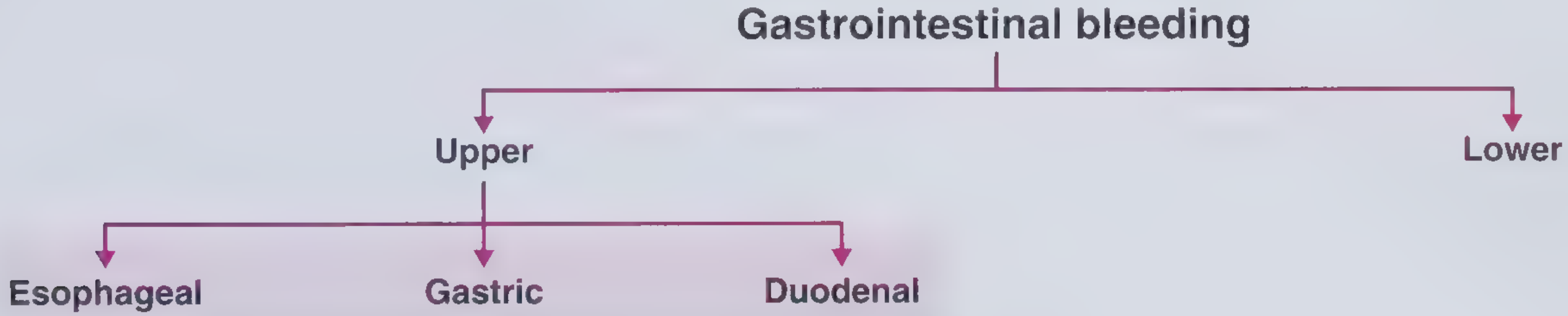
UGI bleeding is defined as hemorrhage originating proximal to the ligament of Treitz (esophagus, stomach, or duodenum). Annual incidence: 39-172 per 100,000 in Western countries. Mortality: 5-10% for severe UGI bleeding, unchanged since the 1970s - not because treatments have failed, but because more patients now are elderly with major comorbidities and cirrhotic disease.
Causes
| Cause | Frequency (UCLA CURE Database, n=968) |
|---|---|
| Peptic ulcer disease | ~35-40% |
| Esophageal/gastric varices | ~22% |
| Portal HTN-related lesions | ~5% |
| Esophagitis | ~5% |
| Angioectasia | ~4% |
| Mallory-Weiss tear | ~4% |
| Dieulafoy lesion | ~3% |
| UGI neoplasm | ~3% |
| Erosions | ~1% |
| No cause found | ~7% |
- Sleisenger & Fordtran's GI and Liver Disease, p. 304
Key mechanism reminders:
- PUD - most common cause; linked to H. pylori, NSAIDs, aspirin. Bleeding arises from erosion into submucosal/muscular arteries (mean diameter ~0.7 mm).
- Varices - portosystemic collaterals from portal HTN; in cirrhotics, varices cause 59% of UGI bleeds.
- Mallory-Weiss - longitudinal mucosal tear at the gastroesophageal junction from forceful retching/vomiting, Valsalva maneuver, alcohol binge.
- Dieulafoy lesion - aberrant submucosal artery protruding through mucosa; 80-95% within 6 cm of the GEJ on the lesser curvature.
- Stress ulcers/erosive gastritis - sepsis, trauma, mechanical ventilation, NSAIDs, alcohol.
Clinical Presentation
| Presentation | Significance |
|---|---|
| Hematemesis (bright red or coffee-ground) | Blood proximal to ligament of Treitz |
| Melena (black, tarry stool) | Digested blood; as little as 50-100 mL can cause melena |
| Hematochezia | Usually LGI, but massive UGI bleed can present this way |
| Elevated BUN:Cr ratio | Digested blood absorbed as protein raises BUN; ratio >20:1 suggests UGI source |
| Syncope, presyncope | Hemodynamic compromise |
Initial Assessment & Risk Stratification
Pre-endoscopy Scoring Systems
Glasgow-Blatchford Score (GBS) - uses pre-endoscopy variables:
- Systolic BP, BUN, hemoglobin, heart rate, syncope, melena, liver disease, heart failure
- Score 0 = very low risk (can be managed outpatient)
- Best for identifying patients who need intervention
AIMS65 Score (5 variables, 1 point each):
- Albumin <3.0 g/dL
- INR >1.5
- Altered mental status
- Systolic BP <90 mmHg
- Age >65
- Score <2 = lower mortality risk
Clinical Rockall Score (pre-endoscopy): age, shock, comorbidities
High-risk features (Tintinalli's Emergency Medicine):
| Very Low Risk | High Risk |
|---|---|
| Age <60, no comorbidities | Advanced age, major comorbidities |
| No hematemesis | Red hematemesis |
| Hemodynamically stable | Hemodynamic instability |
| Negative NG aspirate | Positive NG aspirate, red blood |
| Normal labs | Abnormal labs (anemia, elevated BUN) |
Initial Resuscitation
- Two large-bore IV lines (18G or larger)
- Fluid resuscitation - crystalloid initially; avoid over-transfusion (liberal transfusion worsens outcomes in variceal bleeding due to increased portal pressure)
- Blood transfusion - restrictive strategy: transfuse at Hb <7 g/dL (Hb <8 if cardiac disease or active variceal bleed)
- Massive transfusion protocol if in hemorrhagic shock
- Airway management - consider early intubation for massive hematemesis, encephalopathy, or inability to protect airway; note: intubation does not improve mortality and has risks
- Hold anticoagulants/antiplatelets - reverse if needed (e.g., PCC for warfarin, vitamin K)
- Correct coagulopathy - FFP if INR >1.5, platelets if <50,000
Nasogastric Tube / Lavage
- A positive aspirate (bloody, maroon, or coffee-ground) confirms UGI source
- A negative aspirate does NOT exclude UGI bleed (false-negative in ~23% due to intermittent bleeding, pyloric spasm)
- Room temperature water preferred for lavage
- NG tube placement does NOT provoke variceal bleeding (no evidence to support this concern)
- Tintinalli's Emergency Medicine, p. 538
Endoscopy
Timing:
- Perform upper endoscopy within 24 hours of presentation after resuscitation (most patients)
- Urgent (<12 hours): active hematemesis, hemodynamic instability despite resuscitation
- Can defer (>24 hours or outpatient): GBS = 0, stable, no high-risk features
Forrest Classification (Endoscopic Risk Stratification)
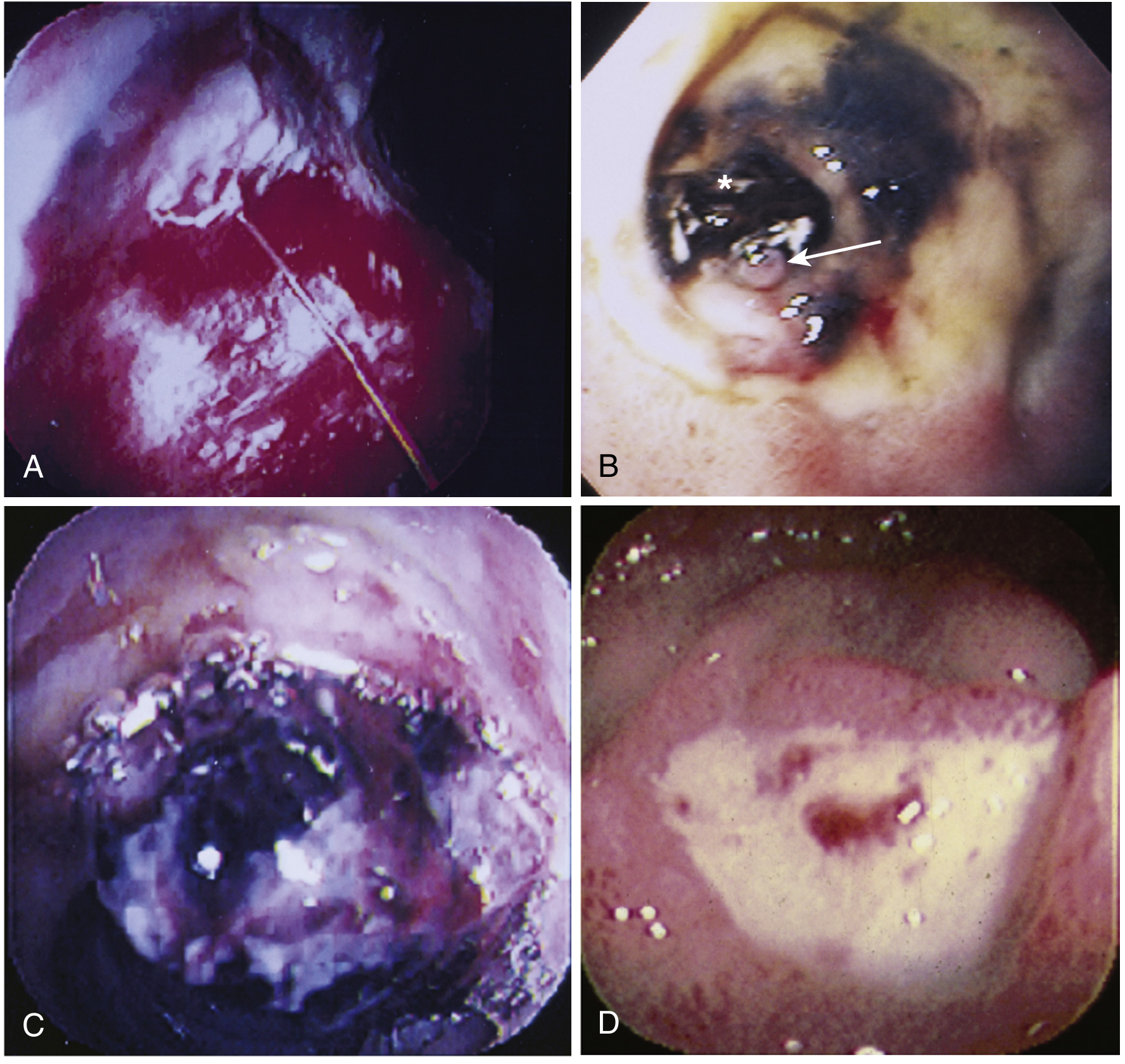
| Forrest Class | Finding | Rebleed Risk (untreated) |
|---|---|---|
| IA | Active spurting | ~90% |
| IB | Active oozing | ~10-20% |
| IIA | Non-bleeding visible vessel (NBVV) | ~50% |
| IIB | Adherent clot | ~33% |
| IIC | Flat pigmented spot | ~5-10% |
| III | Clean ulcer base | <5% |
- Forrest IA, IIA, IIB: require endoscopic hemostasis
- Forrest IIC and III: no endoscopic treatment needed; discharge on oral PPI
- Sleisenger & Fordtran's, p. 306
Endoscopic Hemostasis Techniques
- Injection therapy: epinephrine (1:10,000-20,000) - reduces arterial flow; always combine with a second modality
- Thermal therapy: multipolar electrocoagulation, heater probe, APC (argon plasma coagulation); direct pressure + coagulation to flatten the vessel
- Mechanical: hemoclips placed across the bleeding vessel/NBVV; very effective for Dieulafoy lesions and active arterial bleeders
- Combination therapy (epinephrine + thermal/clip): rebleeding reduced to ~15% vs 30% with monotherapy
Medical Management
Non-variceal Bleed (PPI)
- IV PPI bolus + infusion: omeprazole 80 mg IV bolus then 8 mg/hr x 72 hours (or equivalent)
- Raises intragastric pH >6, stabilizes clot formation
- Started empirically before endoscopy, confirmed/titrated after
- High-dose IV PPI for Forrest IA, IIA, IIB after endoscopic therapy
- Switch to oral PPI after 72 hours
Variceal Bleed (additional measures)
- Vasoconstrictors - octreotide (somatostatin analogue): 50 mcg IV bolus then 25-50 mcg/hr infusion; reduces portal blood flow; start immediately, continue 3-5 days
- Prophylactic antibiotics - ceftriaxone 1g IV daily x 7 days (or norfloxacin 400 mg BID); reduces bacterial infection and rebleeding mortality in cirrhosis
- Endoscopic band ligation (EBL) - preferred over sclerotherapy for acute esophageal varices
- Balloon tamponade (Sengstaken-Blakemore tube) - bridge therapy when endoscopy fails; high complication rate
- TIPS (Transjugular Intrahepatic Portosystemic Shunt) - rescue therapy for refractory variceal bleeding; also used early (within 72 hrs) in high-risk cirrhotics (Child-Pugh C or B with active bleeding)
- Non-selective beta-blocker (propranolol/nadolol or carvedilol) - secondary prophylaxis after acute episode
- Frameworks for Internal Medicine, p. 218
Rebleeding & Failure of Endoscopy
If endoscopy fails (persistent active bleeding or rebleed):
- Repeat endoscopy - second-look endoscopy in high-risk patients; can attempt hemostasis again
- Interventional radiology - angiography with transcatheter arterial embolization (TAE); for non-variceal bleeding not amenable to endoscopy
- Surgery - increasingly rare but still needed for:
- Posterior duodenal ulcer eroding into the gastroduodenal artery
- Failed endoscopic + radiologic therapy
- Hemodynamic instability unable to be controlled
Post-Acute Management
- Test and treat H. pylori if PUD confirmed (eradication markedly reduces recurrence)
- Avoid NSAIDs; if unavoidable, use with PPI cover
- Continue PPI orally (at least 4-8 weeks for PUD)
- Repeat endoscopy in 6-8 weeks for gastric ulcers (to confirm healing and exclude malignancy)
- Variceal bleed survivors: start beta-blocker + repeat EBL every 1-4 weeks until variceal eradication; consider TIPS evaluation
Prognosis
- Bleeding is self-limited in 80% without specific therapy
- Of the 20% who rebleed or have persistent bleeding: mortality is 30-40%
- Predictors of poor outcome: active arterial bleeding at endoscopy, large ulcer (>2 cm), posterior duodenal wall location, Hb <10, hemodynamic instability, age >65, cirrhosis, renal failure
- Sleisenger & Fordtran's, p. 304-305
Sources: Sleisenger & Fordtran's Gastrointestinal and Liver Disease | Tintinalli's Emergency Medicine | Frameworks for Internal Medicine | Goldman-Cecil Medicine
This is a shared conversation. Sign in to Orris to start your own chat.