
Triangle of doom
Searching the Web
triangle of doom meaning
This is a medical/anatomical topic. Let me pull up the full details from the medical library.
Reading File
Finding Sources
Finding Sources
Good - rich content in Fischer's Mastery of Surgery. Let me read the key sections.
Reading File
Reading File
Reading File
Loading Image
Excellent - I have everything needed for a complete answer. Here it is:
Triangle of Doom
The triangle of doom is a surgically critical anatomical region in the posterior inguinal/pelvic area, visible during laparoscopic hernia repair from the preperitoneal perspective. It earns its name because inadvertent dissection or fixation (clips, tacks, sutures) within it can cause life-threatening hemorrhage.
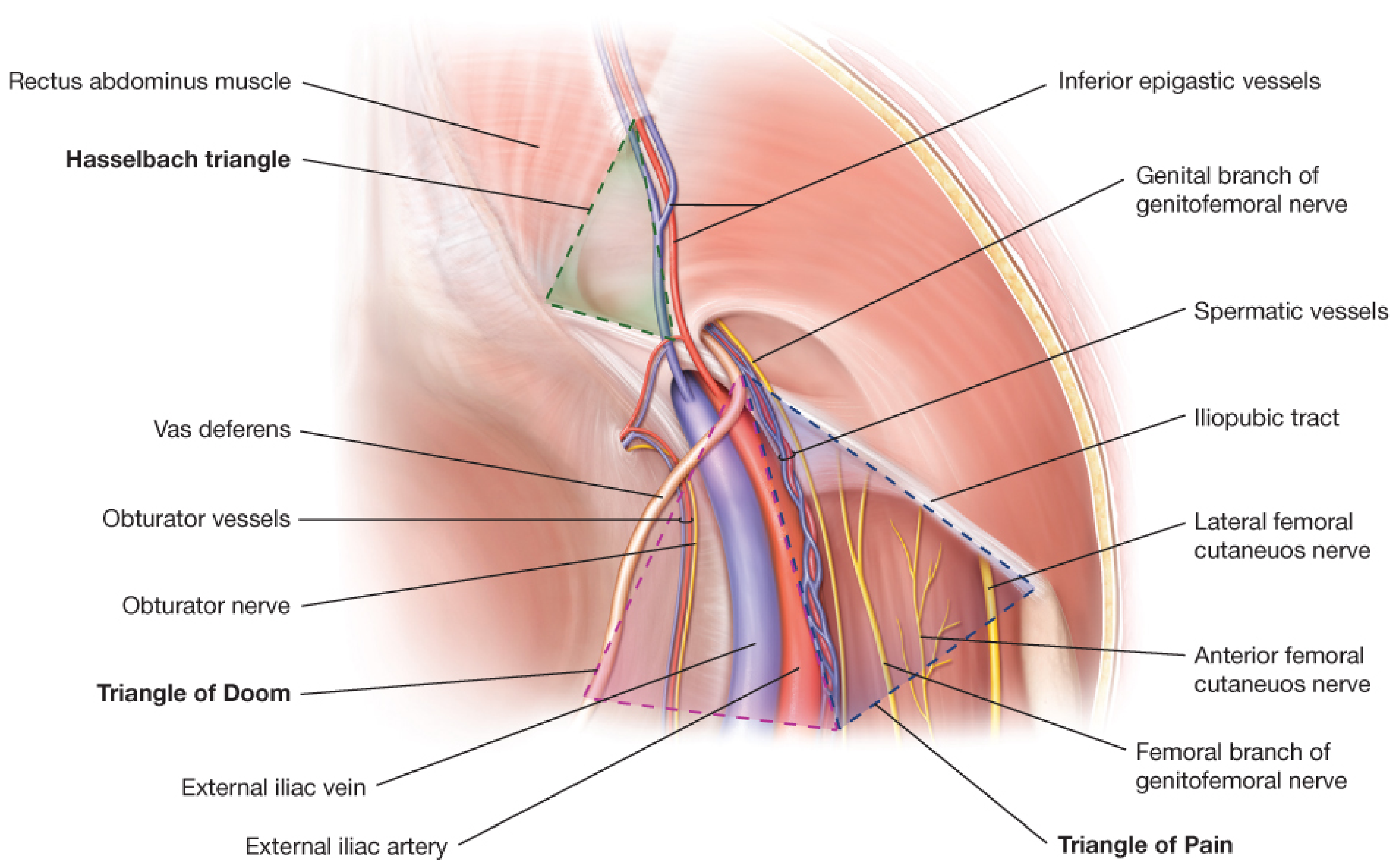
Boundaries
The triangle lies below the iliopubic tract, in Zone 3 of the myopectineal orifice:
| Boundary | Structure |
|---|---|
| Medial | Vas deferens (ductus deferens) in males; round ligament in females |
| Lateral | Testicular (gonadal) vessels |
| Inferior | Cut edge of the peritoneal fold |
The two sides converge toward the internal inguinal ring, where the vas deferens and testicular vessels approach each other.
Contents - Why It's Dangerous
- External iliac artery
- External iliac vein
- Femoral nerve (also present)
- Anomalous aberrant obturator vessels may occasionally be present (linking the internal iliac to the obturator artery - a "corona mortis" variant)
Any suture, tack, or clip placed inside this triangle risks major vascular injury and significant hemorrhage. The inferior epigastric vessels also lie just medial to the internal ring, immediately deep to the transversalis fascia.
Sex Difference
- Males: both the vas deferens and testicular vessels form well-defined triangle boundaries converging at the internal ring - the triangle is clearly defined
- Females: the round ligament approaches the internal ring medially, but no vessels of significance approach it laterally, so the triangle is less well-demarcated clinically
Clinical Relevance - Laparoscopic Hernia Repair
During TAPP (Transabdominal Pre-Peritoneal) and TEP (Totally Extraperitoneal) inguinal hernia repair, mesh fixation must be kept above and anterior to the iliopubic tract to avoid both the triangle of doom and its lateral neighbor, the triangle of pain (which contains the lateral femoral cutaneous, femoral, and genitofemoral nerves).
"Fixation placed below this tract and lateral to the ductus deferens may cause vascular or nerve injury respectively." - Fischer's Mastery of Surgery, 8th ed.
The two triangles together form a parallelogram shape in the preperitoneal view. Identifying and respecting both is a core part of the "critical view of the myopectineal orifice" - the laparoscopic equivalent of the critical view of safety in cholecystectomy.
Comparison: Triangle of Doom vs. Triangle of Pain
| Feature | Triangle of Doom | Triangle of Pain |
|---|---|---|
| Zone | Zone 3 (medial) | Zone 1 (lateral) |
| Medial border | Vas deferens | Testicular vessels |
| Lateral border | Testicular vessels | ASIS / psoas region |
| Superior border | - | Iliopubic tract |
| Inferior border | Peritoneal fold | Peritoneal fold |
| Contents | External iliac a. & v., femoral nerve | Lateral femoral cutaneous n., genitofemoral n., femoral n. |
| Risk if violated | Hemorrhage | Chronic neuropathic pain, dysesthesia |
Sources: Fischer's Mastery of Surgery, 8th ed.; General Anatomy and Musculoskeletal System, THIEME Atlas; Schwartz's Principles of Surgery, 11th ed.
This is a shared conversation. Sign in to Orris to start your own chat.