
Renal replacement therapy
"renal replacement therapy" AND "acute kidney injury"
renal replacement therapy modalities hemodialysis hemofiltration CRRT diagram
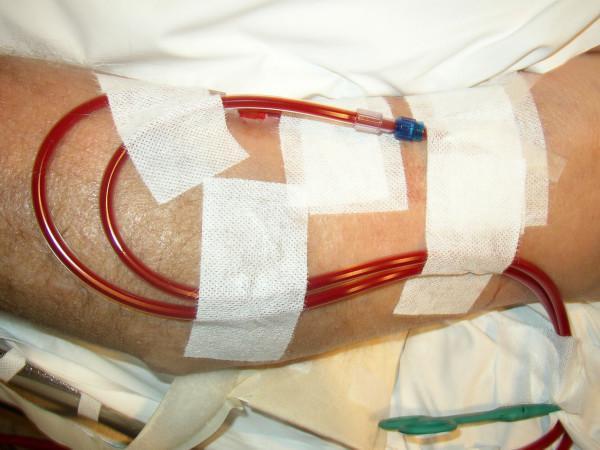
A clinical photograph of a human forearm showing the setup for hemodialysis or continuous venovenous hemofiltration (CVVH). Two large-bore (15-gauge) cannulas are inserted into an arteriovenous (AV) fistula. The tubing is filled with blood, appearing as dark red columns within the translucent flexible plastic. The catheters are secured to the limb using a systematic arrangement of white rectangular gauze pads and medical adhesive tape. One visible connector features a clear Luer lock housing with a blue-coded hub. The tubes run parallel to each other across the arm before looping towards the dialysis machine. This procedural image demonstrates vascular access management and stabilization techniques used in renal replacement therapy. The orientation shows a typical clinical setting for a patient undergoing high-flow extracorporeal blood purification.
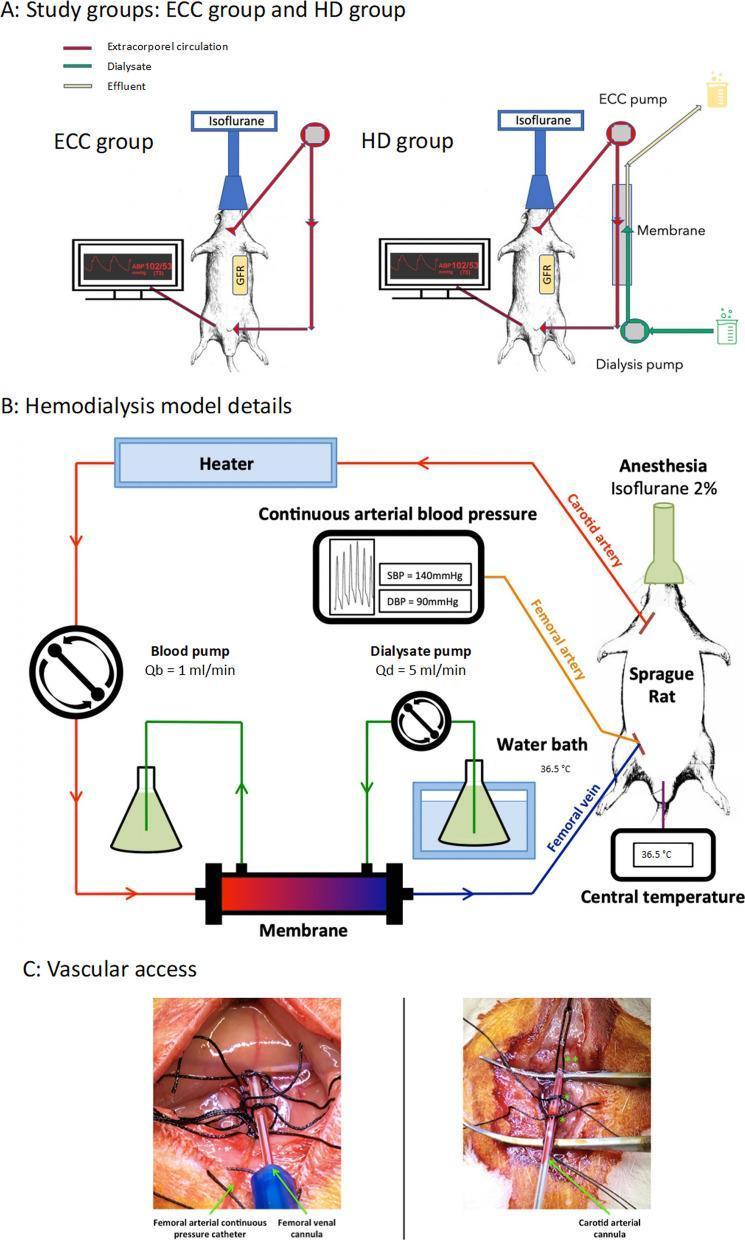
This composite educational graphic details a preclinical experimental model for renal replacement therapy using Sprague-Dawley rats. Section A presents a comparative diagram of the Extracorporeal Circulation (ECC) group versus the Hemodialysis (HD) group. The ECC circuit (red lines) involves a carotid-to-femoral shunt driven by an ECC pump. The HD group adds a semipermeable membrane and a counter-current dialysate circuit (green lines) driven by a secondary pump. Section B provides an expanded schematic of the hemodialysis circuit, detailing specific parameters: 2% isoflurane anesthesia, blood flow (Qb) at 1 ml/min, dialysate flow (Qd) at 5 ml/min, and temperature regulation via heater and water bath (36.5°C). Real-time monitoring of Arterial Blood Pressure (ABP) and Glomerular Filtration Rate (GFR) is indicated. Section C includes clinical photographs of the surgical vascular access sites, illustrating the catheterization of the carotid artery for arterial blood output and the femoral vein for return, along with a femoral arterial pressure catheter. This material demonstrates the technical setup for studying renal pathophysiology and dialytic efficacy in a rodent model.
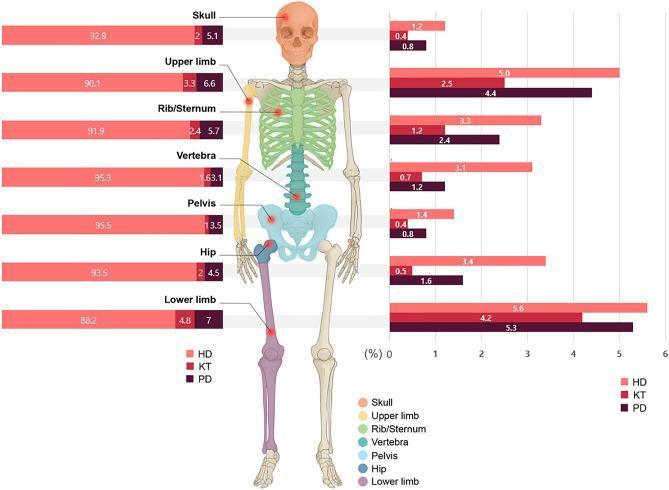
A multi-panel medical infographic illustrating the relationship between fracture anatomical sites and kidney replacement therapy (KRT) modalities: Hemodialysis (HD), Kidney Transplant (KT), and Peritoneal Dialysis (PD). The central element is a color-coded human skeletal diagram highlighting seven anatomical regions: skull, upper limb, rib/sternum, vertebra, pelvis, hip, and lower limb. The left panel features horizontal stacked bar charts showing the proportion (%) of each KRT modality within specific fracture cohorts, demonstrating that HD patients consistently comprise the vast majority (approx. 88-95%) of patients at every fracture site. The right panel displays clustered horizontal bar graphs showing the frequency (%) of fractures at each site stratified by modality. This data indicates that the HD group has the highest fracture frequency across all sites compared to PD and KT, with the upper and lower limbs being the most frequent sites of injury. This comparison chart serves as a clinical epidemiology resource for understanding bone mineral disorders and fracture risk in end-stage kidney disease (ESKD) populations.
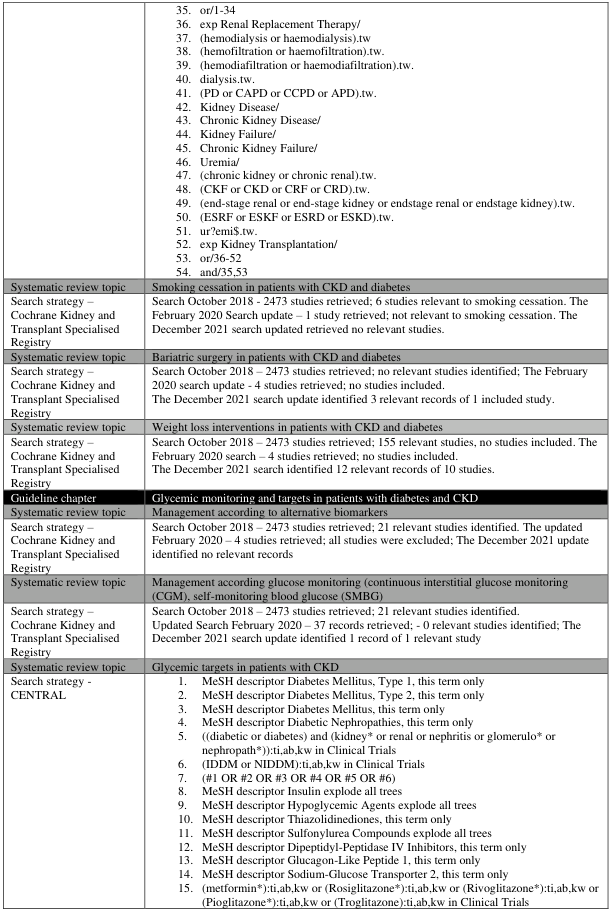
<table><thead><tr><td></td><td>35. or/1-34<br>36. exp Renal Replacement Therapy/<br>37. (hemodialysis or haemodialysis).tw.<br>38. (hemofiltration or haemofiltration).tw.<br>39. (hemodiafiltration or haemodiafiltration).tw.<br>40. dialysis.tw.<br>41. (PD or CAPD or CCPD or APD).tw.<br>42. Kidney Disease/<br>43. Chronic Kidney Disease/<br>44. Kidney Failure/<br>45. Chronic Kidney Failure/<br>46. Uremia/<br>47. (chronic kidney or chronic renal).tw.<br>48. (CKF or CKD or CRF or CRD).tw.<br>49. (end-stage renal or end-stage kidney or endstage renal or endstage kidney).tw.<br>50. (ESRF or ESKF or ESRD or ESKD).tw.<br>51. ur?emi$.tw.<br>52. exp Kidney Transplantation/<br>53. or/36-52<br>54. and/35,53</td></tr></thead><tbody><tr><td>Systematic review topic</td><td>Smoking cessation in patients with CKD and diabetes</td></tr><tr><td>Search strategy – Cochrane Kidney and Transplant Specialised Registry</td><td>Search October 2018 - 2473 studies retrieved; 6 studies relevant to smoking cessation. The February 2020 Search update - 1 study retrieved; not relevant to smoking cessation. The December 2021 search updated retrieved no relevant studies.</td></tr><tr><td>Systematic review topic</td><td>Bariatric surgery in patients with CKD and diabetes</td></tr><tr><td>Search strategy – Cochrane Kidney and Transplant Specialised Registry</td><td>Search October 2018 – 2473 studies retrieved; no relevant studies identified; The February 2020 search update - 4 studies retrieved; no studies included.<br>The December 2021 search update identified 3 relevant records of 1 included study.</td></tr><tr><td>Systematic review topic</td><td>Weight loss interventions in patients with CKD and diabetes</td></tr><tr><td>Search strategy – Cochrane Kidney and Transplant Specialised Registry</td><td>Search October 2018 – 2473 studies retrieved; 155 relevant studies, no studies included. The February 2020 search – 4 studies retrieved; no studies included.<br>The December 2021 search identified 12 relevant records of 10 studies.</td></tr><tr><td>Guideline chapter</td><td>Glycemic monitoring and targets in patients with diabetes and CKD</td></tr><tr><td>Systematic review topic</td><td>Management according to alternative biomarkers</td></tr><tr><td>Search strategy – Cochrane Kidney and Transplant Specialised Registry</td><td>Search October 2018 – 2473 studies retrieved; 21 relevant studies identified. The updated February 2020 – 4 studies retrieved; all studies were excluded; The December 2021 update identified no relevant records</td></tr><tr><td>Systematic review topic</td><td>Management according glucose monitoring (continuous interstitial glucose monitoring (CGM), self-monitoring blood glucose (SMBG)</td></tr><tr><td>Search strategy – Cochrane Kidney and Transplant Specialised Registry</td><td>Search October 2018 – 2473 studies retrieved; 21 relevant studies identified.<br>Updated Search February 2020 – 37 records retrieved; - 0 relevant studies identified; The December 2021 search update identified 1 record of 1 relevant study</td></tr><tr><td>Systematic review topic</td><td>Glycemic targets in patients with CKD</td></tr><tr><td>Search strategy - CENTRAL</td><td>1. MeSH descriptor Diabetes Mellitus, Type 1, this term only<br>2. MeSH descriptor Diabetes Mellitus, Type 2, this term only<br>3. MeSH descriptor Diabetes Mellitus, this term only<br>4. MeSH descriptor Diabetic Nephropathies, this term only<br>5. ((diabetic or diabetes) and (kidney* or renal or nephritis or glomerulo* or nephropath*)):ti,ab,kw in Clinical Trials<br>6. (IDDM or NIDDM):ti,ab,kw in Clinical Trials<br>7. (#1 OR #2 OR #3 OR #4 OR #5 OR #6)<br>8. MeSH descriptor Insulin explode all trees<br>9. MeSH descriptor Hypoglycemic Agents explode all trees<br>10. MeSH descriptor Thiazolidinediones, this term only<br>11. MeSH descriptor Sulfonylurea Compounds explode all trees<br>12. MeSH descriptor Dipeptidyl-Peptidase IV Inhibitors, this term only<br>13. MeSH descriptor Glucagon-Like Peptide 1, this term only<br>14. MeSH descriptor Sodium-Glucose Transporter 2, this term only<br>15. (metformin*):ti,ab,kw or (Rosiglitazone*):ti,ab,kw or (Rivoglitazone*):ti,ab,kw or (Pioglitazone*):ti,ab,kw or (Troglitazone*):ti,ab,kw in Clinical Trials</td></tr></tbody></table>
Renal Replacement Therapy (RRT)
Definition and Overview
Mechanisms of Solute Clearance
| Mechanism | Principle | Best For |
|---|---|---|
| Diffusion | Concentration gradient across a semipermeable membrane | Small molecules (<1 kDa): urea, creatinine, K⁺ |
| Convection | Hydrostatic pressure-driven ultrafiltration (solvent drag) | Water and medium-large molecules up to 50 kDa; fluid overload |
| Combined | Hemodiafiltration uses both mechanisms | Broad-spectrum clearance |
RRT Modalities
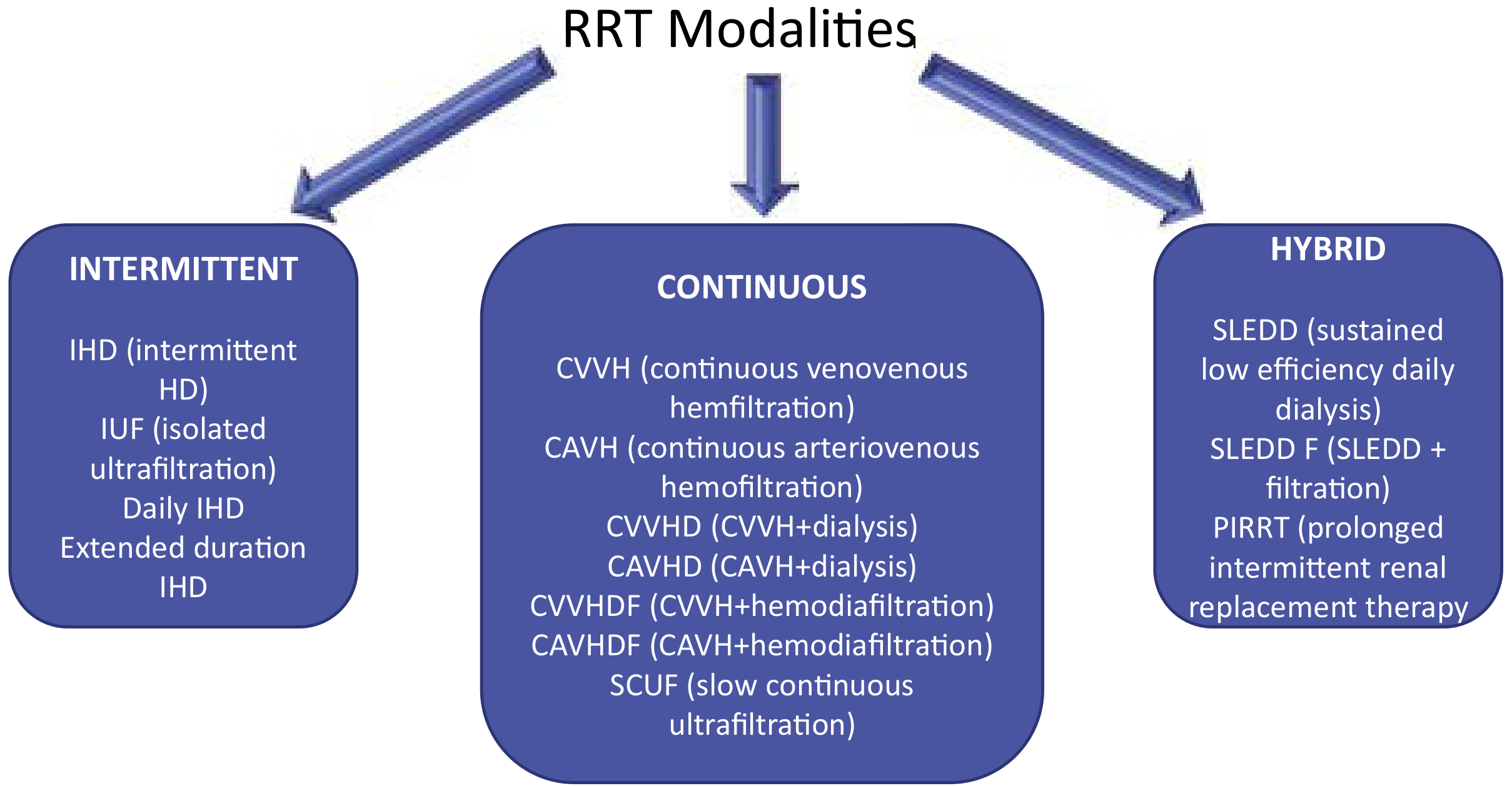
1. Intermittent Hemodialysis (IHD)
- Diffusive clearance; blood and dialysate flow in opposite directions (countercurrent)
- Typically 4-6 hours per session, 3-6 days/week
- Increases solute clearance by increasing blood flow rate or dialysate flow rate
- Best for hemodynamically stable patients
- Subtypes: IHD, isolated ultrafiltration (IUF), daily IHD, extended-duration IHD
2. Continuous RRT (CRRT)
- Runs 24 hours/day; best tolerated by hemodynamically unstable patients on vasopressors
- CRRT dose: Effluent flow targeted at 25 mL/kg/hour in critically ill AKI (Brenner & Rector)
- Venovenous approaches dominate (arteriovenous approaches abandoned due to bleeding risk):
- CVVH - continuous venovenous hemofiltration (convection only)
- CVVHD - continuous venovenous hemodialysis (diffusion only)
- CVVHDF - continuous venovenous hemodiafiltration (both)
- SCUF - slow continuous ultrafiltration (volume removal only)
- Preferred in: acute liver failure (reduces risk of cerebral edema/herniation), hemodynamic instability
3. Hybrid / Prolonged Intermittent RRT (PIRRT)
- Middle ground between IHD and CRRT
- Also called SLED (sustained low-efficiency daily dialysis) or SLEDD
- Typically runs 6-18 hours/day, every other day or daily
- More gradual volume/solute shifts than IHD; better hemodynamic tolerance
- When prescribed daily, closely resembles CRRT in clearance profile
4. Peritoneal Dialysis (PD)
- Catheter placed intraperitoneally; dextrose-containing fluid drives osmotic clearance
- Risk of peritonitis
- Not suitable for recent abdominal surgery; less effective in hypermetabolic critical illness
- Important in low- and middle-income countries (LMICs) where other modalities are unavailable
- Subtypes: CAPD (continuous ambulatory), CCPD (continuous cycling), APD (automated PD)
Indications for Initiating RRT
Classic / Emergency Indications (AEIOU mnemonic)
| Indication | Notes |
|---|---|
| Acidosis | Severe metabolic acidosis (pH <7.15-7.25) refractory to medical management |
| Electrolyte disturbance | Hyperkalemia refractory to conservative therapy |
| Ingestion / overdose | Drug overdose of dialyzable toxins |
| Overload (fluid) | Refractory pulmonary edema, volume overload unresponsive to diuretics |
| Uremia | Uremic symptoms (pericarditis, encephalopathy, bleeding); BUN typically >100-140 mg/dL |
Timing: Early vs. Late Initiation
- Early initiation (Stage 2 AKI): One single-center cardiac surgery trial found lower mortality (39.3% vs 54.7%) and higher renal recovery at 90 days with early RRT, but 90% of delayed patients also received RRT eventually, and the difference in time was only 21 hours - so results should be interpreted with caution.
- Multiple large RCTs (including IDEAL-ICU, AKIKI, STARRT-AKI trials) found no mortality benefit to early vs. delayed RRT. Importantly, in the IDEAL-ICU trial, 29% of patients in the delayed arm recovered and never needed RRT - highlighting the danger of over-initiating.
- Current guidance: Initiate promptly when absolute indications exist; do NOT delay until a mandatory life-threatening indication; do NOT preemptively start RRT in AKI patients who may spontaneously recover.
Choice of Modality
| Clinical Situation | Preferred Modality |
|---|---|
| Hemodynamically stable | IHD or PIRRT/SLED |
| Hemodynamically unstable (on vasopressors) | CRRT |
| Acute liver failure | CRRT (reduces cerebral edema risk) |
| Recent abdominal surgery | IHD or CRRT (avoid PD) |
| LMIC settings with limited resources | Peritoneal dialysis |
| Volume removal only | SCUF |
Anticoagulation in CRRT
- Regional citrate anticoagulation (RCA) - preferred; citrate chelates ionized calcium in the circuit; calcium is replaced post-filter systemically
- Systemic heparin - effective but increases bleeding risk; relevant concern in postoperative patients
- Regional heparin with protamine reversal - alternative but less used
- RCTs comparing citrate vs. heparin show citrate has at least equivalent efficacy with fewer bleeding complications
Intensity / Dose of RRT
- Higher ultrafiltration doses in CRRT studies (e.g., ATN trial at 20 vs 35 mL/kg/hr; RENAL trial at 25 vs 40 mL/kg/hr) showed no mortality benefit with higher intensity
- Target: Effluent flow of 25 mL/kg/hour for CRRT in ICU patients
- Increased dose has even shown some untoward effects in some trials
- Prescribed dose is often not the delivered dose - circuit downtime means actual delivered dose is lower
Vascular Access
- Double-lumen, large-bore central venous catheter (dialysis catheter / Mahurkar / Vascath)
- Preferred sites: right internal jugular > femoral > left internal jugular > subclavian
- Subclavian avoided when possible due to risk of subclavian vein stenosis (compromises future AV fistula)
- For chronic HD: arteriovenous fistula (AVF) is preferred over AV graft or tunneled catheter
Drug Dosing in RRT
- Small, water-soluble, low-protein-bound drugs are most cleared by dialysis
- Vancomycin, aminoglycosides, many antibiotics require dose adjustment
- Lipid-soluble, highly protein-bound drugs (e.g., most benzodiazepines) are poorly dialyzed
- Dosing must be tailored to the specific RRT modality in use (IHD vs CRRT have very different clearance profiles)
RRT in Chronic Kidney Disease / ESRD
- Dialysis generally initiated when GFR <10 mL/min (earlier in diabetics if volume-dependent hypertension or hyperkalemia is uncontrollable)
-
80% of ESRD patients receive dialysis; ~5:1 ratio of hemodialysis to peritoneal dialysis (Goldman-Cecil Medicine)
- ~25% of renal transplants in the US are performed in diabetic patients
- Transplantation is the preferred long-term modality - superior survival vs. all dialysis modalities:
- 5-year survival: 96% (transplant) vs. 83% (PD) vs. 81% (HD) - Brenner & Rector
- Transplanted children have adjusted relative risk of death = 0.26 vs. those remaining on dialysis
Complications of Chronic Dialysis
| Complication | Notes |
|---|---|
| Cardiovascular disease | Most common cause of death in dialysis patients |
| Dialysis-related amyloidosis | β₂-microglobulin deposition; carpal tunnel, joint pain |
| Arteriovenous access failure | Thrombosis, stenosis, infection |
| Intradialytic hypotension | Rapid fluid/solute shifts; risk of prolonging AKI |
| Peritonitis (PD) | Major complication; gram-positive organisms most common |
| Hyperphosphatemia / renal osteodystrophy | Secondary hyperparathyroidism |
| Anemia | EPO deficiency; treated with erythropoiesis-stimulating agents |
Outcomes After AKI Requiring RRT
- AKI mortality averages ~23%; Medicare 90-day mortality post-discharge reaches 35% for AKI patients
- Most common cause of death is cardiovascular
- Risk of CKD progression, renal malignancy, hypertension, and stroke all increased
- Recovery defined: early (<7 days post-AKI), late (7-90 days); failure to recover at 90 days = CKD
- All AKI patients should have rapid post-discharge nephrology follow-up (Current Surgical Therapy, 14e)
- Brenner and Rector's The Kidney, 2-Volume Set - ICU RRT chapter
- Current Surgical Therapy, 14e - Renal Support Therapy
- Miller's Anesthesia, 10e - Perioperative RRT
- Goldman-Cecil Medicine - Diabetic nephropathy and ESRD management
- Harrison's Principles of Internal Medicine, 22e - Renal indications in critical illness