
Fineness
Fineness refers to the purity of a precious metal, expressed as parts per thousand. For example, 999 fineness means 99.9% pure gold. It is also used in textiles to describe the diameter/count of fibers (e.g., wool micron count), and in materials science to describe particle size.
Searching sources...
Searching the Web
fineness definition meaning precious metals textiles
The word fineness has several distinct meanings depending on context. Here is a breakdown:
Fineness - Meanings & Contexts
1. General Meaning
The state or quality of being fine - meaning delicate, refined, or high quality. Used in everyday English to describe subtlety, precision, or excellence (e.g., "the fineness of the craftsmanship").
2. Precious Metals (Most Common Technical Use)
Millesimal fineness is the standard system for expressing the purity of gold, silver, platinum, and palladium alloys. It represents the parts per thousand of pure metal in an alloy.
| Fineness | Purity | Common Name |
|---|---|---|
| 999 | 99.9% | Fine gold / Fine silver |
| 999.9 | 99.99% | Four-nines gold |
| 750 | 75% | 18-karat gold |
| 585 | 58.5% | 14-karat gold |
| 375 | 37.5% | 9-karat gold |
| 925 | 92.5% | Sterling silver |
| 950 | 95% | Platinum standard |
- It is an extension of the older karat system (fractions of 24). For example, 18 karat = 18/24 = 75% = fineness 750.
- Many European countries stamp items with millesimal marks (e.g., "585", "750") rather than karat designations.
- Fineness affects a metal's value, hardness, color, and eligibility for investment accounts (e.g., gold IRAs typically require .995 or higher).
3. Textiles & Fibers
In textile science, fineness describes how thin or fine a fiber or yarn is:
- For wool, fineness is measured in microns (fiber diameter) - lower microns = finer wool (e.g., Merino wool at 15-24 microns).
- For yarn, it is expressed as a count (number of units of length per unit of weight). Different systems exist: Tex, Denier, English count, etc.
4. Particle/Powder Science
In materials science and cement/milling industries, fineness refers to the particle size distribution of a powder. Finer particles have greater surface area and different reactivity (e.g., "cement fineness" measured by the Blaine test in cm²/g).
5. Currency / Coinage
Historically, the fineness of a coin determined its intrinsic worth. A coin with higher fineness contained more pure metal relative to base metal alloys added for durability.
Could you let me know which context you're most interested in? I can go deeper into precious metals standards, textile measurement systems, materials science applications, or the general linguistic usage.
Fineness in medical
Reading File
"Fineness" in a medical context could mean a few different things - fiber fineness in pathology (e.g., nerve fibers, collagen), dental fineness, or a clinical descriptor. Let me search the textbooks to find the most relevant medical usage.
Searching sources...
Finding Sources
Searching the Web
fineness medical definition clinical usage pathology
The textbooks gave excellent results. Let me read the key passages for full context.
Reading File
Reading File
Reading File
Reading File
Excellent - I now have rich textbook content on all medical uses of "fineness." Here is a thorough answer:
Fineness in Medicine
In medical and biomedical science, "fineness" appears across several distinct domains. The medical textbooks identify these key usages:
1. Fineness of Motor Control (Neuroscience / Physiology)
This is the most prominent medical use. Fineness of muscle control refers to how precisely and smoothly a muscle can be activated - i.e., the granularity of force modulation.
Mechanism - Innervation Number:
Each motor neuron innervates a group of muscle fibers called a motor unit. The innervation number (number of muscle fibers per motor neuron) directly determines fineness of control:
"The innervation number also indicates the fineness of control of the muscle at low forces; the smaller the innervation number, the finer the control achieved by varying the number of activated motor units."
- Kandel, Principles of Neural Science, 6th Ed.
| Muscle | Avg. Innervation Number | Fineness of Control |
|---|---|---|
| Rectus lateralis (eye) | 5 | Very fine (precise eye movements) |
| Tensor tympani | 8 | Very fine |
| Lumbricales | 107 | Fine |
| Tibialis anterior | 613 | Moderate |
| Gastrocnemius (medial) | 1,800 | Coarse (power, not precision) |
- Muscles requiring precise, fine movements (e.g., extraocular muscles, hand intrinsics) have very small innervation numbers.
- Muscles for gross power (e.g., gastrocnemius) have large innervation numbers and coarser control.
Clinical relevance - Poliomyelitis:
When some motor neurons are destroyed (e.g., in polio), surviving nerve fibers sprout new axons that innervate the paralyzed fibers, forming macromotor units:
"Formation of these large motor units decreases the fineness of muscle control but allows the muscles to regain varying degrees of strength."
- Guyton & Hall, Medical Physiology
This is why polio survivors may recover functional strength but lose fine motor precision.
2. Fineness of Sensory Discrimination (Neuroanatomy / Cortex)
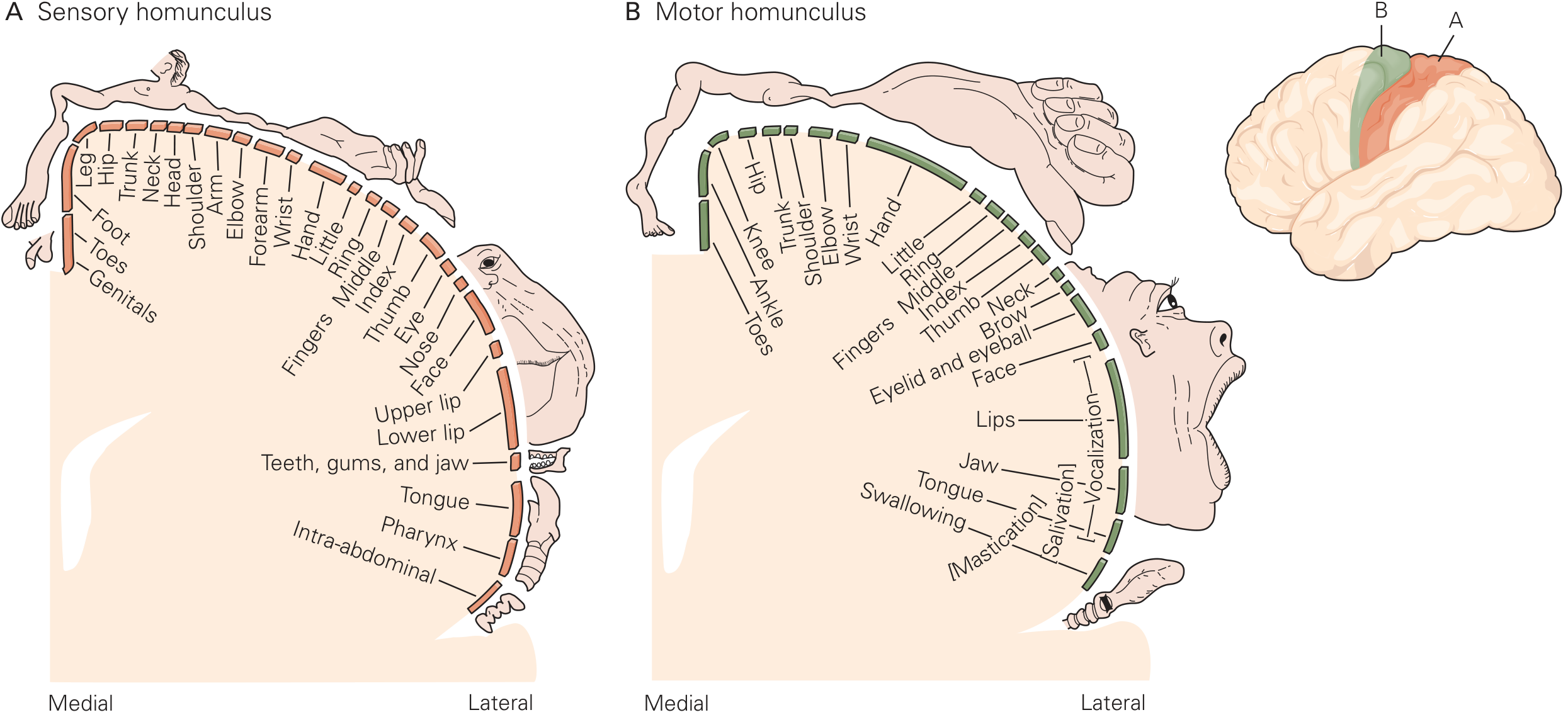
The concept also applies to somatosensory cortex organization. The amount of cortical surface area devoted to each body part is NOT proportional to the body part's size - it is proportional to the fineness of sensory discrimination required:
"The amount of surface area of cortex devoted to each body part is not proportional to its mass. Instead, it is proportional to the fineness of discrimination in the body part, which in turn is related to the density of innervation of sensory fibers."
- Kandel, Principles of Neural Science, 6th Ed.
This is why the homunculus (cortical map) shows disproportionately large representations of the fingers, lips, and tongue - body parts with the finest sensory discrimination - and smaller representations of the back or legs.
3. Fineness of Dust (Occupational & Preventive Medicine)
In pneumoconiosis (dust-related lung diseases), fineness refers to the particle size of inhaled dust - a major determinant of lung toxicity:
"The hazardous effects of dusts on the lungs depend upon a number of factors such as (a) chemical composition (b) fineness (c) concentration of dust in the air (d) period of exposure and (e) health status of the person exposed."
- Park's Textbook of Preventive and Social Medicine
- Dust in the size range of 0.5 to 3 microns is most hazardous because it penetrates deep into the alveoli and causes lung fibrosis.
- Finer (smaller) particles are MORE dangerous as they evade mucociliary clearance and reach the alveolar surface.
- This is the basis for threshold limit values (TLVs) being different for different dusts.
- Relevant diseases: Silicosis, Asbestosis, Anthracosis, Byssinosis, Bagassosis, Farmer's Lung.
4. Red Nucleus & Motor Control (Neurophysiology)
The red nucleus (in the brainstem) also participates in motor control, but with less fineness than the motor cortex:
"The fineness of representation of the different muscles is far less developed than in the motor cortex, especially in human beings, who have relatively small red nuclei."
- Guyton & Hall, Medical Physiology
This explains why the corticospinal (pyramidal) system governs fine voluntary movements, while the rubrospinal tract (from the red nucleus) handles more gross limb movements.
Summary Table
| Context | What "Fineness" Means | Key Determinant |
|---|---|---|
| Motor control | Precision of force grading in a muscle | Innervation number (motor unit size) |
| Sensory cortex | Precision of tactile/spatial discrimination | Density of sensory fiber innervation |
| Occupational medicine | Particle size of inhaled dust | Micron size (0.5-3 µm most hazardous) |
| Red nucleus vs. cortex | Degree of precise muscle representation | Relative size of red nucleus |
This is a shared conversation. Sign in to Orris to start your own chat.