
FMGE oriented Integrated details notes on Yoke muscles. Write everything clearly and properly from FMGE toppers point of view. Don't leave any important point which can be asked in FMGE from this topic.
Reading File
Finding Sources
Finding Sources
Finding Sources
Reading File
Finding Sources
Finding Sources
Reading File
Finding Sources
Finding Sources
Loading Image
Loading Image
Finding Sources
I now have all the key content from Kanski's. Let me now compile the comprehensive FMGE-oriented notes.
FMGE Integrated Notes: Yoke Muscles (Ocular Motility)
Source: Kanski's Clinical Ophthalmology, 10th Ed.
1. DEFINITION
Yoke muscles (= contralateral synergists) are pairs of muscles, one from each eye, that work together to produce conjugate (same-direction) ocular movements.
Classic example: The yoke of the left superior oblique is the right inferior rectus.
2. EXTRAOCULAR MUSCLES - QUICK RECAP
There are 6 extraocular muscles per eye:
- 4 Recti: Superior rectus (SR), Inferior rectus (IR), Medial rectus (MR), Lateral rectus (LR)
- 2 Obliques: Superior oblique (SO), Inferior oblique (IO)
Nerve supply (HIGH YIELD for FMGE):
| Muscle | Nerve |
|---|---|
| LR | CN VI (Abducens) |
| SO | CN IV (Trochlear) |
| All others (SR, IR, MR, IO) | CN III (Oculomotor) |
Mnemonic: "LR6 SO4 rest 3"
3. POSITIONS OF GAZE
Diagnostic Positions of Gaze
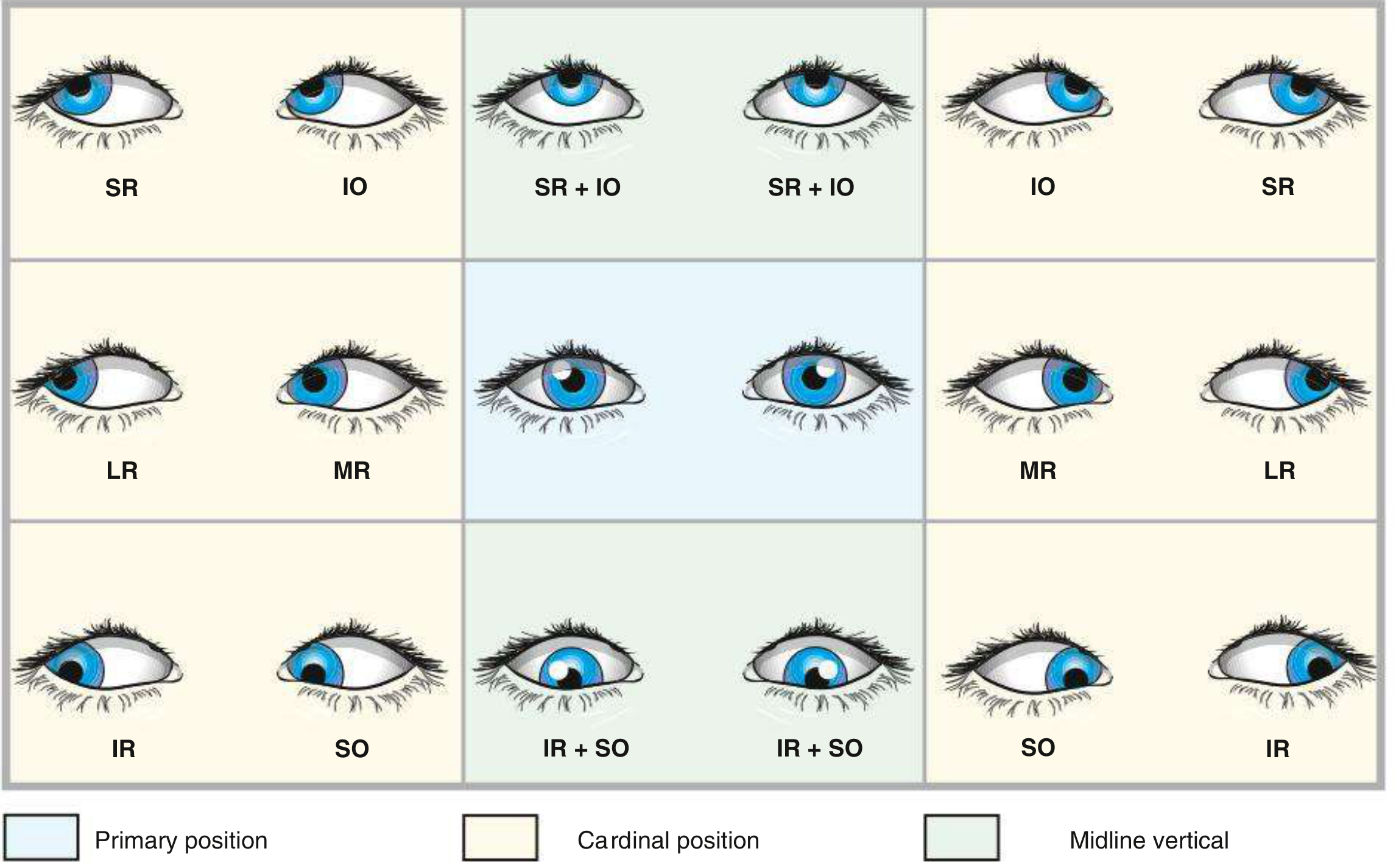
Fig. 18.10 - Kanski's: IO = inferior oblique; IR = inferior rectus; LR = lateral rectus; MR = medial rectus; SO = superior oblique; SR = superior rectus
- 9 diagnostic positions = 6 cardinal + primary position + elevation + depression
- 6 cardinal positions = the positions where ONE muscle per eye is primarily responsible
The 6 Cardinal Positions and Their Yoke Muscle Pairs (MOST IMPORTANT TABLE):
| Cardinal Position | Right Eye Muscle | Left Eye Muscle | Yoke Pair |
|---|---|---|---|
| Dextroversion (gaze right) | Right LR | Left MR | RLR - LMR |
| Laevoversion (gaze left) | Right MR | Left LR | RMR - LLR |
| Dextroelevation (right + up) | Right SR | Left IO | RSR - LIO |
| Laevoelevation (left + up) | Left SR | Right IO | LSR - RIO |
| Dextrodepression (right + down) | Right IR | Left SO | RIR - LSO |
| Laevodepression (left + down) | Left IR | Right SO | LIR - RSO |
FMGE pearl: "Which is the yoke of left SO?" = Right IR. "Yoke of right SR?" = Left IO.
4. TERMINOLOGY - TYPES OF MUSCLES
| Term | Definition | Example |
|---|---|---|
| Agonist | Primary mover in a given direction (same eye) | Right LR for rightward gaze |
| Antagonist | Moves in opposite direction to agonist (same eye) | Right MR is antagonist of Right LR |
| Synergist | Same eye, same direction of movement | Right SR + Right IO (both elevate) |
| Yoke muscle | Contralateral synergist; different eye, same direction | Right SR and Left IO |
5. THE TWO LAWS OF OCULAR MOTILITY (ULTRA HIGH-YIELD)
Law 1: Sherrington's Law of Reciprocal Innervation
- When innervation to an extraocular muscle increases, innervation to its ipsilateral antagonist decreases reciprocally
- Applies to both versions and vergences
- Example: When right MR contracts (adducts), right LR automatically relaxes
Mnemonic: Sherrington = Same eye (ipsilateral agonist-antagonist pair)
Law 2: Hering's Law of Equal Innervation
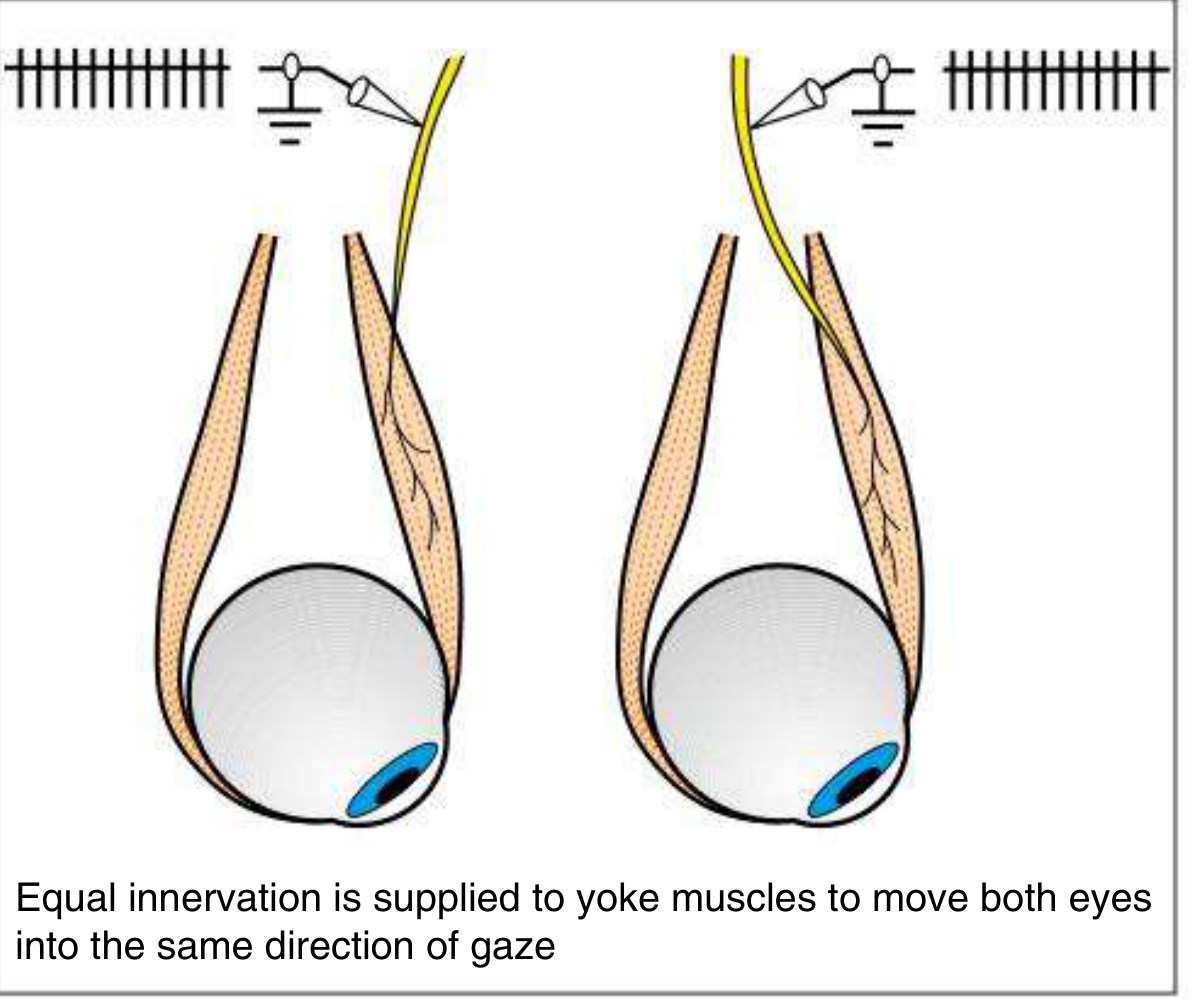
Equal innervation is supplied to yoke muscles to move both eyes into the same direction of gaze
- During any conjugate eye movement, equal and simultaneous innervation flows to both yoke muscles
- The amount of innervation is always determined by the fixating eye
Mnemonic: Hering = Horizontal pairing (contralateral / Heteronymous / Yoke pair)
6. PRIMARY vs. SECONDARY DEVIATION (FMGE FAVOURITE)
This is based on Hering's law applied to paretic squint:
Setup Example: Left Lateral Rectus Palsy
Primary deviation = angle of misalignment when the normal eye fixates
- Right (normal) eye fixates → left (paretic) eye deviates inward
- Smaller deviation
Secondary deviation = angle when the paretic eye fixates
- Left (paretic) LR forced to fixate → extra innervation sent to left LR
- By Hering's law → equal extra innervation goes to the yoke muscle = right MR
- Right MR over-acts → excessive adduction of right eye
- Larger deviation
FMGE key rule: Secondary deviation > Primary deviation in paretic (incomitant) squint In concomitant squint: primary = secondary deviation
7. MUSCLE SEQUELAE IN PARETIC SQUINT (Cascade of Changes)
Once a muscle is palsied (e.g., left SO palsy), the following sequence develops over time:
- Primary underaction - Paretic muscle (e.g., left SO) underacts
- Secondary overaction of contralateral yoke - Right IR overacts (Hering's law)
- Secondary overaction + contracture of ipsilateral antagonist - Left IO overacts/contracts (Sherrington's law)
- Secondary inhibition of contralateral antagonist - Right SR becomes inhibited (Hering + Sherrington laws)
This pattern is what the Hess chart demonstrates and is used to distinguish recent vs. longstanding palsy.
8. COMPLETE YOKE MUSCLE PAIRS TABLE (MASTER THIS)
| Direction of Gaze | Yoke Pair | Mnemonic Aid |
|---|---|---|
| Right gaze | R-LR + L-MR | Lateral moves right eye right; medial brings left eye right |
| Left gaze | L-LR + R-MR | |
| Up-right (dextroelevation) | R-SR + L-IO | SR depresses in abduction? No - SR elevates in abduction |
| Up-left (laevoelevation) | L-SR + R-IO | |
| Down-right (dextrodepression) | R-IR + L-SO | SO depresses in adduction |
| Down-left (laevodepression) | L-IR + R-SO |
9. ACTIONS OF EXTRAOCULAR MUSCLES (Foundation for Understanding Yokes)
| Muscle | Primary Action | Secondary Action | Tertiary Action |
|---|---|---|---|
| MR | Adduction | - | - |
| LR | Abduction | - | - |
| SR | Elevation | Intorsion | Adduction |
| IR | Depression | Extorsion | Adduction |
| SO | Intorsion | Depression | Abduction |
| IO | Extorsion | Elevation | Abduction |
FMGE pearl: SO is tested best when eye is adducted (depression test). SR is tested best when eye is abducted.
10. VERSIONS vs. VERGENCES
| Feature | Versions | Vergences |
|---|---|---|
| Definition | Conjugate (same direction) movements | Disjugate (opposite direction) movements |
| Examples | Dextroversion, laevoversion | Convergence, divergence |
| Hering's law | Applies | Applies |
| Sherrington's law | Applies | Applies |
| Yoke muscles | Active | Not applicable in the same sense |
11. CLINICAL APPLICATION - NERVE PALSIES AND YOKE PAIRS
CN VI (Abducens) Palsy - Right side
- Paretic muscle: Right LR
- Yoke muscle (over-acts when paretic eye fixates): Left MR
- Primary deviation: Esotropia (convergent squint)
- Secondary deviation > Primary deviation
CN IV (Trochlear) Palsy - Right side
- Paretic muscle: Right SO
- Yoke muscle: Left IR
- Characteristic: Hypertropia, head tilt to opposite side (Parks-Bielschowsky test)
- Most common isolated nerve palsy causing vertical diplopia
CN III (Oculomotor) Palsy
- Paretic muscles: SR, IR, MR, IO (+ ptosis, mydriasis)
- Yoke pairs affected: Multiple
12. HESS CHART - KEY FACTS FOR FMGE
- Used to identify which muscle is paretic and assess muscle sequelae
- Plots the 9 positions of gaze
- Smaller field = paretic eye (underaction)
- Larger field = contralateral eye (yoke overaction = secondary overaction)
- Used to distinguish recent vs. longstanding palsy
- Recent palsy: clear size difference between two fields
- Longstanding palsy: fields become more equal as contracture occurs
13. FMGE ONE-LINERS / HIGH-YIELD MNEMONICS
| Fact | Detail |
|---|---|
| Yoke = | Contralateral synergist |
| Sherrington's law = | Same eye agonist-antagonist (reciprocal) |
| Hering's law = | Yoke muscles get equal innervation |
| 2° deviation > 1° deviation | Only in paretic/incomitant squint |
| LR6, SO4, rest 3 | Nerve supply mnemonic |
| Yoke of LSO | Right IR |
| Yoke of RSR | Left IO |
| Yoke of LIR | Right SO |
| Yoke of RMR | Left LR |
| Best position to test SO | Eye adducted (depression in adduction) |
| Best position to test SR | Eye abducted (elevation in abduction) |
| Conjugate movements governed by | Hering's law |
| Head tilt test (Parks-Bielschowsky) | For CN IV palsy (SO palsy) |
| Most common cause of vertical diplopia | CN IV (Trochlear) palsy |
| Concomitant squint | Primary = Secondary deviation |
| Incomitant squint | Secondary > Primary deviation |
14. COMMON FMGE QUESTION PATTERNS
Q: Yoke of left superior oblique is?
A: Right inferior rectus (acting in dextrodepression / gaze down-right)
Q: Hering's law applies to?
A: Conjugate (version) movements - equal innervation to yoke muscle pairs
Q: In left LR palsy, patient fixes with paretic eye - what happens?
A: Over-innervation to L-LR → equal innervation to yoke (R-MR) → R-MR overacts → large esotropia (secondary deviation)
Q: Secondary deviation is greater than primary deviation in?
A: Incomitant (paralytic) squint
Q: Which law explains that when you contract the agonist, the antagonist relaxes?
A: Sherrington's law of reciprocal innervation
Q: In Hess chart, the smaller field represents?
A: The paretic (affected) eye
Q: Which muscle is the yoke of right medial rectus?
A: Left lateral rectus (laevoversion)
Source: Kanski's Clinical Ophthalmology: A Systematic Approach, 10th Ed., Chapter 18 - Strabismus
This is a shared conversation. Sign in to Orris to start your own chat.