
Give me a 10 marks answer about Venturi principle and it’s application for AIIMS md anaesthesia exams from standard textbooks
Reading File
Now let me search the medical library for Venturi principle and its anaesthesia applications.
Finding Sources
Finding Sources
Reading File
Reading File
Finding Sources
Reading File
Finding Sources
Finding Sources
Reading File
Finding Sources
Finding Sources
Finding Sources
Finding Sources
Reading File
Searching the Web
Venturi principle anaesthesia applications Sanders injector jet ventilation flowmeter AIIMS exam
Reading Web Page
https://sajaa.co.za/index.php/sajaa/article/download/1449/14…
Loading Image
I now have comprehensive information from multiple standard anaesthesia textbooks. Let me compile the full 10-mark answer.
Venturi Principle and Its Applications in Anaesthesia
1. Introduction and Historical Background
The Venturi effect was described by Giovanni Battista Venturi (1746-1822), an Italian physicist. It is fundamentally an extension of Bernoulli's Principle, which states that for an ideal, incompressible, non-viscous fluid in steady flow, the total mechanical energy (sum of kinetic energy, pressure energy, and potential energy) remains constant along a streamline.
Bernoulli's simplified equation:
P + ½ρv² + ρgh = constant
Where P = pressure, ρ = fluid density, v = velocity, g = gravity, h = height.
2. The Venturi Principle - Physics
A Venturi consists of a tube with a narrowed (constricted) segment along its length. When a fluid (liquid or gas) flows through this constriction:
- Velocity increases (conservation of mass/continuity equation: A₁V₁ = A₂V₂)
- Lateral pressure falls (per Bernoulli's equation - kinetic energy rises, so pressure energy must fall)
- As fluid exits the constriction and returns to the wider bore, velocity falls and pressure recovers
The practical consequence of this pressure drop at the constriction is entrainment - the low-pressure zone at the jet orifice draws in (entrains) a second fluid from the surroundings. This entrainment is the most clinically useful property exploited in anaesthesia, even though strictly speaking the Venturi effect describes only the pressure-velocity relationship, not entrainment per se.
The air-to-oxygen entrainment ratio determines the final FiO2 delivered. This ratio is controlled by:
- Diameter of the jet nozzle
- Size of the entrainment ports
- Input oxygen flow rate
3. Applications in Anaesthesia
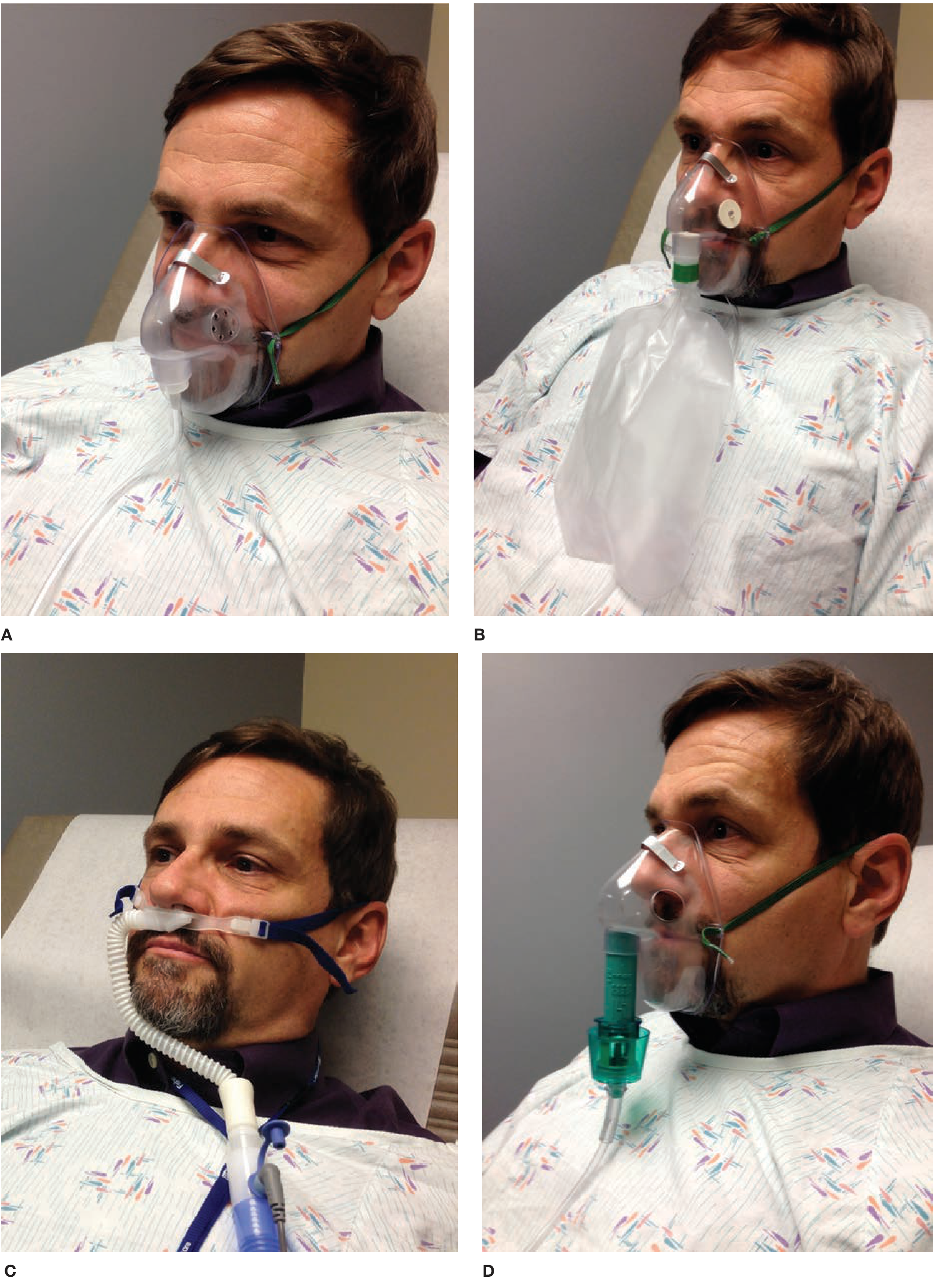
A. Venturi Mask (HAFOE - High Air Flow Oxygen Enrichment Device)
The Venturi mask (Ventimask/Flexicare) was developed by E.J. Campbell in 1967. It is the classic clinical application of the Venturi principle.
Components: Mask body + jet nozzle + entrainment ports (colour-coded interchangeable valves)
Mechanism:
- 100% oxygen is delivered at high pressure through a narrow-bore jet nozzle
- The resulting low-pressure zone entrains ambient air (21% O2) through side ports
- The ratio of entrained air to oxygen determines the final FiO2
- Interchangeable or adjustable valves allow clinicians to titrate FiO2
FiO2 range: 24%, 28%, 31%, 35%, 40%, 60% (colour coded)
Total flow data (from Morgan & Mikhail's Clinical Anesthesiology, 7e):
| FiO2 | Inlet O2 Flow (min) | Total Flow |
|---|---|---|
| 0.24 | 4 L/min | 97 L/min |
| 0.28 | 6 L/min | 68 L/min |
| 0.35 | 8 L/min | 45 L/min |
| 0.40 | 12 L/min | 50 L/min |
| 0.50 | 12 L/min | 33 L/min |
Key clinical properties:
- Fixed-performance device at lower FiO2 (<0.3): total flow exceeds patient's peak inspiratory demand, ensuring stable FiO2
- At FiO2 >0.3, less ambient air is entrained - becomes variable performance
- Actual FiO2 may vary by up to 6% from the anticipated setting
- FiO2 rises if air entrainment ports are blocked (patient's hands, bedsheets, water condensate)
- Humidification increases gas density, slows entrainment, and raises FiO2
Indications:
- COPD patients - prevents CO2 retention from hyperoxia; first-line oxygen delivery in patients at risk of hypercapnia
- Any patient requiring precise, controlled FiO2
- The British Thoracic Society recommends Venturi mask for oxygen therapy in COPD exacerbations
Advantages:
- Only device providing truly fixed FiO2 (prior to advent of HFNC)
- Reliable even with varying minute ventilation
- Prevents complications of excess or insufficient oxygen
Disadvantages:
- Bulky; patients often remove it
- Cannot deliver very high FiO2
- Accurate analysis of delivered FiO2 during breathing is difficult
- Noisy (high flow)
B. Jet Nebulisers
Gas-flow (jet) nebulisers exploit the Venturi principle to generate aerosol particles for drug delivery. Oxygen (or compressed air) is directed at high pressure through a narrow orifice, creating a low-pressure zone that entrains liquid medication from a reservoir, atomising it into fine droplets for inhalation. Large-volume air-entraining nebulisers also allow FiO2 adjustment by modifying the entrainment port size, functioning similarly to Venturi masks.
C. Jet Ventilation / Sanders Injector
This is a key anaesthetic application, especially for laryngoscopy, bronchoscopy, and panendoscopy.
Mechanism: High-pressure oxygen (typically 20-50 psi in adults, 1 second on/3 seconds off) is delivered through a narrow orifice via a jet cannula or injector attached to a rigid laryngoscope or bronchoscope. Each oxygen pulse entrains room air via the Venturi effect, increasing the total gas volume delivered and diluting the delivered oxygen concentration. (Miller's Anesthesia, 10e)
Types:
- Low-Frequency Jet Ventilation (LFJV): 10-30 breaths/min, manually triggered (Sanders injector, Manujet III). Used for suspension microlaryngoscopy, ENT procedures, and as rescue in "can't intubate, can't ventilate" (CICV) emergencies.
- High-Frequency Jet Ventilation (HFJV): >60 breaths/min, using specialised ventilators. Used during cardiac ablation procedures to reduce organ motion, during hepatic/renal tumour ablations.
Advantages: Provides surgical access while maintaining ventilation; motionless surgical field during HFJV; avoids endotracheal tube with laser risk
Disadvantages:
- Risk of barotrauma (50 psi = 3515 cmH2O)
- Cannot measure ETCO2 or tidal volume reliably
- Requires TIVA
- Suboptimal in obese patients
- Requires a patent airway for passive expiration (recoil-dependent)
D. Portable Suction Units (Venturi Suction)
Compressed oxygen or piped gas is passed through a Venturi injector to create a low-pressure zone that generates suction. Used as an emergency suction source when electrical suction is unavailable. The Venturi suction apparatus requires no electricity, making it useful in remote or austere settings.
E. Anaesthetic Vaporisers
In plenum vaporisers (e.g., Tec series), the carrier fresh gas flow passes over or through the vaporising chamber. The Venturi principle may be applied in the bypass circuit to draw a controlled proportion of gas through the liquid anaesthetic chamber, ensuring accurate vapour concentration delivery.
F. Flowmeters (Rotameters)
Although rotameters primarily use the variable-orifice principle, Venturi-type flowmeters exploit the pressure drop across a fixed constriction (measured by a differential manometer) to calculate flow, as per the Venturi equation. These provide pressure restriction valves in pipeline systems.
G. Pressure Restriction Valves and Ventilator Driving Gas
Venturi-based valves are used in anaesthetic breathing circuits to restrict back-pressure. Some ventilators use the Venturi principle with compressed oxygen as a driving gas to entrain and mix with air, powering the bellows assembly.
4. Summary Table: Venturi Principle Applications in Anaesthesia
| Device | Principle Used | Clinical Purpose |
|---|---|---|
| Venturi mask | Air entrainment at jet nozzle | Fixed FiO2 O2 therapy; COPD |
| Jet nebuliser | Fluid entrainment at orifice | Drug aerosol delivery |
| Sanders injector / LFJV | Venturi entrainment + bulk flow | Laryngoscopy/bronchoscopy ventilation |
| HFJV | High-frequency entrainment | Cardiac ablation, ENT surgery |
| Portable suction | Sub-ambient pressure at orifice | Emergency suction |
| Vaporiser bypass | Controlled gas entrainment | Volatile agent delivery |
| Flowmeter | Pressure drop at constriction | Flow measurement |
| Ventilator driving gas | Entrainment of air | Powering bellows |
5. Key Distinctions for Exam
- The Venturi effect describes the pressure-velocity relationship in a constriction; entrainment is a useful consequence, not the definition itself
- Venturi mask is a fixed-performance device at low FiO2 but becomes variable-performance at FiO2 >0.3 (total flow <40 L/min)
- Humidification increases FiO2 delivered by Venturi mask (by reducing entrainment)
- Sanders injector: Venturi entrains ambient air with each oxygen pulse - dilutes FiO2 and increases tidal volume
- Barotrauma is the primary hazard of jet ventilation (not CO2 retention)
References:
- Morgan & Mikhail's Clinical Anesthesiology, 7e, p. 2512-2514
- Miller's Anesthesia, 10e (Panendoscopy section, p. 9807-9808)
- Murray & Nadel's Textbook of Respiratory Medicine, p. 3215-3216
- Fishman's Pulmonary Diseases and Disorders, p. 2545-2546
- South African Journal of Anaesthesia and Analgesia 2023 - "Bernoulli's principle and the Venturi effect"
This is a shared conversation. Sign in to Orris to start your own chat.