
Abdominal discomfort 1 yr kid management
Reading File
Quick answer: Abdominal discomfort in a 1-year-old has many causes - colic, constipation, gastroenteritis, intussusception, and lactose intolerance are the most common. Management starts with history and physical exam to identify red flags (bilious vomiting, bloody stools, distension, inconsolable crying), then targeted treatment. Keep the child hydrated and seek urgent care for any red flag sign.
Searching sources...
Finding Sources
Finding Sources
Searching PubMed
abdominal pain infant toddler management
Finding Sources
Finding Sources
Finding Sources
Reading File
Reading File
Reading File
Reading File
Reading File
Finding Sources
Reading File
Reading File
Now I have sufficient information from the textbooks to give a comprehensive answer. Let me also retrieve information on intussusception management and colic.
Reading File
Reading File
Searching Images
intussusception child abdominal xray ultrasound currant jelly
I now have enough from the textbooks to compile a thorough, well-structured answer. Let me also get the intussusception management details (the reduction section I partially read):
Reading File
I now have comprehensive information to write a detailed, well-structured answer. Let me compile it.
Abdominal Discomfort in a 1-Year-Old: Management
A 1-year-old with abdominal discomfort presents a diagnostic challenge because children at this age cannot localize or articulate pain. The approach begins with identifying the underlying cause, then treating accordingly.
Step 1 - Initial Assessment
History to obtain from caregiver:
- Onset, duration, pattern (cyclic vs. continuous)
- Associated symptoms: vomiting (bilious or non-bilious?), fever, diarrhea, blood in stool
- Feeding history, recent illness, vaccinations
- Bowel habits (last stool, consistency, color)
- Weight gain trajectory
Physical examination:
- General appearance - is the child well-appearing or ill-appearing?
- Abdominal palpation: tenderness, distension, guarding, palpable mass
- Rectal exam if indicated
- Assess hydration status
Step 2 - Identify the Cause (Differential by Mechanism)
As summarized from Rosen's Emergency Medicine, pediatric abdominal disorders in infancy are classified as:
| Category | Common Causes in Infancy (~1 year) |
|---|---|
| Mechanical | Intussusception, malrotation/volvulus, incarcerated hernia, Hirschsprung disease, Meckel diverticulum |
| Inflammatory/Infectious | Gastroenteritis, necrotizing enterocolitis (NEC), UTI |
| Functional/Developmental | Colic, GERD, constipation |
| Genitourinary | Urinary tract infection |
RED FLAGS - Urgent/Emergency Conditions
These must be ruled out first:
1. Intussusception (Most Important in This Age Group)
- Most common cause of intestinal obstruction in children < 2 years, peak 5-12 months
- Classic triad: cyclic colicky pain + palpable "sausage-shaped" abdominal mass + "currant jelly" bloody stool (all three are present in a minority; pain is the most consistent finding)
- Pain episodes last 10-15 min, recurring every 15-30 min; child draws knees up, screams, then may appear well between episodes
- Red flag: Lethargy/altered consciousness can be the only sign in some infants
Workup:
- Abdominal X-ray (limited - rules out perforation, may show soft tissue mass or paucity of colonic gas)
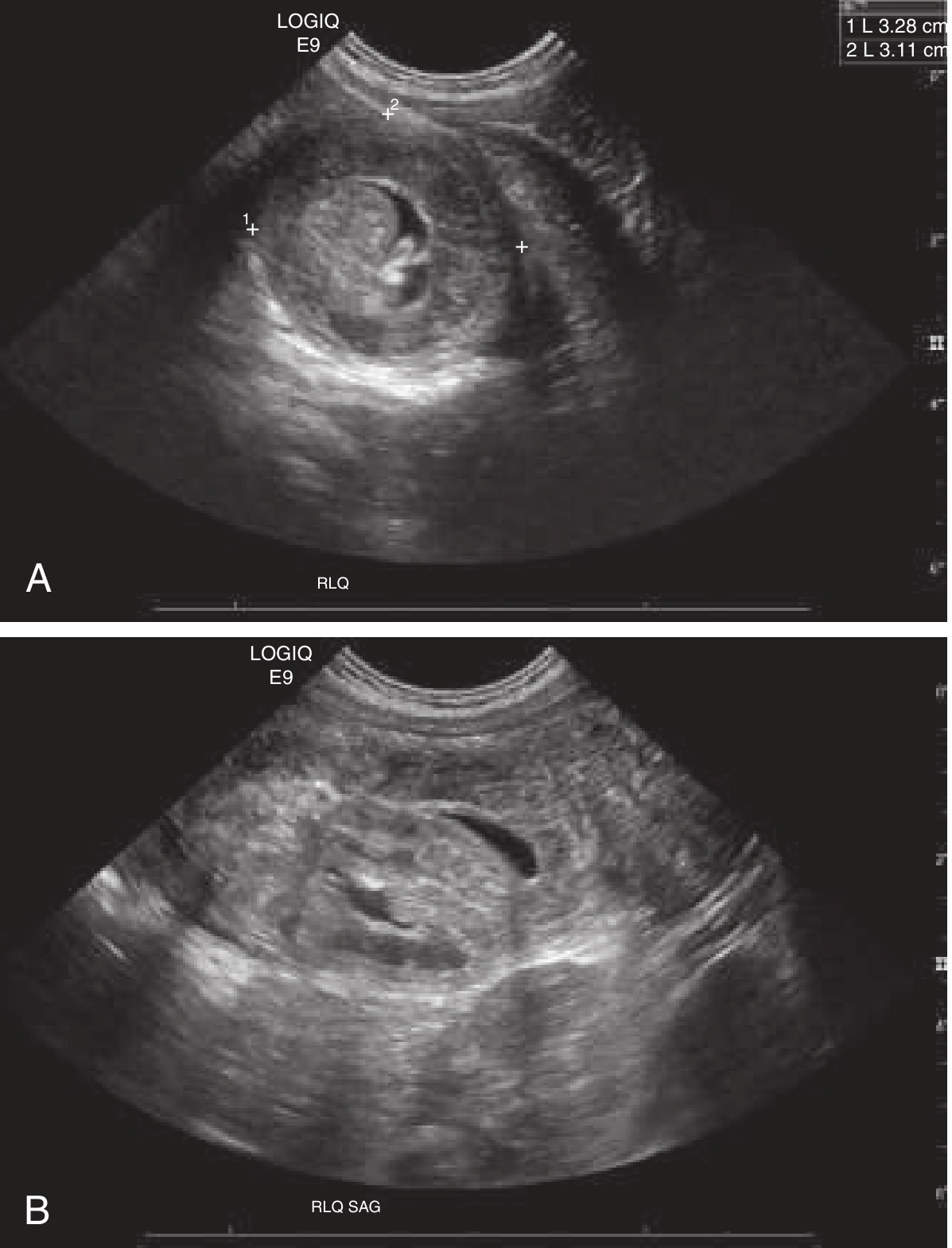
- Ultrasound = imaging modality of choice - "target sign" or "doughnut sign" on transverse view; "pseudo-kidney sign" on longitudinal view (sensitivity and specificity high in skilled hands)
Management:
- IV access + IV fluids (20 mL/kg NS boluses), NPO
- Prompt surgical consultation
- Pneumatic (air) or hydrostatic (contrast) enema - diagnostic and therapeutic - success rate ~90%
- Surgical reduction if enema fails, perforation, or shock
- Observe 6 hours post-reduction; discharge if tolerating orals and no recurrence
- ROSEN's Emergency Medicine, pp. 3233-3235
Intussusception ultrasound - "target sign":
2. Malrotation with Midgut Volvulus
- Bilious (yellow-green) vomiting in a child < 1 year = surgical emergency until proven otherwise
- Emergent pediatric surgical consultation even before diagnostic studies
- IV fluids, CBC, electrolytes, glucose
- Operative intervention must be rapid to prevent bowel necrosis
- ROSEN's Emergency Medicine, p. 3228
3. Hirschsprung Disease
- 20% of partial intestinal obstruction cases in early infancy
- Congenital aganglionosis of distal colon - functional obstruction
- Presents as: chronic constipation, abdominal distension, failure to pass meconium, vomiting
- Explosive stool on digital rectal exam ("squirt sign") is characteristic
- Management: Fluid/electrolyte stabilization; definitive = surgical resection of aganglionic segment
- ROSEN's Emergency Medicine, p. 3235
4. Meckel Diverticulum
- "Rule of 2s": 2 cm wide, 2 cm long, within 2 feet of ileocecal valve, 2% of population
- Classic: massive painless rectal bleeding (brick-red blood), sometimes with cramping
- Complications include intussusception, obstruction, perforation
- Diagnosis: Technetium-99m (Meckel) scan
- ROSEN's Emergency Medicine, p. 3233
Common Non-Surgical Causes
Gastroenteritis
- Most common cause of acute abdominal pain/discomfort in this age group overall
- Nausea, vomiting, diarrhea, low-grade fever
- Management:
- Oral rehydration therapy (ORT) - proven equivalent to IV therapy in children with mild-moderate dehydration
- Continue age-appropriate feeding after rehydration
- IV fluids for severe dehydration or inability to tolerate orals
- Antibiotics only if specific bacterial cause confirmed or severely ill (e.g., piperacillin-tazobactam + gentamicin for enteric bacterial pathogens)
- Zinc supplementation per WHO guidelines in developing countries
GERD (Gastroesophageal Reflux Disease)
- Usually begins shortly after birth, resolves by ~1 year
- Non-bilious vomiting, irritability after feeds, not progressive or projectile
- Management:
- Conservative first: smaller feeds, frequent burping, formula thickened with cereal, semi-upright after feeds (avoid car seats - worsen reflux)
- Pharmacological (acid suppression) only if severe symptoms (esophagitis, weight loss, significant irritability) and conservative measures failed
- Referral to pediatric gastroenterologist for severe/refractory cases
- ROSEN's Emergency Medicine, p. 3232
Constipation
- Common at ~1 year (dietary transitions, reduced fluid)
- Hard stools, straining, reduced frequency
- Management:
- Dietary: adequate fluids, fruits (prune juice), fiber
- Osmotic laxatives (e.g., PEG/lactulose) for persistent cases
- Most can be managed outpatient with pediatric GI follow-up
Infantile Colic (Less Likely at 1 Year - Peaks 6 Weeks)
- Defined as > 3 hours of crying per day, > 3 days/week, for > 3 weeks in an otherwise healthy infant
- Usually resolves by 3-4 months; at 1 year, another cause should be sought
- Management: Reassurance, dietary changes (eliminate cow's milk protein from mother's diet if breastfeeding), simethicone (limited evidence), probiotics (Lactobacillus reuteri has some evidence)
Diagnostic Workup Summary
| Finding | Suggested Diagnosis | Next Step |
|---|---|---|
| Cyclic colicky pain, legs drawn up | Intussusception | Ultrasound abdomen |
| Bilious vomiting | Malrotation/volvulus | Surgical consult STAT |
| Painless rectal bleeding | Meckel diverticulum | Tc-99m scan |
| Chronic constipation, failed meconium | Hirschsprung | Contrast enema, rectal biopsy |
| Fever + diarrhea | Gastroenteritis / UTI | Stool culture, urine culture |
| Vomiting after feeds, non-bilious | GERD | Clinical diagnosis |
| Irritability, well-appearing | Colic, GERD, UTI | UA + urine culture to exclude UTI |
General Emergency Management Priorities
- Assess airway, breathing, circulation
- IV access + fluid resuscitation if dehydrated or in shock (20 mL/kg NS bolus)
- Blood glucose, CBC, electrolytes, urine analysis
- Never discharge a child with bilious vomiting, bloody stool, or signs of obstruction without surgical evaluation
- Abdominal ultrasound is the first-line imaging (avoids radiation, high yield in skilled hands)
- Surgical consultation early if red flags present
Sources: ROSEN's Emergency Medicine - Concepts and Clinical Practice (Pediatric Gastrointestinal Disorders, Chapter 166); Tintinalli's Emergency Medicine (Chapter 133, Pediatric GI Emergencies)
This is a shared conversation. Sign in to Orris to start your own chat.