
Atrophic rhinitis
Reading File
Now I'll search the medical library and PubMed in parallel for atrophic rhinitis.
Finding Sources
Finding Sources
Searching PubMed
atrophic rhinitis
Good. Now let me read the detailed content from both otolaryngology sources simultaneously.
Reading File
Reading File
Searching Images
atrophic rhinitis nasal mucosa ozena
I have comprehensive content. Let me also fetch the most relevant clinical image.
Loading Image
Here is a comprehensive overview of atrophic rhinitis.
Atrophic Rhinitis
Definition
Atrophic rhinitis is a chronic condition characterized by progressive atrophy of the nasal mucosa, submucosal glands, turbinate bones, and nasal nerves, resulting in a paradoxically widened but functionally impaired nasal cavity. It is also known as rhinitis sicca or, in its severe primary form with foul-smelling discharge, ozena (from the Greek word for stench). — K.J. Lee's Essential Otolaryngology, p. 579; Cummings Otolaryngology Head and Neck Surgery
Classification
Primary Atrophic Rhinitis
- Most prevalent in developing countries in subtropical and temperate climate zones
- Etiology is incompletely understood, but bacterial colonization is strongly implicated
- Causative organisms: Klebsiella ozaenae, Staphylococcus aureus, Proteus mirabilis, Escherichia coli
- More severe and progressive course
Secondary Atrophic Rhinitis
- More prevalent in developed countries; less severe and less progressive
- Caused by identifiable precipitants:
- Iatrogenic: excessive turbinate resection (→ Empty Nose Syndrome), sinonasal surgery
- Trauma
- Radiation therapy
- Granulomatous diseases (e.g., granulomatosis with polyangiitis, sarcoidosis, leprosy)
- Rhinitis medicamentosa (prolonged use of topical decongestants)
Pathology / Histology
The hallmark histological findings are:
- Squamous metaplasia of the respiratory epithelium
- Glandular atrophy — loss of seromucinous glands
- Diffuse endarteritis obliterans — progressive vascular occlusion reducing mucosal blood flow
- Loss of mucociliary function
- Atrophy and fibrosis of nasal mucosa, submucosa, turbinate bone, and nerves
— K.J. Lee's Essential Otolaryngology, p. 579
Clinical Features
| Feature | Detail |
|---|---|
| Nasal obstruction/congestion | Paradoxical — cavity is wide but patient feels blocked |
| Crusting | Yellow-green, thick, extensive crusts |
| Fetor (ozena) | Foul odor from crusts; characteristic of primary form |
| Anosmia | Loss of smell, partly due to mucosal destruction |
| Nasal dryness | From loss of glandular secretions |
| Wide nasal cavity | Visible on endoscopy/imaging |
| Epistaxis | From friable mucosa |
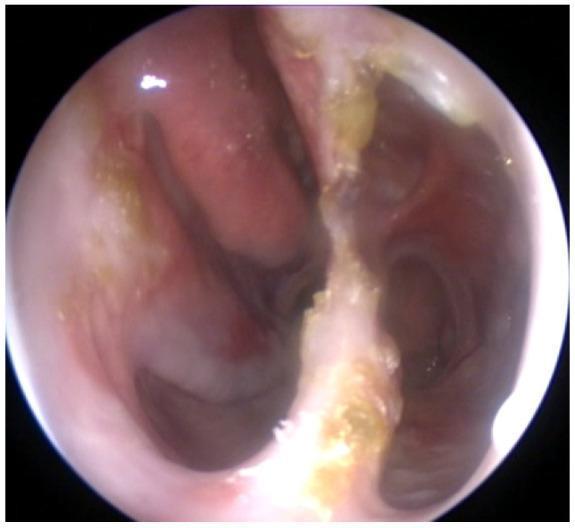
Endoscopic Appearance
The image below shows an endoscopic view of nasal atrophy: atrophic, thin, pale mucosa with near-absent turbinates, yellow-gold crusting adherent to the septum and posterior nasal cavity, and a widened nasal space — findings characteristic of advanced secondary atrophic rhinitis (in this case from granulomatous disease with septal perforation):
Diagnosis
Diagnosis is primarily clinical:
- History and examination findings (wide nasal cavity, crusting, fetor, anosmia)
- Nasal endoscopy showing atrophic mucosa and turbinate reduction
- Culture of nasal secretions (may identify K. ozaenae)
- CT sinuses: widened nasal cavity, turbinate atrophy, mucosal thickening
Management
Medical (first-line)
| Treatment | Purpose |
|---|---|
| Nasal saline irrigation | Softens and removes crusts; cornerstone of therapy |
| Nasal lubricants/emollients | Reduce mucosal dryness |
| Antibiotics | Target causative organisms (e.g., ciprofloxacin for K. ozaenae, rifampicin, streptomycin in some regimens) |
| Estrogen nasal drops | Historically used to promote mucosal vascularization |
| Glucose in glycerin drops | Inhibit proteolytic bacteria |
Surgical (for refractory cases)
- Nasal cavity narrowing procedures — reduce the dead space to improve air humidification and prevent crust formation
- Submucosal injection of Teflon, fat, or cartilage
- Young's operation: surgical closure of one or both nostrils (allows mucosal recovery)
- Modified Young's procedure (partial closure)
- Autologous fat/platelet-rich plasma (PRP) injection — emerging regenerative approach (see PubMed below)
— K.J. Lee's Essential Otolaryngology, p. 579; Cummings Otolaryngology
Atrophic Rhinitis vs. Empty Nose Syndrome
These are distinct entities:
- Atrophic rhinitis: mucosal and glandular atrophy ± infection; can be primary or secondary
- Empty nose syndrome (ENS): paradoxical nasal obstruction specifically attributed to excessive turbinate removal surgically; may represent the most severe form of iatrogenic secondary atrophic rhinitis but is classified separately
— K.J. Lee's Essential Otolaryngology, p. 579
Recent Evidence (PubMed, 2023–2026)
- A 2025 systematic review (PMID: 40820344) examined platelet-rich plasma (PRP) injection in atrophic rhinitis, reflecting growing interest in regenerative approaches.
- Two 2025 systematic reviews (PMIDs: 39126290, 40617870) addressed Empty Nose Syndrome management and its psychological burden (depression/anxiety), relevant to the iatrogenic secondary subtype.
No high-level evidence currently contradicts the standard management approach; saline irrigation and surgical cavity reduction remain the mainstay.
Summary: Atrophic rhinitis is a chronic, progressive nasal condition causing mucosal and turbinate atrophy, paradoxical nasal obstruction, fetor, and crusting. Primary disease is driven by bacterial infection (especially K. ozaenae) in tropical regions; secondary disease follows surgery, radiation, or granulomatous processes. Management centers on saline irrigation, antibiotics for bacterial forms, and surgical cavity narrowing in refractory cases. — Cummings Otolaryngology; K.J. Lee's Essential Otolaryngology
This is a shared conversation. Sign in to Orris to start your own chat.