
GLP 1 agonist
"GLP-1 receptor agonist" AND cardiovascular
GLP-1 receptor agonist mechanism of action diagram
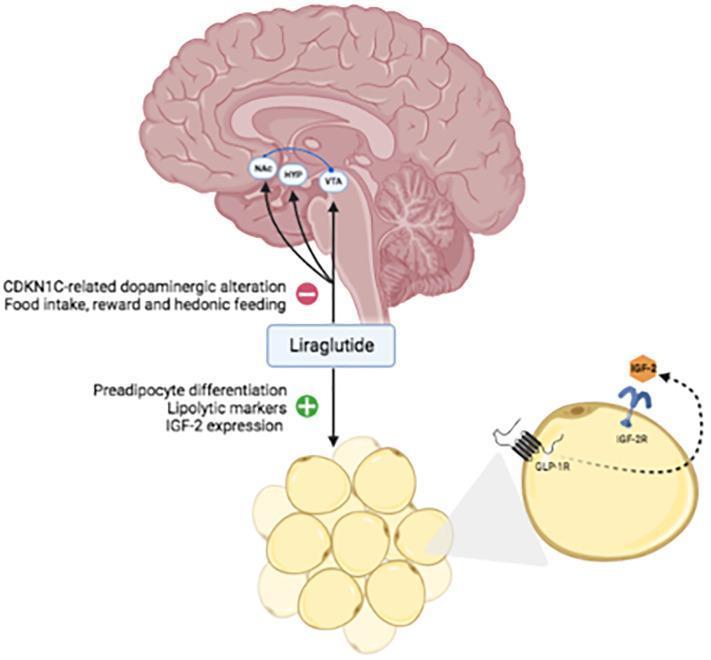
This pathophysiology diagram illustrates the hypothetical central and peripheral mechanisms of Liraglutide, a GLP-1 receptor agonist, in the context of Beckwith-Wiedemann Syndrome (BWS). The upper section shows a sagittal anatomical diagram of the human brain, highlighting the mesolimbic and homeostatic pathways involving the Nucleus Accumbens (NAc), Hypothalamus (HYP), and Ventral Tegmental Area (VTA), interconnected by blue neural pathways. Arrows from Liraglutide point to these regions, indicating a regulatory effect on food intake, reward, and hedonic feeding, potentially counteracting CDKN1C-related dopaminergic alterations. The lower section depicts the peripheral effect on adipose tissue. Liraglutide is shown stimulating a cluster of adipocytes, with positive signs (+) associated with preadipocyte differentiation, lipolytic markers, and IGF-2 expression. A detailed inset shows a single adipocyte expressing GLP-1R and IGF-2R receptors on its membrane, with IGF-2 acting as an extracellular ligand. This educational graphic demonstrates the drug's multi-organ approach to managing obesity by modulating central appetite signaling and peripheral lipid metabolism.
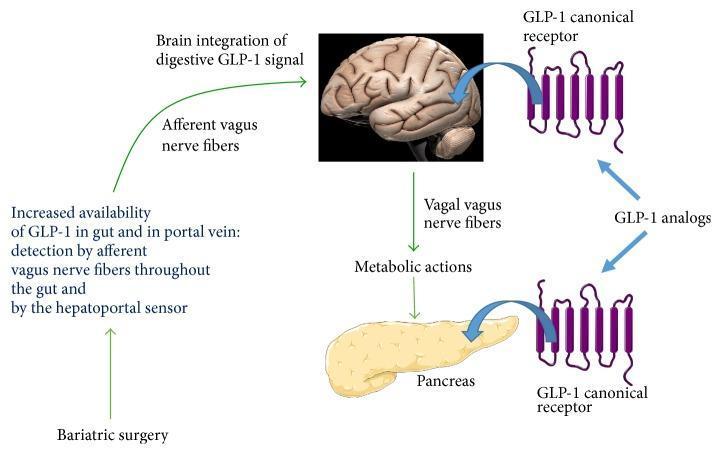
This pathophysiology diagram illustrates the comparative mechanisms of GLP-1 (glucagon-like peptide-1) action following bariatric surgery versus the administration of GLP-1 analogs. The bariatric surgery pathway is depicted as a gut-brain-periphery axis: surgery increases GLP-1 availability in the gut and portal vein, which is detected by hepatoportal sensors and afferent vagus nerve fibers. This signal travels to the brain for integration, which then sends efferent signals via vagal nerve fibers to trigger metabolic actions in peripheral organs like the pancreas. In contrast, the diagram shows GLP-1 analogs bypassing the gut-brain circuit to act directly on GLP-1 canonical receptors (represented by 7-transmembrane G protein-coupled receptor icons) located in tissues such as the brain and pancreas. Key anatomical landmarks included are the brain and the pancreas. This visual serves as an educational tool for endocrinology and metabolic surgery, highlighting the neuro-hormonal integration involved in endogenous GLP-1 signaling compared to direct pharmacological receptor activation.
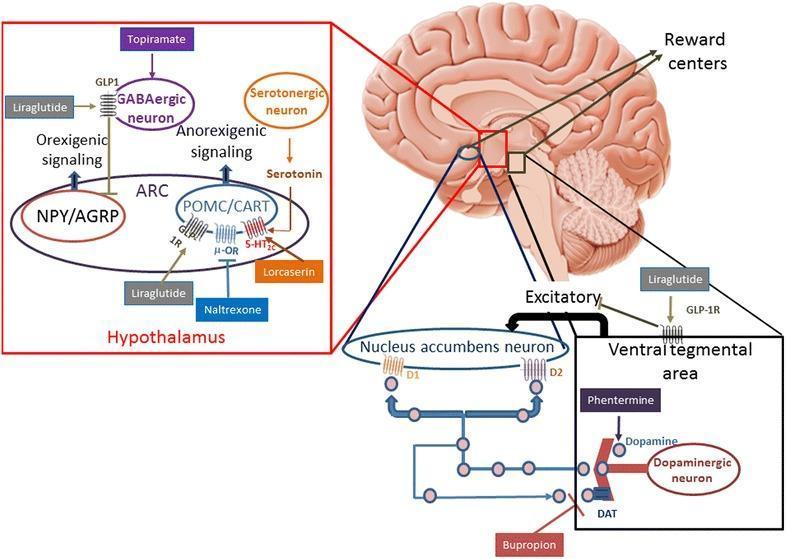
This medical illustration depicts the sagittal view of the human brain, focusing on the neurocircuitry of appetite and reward in the hypothalamus and ventral tegmental area (VTA). The diagram illustrates the mechanism of action for various antiobesity medications. In the magnified hypothalamus section (arcuate nucleus, ARC), orexigenic NPY/AgRP neurons and anorexigenic POMC/CART neurons are shown. Liraglutide is depicted acting on GLP-1 receptors (GLP-1R) on both GABAergic and POMC/CART neurons. Lorcaserin targets the 5-HT2C receptor, while Naltrexone blocks the μ-opioid receptor (μ-OR) to prevent feedback inhibition. Topiramate is shown interacting with GABAergic neurons. The lower magnified section highlights the reward system, where Phentermine and Bupropion influence dopaminergic signaling in the VTA and nucleus accumbens. Key neurotransmitters involved include dopamine (acting on D1/D2 receptors), serotonin, and GABA. Arrows indicate excitatory and inhibitory pathways leading toward cortical reward centers, demonstrating the integration of homeostatic appetite control and hedonic reward processing.
GLP-1 Receptor Agonists (GLP-1 RAs)
The Incretin Effect
- GLP-1 (glucagon-like peptide-1)
- GIP (glucose-dependent insulinotropic polypeptide)
- Lippincott Illustrated Reviews: Pharmacology, p. 808
Drugs in This Class
| Drug | Route | Dosing Frequency |
|---|---|---|
| Semaglutide | SC (also oral formulation available) | Once weekly |
| Dulaglutide | SC | Once weekly |
| Liraglutide | SC | Once daily |
| Exenatide (short-acting) | SC | Twice daily |
| Exenatide ER | SC | Once weekly |
| Lixisenatide | SC | Once daily |
- Insulin glargine + lixisenatide
- Insulin degludec + liraglutide
Mechanism of Action
- Glucose-dependent insulin secretion - stimulate insulin release only when glucose is elevated (therefore low hypoglycemia risk)
- Glucagon suppression - reduce postprandial glucagon secretion
- Delayed gastric emptying - slow glucose absorption, blunt postprandial spikes
- Enhanced satiety - act on hypothalamic GLP-1 receptors to reduce food intake
- Beta-cell proliferation - may preserve or expand functional beta-cell mass
Pharmacokinetics
-
All are polypeptides - must be administered subcutaneously (except oral semaglutide)
-
Short-acting (lixisenatide, twice-daily exenatide): more pronounced gastric emptying delay, work mainly on postprandial glucose
-
Long-acting (liraglutide, dulaglutide, weekly semaglutide, weekly exenatide): more sustained insulin secretion, greater effect on fasting glucose
-
Lippincott Illustrated Reviews: Pharmacology, p. 808-809
Indications
- Type 2 diabetes mellitus - all agents
- Cardiovascular risk reduction in T2DM + ASCVD - dulaglutide, liraglutide, semaglutide specifically approved for this
- Obesity - liraglutide 3 mg (Saxenda) and semaglutide 2.4 mg weekly (Wegovy)
- Harrison's Principles of Internal Medicine, 22E, p. cardiovascular disease chapter
Adverse Effects
| Effect | Details |
|---|---|
| Nausea, vomiting, diarrhea | Most common; dose-dependent; improve over time |
| Pancreatitis | Rare but reported; contraindicated in history of pancreatitis |
| Thyroid C-cell tumors | Seen in rodents (medullary thyroid carcinoma); contraindicated in personal/family history of MTC or MEN2 |
| Hypoglycemia | Low risk (glucose-dependent mechanism) - risk increases if combined with sulfonylurea or insulin |
| Injection site reactions | Local irritation |
| Gastroparesis risk | Contraindicated in severe gastroparesis due to gastric emptying delay |
Perioperative Considerations
- Sabiston Textbook of Surgery, p. perioperative care chapter
Drug Interactions
- Do NOT combine with DPP-4 inhibitors (e.g., sitagliptin, linagliptin) - redundant mechanism and no added benefit
- Additive with SGLT-2 inhibitors for cardiovascular and glycemic benefit
- Warfarin levels may be affected due to delayed gastric absorption
- Combined with sulfonylurea/insulin: reduce sulfonylurea/insulin dose to avoid hypoglycemia
GIP/GLP-1 Dual Agonist: Tirzepatide
Recent Evidence (2024-2025)
- A Lancet Diabetes & Endocrinology meta-analysis (2025) of RCTs confirmed GLP-1 RAs reduce both kidney and cardiovascular disease outcomes (PMID 39608381).
- A 2025 American Journal of Kidney Disease meta-analysis showed significant benefit in patients with CKD receiving GLP-1 RAs (PMID 39863261).
Summary Table: GLP-1 RAs vs DPP-4 Inhibitors
| Feature | GLP-1 RAs | DPP-4 Inhibitors |
|---|---|---|
| Mechanism | Activate GLP-1R directly | Block GLP-1 degradation |
| HbA1c reduction | Greater (~1-2%) | Moderate (~0.5-1%) |
| Weight | Decrease | Neutral |
| Hypoglycemia | Low (alone) | Low |
| Route | SC injection (or oral for sema) | Oral |
| CV benefit | Yes (certain agents) | Neutral/Uncertain |
| Cost | Higher | Moderate |