
Can you give the preparationsteps for beta oxidation equation continuous with beta oxidation of fatty acid
Reading File
Beta oxidation of fatty acids involves two main phases: an activation/preparation step followed by the cyclic spiral of beta oxidation. Let me search the medical library for authoritative content.
Searching sources...
Finding Sources
Finding Sources
Reading File
Reading File
Reading File
Reading File
Now let me fetch the key diagrams to include in the answer.
Loading Image
Loading Image
Now let me get the beta-oxidation cycle diagram (Figure 22-3) as well.
Finding Sources
Reading File
Loading Image
I now have all the information and diagrams needed for a complete, well-structured answer.
Beta Oxidation of Fatty Acids: Preparation Steps + The Oxidation Spiral
Beta oxidation occurs in two sequential phases: (A) Preparation/Activation and (B) The Cyclic Beta-Oxidation Spiral. Both take place in the mitochondrial matrix.
PHASE A: PREPARATION STEPS
Step 1 - Fatty Acid Activation (Cytosol / Outer Mitochondrial Membrane)
Before any oxidation can occur, the fatty acid must be "activated" to an acyl-CoA derivative. This is the only energy-consuming step in the entire pathway.
Equation:
Fatty acid + CoA-SH + ATP → Acyl-CoA + AMP + PPi (enzyme: Acyl-CoA synthetase / thiokinase; requires Mg²⁺)
- ATP is cleaved to AMP + pyrophosphate (PPi), consuming the equivalent of 2 high-energy phosphate bonds
- The PPi is immediately hydrolyzed by inorganic pyrophosphatase → 2 Pi, making the reaction irreversible
- This reaction takes place on the outer mitochondrial membrane (and also in the endoplasmic reticulum and peroxisomes)
Step 2 - Transport Across the Inner Mitochondrial Membrane (Carnitine Shuttle)
Short- and medium-chain acyl-CoAs can cross the inner mitochondrial membrane freely. However, long-chain acyl-CoA cannot cross the inner membrane directly. It uses the carnitine transport system:
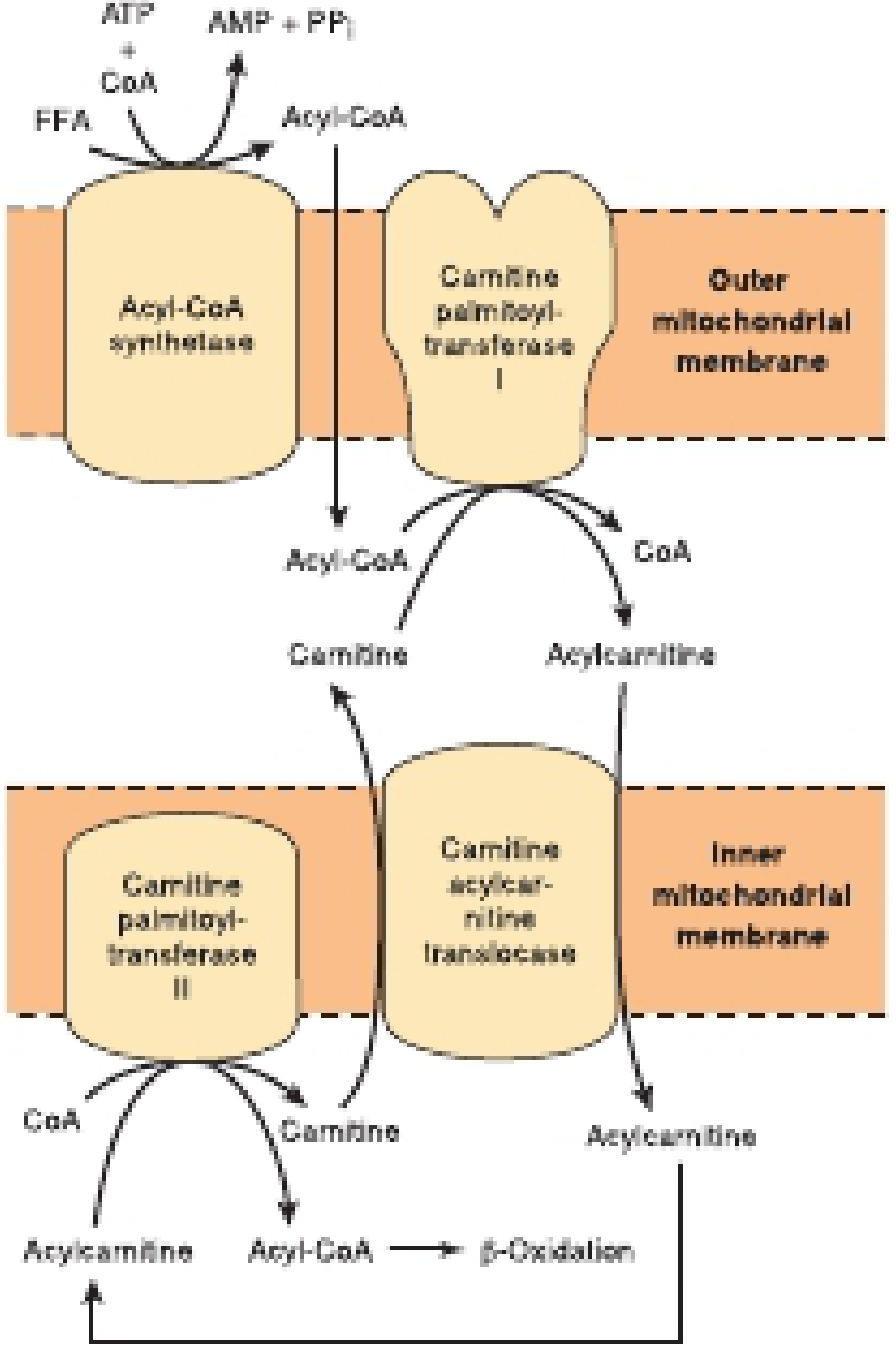
Sequence:
| Sub-step | Reaction | Enzyme | Location |
|---|---|---|---|
| 2a | Acyl-CoA + Carnitine → Acylcarnitine + CoA | Carnitine palmitoyltransferase-I (CPT-I) | Outer face of inner membrane |
| 2b | Acylcarnitine transported into matrix in exchange for free carnitine | Carnitine-acylcarnitine translocase | Inner membrane |
| 2c | Acylcarnitine + CoA-SH → Acyl-CoA + Carnitine | Carnitine palmitoyltransferase-II (CPT-II) | Inner face of inner membrane |
Key point: CPT-I is the rate-limiting and regulated step of the entire fatty acid oxidation pathway. It is inhibited by malonyl-CoA (a signal of active fatty acid synthesis), which prevents simultaneous synthesis and oxidation.
PHASE B: THE BETA-OXIDATION SPIRAL (Cyclic Reactions)
Once acyl-CoA is inside the mitochondrial matrix, the beta-oxidation cycle begins. Each cycle removes 2 carbons as acetyl-CoA and produces 1 FADH₂ + 1 NADH per turn.
Overview:
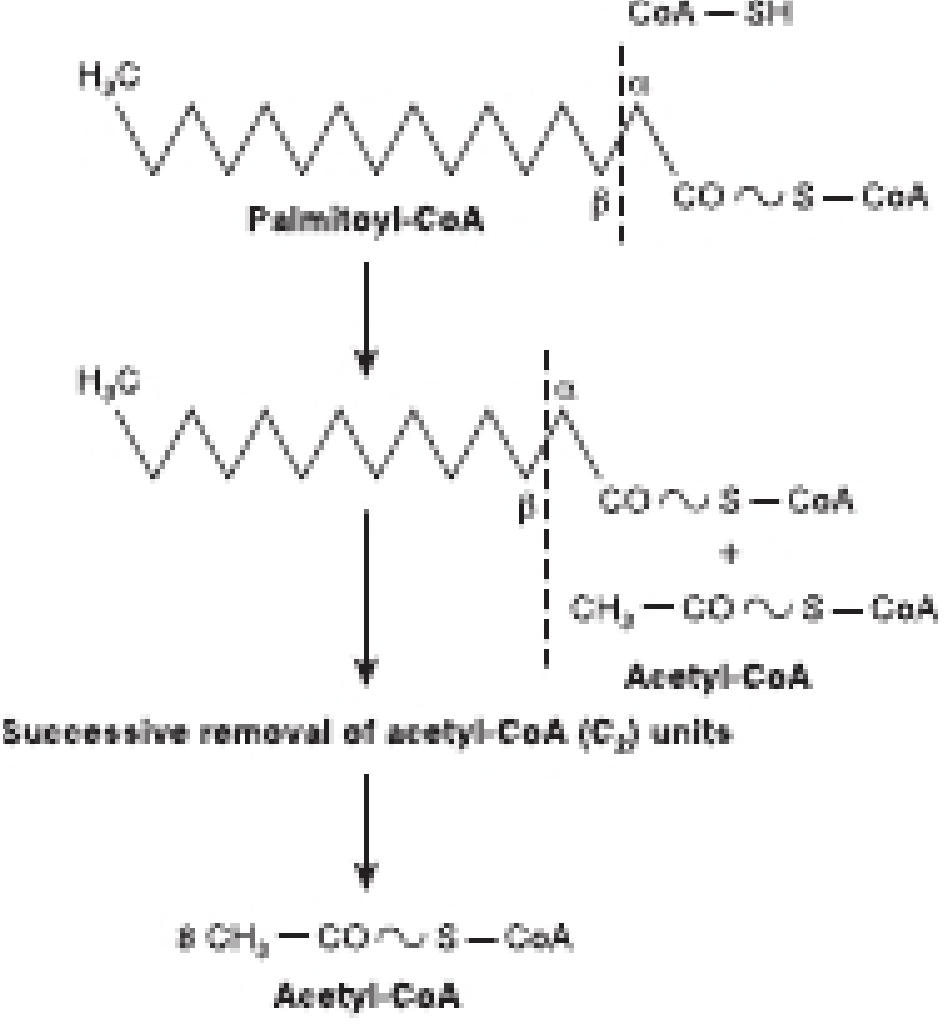
Detailed step-by-step cycle:
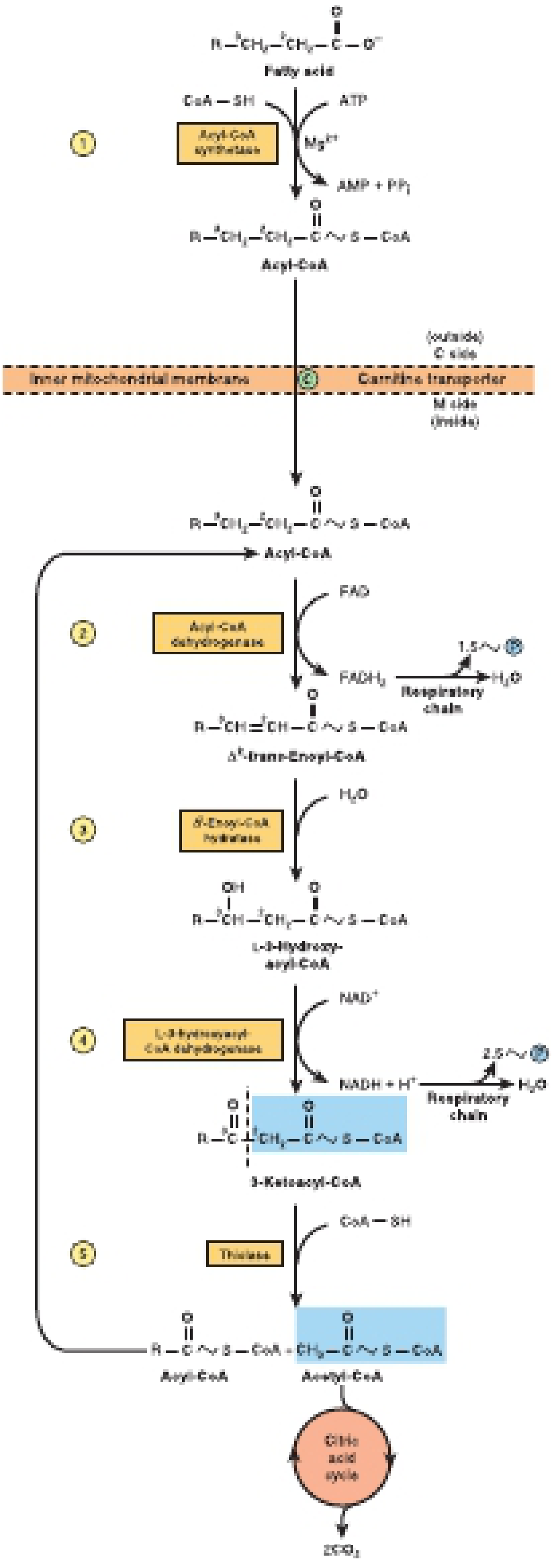
Reaction 1 - Oxidation (Dehydrogenation)
Acyl-CoA + FAD → Δ²-trans-Enoyl-CoA + FADH₂ (enzyme: Acyl-CoA dehydrogenase)
- Removes 2H from the α(C2) and β(C3) carbons
- Introduces a trans double bond between C2 and C3
- Produces FADH₂ (yields ~1.5 ATP via respiratory chain)
Reaction 2 - Hydration
Δ²-trans-Enoyl-CoA + H₂O → L-3-Hydroxyacyl-CoA (enzyme: Δ²-Enoyl-CoA hydratase)
- Water is added across the double bond
- Produces the L-stereoisomer of 3-hydroxyacyl-CoA
Reaction 3 - Oxidation (Second Dehydrogenation)
L-3-Hydroxyacyl-CoA + NAD⁺ → 3-Ketoacyl-CoA + NADH + H⁺ (enzyme: L-3-Hydroxyacyl-CoA dehydrogenase)
- The hydroxyl group at C3 is oxidized to a keto group
- Produces NADH (yields ~2.5 ATP via respiratory chain)
Reaction 4 - Thiolysis (Cleavage)
3-Ketoacyl-CoA + CoA-SH → Acyl-CoA (2C shorter) + Acetyl-CoA (enzyme: Thiolase / 3-ketoacyl-CoA thiolase)
- Bond between C2 and C3 is cleaved
- Releases 1 acetyl-CoA (enters the citric acid cycle)
- The remaining acyl-CoA (now 2 carbons shorter) re-enters the cycle
Summary Equation (for palmitoyl-CoA, C16)
Activation:
Palmitate + CoA + ATP → Palmitoyl-CoA + AMP + PPi
7 cycles of beta-oxidation:
Palmitoyl-CoA + 7 CoA + 7 FAD + 7 NAD⁺ + 7 H₂O → 8 Acetyl-CoA + 7 FADH₂ + 7 NADH + 7 H⁺
Net ATP yield from palmitate:
| Source | ATP |
|---|---|
| 7 FADH₂ via respiratory chain | 10.5 ATP |
| 7 NADH via respiratory chain | 17.5 ATP |
| 8 Acetyl-CoA via citric acid cycle | 80 ATP |
| Gross total | 108 ATP |
| Minus 2 (activation) | -2 ATP |
| Net gain | ~106 ATP |
Key Regulatory Points
- CPT-I is the main control point - inhibited by malonyl-CoA (prevents futile cycling when fatty acid synthesis is active)
- Beta-oxidation is stimulated in fasting, starvation, and uncontrolled diabetes mellitus
- Odd-chain fatty acids produce propionyl-CoA as the final 3-carbon product, which is converted to succinyl-CoA and enters the citric acid cycle (the only glucogenic part of a fatty acid)
Sources: Harper's Illustrated Biochemistry 32nd Ed, Chapter 22; Ganong's Review of Medical Physiology 26th Ed, Chapter 1
This is a shared conversation. Sign in to Orris to start your own chat.