

this is the etiology and pathogenesis of benign prostatic hyperplasia. read it out and make a flowchart of this etiopathogenesis
benign prostatic hyperplasia pathogenesis DHT stromal epithelial growth factors 5 alpha reductase
benign prostatic hyperplasia pathogenesis
Etiopathogenesis of Benign Prostatic Hyperplasia (BPH)
- promote cellular growth/proliferation
- inhibit cell death
Key mechanism
- DHT is the major prostatic androgen and makes up about 90% of prostatic androgens.
- It is formed from testosterone by type 2 5-alpha-reductase.
- Type 2 5-alpha-reductase is located predominantly in stromal cells of the prostate.
- DHT then binds to nuclear androgen receptors (AR) in both stromal and epithelial prostatic cells.
- DHT has greater affinity for AR and forms a more stable receptor complex than testosterone.
- The DHT-AR complex activates androgen-dependent genes, including genes encoding growth factors and their receptors.
- FGF (fibroblast growth factor): produced by stromal cells; acts by a paracrine mechanism to stimulate epithelial growth. Developmental stromal-epithelial signaling pathways may be reactivated in adult life.
- TGF-beta: stimulates fibroblasts and other mesenchymal/stromal cells, but inhibits epithelial proliferation.
- increased proliferation of stromal cells
- reduced death of epithelial cells
- nodular enlargement of the prostate, producing BPH
Flowchart: Etiopathogenesis of BPH
Increasing age + presence of androgens
                  ↓
Testosterone reaches the prostate
                  ↓
Stromal-cell type 2 5-alpha-reductase
                  ↓
Conversion of testosterone to DHT
                  ↓
DHT binds nuclear androgen receptors
in stromal and epithelial cells
                  ↓
Activation of androgen-dependent genes
                  ↓
Increased production/action of growth factors
                  ↓
        ┌───────────────────────┴────────────────────────┐
        ↓                                                ↓
FGF produced by stromal cells                       TGF-beta action
        ↓                                                ↓
Paracrine stimulation of                         ↑ Fibroblast and stromal/
epithelial growth                                mesenchymal-cell growth
        ↓                                                ↓
        └───────────────────────┬────────────────────────┘
                                ↓
               ↑ Stromal-cell proliferation
                                +
               ↓ Epithelial-cell death (apoptosis)
                                ↓
          Accumulation of senescent cells
                                ↓
        Nodular hyperplasia of periurethral prostate
                                ↓
     BENIGN PROSTATIC HYPERPLASIA (BPH)
                                ↓
      Urethral compression and lower urinary-tract symptoms
BPH is an androgen-dependent nodular hyperplasia in which stromal 5-alpha-reductase converts testosterone to DHT; DHT acts through androgen receptors and growth factors such as FGF and TGF-beta, causing increased stromal proliferation and reduced epithelial apoptosis.
Create a labeled BPH etiopathogenesis diagram
A labeled educational flowchart diagram of the etiopathogenesis of benign prostatic hyperplasia. Show: ageing and androgens at top; testosterone entering prostate; stromal-cell type 2 5-alpha-reductase converting testosterone to dihydrotestosterone (DHT); DHT binding nuclear androgen receptors in stromal and epithelial cells; activation of androgen-dependent genes; growth factors FGF and TGF-beta; FGF from stromal cells causing paracrine epithelial growth, TGF-beta causing stromal fibroblast/mesenchymal growth; final combined effects of increased stromal proliferation and reduced epithelial-cell apoptosis, leading to accumulation of cells, nodular hyperplasia in the periurethral/transition zone, then benign prostatic hyperplasia and urethral compression/lower urinary tract symptoms. Use correct arrow directions and exact readable labels. Include a small note: DHT has higher androgen receptor affinity than testosterone.
benign prostatic hyperplasia pathogenesis DHT stromal epithelial FGF TGF beta authoritative review
benign prostatic hyperplasia pathogenesis
BPH Etiopathogenesis Diagram
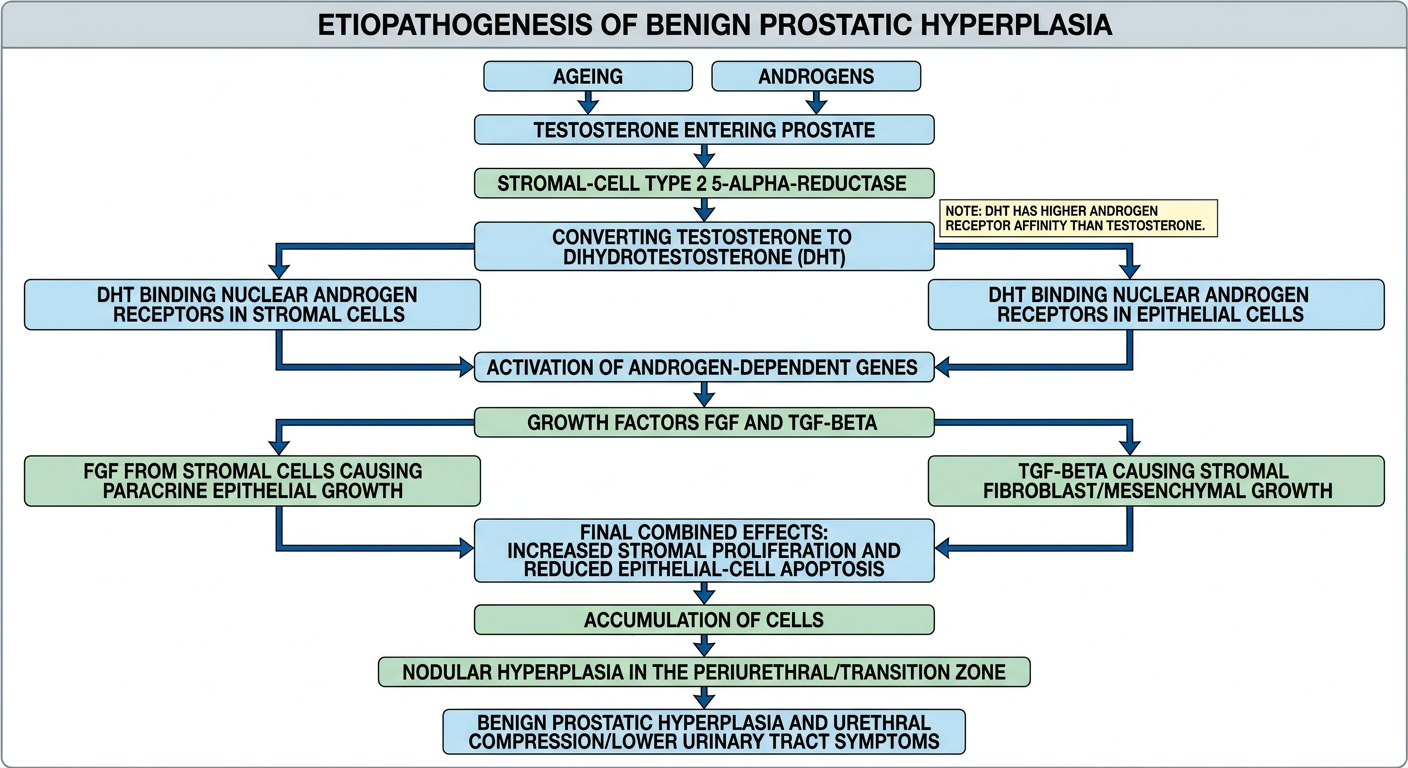
Testosterone → 5-alpha-reductase type 2 in stromal cells → DHT → androgen receptor → FGF/TGF-beta signaling → stromal proliferation + reduced epithelial apoptosis → nodular BPH → urethral compression/LUTS.
why it occurs mostly in old males
benign prostatic hyperplasia aging pathogenesis
benign prostatic hyperplasia aging DHT pathogenesis authoritative review
Why age matters
-
Lifelong exposure to DHT
- The prostate continues to be exposed to androgens throughout adult life.
- In stromal cells, testosterone is converted to DHT by type 2 5-alpha-reductase.
- DHT binds androgen receptors and promotes prostatic growth-factor signaling.
- DHT is necessary for BPH, though it is not the only cause.
-
Less cell death with aging
- In older men, normal apoptosis of prostatic epithelial cells becomes relatively reduced.
- Cells, particularly senescent cells, therefore accumulate over time.
- The result is gradual nodular enlargement rather than a sudden process.
-
Stromal-epithelial growth signaling becomes abnormal
- Aging can reactivate developmental stromal-epithelial signaling.
- Stromal growth factors, especially FGF, stimulate epithelial growth by a paracrine effect.
- This produces both stromal and glandular hyperplasia.
-
Changing hormonal balance
- Serum testosterone declines with age, but intraprostatic androgen action, including DHT and androgen-receptor signaling, may persist.
- The relative estrogen-to-androgen balance changes with age and may favor stromal growth and altered growth-factor activity.
- Therefore, BPH is not simply due to high serum testosterone.
-
Chronic inflammation and metabolic factors
- In many aging men, low-grade prostatic inflammation, obesity, insulin resistance, and metabolic syndrome can promote cytokines, oxidative stress, and growth signaling.
- These factors contribute to progression, but do not explain every case. A recent review discusses the link between metabolic syndrome and BPH (Fu et al., 2024).
Simple summary
Aging
  ↓
Persistent local DHT action + altered estrogen-androgen balance
  ↓
Growth-factor signaling and stromal-epithelial interaction
  +
Reduced apoptosis / accumulation of senescent cells
  +
Inflammation and metabolic influences in some men
  ↓
Progressive stromal and epithelial hyperplasia
  ↓
Transition-zone nodules
  ↓
BPH, urethral compression, and LUTS