I now have comprehensive material. Let me compile the full viva answer.
HNA II — Speech Functions & Hemispheric Asymmetry
Complete Viva Notes (Guyton & Hall + Ganong/Sembulingam)
1. What is Speech as a Function of HNA?
Speech is the most complex higher nervous activity (HNA) unique to humans. It is both a motor function (producing spoken/written words) and a sensory function (understanding spoken/written language). It requires coordinated activity of multiple cortical areas, subcortical structures, and the motor system controlling the lips, tongue, and larynx.
Speech relies on two key things:
- Comprehension – understanding what you hear or read
- Expression – forming and producing meaningful words
2. Cortical Speech Centers (Broca & Wernicke Areas)
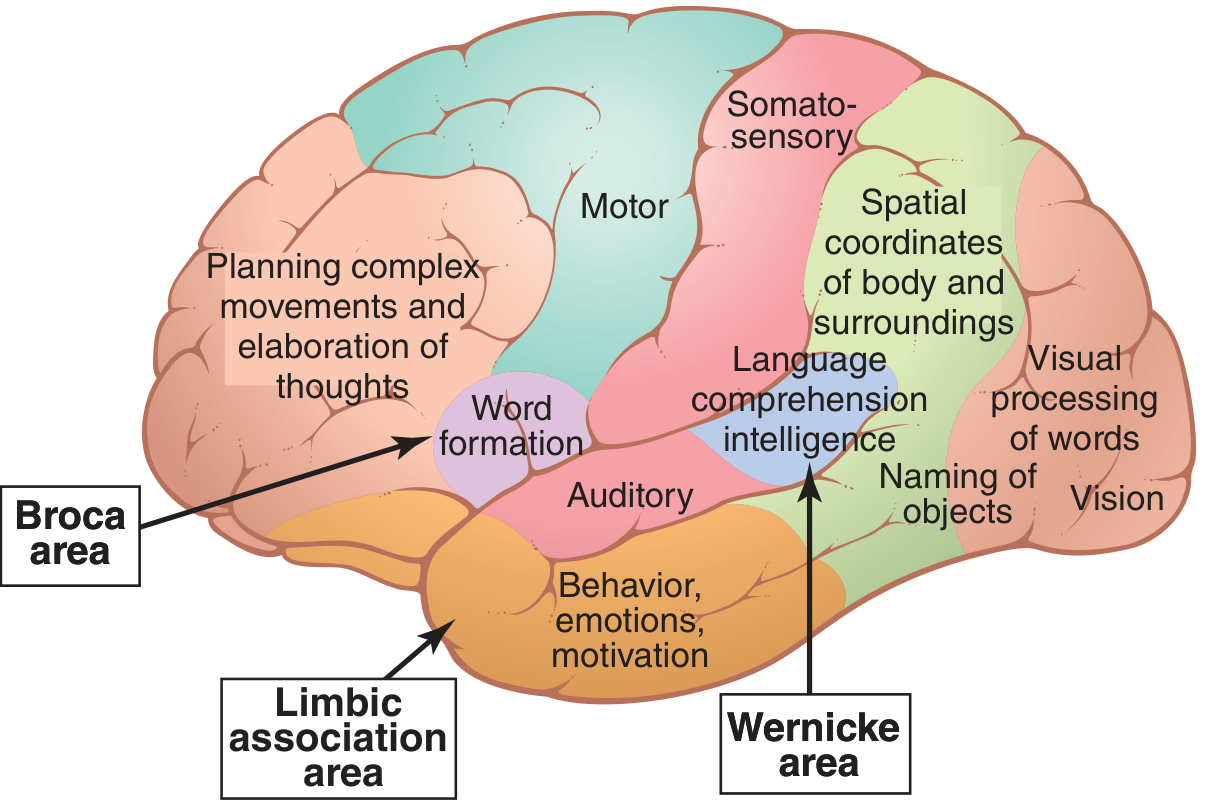
(Guyton & Hall, Fig. 58.5 — reproduced below)
Guyton & Hall — Broca area (word formation, frontal lobe) and Wernicke area (language comprehension, temporal lobe)
There are four main cortical language areas, all in the dominant (usually left) hemisphere:
| Area | Location | Function |
|---|
| Broca's area | Inferior frontal gyrus (Brodmann 44, 45) | Speech production / motor articulation |
| Wernicke's area | Posterior superior temporal gyrus | Language comprehension |
| Angular gyrus | Posterior parietal / anterolateral occipital | Visual language processing (reading) |
| Supplementary motor area | Medial frontal cortex | Initiation of voluntary speech |
In 95% of all people (both right- and left-handed), these areas are in the LEFT hemisphere (Guyton & Hall).
3. Function of Broca's Area
- Located in the inferior frontal gyrus, just in front of the primary motor cortex
- Receives input from Wernicke's area via the arcuate fasciculus
- Converts language concepts into detailed, coordinated motor programs for vocalization — it drives the muscles of the lips, tongue, pharynx, and larynx
- Projects via a speech articulation area in the insula → to the motor cortex → to produce actual speech sounds
- Think: "Broca = speaks / produces speech"
"Broca area processes the information received from Wernicke area into a detailed and coordinated pattern for vocalization and then projects the pattern via a speech articulation area in the insula to the motor cortex." — Ganong's Medical Physiology
4. Function of Wernicke's Area
- Located in the posterior part of the superior temporal gyrus, just behind the primary auditory cortex
- Understands both auditory and visual language — it is the "comprehension centre"
- It links sensory input (sound of words, visual images of letters) to meaning
- Most intellectual functions are language-based, so Wernicke's area is one of the most important areas in the whole brain for intellect
- Think: "Wernicke = understands / comprehends language"
"The major area for language comprehension, called the Wernicke area, lies behind the primary auditory cortex in the posterior part of the superior temporal gyrus... It is one of the most important regions of the entire brain for higher intellectual function." — Guyton & Hall
5. How is Speech Produced and Perceived? (The Wernicke–Geschwind Model)
Ganong — Language pathway: Wernicke → Arcuate fasciculus → Broca → Motor cortex → Speech
Pathway for HEARING and REPEATING a word:
- Sound → Primary auditory cortex (Heschl's gyrus, temporal lobe)
- → Wernicke's area (word is recognized and understood)
- → Via arcuate fasciculus (white matter bundle) → Broca's area
- Broca's area forms motor program → via insula → primary motor cortex
- Motor cortex → muscles of mouth, tongue, larynx → spoken word
Pathway for READING and SPEAKING a word:
- Visual input → Primary visual cortex → Higher visual areas
- → Angular gyrus (converts visual word into auditory equivalent)
- → Wernicke's area (comprehension)
- → Arcuate fasciculus → Broca's area → Motor cortex → Speech
"A major share of our sensory experience is converted into its language equivalent before being stored in the memory areas." — Guyton & Hall
6. What is Hemispheric Dominance?
- One hemisphere is more specialized for certain functions than the other — this is called cerebral dominance or lateralization
- For language and speech: Left hemisphere is dominant in ~95% of right-handers and ~70% of left-handers
- For most other "dominant" functions like: analytical thinking, mathematics, logic, reading, writing → LEFT hemisphere
- The "dominant" hemisphere is determined mostly by genetic factors + early developmental experience
7. Role of the LEFT Hemisphere (Dominant Hemisphere)
The left hemisphere specializes in:
- Speech and language (Broca's + Wernicke's areas)
- Reading and writing
- Mathematical calculations
- Logical and analytical reasoning
- Verbal memory — stores information in language form
- Sequential processing of information
"When the Wernicke area in the dominant hemisphere of an adult is destroyed, the person loses almost all intellectual functions associated with language or verbal symbolism, such as the ability to read, perform mathematical operations, and even the ability to think through logical problems." — Guyton & Hall
8. Role of the RIGHT Hemisphere (Non-dominant Hemisphere)
The right hemisphere specializes in:
- Music and prosody (tone and rhythm of speech)
- Non-verbal visual experiences — recognizing faces, spatial patterns
- Spatial relationships — understanding body position in surroundings
- Body language and emotional tone (intonation/emotion in voice)
- Artistic and creative abilities
- Holistic (gestalt) processing
"The so-called nondominant hemisphere might actually be dominant for some other types of intelligence." — Guyton & Hall
Note: Both hemispheres communicate via the corpus callosum.
9. Types of Aphasia
Aphasia = disorder of language (not due to hearing/vision loss or motor paralysis) — caused by lesions in the dominant hemisphere, most commonly from stroke.
| Type | Lesion Site | Fluency | Comprehension | Repetition | Key Feature |
|---|
| Broca's (Motor/Expressive) | Broca's area (frontal) | Non-fluent | Intact | Impaired | Telegraphic, effortful speech; patient knows what to say but can't say it fluently |
| Wernicke's (Sensory/Receptive) | Wernicke's area (temporal) | Fluent | Impaired | Impaired | Fluent but nonsensical speech (jargon/neologisms); doesn't understand what's said |
| Conduction | Arcuate fasciculus | Fluent | Intact | Impaired | Can't repeat; aware of errors |
| Global | Large perisylvian area | Non-fluent | Impaired | Impaired | Severe; both expression and comprehension lost |
| Anomic | Angular gyrus | Fluent | Intact | Intact | Can't name objects; trouble finding words |
| Transcortical Motor | Anterior/superior to Broca's | Non-fluent | Intact | Intact | Reduced spontaneous speech; can repeat |
| Transcortical Sensory | Posterior to Wernicke's | Fluent | Impaired | Intact | Similar to Wernicke's but repetition preserved |
10. Clinical Manifestations of Speech Disorders
Broca's Aphasia:
- Speech is slow, labored, telegraphic (short phrases, no connecting words)
- Agrammatism — omits grammatical words ("Give water" instead of "Give me some water")
- Patient understands what you say and is frustrated by their difficulty
- Writing is also abnormal
Wernicke's Aphasia:
- Speech is fluent but meaningless — full of invented words (neologisms) and jargon
- Patient cannot understand spoken or written language
- Unaware of their own errors
- May appear confused or even "psychiatric" to untrained observers
Other Points:
- Agraphia (can't write) + Alexia (can't read) → Angular gyrus lesion
- Stuttering → associated with right cerebral dominance and abnormal supplementary motor area activity
- Prosopagnosia → right temporal lobe damage → can't recognize faces
Quick Summary for Viva
| Question | One-line Answer |
|---|
| What is speech in HNA? | Highest form of cortical function for language expression and comprehension |
| Cortical speech centers? | Broca's (frontal), Wernicke's (temporal), Angular gyrus, Supplementary motor area |
| Broca's function? | Motor/expressive — converts language to speech movements |
| Wernicke's function? | Sensory/receptive — understands spoken and written language |
| How is speech produced? | Wernicke → Arcuate fasciculus → Broca → Insula → Motor cortex → muscles |
| Hemispheric dominance? | One hemisphere (usually left) is specialized for language in 95% of people |
| Left hemisphere role? | Language, logic, math, reading, writing, verbal memory |
| Right hemisphere role? | Music, spatial awareness, emotion, face recognition, body language |
| Types of aphasia? | Broca's (non-fluent), Wernicke's (fluent-nonsensical), Conduction, Global, Anomic |
| Clinical features of speech disorder? | Telegraphic speech (Broca), jargon speech (Wernicke), can't name objects (Anomic) |
References: Guyton & Hall Medical Physiology (14th ed.), Ch. 58; Ganong's Review of Medical Physiology (26th ed.), Ch. 15