
Poisonous vs non poisonous snake
Here's a quick overview while I gather more details:
Snakes are broadly split into venomous (often called "poisonous" colloquially) and non-venomous. Key differences include head shape (triangular vs. oval), pupil shape (elliptical vs. round), scale patterns, and behavior. True poisonous snakes are rare - venom is injected, not ingested, so technically most "poisonous" snakes are venomous.
Searching sources...
Reading File
Searching the Web
venomous vs non-venomous snake identification differences
Finding Sources
Reading Web Page
https://www.victorpest.com/articles/how-to-identify-venomous…
Loading Image
Finding Sources
Reading File
Loading Image
Here is a thorough breakdown of venomous vs. non-venomous snakes:
"Poisonous" vs. "Venomous" - The Right Terminology First
Technically, snakes are venomous, not poisonous. The distinction matters:
- Venom = injected (via bite/fangs). Venomous snakes deliver toxins actively.
- Poison = harmful when touched or ingested. Very few snakes are truly "poisonous" (e.g., the garter snake that eats toxic newts and retains toxins in its skin).
So when people say "poisonous snake," they almost always mean venomous snake.
Visual Identification Guide
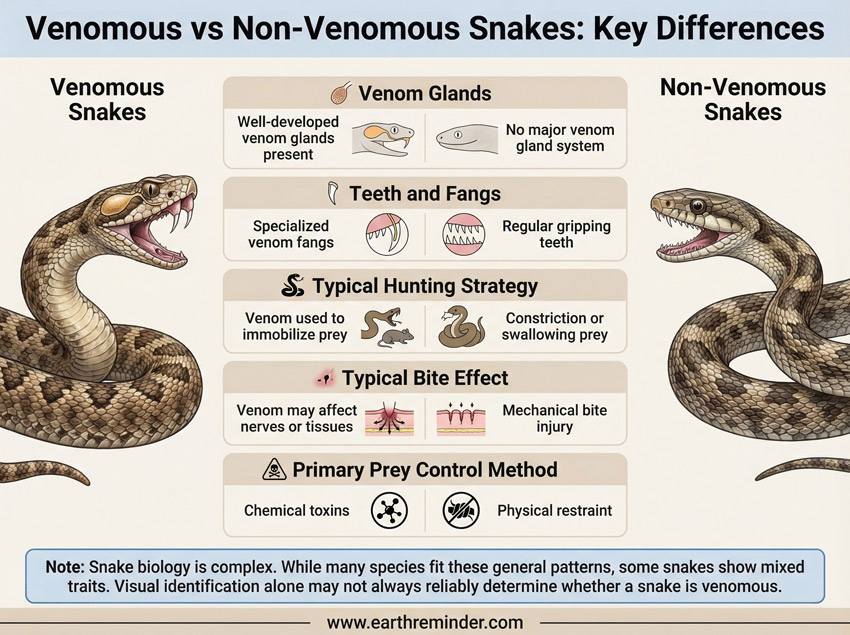
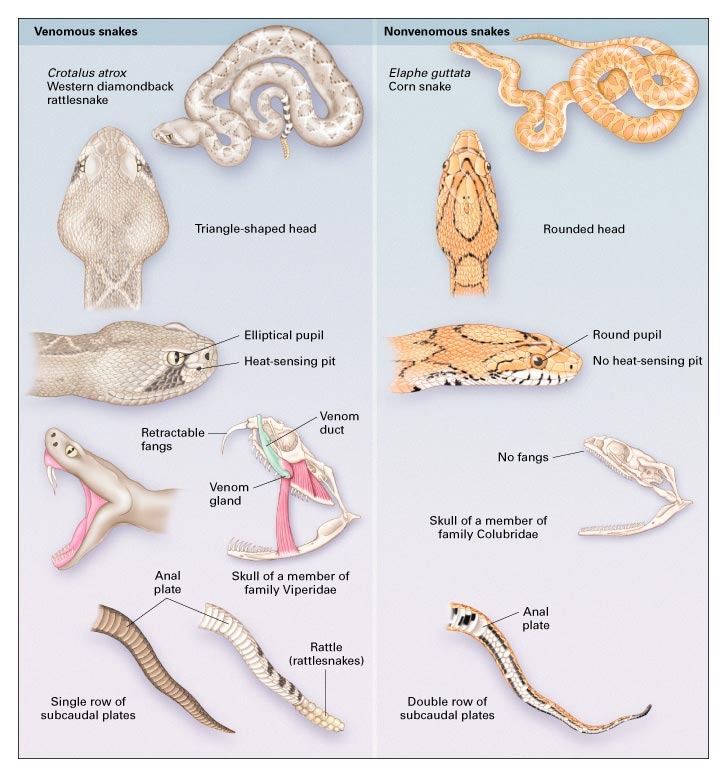
Key Differences at a Glance
| Feature | Venomous | Non-Venomous |
|---|---|---|
| Head shape | Triangular / arrow-shaped | Oval / rounded |
| Pupils | Elliptical (cat-like slits) | Round |
| Fangs | Present - retractable, hollow | Absent (regular gripping teeth only) |
| Venom glands | Present (behind eyes, widen head) | Absent |
| Body shape | Often thick, stocky | Generally slimmer |
| Tail | Short, stubby | Long, tapered |
| Subcaudal plates | Single row | Double row ("zipper tail") |
| Heat-sensing pits | Present in pit vipers (between eye and nostril) | Absent |
| Rattle | Rattlesnakes only | Never |
| Hunting method | Venom to immobilize prey | Constriction or swallow whole |
| Bite mark | Two large puncture wounds | Row of small teeth marks |
Caution: These are general rules with exceptions. Some non-venomous snakes flatten their heads to mimic a triangular shape as a defense mechanism. Never rely on a single feature alone.
Types of Snake Venom
According to the Essentials of Forensic Medicine and Toxicology (2026 edition):
1. Neurotoxic Venom
- Produced by elapids (cobras, mambas, kraits, coral snakes)
- Causes selective neuromuscular blockade (similar to d-tubocurarine) leading to flaccid paralysis
- Primarily affects respiratory and cardiac centers
- Cholinesterase is rich in elapid venom
2. Vasculotoxic / Hemotoxic Venom
- Produced by viperids (Russell's viper, puff adder)
- Causes intravascular hemolysis and disrupts the coagulation mechanism
- Russell's viper venom contains proteases that activate the clotting cascade, leading to DIC
- Rich in proteolytic enzymes, hyaluronidase, and L-amino acid oxidase
3. Myotoxic Venom
- Produced by sea snakes
- Causes direct muscle destruction (rhabdomyolysis)
4. Mixed Venom
- Rattlesnakes, cottonmouths (water moccasins), copperheads: cytotoxic + hemorrhagic + neurotoxic
- Coral snakes: primarily neurotoxic, curare-like effects at neuromuscular junctions
Common Examples
Venomous Snakes
- Cobra (neurotoxic)
- Krait (neurotoxic)
- Russell's viper (vasculotoxic)
- Rattlesnake (mixed)
- Copperhead (mixed)
- Cottonmouth / Water Moccasin (mixed)
- Coral snake (neurotoxic)
- King cobra (neurotoxic)
- Mamba (neurotoxic)
- Sea snake (myotoxic)
Non-Venomous Snakes
- Corn snake (Elaphe guttata)
- Ball python
- King snake
- Garter snake
- Rat snake
- Boa constrictor
- Green tree python
Clinical Note on Snake Bites
From forensic/toxicology and surgical textbooks:
- Most snake bites are from non-venomous snakes
- In venomous bites, inadequate venom is injected in more than half of cases (called a "dry bite"), producing only mild symptoms
- The most common immediate symptom after any bite (venomous or not) is fright and anxiety
- Venom concentration varies by time of day and season - bites at night and just after hibernation tend to be most severe
- Venom spreads via lymphatics and superficial veins, and rapidly through subcutaneous areolar tissue
(Essentials of Forensic Medicine and Toxicology, 36th edition, 2026; Sabiston Textbook of Surgery)
The Coral Snake Exception - "Red Touches Yellow"
One famous memory aid applies to North American coral snakes vs. harmless mimics (like the scarlet kingsnake):
- "Red touches yellow, kill a fellow" = Coral snake (venomous)
- "Red touches black, friend of Jack" = Scarlet kingsnake (non-venomous)
This rhyme only applies in North America and should not be used globally.
Bottom line: The safest approach is to never handle any wild snake unless you are an expert. If bitten, seek emergency care immediately - do not apply tourniquets, do not suck out venom, keep the bite site below heart level, and stay calm to slow venom absorption.
This is a shared conversation. Sign in to Orris to start your own chat.