
Tell me ten common disease with ecg change
Reading File
Now let me search the medical library for ECG changes in common diseases, running parallel queries:
Finding Sources
Finding Sources
Finding Sources
Finding Sources
Finding Sources
Reading File
Finding Sources
Finding Sources
Reading File
Finding Sources
Finding Sources
Reading File
Finding Sources
I now have solid textbook material. Let me also fetch the hyperkalemia ECG image and search for more ECG images:
Loading Image
Searching Images
ECG changes diseases STEMI pericarditis hyperkalemia pulmonary embolism
I have rich textbook content and ECG images. Now I'll compile the comprehensive answer.
10 Common Diseases with ECG Changes
1. 🫀 ST-Elevation Myocardial Infarction (STEMI)
ECG Changes:
- ST-segment elevation ≥1 mm in ≥2 contiguous leads (≥2 mm in precordial leads)
- Reciprocal ST depression in opposite leads
- Pathological Q waves (>0.04 s, >25% of R-wave height) — indicate completed infarction
- New LBBB = STEMI equivalent
| Territory | Leads with ST Elevation |
|---|---|
| Anterior | V1–V4 |
| Inferior | II, III, aVF |
| Lateral | I, aVL, V5–V6 |
| Posterior | Tall R in V1–V2; ST elevation on right-sided leads |
| Right Ventricle | II, III, aVF + ST elevation in V3R–V6R |
Tintinalli's Emergency Medicine — The 12-lead ECG is the single best test to identify AMI on presentation; obtain and interpret within 10 minutes of symptom onset.
2. 💥 NSTEMI / Unstable Angina
ECG Changes:
- ST-segment depression (horizontal or downsloping) — most significant
- T-wave inversion (symmetric, deep)
- May have a normal ECG (1–6% of NSTEMI patients)
- Dynamic changes (ST/T changes that evolve over serial ECGs) — 84% likelihood of CAD with classic symptoms
3. 🔵 Acute Pericarditis
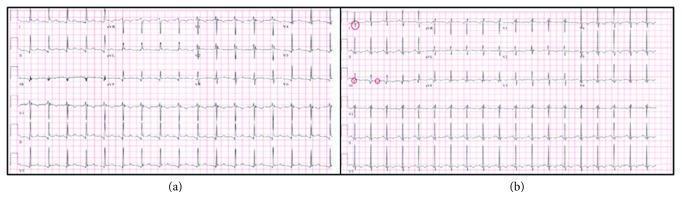
ECG Changes (classically progress through 4 stages):
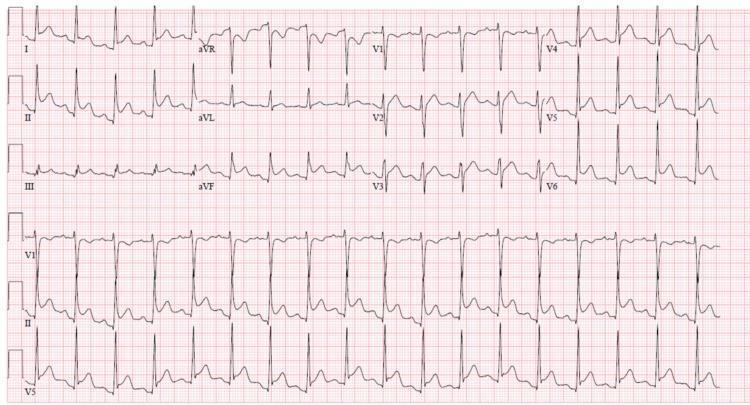
- Stage I — Diffuse concave ("saddle-shaped") ST elevation in nearly all leads EXCEPT aVR & V1; PR-segment depression (most specific sign); PR elevation in aVR
- Stage II — ST normalizes; T-wave flattening
- Stage III — Diffuse T-wave inversion
- Stage IV — ECG normalizes
Key distinguishing features from STEMI:
- ST elevation is diffuse (not restricted to one coronary territory)
- ST elevation is concave (not convex)
- PR depression is present
- No reciprocal ST depression (except aVR)
- Spodick's sign: downsloping TP segment
4. 🌬️ Acute Pulmonary Embolism (PE)
ECG Changes (reflect acute right heart strain):
- S1Q3T3 — deep S wave in lead I, Q wave in lead III, inverted T wave in lead III (classic but present in only ~20%)
- Sinus tachycardia — most common finding
- New RBBB (complete or incomplete)
- Right axis deviation
- T-wave inversion in V1–V4 (right ventricular strain pattern)
- P pulmonale (tall peaked P wave in II)
- Atrial fibrillation/flutter
5. ⚡ Hyperkalemia
ECG Changes (progress with rising K⁺ level):
| Serum K⁺ | ECG Finding |
|---|---|
| 5.5–6.5 mEq/L | Tall, symmetric, peaked T waves (narrow base, "tent-shaped") |
| 6.5–7.5 mEq/L | Loss of P waves, prolonged PR interval |
| 7.0–8.0 mEq/L | Widened QRS complex, shortened QT |
| >8.0 mEq/L | Sine-wave pattern → ventricular fibrillation → asystole |
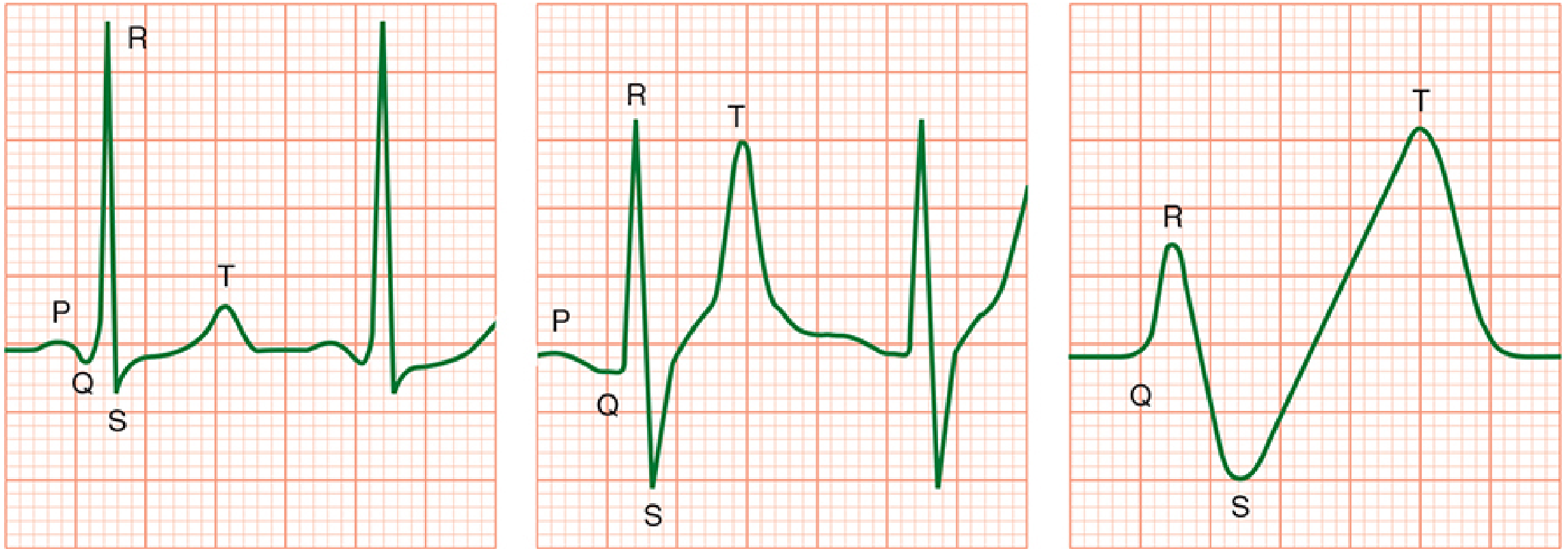
Morgan & Mikhail's Clinical Anesthesiology — Changes progress from symmetrically peaked T waves → QRS widening → loss of P wave → sine wave → ventricular fibrillation or asystole.
Harrison's Principles of Internal Medicine 22E — Classically: peaked T waves (5.5–6.5 mM), loss of P waves (6.5–7.5 mM), widened QRS (7.0–8.0 mM).
6. 💧 Hypokalemia
ECG Changes:
- U waves (prominent — the hallmark; follows T wave, best seen in V2–V3)
- Flattened or inverted T waves
- ST-segment depression
- Prolonged QU interval (often mistaken for prolonged QT)
- Severe: widened QRS, ventricular arrhythmias (VT, VF, torsades de pointes)
7. 🩺 Digoxin Toxicity / Effect
ECG Changes:
- "Reverse tick" or "Salvador Dalí moustache" ST depression — downsloping ST depression with upward concavity (digoxin effect, not toxicity)
- Shortened QT interval
- Flattened or inverted T waves
- PR prolongation (first-degree AV block)
- Toxicity: bradyarrhythmias, AV blocks (2nd/3rd degree), bidirectional VT (classic for digoxin toxicity), atrial tachycardia with AV block
8. ❤️🔥 Hypertrophic Cardiomyopathy (HCM)
ECG Changes:
- LVH criteria (Sokolow-Lyon: S in V1 + R in V5/V6 ≥35 mm)
- Deep, narrow Q waves in lateral leads (I, aVL, V5–V6) — "septal Q waves" due to abnormal septal depolarization
- T-wave inversions in lateral leads
- Left axis deviation
- Giant inverted T waves in apical variant (Yamaguchi syndrome): deep, symmetric T inversions in V4–V6
9. 🫁 Chronic Obstructive Pulmonary Disease (COPD) / Cor Pulmonale
ECG Changes:
- P pulmonale — tall, peaked P waves (>2.5 mm) in II, III, aVF (right atrial enlargement)
- Right axis deviation (>+90°)
- RVH — tall R in V1, deep S in V5–V6 (R/S ratio >1 in V1)
- Low voltage throughout (due to hyperinflated lungs)
- Clockwise rotation — persistent S waves across precordial leads (S1S2S3 pattern)
- Multifocal atrial tachycardia (MAT) — three or more distinct P-wave morphologies; highly associated with COPD
10. 🧊 Hypothermia
ECG Changes:
- Osborn (J) wave — pathognomonic: a positive deflection at the J point (junction of QRS and ST segment), best seen in V4–V6 and inferior leads; size correlates with severity of hypothermia
- Sinus bradycardia → junctional rhythm → atrial fibrillation → ventricular fibrillation (at <28°C)
- Prolongation of all intervals — PR, QRS, QT
- Muscle tremor artifact (shivering)
- Susceptibility to ventricular fibrillation with stimulation
Summary Table
| Disease | Hallmark ECG Finding |
|---|---|
| STEMI | ST elevation + Q waves (territory-specific) |
| NSTEMI/UA | ST depression + T-wave inversion |
| Pericarditis | Diffuse concave ST elevation + PR depression |
| Pulmonary Embolism | S1Q3T3 + sinus tachycardia + RBBB |
| Hyperkalemia | Peaked T waves → wide QRS → sine wave |
| Hypokalemia | Prominent U waves + T flattening |
| Digoxin | Reverse-tick ST depression + short QT |
| HCM | LVH + deep septal Q waves + lateral T inversions |
| COPD/Cor Pulmonale | P pulmonale + RAD + RVH + MAT |
| Hypothermia | Osborn (J) waves + bradycardia |
Sources: Tintinalli's Emergency Medicine, Morgan & Mikhail's Clinical Anesthesiology 7e, Harrison's Principles of Internal Medicine 22E, Braunwald's Heart Disease, Miller's Anesthesia 10e
This is a shared conversation. Sign in to Orris to start your own chat.