
Coombs test
Reading File
The Coombs test (antiglobulin test) detects antibodies or complement proteins on red blood cells (direct) or in serum (indirect). It is used to diagnose hemolytic anemias, HDN, and transfusion reactions.
Searching sources...
Finding Sources
Finding Sources
Reading File
Reading File
Reading File
Loading Image
Loading Image
Finding Sources
Reading File
Reading File
Here is a thorough overview of the Coombs test (antiglobulin test) drawn from multiple authoritative textbooks.
Coombs Test (Antiglobulin Test)
Overview
The Coombs test detects antibodies or complement proteins attached to red blood cell (RBC) surfaces. It comes in two forms - direct and indirect - each serving a distinct clinical purpose.
Direct Coombs Test (DAT - Direct Antiglobulin Test)
Principle: The patient's RBCs are washed (to remove unbound serum proteins), then incubated with antihuman immunoglobulin (anti-IgG) and/or anticomplement reagents. If antibodies or complement components (C3/C4) are already coating the RBCs in vivo, the antihuman antibody crosslinks the cells and causes visible agglutination - a positive result.
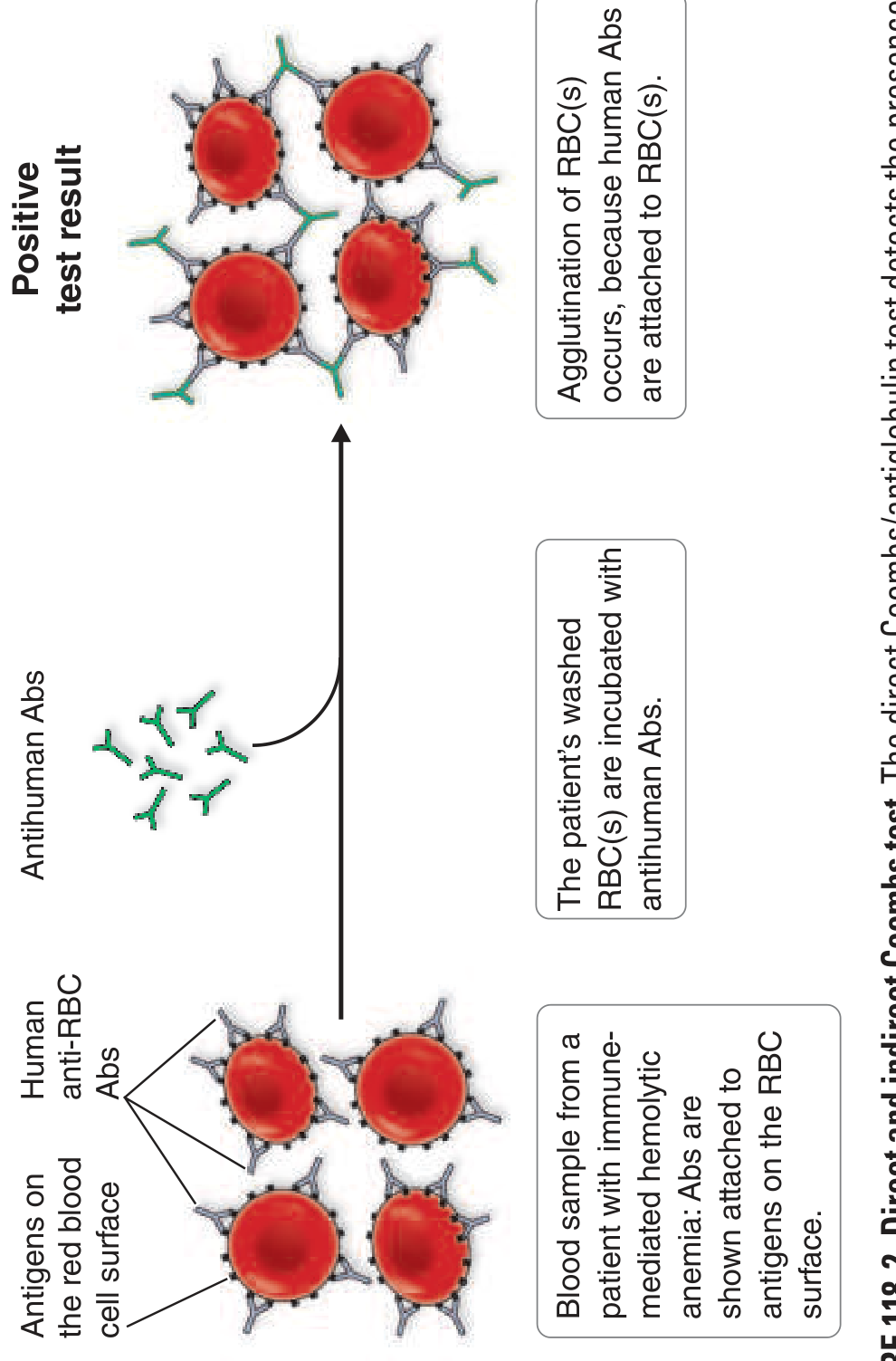
The standard antiglobulin reagent contains antibodies to all four IgG subclasses and complement components C3 and C4.
Positive DAT indicates: Antibodies or complement are bound to RBCs in the patient's circulation.
Indirect Coombs Test (IAT - Indirect Antiglobulin Test)
Principle: The patient's serum is first incubated with Rh+ test RBCs to allow any free antibodies (e.g., anti-Rh) to bind. The cells are then washed to remove unbound immunoglobulin and then treated with antihuman immunoglobulin - agglutination confirms the presence of antibodies in the serum.
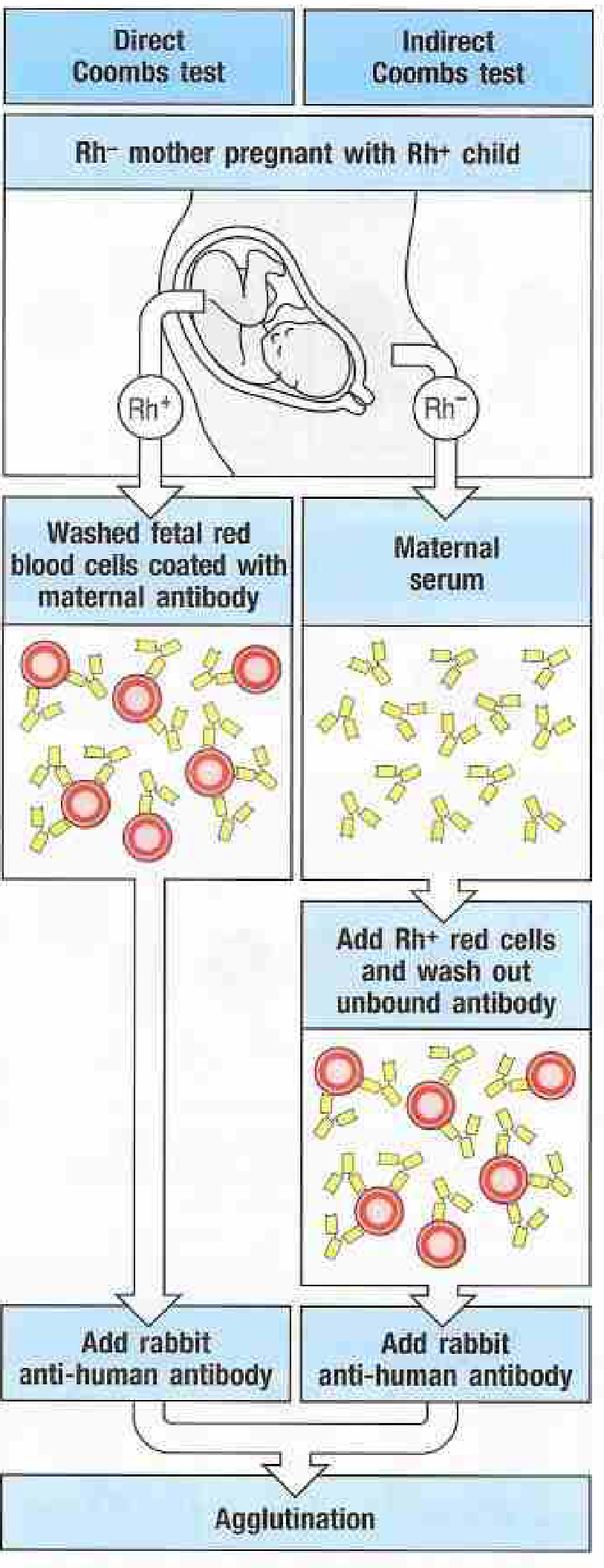
Positive IAT indicates: Free (unbound) antibodies are circulating in the patient's serum.
Clinical Uses
| Test | Primary Uses |
|---|---|
| Direct | Autoimmune hemolytic anemia (AIHA), hemolytic transfusion reactions, HDN, drug-induced hemolysis |
| Indirect | Pre-transfusion crossmatching, antenatal Rh antibody screening, detecting alloantibodies |
Causes of a Positive Direct Coombs Test
1. Autoimmune Hemolytic Anemia (AIHA)
- Warm AIHA (70-80% of AIHA cases): DAT positive for IgG alone or IgG + C3. Autoantibodies react optimally at 37°C. Hemolysis is mainly extravascular (spleen).
- Cold AIHA / Cold Agglutinin Disease (15-20% of AIHA): DAT positive for C3 only (IgG negative). Cold agglutinins detectable in serum.
- Mixed AIHA (~5%): Both warm and cold reactive antibodies.
2. Hemolytic Disease of the Newborn (HDN)
Maternal IgG anti-Rh antibodies cross the placenta and coat fetal RBCs. The direct Coombs test on washed fetal RBCs detects this coating. The indirect Coombs test on maternal serum screens for anti-Rh before hemolysis occurs in the fetus.
3. Hemolytic Transfusion Reactions
Both immediate and delayed antibody-mediated hemolytic reactions are confirmed with a positive DAT. Elevated LDH and indirect bilirubin accompany a positive result.
4. Drug-Induced Immune Hemolytic Anemia
Four mechanisms are recognized (Henry's Clinical Diagnosis):
| Mechanism | Drugs | DAT Pattern |
|---|---|---|
| Ternary complex / neoantigen | Quinine, quinidine, NSAIDs, many others | C3-positive (IgM activates complement, not detected on RBC) |
| Drug adsorption to RBC | Penicillin, cephalosporins (high dose) | IgG-positive |
| Drug-induced autoantibody | Methyldopa, levodopa, fludarabine, procainamide, immune checkpoint inhibitors (anti-PD1, anti-CTLA4) | IgG-positive (mimics warm AIHA) |
| Nonimmunologic protein adsorption | Cephalosporins (nonspecific IgG uptake) | IgG-positive (no true antibody) |
Notable: About 15% of patients on methyldopa develop a positive DAT (dose-dependent, after a 3-6 month lag), but actual hemolytic anemia occurs in <1%.
Interpretation Pitfalls
- False-positive DAT: Seen in normal blood donors and hospitalized patients (incidence varies from 1:100 to 1:15,000 depending on technique). The usual cause is nonspecific, low-avidity IgG adherence. Positive DAT in the absence of hemolysis requires cautious interpretation - SLE and B-cell lymphoid malignancies can produce true anti-RBC autoantibodies without active hemolysis.
- False-negative DAT (rare, 0-5% of AIHA): Due to low-affinity antibodies that elute off RBCs in vitro, IgA-class antibodies (not detected by standard reagent), or antibody quantities below the detection threshold.
- Interference with crossmatching: A positive DAT almost always interferes with compatibility testing; the blood bank provides "least incompatible" units.
DAT Patterns and Their Meaning
| DAT Result | Usual Interpretation |
|---|---|
| IgG only | Warm AIHA, drug adsorption (penicillin), drug-induced autoantibody |
| C3 only | Cold AIHA / cold agglutinin disease, ternary complex drug reaction |
| IgG + C3 | Warm AIHA (subset), mixed AIHA |
Sources:
- Goldman-Cecil Medicine, pp. 1688-1689
- Harrison's Principles of Internal Medicine 22E (2025), p. 954
- Janeway's Immunobiology 10e, Appendix A
- Henry's Clinical Diagnosis and Management by Laboratory Methods, pp. 988-995
- Robbins & Kumar Basic Pathology
This is a shared conversation. Sign in to Orris to start your own chat.