
Tobacco cessation months
Reading File
Tobacco cessation involves a timeline of recovery benefits that begin within minutes and continue for months to years after quitting. Here's a quick overview while I search the textbooks for more detail.
Quick Answer: After quitting tobacco, the body begins recovering almost immediately. Within 20 minutes, heart rate drops. Within months, lung function improves, circulation recovers, and cancer risk begins to fall. The most commonly cited milestones span from 20 minutes to 10-15 years post-cessation.
Searching sources...
Finding Sources
Finding Sources
Searching PubMed
"smoking cessation" AND "health benefits"
Good results. Let me pull the specific content from the most relevant sources - Fuster's Heart and Fishman's Pulmonary, which cover the timeline of cessation benefits.
Reading File
Reading File
I see a table of contents. Let me fetch the actual "Health Benefits of Smoking Cessation" section and also the cessation timeline content from Fuster's Heart.
Reading File
Finding Sources
Excellent - I have rich content from Fuster and Hurst's The Heart. Let me also get the Kaplan & Sadock synopsis content which has the specific timeline table/list.
Reading File
I now have comprehensive information from multiple authoritative textbooks. Let me also fetch the lung cancer risk graph image from Fishman's, as it's highly relevant and visually informative.
Loading Image
I now have comprehensive, authoritative content. Here is the full answer:
Tobacco Cessation: Health Benefits Over Time
Smoking cessation has significant and immediate health benefits for persons of all ages, whether or not they already have smoking-related disease. Former smokers live longer than those who continue to smoke. - Kaplan & Sadock's Synopsis of Psychiatry
Timeline of Benefits After Quitting
Within Hours to Days
- Within hours: Heart rate falls and carbon monoxide levels in the blood decrease. - Fuster and Hurst's The Heart, 15th Edition
- Within days: Platelet activation is reduced, lowering thrombotic risk. - Fuster and Hurst's The Heart, 15th Edition
At 1 Year
- Half of the excess risk of coronary heart disease (CHD) is eliminated after 1 year of cessation. The cardiovascular benefit begins almost immediately and builds rapidly. - Fuster and Hurst's The Heart, 15th Edition
- In patients who quit after a first myocardial infarction, repeat coronary event risk approaches that of nonsmokers within 3 years. - Fuster and Hurst's The Heart, 15th Edition
At 2 Years
- In patients with left ventricular dysfunction, quitting is associated with decreased morbidity and mortality within 2 years. - Fuster and Hurst's The Heart, 15th Edition
- Surgical complication risk (wound healing, infection) is reduced if cessation occurs within 2 months of surgery. - Scott-Brown's Otorhinolaryngology Head & Neck Surgery
At 3-5 Years
- Repeat coronary event risk in post-MI patients who quit reaches nonsmoker levels by 3 years. - Fuster and Hurst's The Heart, 15th Edition
- Stroke risk: former smokers nearly eliminate all excess stroke risk after 5 to 15 years. - Fuster and Hurst's The Heart, 15th Edition
At 5-15 Years
- Excess stroke risk is fully eliminated in most former smokers within this window.
- Excess lung cancer risk declines more slowly than cardiovascular risk - former smokers who quit many years ago still carry elevated risk compared to never-smokers, though the risk is substantially reduced. - Fuster and Hurst's The Heart, 15th Edition
Pregnancy-Specific Milestone
- Women who stop smoking before pregnancy or during the first 3-4 months of pregnancy reduce their risk of delivering a low-birth-weight infant to that of never-smokers. - Kaplan & Sadock's Synopsis of Psychiatry
Impact on Specific Diseases
| Disease | Benefit from Cessation |
|---|---|
| Coronary heart disease | 50% excess risk eliminated at 1 year; approaches nonsmoker risk at ~3 years post-MI |
| Stroke | Excess risk nearly eliminated at 5-15 years |
| COPD | Slower lung function decline, fewer symptoms, fewer exacerbations, lower mortality |
| Lung cancer | Risk reduction begins but former smokers retain elevated risk vs. never-smokers for decades |
| Other cancers | Reduced recurrence and development of secondary cancers |
| Cardiovascular mortality | 36% reduction in all-cause mortality vs. continued smokers (systematic review of 20 studies) |
| Post-MI mortality | 15% to 61% reduction in mortality |
- Fuster and Hurst's The Heart, 15th Edition; Fishman's Pulmonary Diseases and Disorders
Lung Cancer Risk: The Earlier, the Better
The graph below shows the cumulative risk of death from lung cancer by age, stratified by age of quitting. Quitting before age 40 reduces the risk of smoking-related premature death by ~90%. Even quitting in the 6th or 7th decade provides meaningful mortality benefit.
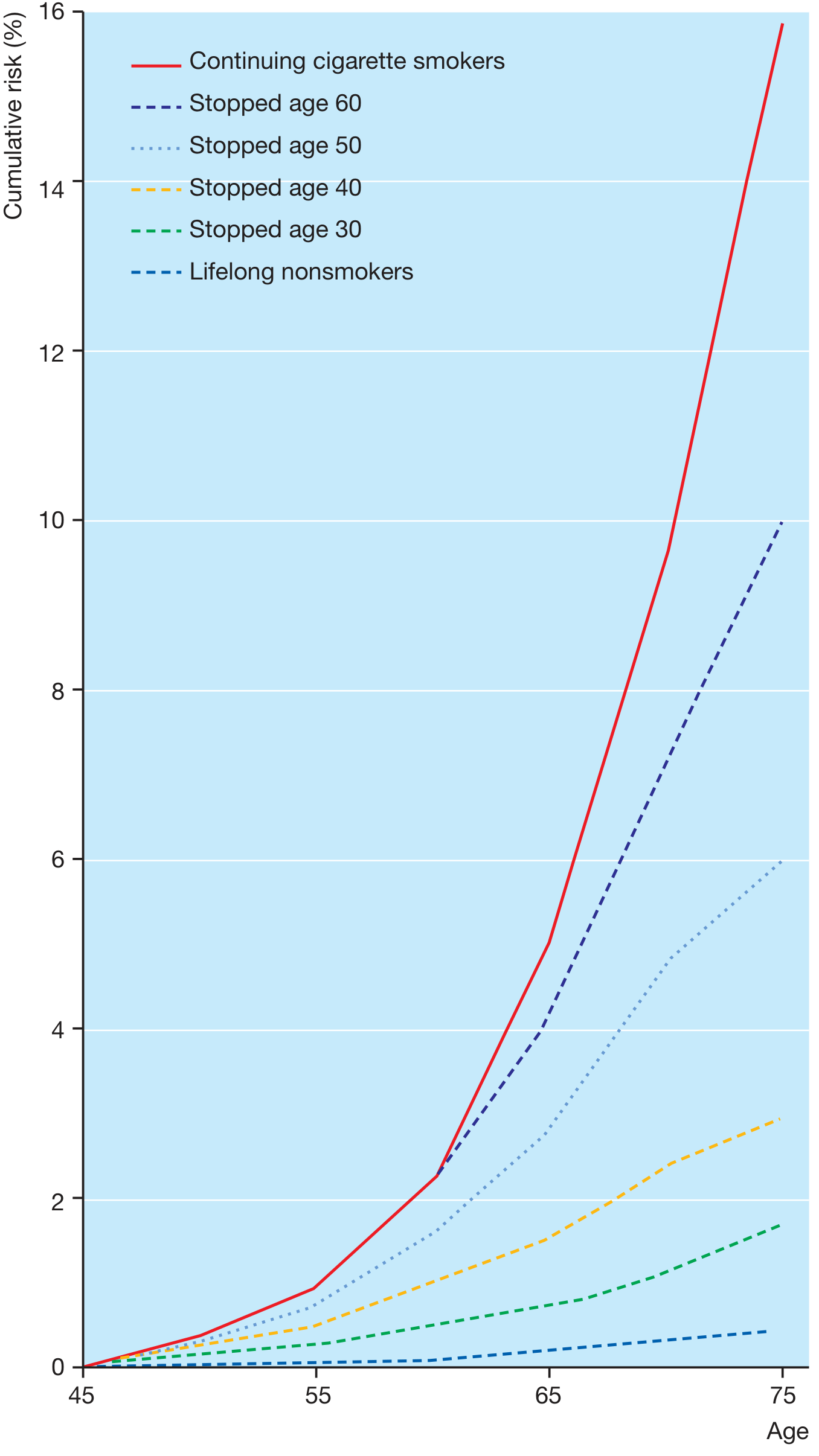
Effects of stopping smoking at various ages on cumulative risk (%) of death from lung cancer up to age 75. From Peto R et al., BMJ 2000. Reproduced in Fishman's Pulmonary Diseases and Disorders.
Pharmacotherapy Duration Note
FDA-approved cessation medications (varenicline, bupropion, nicotine replacement) have all been shown in meta-analyses and large RCTs to be more effective than placebo for promoting cessation for 6 months or more. Inpatient-initiated cessation counseling sustained through the outpatient transition increases quit rates for up to 6 months after discharge. - Fuster and Hurst's The Heart, 15th Edition
Weight Gain After Cessation
Post-cessation weight gain averages 4.4 kg in men and 5.0 kg in women at 10 years. However, the health risks of this weight gain are almost certainly outweighed by the substantial cardiovascular and oncologic benefits of quitting. - Fishman's Pulmonary Diseases and Disorders
Key message: The benefits of quitting begin within hours and compound over months and years. Cardiovascular risk falls fastest (within 1-3 years), while cancer risk reduction is slower but still clinically meaningful. There is no age at which quitting is "too late" to gain benefit.
What are the specific withdrawal symptoms and how long do they last?
See for how long tobacco stopped we will consider it as past history ( and not include in TCC)
The user is asking two things:
- Tobacco withdrawal symptoms and their duration
- A clinical coding/documentation question: after how many months of tobacco cessation is it considered "past history" and no longer recorded as Tobacco Current Consumer (TCC)?
Let me search both aspects simultaneously.
Quick Answer: Nicotine withdrawal symptoms typically peak within 24-72 hours and largely resolve within 2-4 weeks. For clinical documentation purposes, most guidelines (DSM-5, ICD) consider tobacco use as "past history" after a defined period of abstinence - commonly cited as 6 months to 1 year, though this varies by guideline.
Searching sources...
Finding Sources
Finding Sources
Searching the Web
tobacco cessation how many months considered past history TCC clinical coding guidelines
Good, now let me pull the detailed withdrawal symptoms content from the textbook sources.
Reading File
Reading File
Finding Sources
I now have all the information needed for a thorough answer on both parts of the question. Let me also get the DSM-5 withdrawal criteria from the textbook that was referenced earlier.
Reading File
I now have everything needed for a complete, authoritative answer. Here it is:
Tobacco Withdrawal: Symptoms & Duration
DSM-5 Criteria for Nicotine Withdrawal
Withdrawal requires at least 4 of the following 7 symptoms, appearing within 24 hours of abrupt cessation or significant dose reduction (after use for at least several weeks):
| # | Symptom |
|---|---|
| 1 | Irritability, frustration, or anger |
| 2 | Anxiety |
| 3 | Difficulty concentrating |
| 4 | Restlessness |
| 5 | Depressed / dysphoric mood |
| 6 | Insomnia (specifically increased awakenings and intense dreaming) |
| 7 | Increased appetite / weight gain |
Plus the hallmark symptom of cigarette craving, which is listed separately in DSM-5 but is uniformly present. - Kaplan & Sadock's Comprehensive Textbook of Psychiatry
Note: DSM-5 removed "reduced heart rate" from the criteria (present in DSM-IV), as research found it has no predictive value for cessation outcomes. - Kaplan & Sadock's Comprehensive Textbook of Psychiatry
Other common features include: coughing, constipation, mouth ulcers, and decreased performance on vigilance/attention tasks.
Duration of Withdrawal Symptoms
| Phase | Timeframe | What happens |
|---|---|---|
| Onset | Within 24 hours of last tobacco use | Symptoms begin |
| Peak | 1-3 days | Symptoms are most intense |
| Resolution of most symptoms | 2-3 weeks (up to 1 month) | Irritability, anxiety, concentration, insomnia largely resolve |
| Full withdrawal resolution | ~4-6 weeks | Withdrawal symptoms persist for 4-6 weeks in addicted individuals |
| Cravings | Up to 6 months or longer | Cigarette cravings can persist well beyond other withdrawal symptoms |
- Kaplan & Sadock's Comprehensive Textbook of Psychiatry; Fuster and Hurst's The Heart, 15th Edition; Harrison's Principles of Internal Medicine 22E
Insomnia note: Insomnia appearing in the first week post-cessation is mostly nicotine withdrawal, not a patch side effect. It typically abates within 4-7 days. - Goldman-Cecil Medicine
Severity note: Withdrawal is typically most severe with cigarette abstinence, intermediate with smokeless tobacco abstinence, and least severe with nicotine replacement product abstinence. - Kaplan & Sadock's Comprehensive Textbook of Psychiatry
When Is Tobacco Considered "Past History" (Not TCC)?
This is defined by DSM-5 remission criteria, which are also used in ICD-10-CM coding:
| Term | Definition |
|---|---|
| Early Remission | No TUD criteria met (except craving) for 3 months to < 12 months |
| Sustained Remission / Past History | No TUD criteria met (except craving) for ≥ 12 months |
- Kaplan & Sadock's Comprehensive Textbook of Psychiatry (line 1341)
- CAI Global ICD-10 coding guide
In clinical coding (ICD-10-CM):
- Current tobacco use / TCC → coded as F17.2xx (Nicotine dependence)
- Early remission (3-12 months quit) → still coded under F17.2xx "in early remission"
- Past history (≥ 12 months quit) → coded as Z87.891 (Personal history of nicotine dependence) - this is when tobacco is removed from the active problem list
Practical answer: 12 months (1 year) of abstinence is the threshold at which tobacco use transitions from an active diagnosis to past medical history in both DSM-5 and ICD-10 classification systems.
Why Cravings Last So Long
Nicotine upregulates nicotinic acetylcholine receptors in the brain. Even after withdrawal symptoms resolve, these receptor changes persist. When nicotine levels drop, addicted smokers no longer feel "normal," creating a compulsive need for the next dose - this is the biological basis of persistent cravings long after physical withdrawal is over. - Harrison's Principles of Internal Medicine 22E
This is a shared conversation. Sign in to Orris to start your own chat.