
Hypothyroidism Notes from pharmacology books
Reading File
Now let me search the library for hypothyroidism pharmacology content across multiple angles simultaneously.
Finding Sources
Finding Sources
Now let me search specifically for pharmacology books on hypothyroidism treatment and levothyroxine:
Finding Sources
Finding Sources
Excellent! I found Katzung's and Goodman & Gilman's - the two premier pharmacology textbooks. Let me now read the key sections from both simultaneously.
Reading File
Finding Sources
Now let me read the core pharmacology sections on hypothyroidism from Katzung and Goodman & Gilman simultaneously:
Reading File
Reading File
Excellent content from both books. Let me now read the Goodman & Gilman treatment section and also get the Lippincott pharmacology content:
Reading File
Finding Sources
Reading File
Reading File
Now let me get the Katzung management section and also the myxedema coma section:
Reading File
Reading File
I now have comprehensive material from Katzung's, Goodman & Gilman's, and Lippincott's pharmacology textbooks. Let me now fetch the Lippincott drug interaction diagram:
Loading Image
I now have all the content I need from three major pharmacology textbooks. Let me compile comprehensive notes.
Hypothyroidism - Pharmacology Notes
Sources: Katzung's Basic & Clinical Pharmacology 16e, Goodman & Gilman's Pharmacological Basis of Therapeutics, Lippincott Illustrated Reviews: Pharmacology
1. Definition & Overview
Hypothyroidism is a syndrome resulting from deficiency of thyroid hormones that causes a reversible slowing of all body functions. When severe, it is called myxedema. It is the most common disorder of thyroid function.
- In infants/children: striking retardation of growth and development - dwarfism and irreversible mental retardation (cretinism)
- In adults: fatigue, lethargy, cold intolerance, mental slowness, depression, dry skin, constipation, mild weight gain, fluid retention, muscle aches, irregular menses, infertility
Signs: Goiter (primary only), bradycardia, delayed relaxation phase of deep tendon reflexes, cool/dry skin, hypertension, nonpitting edema, facial puffiness
2. Etiology & Pathogenesis
| Cause | Pathogenesis | Goiter | Degree |
|---|---|---|---|
| Hashimoto thyroiditis | Autoimmune destruction of thyroid | Present early, absent later | Mild to severe |
| Drug-induced | Blocked hormone formation | Present | Mild to moderate |
| Dyshormonogenesis | Impaired T4 synthesis (enzyme deficiency) | Present | Mild to severe |
| Radiation / 131I / Thyroidectomy | Destruction or removal of gland | Absent | Severe |
| Congenital (cretinism) | Athyreosis, ectopic thyroid, iodine deficiency, TSH receptor-blocking antibodies | Absent or present | Severe |
| Secondary (TSH deficit) | Pituitary or hypothalamic disease | Absent | Mild |
Most common cause in the US: Hashimoto thyroiditis - an immunologic disorder in genetically predisposed individuals, with antithyroid antibodies (anti-TPO, anti-thyroglobulin) and lymphocyte sensitization to thyroid antigens.
Worldwide: Iodine deficiency remains the most common cause.
Drug-inducing hypothyroidism: Iodides (including amiodarone), lithium, fluoride, thioamides, aminosalicylic acid, phenylbutazone, perchlorate, ethionamide, thiocyanate, cytokines (interferons, interleukins), bexarotene, tyrosine kinase inhibitors (sunitinib, sorafenib, imatinib), HIV protease inhibitors.
3. Diagnosis
- Primary hypothyroidism: Low free T4 + elevated serum TSH (TSH is the single best test)
- Central hypothyroidism (secondary/tertiary): Low free T4 with low/normal TSH
- TSH changes precede changes in free T4 and free T3 - Goodman & Gilman's, p. 2401
4. Thyroid Hormone Preparations
Three available preparations:
| Preparation | Drug | Notes |
|---|---|---|
| T4 (thyroxine) | Levothyroxine (L-T4) | Drug of choice |
| T3 (triiodothyronine) | Liothyronine (L-T3) | Nearly 100% absorbed; shorter half-life |
| T4 + T3 combination | Liotrix | Desiccated thyroid extract also used |
5. Levothyroxine - The Drug of Choice
Why T4 over T3?
- Better tolerated than T3 preparations
- Longer half-life (~7 days) - once-daily dosing
- Steady state achieved in 6-8 weeks
- Relies on endogenous Dio1/Dio2 deiodinases to convert T4 → T3, maintaining physiological T3 levels
- More closely mimics normal thyroid gland physiology
Pharmacokinetics (Katzung's, p. 1087; Goodman & Gilman's, p. 2415-2417)
- Absorption: Best in duodenum and ileum; oral bioavailability ~70-80% (tablet); improved with liquid-filled capsules (Tirosint)
- Serum T4 peaks: 2-4 hours after oral ingestion
- Plasma half-life: ~7 days (once-daily dosing is sufficient; missing one dose has minimal effect - take double dose the next day)
- Routes: Oral (preferred); IV for myxedema coma or when oral not possible
- IV dose: ~80% of the patient's oral requirement
Absorption impaired by:
- Food (bran, soy, coffee)
- Calcium carbonate, iron supplements, antacids - separate by at least 4 hours
- Severe myxedema with ileus
- Malabsorptive states: atrophic gastritis, H. pylori gastritis, celiac disease, lactose intolerance, bariatric surgery
Best taken on an empty stomach - 30-60 minutes before meals, 4 hours after meals, or at bedtime.
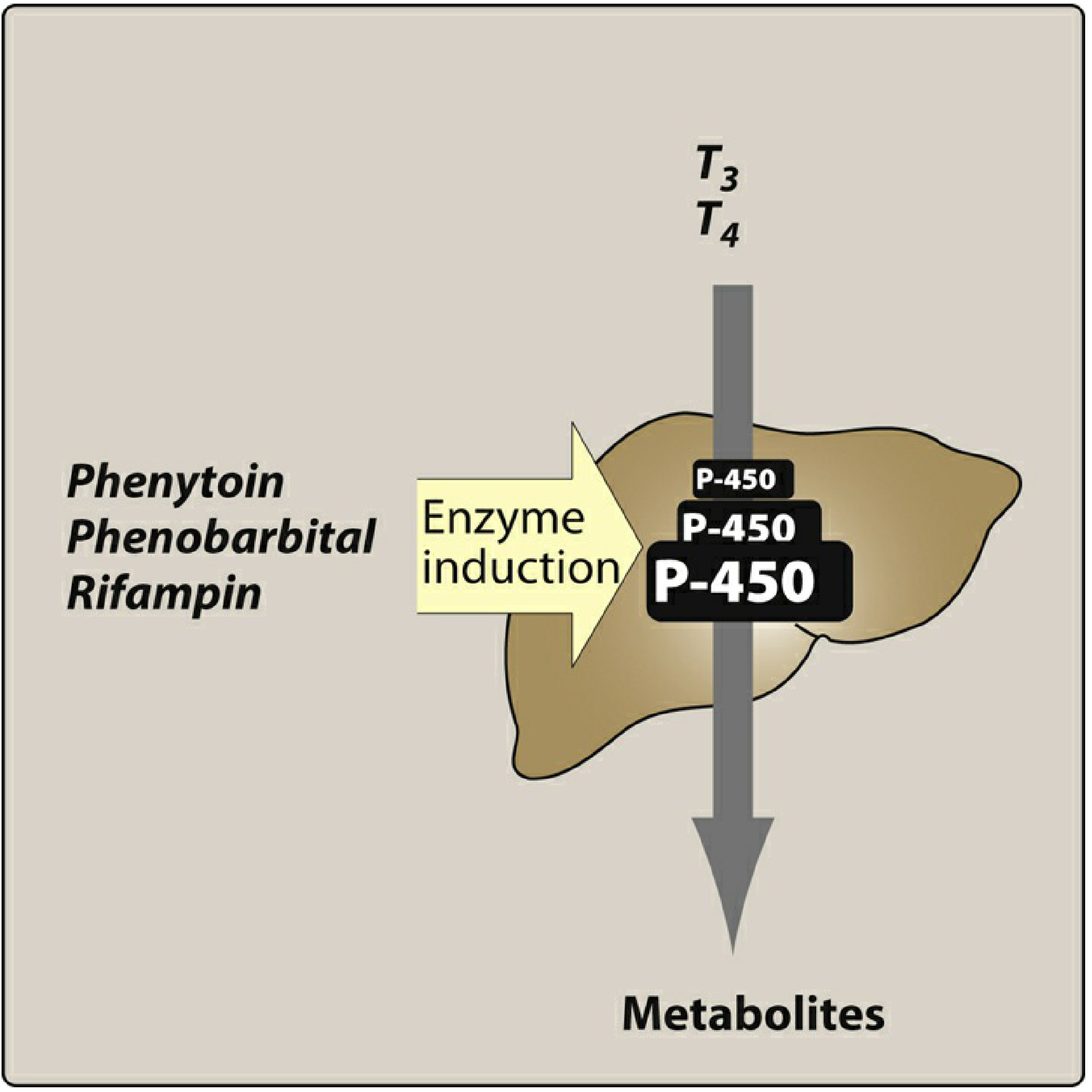
Metabolism increased by (CYP inducers):
- Rifampin, phenobarbital, carbamazepine, phenytoin, tyrosine kinase inhibitors, HIV protease inhibitors
- These require higher levothyroxine doses in patients dependent on replacement
6. Dosing Guidelines
Adults
- Average dose: 1.7 mcg/kg/day (~125 mcg/day) - based on lean body mass
- Older adults (>65 years): 1.6 mcg/kg/day (lower because body mass declines)
- Post-thyroidectomy (thyroid cancer suppression): 2.2 mcg/kg/day (supratherapeutic to suppress TSH)
Children (require more T4/kg than adults)
- 1-6 months: 10-15 mcg/kg/day
- Requirements decrease with age toward adult dosing
Starting doses - titrated by clinical context:
| Patient Type | Starting Dose | Titration |
|---|---|---|
| Young, mild disease | Full replacement immediately | - |
| Older adult (>50 yrs), no cardiac disease | 50 mcg/day | Increase gradually |
| Older adult + cardiac disease / long-standing hypothyroidism | 12.5-25 mcg/day for 2 weeks | Increase 12.5-25 mcg every 2 weeks |
| Elderly or suspected cardiac disease (Goodman & Gilman) | 12.5-50 mcg/day | Increase 25 mcg every 6 weeks |
- Follow-up blood tests: ~6 weeks after any dose change (due to 7-day T4 half-life and 6-8 week steady-state)
- Goal of therapy: Normalize TSH (primary hypothyroidism) or normalize free T4 (central hypothyroidism) + symptom relief
- Therapeutic TSH range: 0.5-2.5 mIU/L
7. Toxicity / Overtreatment Signs
Toxicity mirrors hyperthyroidism and correlates directly with hormone level:
- Children: Restlessness, insomnia, accelerated bone maturation/growth
- Adults: Nervousness, heat intolerance, palpitations, tachycardia, unexplained weight loss
- Chronic overtreatment (elderly): Atrial fibrillation and accelerated osteoporosis
8. Combination Therapy (T4 + T3)
- Multiple trials show combination levothyroxine + liothyronine is NOT superior to levothyroxine alone
- Some patients remain symptomatic on T4 alone - possibly due to genetic variations in deiodinases (Dio2 Thr92Ala polymorphism) or hormone transporters
- No long-acting liothyronine preparation exists; no T4/T3 combination matching the natural 11:1 T4:T3 secretion ratio
- Desiccated thyroid extract (DTE): A double-blind crossover study found patients who preferred DTE tended to lose weight on it
- Bottom line: Levothyroxine monotherapy recommended; combination therapy may be considered in select patients who feel unwell despite euthyroid TSH/free T4
9. Special Management Scenarios
A. Myxedema + Coronary Artery Disease
- Low thyroid hormone paradoxically protects the heart against increased demands
- Correcting myxedema too quickly risks angina, atrial fibrillation, or MI
- If coronary artery surgery is indicated, perform it BEFORE correcting myxedema
- In cardiac patients: start 12.5-25 mcg/day; if angina or arrhythmia develops - stop or reduce dose immediately
B. Myxedema Coma (Emergency)
- End state of untreated hypothyroidism: weakness, stupor, hypothermia, hypoventilation, hypoglycemia, hyponatremia, shock, death
- ICU management; mechanical ventilation may be needed
- All drugs must be given IV (poor GI absorption in myxedema)
- Treatment:
- Levothyroxine IV: loading dose 300-400 mcg, then 50-100 mcg daily
- Liothyronine (T3) IV: 5-20 mcg initial, then 2.5-10 mcg every 8 hours (adds T3 but more cardiotoxic and harder to monitor)
- Lower doses for elderly, small, or cardiac patients
- IV hydrocortisone if associated adrenal/pituitary insufficiency
- Caution with opioids and sedatives (extreme caution)
- Cautious IV fluids (avoid water overload - large pools of empty T3/T4 binding sites)
C. Hypothyroidism in Pregnancy
- Hypothyroid women often have anovulatory cycles - reduced fertility until euthyroid
- Dose must be adequate - fetal brain development depends on maternal T4 in early pregnancy
- Dose typically needs to increase ~25-30% during pregnancy (due to elevated TBG from estrogen, placental Dio3 expression, transplacental T4 transfer)
- Practical advice: Take one extra dose twice a week as soon as pregnancy is confirmed
- Separate levothyroxine from prenatal vitamins/calcium by at least 4 hours
- Target TSH:
- First trimester: 0.1-2.5 mIU/L
- Second trimester: 0.2-3.0 mIU/L
- Third trimester: 0.3-3.0 mIU/L
- Maintain total T4 at or above upper range of normal
D. Subclinical Hypothyroidism
- Defined as elevated TSH + normal free T4 levels
- Treatment decision is individualized; generally treat if TSH >10 mIU/L, symptomatic, or with goiter
E. Drug-Induced Hypothyroidism
- First step: Remove the offending agent if possible
- If the drug cannot be stopped (e.g., amiodarone for arrhythmias, lithium for bipolar): treat with levothyroxine replacement
- Amiodarone-induced hypothyroidism: levothyroxine therapy is safe and effective
10. Drug Interactions Summary (Katzung Table 38-3)
| Interaction Type | Drugs |
|---|---|
| Inhibit TSH/TRH secretion (no hypothyroidism) | Dopamine, bromocriptine, cabergoline, levodopa, corticosteroids, octreotide, metformin, heroin |
| Inhibit synthesis / cause hypothyroidism | Iodides, amiodarone, lithium, thioamides, tyrosine kinase inhibitors, HIV protease inhibitors |
| Increase TBG (raise total T4/T3, but free T4 normal) | Estrogens, tamoxifen, raloxifene, heroin, methadone, mitotane |
| Decrease TBG | Androgens, glucocorticoids, danazol |
| Displace T3/T4 from TBG (transient effect) | Salicylates, heparin (IV), furosemide (IV) |
| Increase T4/T3 metabolism (CYP inducers) | Rifampin, phenobarbital, carbamazepine, phenytoin, tyrosine kinase inhibitors |
| Impair T4 absorption | Calcium, iron, antacids, cholestyramine, soy, bran, coffee |
11. Liothyronine (T3) - When Used
- Oral bioavailability ~95% (nearly complete)
- Half-life shorter than T4
- Absorbed unaffected by mild hypothyroidism
- Used in myxedema coma as adjunct IV therapy
- For parenteral use, IV route preferred for both T4 and T3
Quick Reference Summary
| Feature | Levothyroxine (T4) |
|---|---|
| Drug of choice | Yes |
| Half-life | ~7 days |
| Steady state | 6-8 weeks |
| Dosing | Once daily, empty stomach |
| Adult dose | 1.7 mcg/kg/day |
| Elderly/cardiac | Start 12.5-25 mcg/day |
| Myxedema coma (IV) | 300-400 mcg loading, then 50-100 mcg/day |
| Pregnancy | Increase dose ~25-30% |
| Monitor | TSH (primary), free T4 (central/pregnancy) |
| Toxicity | Mirrors hyperthyroidism |
Katzung's Basic & Clinical Pharmacology 16e, p. 1087-1090 | Goodman & Gilman's Pharmacological Basis of Therapeutics, p. 2373-2482 | Lippincott Illustrated Reviews: Pharmacology, p. 782
This is a shared conversation. Sign in to Orris to start your own chat.