

Do palmistry
- Life line: Long and smoothly curved around the base of the thumb. In palmistry, this is read as steady energy, resilience, and a preference for security and close connections. It does not indicate lifespan.
- Head line: Long and slopes slightly downward across the palm. Traditionally linked with practical thinking balanced by imagination, intuition, and learning through experience.
- Heart line: Moderately defined and gently curved beneath the fingers. This is often read as someone warm but selective, who values loyalty and emotional sincerity over drama.
- Fate line: A lighter vertical line in the center suggests a career or life direction shaped more by your own choices and changes over time than by one fixed path.
- Thumb and Venus mount: The full area at the thumb base is traditionally associated with affection, sociability, and determination. Your thumb also looks flexible, suggesting adaptability rather than stubbornness.
Explain what the mounts and finger shapes symbolize
Mounts
-
Mount of Venus - the full pad at the base of your thumb
Yours appears fairly well developed. Traditionally, this symbolizes warmth, affection, physical energy, loyalty to loved ones, and enjoyment of comfort. A balanced rather than overly prominent Venus mount is often read as caring without being excessively possessive. -
Mount of Jupiter - below the index finger
This looks moderately raised. Palmistry associates it with ambition, confidence, leadership, self-respect, and the wish to grow. Moderate development is interpreted as preferring earned respect over dominating others. -
Mount of Saturn - below the middle finger
It looks balanced rather than especially high. Traditionally linked to responsibility, patience, reflection, and seriousness. A balanced Saturn mount is read as practical and dependable without becoming withdrawn. -
Mount of Apollo or Sun - below the ring finger
This area looks reasonably smooth and moderate. It symbolizes creativity, aesthetics, recognition, optimism, and the ability to appreciate beauty. A moderate mount is usually read as creative expression that does not need constant external attention. -
Mount of Mercury - below the little finger
This appears present but not overly prominent. Traditionally connected with communication, quick thinking, business sense, adaptability, and persuasion. The reading would be someone who can explain or negotiate well when needed, rather than someone constantly seeking the spotlight. -
Mount of Luna or Moon - along the outer lower palm, opposite the thumb
Yours looks moderately full. In palmistry, it represents imagination, intuition, empathy, travel, and a rich inner life. This is often interpreted as being receptive to atmosphere and other people’s moods. -
Upper Mars - outer palm between the head and heart lines
Associated with courage under pressure, restraint, and calm defense of boundaries. -
Lower Mars - inner palm near the start of the life line
Associated with stamina, assertiveness, and persistence. Your Mars areas look balanced, which palmists would read as calm strength rather than confrontation for its own sake.
Finger shapes and proportions
-
Long, fairly straight fingers
Traditionally linked with attention to detail, thoughtfulness, planning, and sensitivity to nuance. You may prefer to understand something properly before committing. -
Rounded fingertips
Your fingertips look more rounded than square or sharply pointed. In palmistry this suggests a flexible, practical, approachable style: imagination guided by common sense. Rounded tips are often associated with adapting well to people and changing circumstances. -
Middle finger as the dominant finger
This is typical anatomically, but palmistry reads a noticeably strong middle finger as responsibility, caution, and a serious approach to commitments. -
Ring finger roughly comparable to, or a little more expressive than, the index finger
Traditionally associated with creative confidence, comfort taking measured risks, and valuing appreciation for one’s work. It does not mean recklessness. -
Shorter little finger relative to the ring finger
In palmistry this is commonly read as private or selective communication early on, with greater openness once trust is established. It can suggest preferring meaningful conversation to superficial talk. -
Flexible-looking thumb with a substantial base
The thumb symbolizes willpower and judgment. A flexible thumb is read as adaptable and diplomatic; a fuller base supports the Venus reading of warmth and strong attachments.
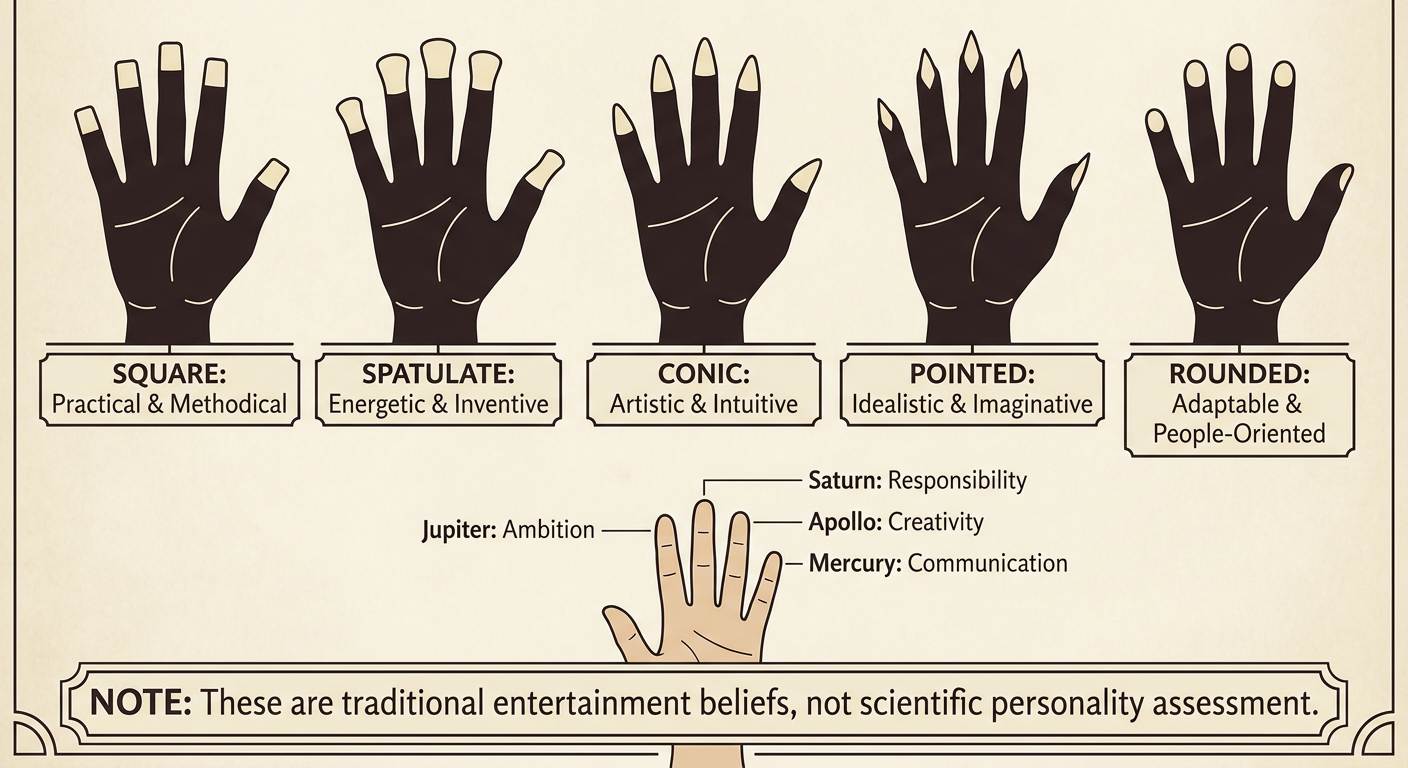
Make a visual guide to finger shapes and meanings
An educational visual guide to traditional palmistry finger shapes and their symbolic meanings, showing five clean hand-finger silhouette examples side by side: square fingertips labeled practical and methodical; spatulate fingertips labeled energetic and inventive; conic fingertips labeled artistic and intuitive; pointed fingertips labeled idealistic and imaginative; rounded fingertips labeled adaptable and people-oriented. Include a small proportional-finger diagram below showing index finger (Jupiter: ambition), middle finger (Saturn: responsibility), ring finger (Apollo: creativity), and little finger (Mercury: communication). Clearly state that these are traditional entertainment beliefs, not scientific personality assessment.
Explain the major palm lines and their symbols
Major palm lines
-
Heart line
The uppermost major line, running beneath the fingers. It symbolizes emotional expression, relationships, affection, and emotional boundaries.- Deep and clear: direct, steady feelings
- Curved: expressive and affectionate
- Straighter: more reserved or practical with emotions
- Breaks or branches: traditionally read as emotional changes or differing relationship priorities
-
Head line
The central line that travels across the palm, often beginning near the thumb and index finger. It symbolizes thinking style, learning, decision-making, and imagination.- Long: sustained focus or depth of thought
- Straight: practical, structured thinking
- Sloping downward: imaginative or intuitive thinking
- Separate from the life line at its start: independent decision-making
In your palm, it appears long with a gentle downward slope, a traditional sign of practical intelligence with imagination.
-
Life line
The curved line that arcs around the base of the thumb toward the wrist. Despite the name, it does not predict lifespan. It traditionally symbolizes vitality, stability, major life shifts, and connection to home or family.- Deep and unbroken: steadiness and resilience
- Wide arc: openness and physical drive
- Narrower arc: conserving energy or valuing personal space
- Branches: changes, travel, or new directions
Your life line looks long and curved, traditionally read as steady energy and a strong pull toward close relationships or familiar foundations.
-
Fate line
A vertical line rising from the wrist or lower palm toward the middle finger. Not everyone has a strong fate line. It symbolizes career direction, sense of purpose, and influences on one’s life path.- Strong and straight: a clear, sustained direction
- Faint or fragmented: a self-created path, changes in career, or several interests
- Beginning from the life line: direction shaped by personal effort or family foundations
Yours looks lighter, which palmists commonly interpret as a path shaped by choices and changing opportunities rather than one fixed calling.
Secondary lines often mentioned
- Sun or Apollo line: A vertical line below the ring finger. Symbolizes creative fulfillment, satisfaction, recognition, or enjoyment of one’s work.
- Mercury line: A vertical or angled line toward the little-finger side. Symbolizes communication, business aptitude, and adaptability. It is not a health diagnosis.
- Relationship lines: Small horizontal marks on the outer edge below the little finger. Traditionally associated with important bonds, not a count of marriages.
- Travel lines: Small lines along the outer lower palm, on the Mount of Moon. Traditionally associated with journeys, relocation, or a desire for new environments.
- Girdle of Venus: A curved line above the heart line, if present. Symbolizes heightened sensitivity, artistic intensity, or emotional responsiveness.