
Dry cough not suppressed with cough syrup in viral fever
Reading File
A dry cough in viral fever that doesn't respond to cough syrup is common - viral upper respiratory infections irritate the airways and cause a post-inflammatory or post-nasal drip cough that is not productive and typically doesn't respond to standard antitussives. The cough is usually self-limiting over 1-3 weeks.
Searching sources...
Finding Sources
Finding Sources
Searching PubMed
dry cough viral respiratory infection treatment
Finding Sources
Finding Sources
Reading File
Finding Sources
Reading File
Finding Sources
Finding Sources
Finding Sources
Finding Sources
Searching the Web
dry cough not responding to antitussive viral URTI management 2024
Reading Web Page
https://www1.racgp.org.au/ajgp/2022/december/viral-infection…
Loading Image
Here is a thorough breakdown of why dry cough in viral fever resists standard cough syrups, and what actually works.
Why Cough Syrup Fails in Viral Fever
The short answer: most OTC antitussives and expectorants have long failed to demonstrate benefit beyond placebo in viral upper respiratory tract infections (URTIs). The RACGP/AJGP 2022 review states plainly: "Antitussive and expectorant cough mixtures continue to be sold but have long failed to demonstrate any benefit beyond placebo." The soothing effect people feel is largely from the syrup vehicle coating the inflamed pharynx, which is the same mechanism by which honey works.
Why the Cough Persists
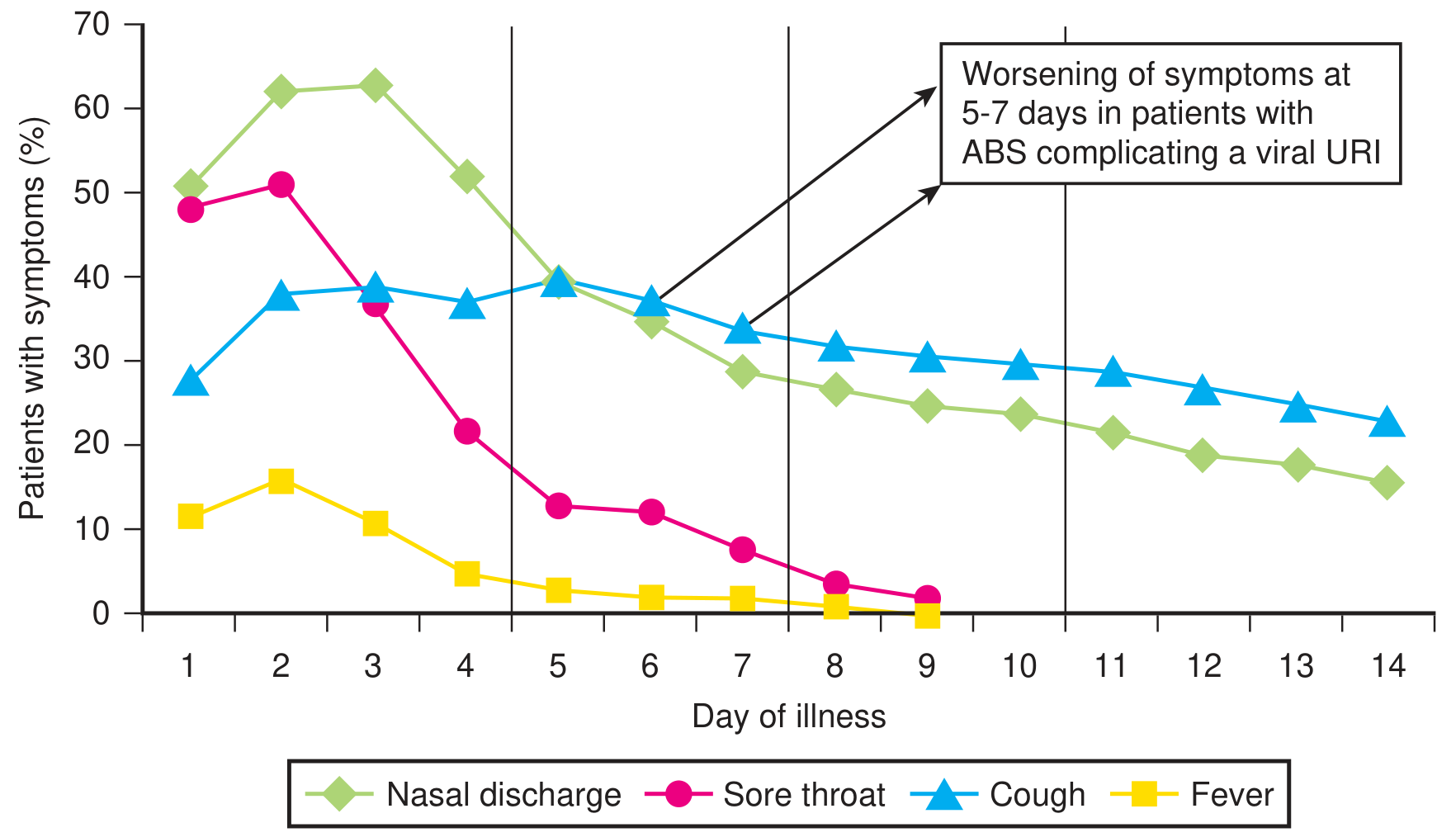
The graph below (from Textbook of Family Medicine 9e) shows that while fever and sore throat resolve within 7-9 days, cough is the last symptom to go - often lingering up to 2 weeks or more:
The underlying mechanisms:
- Viral airway inflammation - The virus directly damages respiratory epithelium, sensitizing cough receptors (C-fibers and rapidly adapting receptors). This neurogenic sensitization does not respond to antitussives.
- Post-nasal drip (PND) / Upper Airway Cough Syndrome - Viral pharyngitis and rhinosinusitis cause thick mucus to drip down the posterior pharynx, mechanically triggering cough. This is the most common cause of dry/persistent cough after a URTI. The cough is typically worse in the evening and on waking.
- Airway hyperreactivity - Viral infections transiently heighten bronchial sensitivity (similar to cough-variant asthma), causing an exaggerated cough response to even mild stimuli like cold air or talking.
- Desiccated/inflamed mucosa - Lack of mucociliary clearance and dry mucous membranes keep irritating the cough reflex.
What Actually Helps
Evidence-Supported Options
| Intervention | Evidence | Notes |
|---|---|---|
| Honey (1-2 tsp, especially at bedtime) | Moderate | Coats inflamed pharynx; comparable to or better than dextromethorphan in studies; safe in adults (not under age 1) |
| Saline nasal spray/irrigation | Good for PND cough | Restores mucociliary drainage, washes away sticky mucus from the post-nasal pathway |
| Steam inhalation / humidifier | Limited evidence | May provide temporary symptom relief by hydrating airways |
| Lozenges | Mild | Local anaesthetic/anti-inflammatory effect in pharynx |
| Zinc lozenges (≥75 mg/day, started within 24 hrs) | Some | May reduce duration of cold symptoms, including cough; heterogeneous evidence |
| Antihistamine + decongestant combination | "Some general benefit" (Cochrane) | Mainly helps with PND-driven cough by reducing mucus and congestion |
| Adequate hydration | Physiological rationale | Keeps secretions thin; no RCT evidence, but universally recommended |
What Does NOT Help
- Antibiotics - Contraindicated unless bacterial superinfection is suspected (purulent sinusitis, pneumonia). Colored sputum alone is NOT an indication.
- Oral corticosteroids - Current evidence does not support use for URI.
- Vitamin C, echinacea, garlic - Not proven to reduce duration or severity.
- Intranasal corticosteroids - No better than placebo for URTI symptom duration.
Red Flags - When to Reassess
Reconsider the diagnosis if the cough:
- Persists beyond 3 weeks (subacute cough - consider post-infectious, cough-variant asthma, or whooping cough)
- Is accompanied by hemoptysis, significant dyspnea, chest pain, or weight loss
- Worsens after initial improvement at days 5-7 (possible acute bacterial sinusitis complicating the viral URI - see the graph above)
- Occurs in someone with a history of atopy/asthma (may have triggered cough-variant asthma)
- Does not resolve by 8 weeks (chronic cough workup: GERD, asthma/NAEB, ACE inhibitor use, post-nasal drip)
Practical Management Summary
- Stop expecting the cough syrup to suppress the cough - reassure the patient it won't work pharmacologically
- Honey at bedtime (1-2 tsp) - the best-evidenced soothing agent
- Saline nasal rinse (e.g., Neti pot or saline spray) twice daily to address post-nasal drip
- Antihistamine/decongestant (e.g., loratadine + pseudoephedrine) if prominent nasal symptoms drive the cough
- Maintain hydration and humidify the room air
- Reassure that cough can last 10-14 days in an uncomplicated viral URI and is self-limiting
- Textbook of Family Medicine 9e, p. 419-420
- RACGP - Viral infections and persistent cough (2022)
- NIH/PMC - Chronic dry cough: Diagnostic and management approaches

IMG_20260729_201644886.jpg
Interpret this chest xray
analyse_media
Reading File
Chest X-Ray Interpretation
Patient: KHADEEJA K | Age: 52 years | PID: 27051
View: PA (Posteroanterior) | Date: 29 July 2026
Systematic Review
| Parameter | Finding |
|---|---|
| Technical quality | Adequate - good inspiration (~9 posterior ribs), no rotation, adequate penetration |
| Trachea | Midline, no deviation |
| Mediastinum | Normal width and contour, no widening |
| Cardiac size | Cardiothoracic ratio < 50% - normal, no cardiomegaly |
| Cardiac borders | Well-defined - right atrium, left ventricle, pulmonary trunk all normal |
| Lung fields | Both lungs clear - no consolidation, no nodules, no masses, no cavitary lesions |
| Interstitium | No reticular or interstitial thickening |
| Hila | Normal in size, position, and density bilaterally - no hilar lymphadenopathy |
| Pleural spaces | No pneumothorax (no visible pleural line) |
| Costophrenic angles | Sharp and clear bilaterally - no pleural effusion |
| Diaphragm | Both hemidiaphragms normal and dome-shaped; right slightly higher than left (normal) |
| Subdiaphragmatic | No free air under the diaphragm |
| Bony thorax | Ribs, clavicles, scapulae intact - no fractures, lytic lesions, or sclerotic changes |
| Soft tissues | Symmetrical, unremarkable |
Impression
Normal Chest X-Ray.
No active cardiopulmonary pathology identified. Specifically:
- No pneumonia or consolidation
- No pleural effusion
- No pneumothorax
- No cardiomegaly or pulmonary vascular congestion
- No suspicious lung masses or nodules
- No hilar lymphadenopathy
Clinical Correlation
Given the prior context of dry cough + viral fever in a 52-year-old female, a normal chest X-ray is reassuring and effectively:
- Rules out pneumonia (bacterial or viral)
- Rules out pleural effusion
- Rules out cardiac causes of cough (no pulmonary venous hypertension pattern)
- Supports the diagnosis of an uncomplicated viral upper respiratory tract infection
The cough is most likely arising from post-nasal drip / upper airway cough syndrome or viral airway irritation - both of which would not produce any chest X-ray changes. Management as outlined previously remains appropriate.
⚠️ Disclaimer: This AI interpretation is a clinical aid only and should be formally reviewed and reported by a qualified radiologist, correlated with full clinical history and examination findings.
This is a shared conversation. Sign in to Orris to start your own chat.