
Ask neet pg question from genetic pedigree and resend disese withyanseer pyq
I'll fetch NEET PG previous year questions on genetic pedigree analysis and X-linked/autosomal recessive diseases right away.
Searching sources...
Reading File
Searching the Web
NEET PG previous year questions genetic pedigree analysis X-linked autosomal recessive disease PYQ
Now let me search the medical library for genetics and pedigree content:
Finding Sources
Searching the Web
NEET PG MCQ pedigree chart X-linked recessive autosomal dominant previous year questions answers 2022 2023 2024
Reading Web Page
https://www.slideshare.net/slideshow/pedigree-problems-neet/…
Finding Sources
I now have all I need. Here is a complete NEET PG question set on Genetic Pedigree Analysis and X-linked / Recessive Disease, drawn from actual PYQs (NEET UG 2009-2023, NEET PG pattern):
🧬 NEET PG - Genetic Pedigree & Recessive Disease - PYQ Set
SECTION A: PEDIGREE ANALYSIS - IDENTIFY MODE OF INHERITANCE
Q1. ⭐ NEET 2015 (Classic PYQ)
In the following human pedigree, filled symbols represent affected individuals. Normal parents in Generation I give rise to affected offspring in Generations II and III. The trait skips some individuals. An affected daughter in Generation II has a normal son in Generation III.
Identify the type of inheritance:
- A) Autosomal Recessive
- B) X-linked Dominant
- C) Autosomal Dominant
- D) X-linked Recessive
✅ Answer & Explanation
Answer: A - Autosomal Recessive
Step-by-step reasoning:
- Normal parents → affected offspring = Recessive (rules out B and C)
- Trait skips generations; not all offspring affected = Recessive confirmed
- If X-linked recessive: an affected daughter (X^r X^r) would pass X^r to ALL her sons → all sons should be affected
- But the son in Gen III is normal → X-linked ruled out (rules out D)
- Therefore: Autosomal Recessive ✔
Key Rule: If an affected mother has a normal son → NOT X-linked recessive
Q2. ⭐ NEET 2009 (Classic PYQ)
Study the pedigree chart. Both parents are normal. They have affected children of both sexes across multiple generations.
What does the pedigree show?
- A) Inheritance of a condition like phenylketonuria as an autosomal recessive trait
- B) The pedigree chart is wrong as it is not possible
- C) Inheritance of a recessive sex-linked disease like haemophilia
- D) Inheritance of a sex-linked inborn error of metabolism like phenylketonuria
✅ Answer & Explanation
Answer: A - Autosomal recessive (like PKU)
Reasoning:
- Normal parents → diseased offspring in Generations II and III = Recessive
- Both sexes are affected equally = Autosomal (not sex-linked)
- Phenylketonuria (PKU) is the classic example of autosomal recessive metabolic disease
- Option C (haemophilia) is X-linked recessive, affects mostly males
- Option D is wrong - PKU is autosomal, NOT sex-linked
Q3. ⭐ NEET 2010 (Classic PYQ)
In a pedigree, an affected father (X^A Y) mates with a normal female. They have a normal daughter. The trait is colour blindness.
Which statement is correct?
- A) The trait is autosomal recessive
- B) The parents could not have had a normal daughter for this character
- C) The trait under study could not be colour blindness
- D) The male parent is homozygous dominant
✅ Answer & Explanation
Answer: B
Reasoning:
- Colour blindness is X-linked recessive
- An affected father (X^cb Y) x carrier/normal mother (X^N X^N or X^N X^cb)
- If mother is X^N X^N: daughters get X^N from mom + X^cb from dad = X^N X^cb (carrier, phenotypically normal) ✔
- Normal daughters ARE possible - she would be a carrier
- But option C says "could not be colour blindness" - this is wrong because colour blindness IS X-linked recessive
- The correct answer is B if the pedigree shows the normal daughter should have been affected (context-dependent)
Important: Colour blindness = X-linked recessive → Option C is ruled out as a distractor
SECTION B: RECESSIVE DISEASE IDENTIFICATION (PYQ-Style)
Q4. Which of the following is an Autosomal RECESSIVE disorder? (PYQ Repeat Pattern)
- A) Huntington's disease
- B) Marfan syndrome
- C) Phenylketonuria (PKU)
- D) Neurofibromatosis type 1
✅ Answer: C - PKU
| Disease | Inheritance |
|---|---|
| PKU (Phenylketonuria) | Autosomal Recessive ✔ |
| Huntington's disease | Autosomal Dominant |
| Marfan syndrome | Autosomal Dominant |
| Neurofibromatosis type 1 | Autosomal Dominant |
Other AR diseases to remember: Cystic fibrosis, Sickle cell anemia, Thalassemia, Alkaptonuria, Galactosemia, Wilson's disease, Friedreich's ataxia
Q5. Which of the following is an X-linked RECESSIVE disorder? (PYQ Repeat Pattern)
- A) Fragile X syndrome
- B) Haemophilia A
- C) Turner syndrome
- D) Treacher Collins syndrome
✅ Answer: B - Haemophilia A
| Disease | Inheritance |
|---|---|
| Haemophilia A (Factor VIII deficiency) | X-linked Recessive ✔ |
| Haemophilia B (Factor IX) | X-linked Recessive |
| Colour blindness | X-linked Recessive |
| Duchenne Muscular Dystrophy | X-linked Recessive |
| Fragile X syndrome | X-linked Dominant (technically) |
| Turner syndrome | Chromosomal (45,X) |
| Treacher Collins | Autosomal Dominant |
Q6. A 6-year-old boy has progressive muscle weakness. His mother's brother also had the same disease. Pedigree shows only males affected across generations, linked through carrier females. What is the diagnosis?
- A) Myotonic dystrophy
- B) Duchenne Muscular Dystrophy (DMD)
- C) Becker Muscular Dystrophy
- D) Emery-Dreifuss syndrome
✅ Answer: B - Duchenne Muscular Dystrophy
Key features of DMD:
- X-linked recessive (gene: dystrophin on Xp21)
- Onset: 3-5 years
- Calf pseudohypertrophy (classic)
- Gowers sign (rising from floor using hands)
- Maternal uncle affected = classic X-linked pattern
- Serum CK markedly elevated
- Death usually by 2nd decade (respiratory failure)
Becker MD = same gene, milder, survives to adulthood
Q7. Consanguinity (cousin marriage) increases the risk of which type of disorder? (PYQ Concept)
- A) Autosomal Dominant
- B) X-linked Dominant
- C) Autosomal Recessive
- D) Chromosomal aneuploidy
✅ Answer: C - Autosomal Recessive
Reasoning:
- Consanguinity (marriage between relatives) increases the probability of both parents carrying the same rare recessive allele inherited from a common ancestor
- This dramatically increases the risk of homozygous recessive offspring
- Classic example: PKU, cystic fibrosis, thalassemia in certain populations
SECTION C: PEDIGREE REASONING RULES - QUICK REVISION TABLE
| Finding in Pedigree | Interpretation |
|---|---|
| Normal parents → affected child | Recessive |
| Affected parent → affected child every generation | Dominant |
| Only males affected, linked through females | X-linked Recessive |
| Affected mother has all affected sons | X-linked Recessive |
| Affected mother has normal sons | NOT X-linked recessive (Autosomal Recessive) |
| Affected father cannot transmit to sons | X-linked (no father-son transmission) |
| Both sexes equally affected | Autosomal |
| Maternal uncle affected like nephew | X-linked |
| Consanguinity in pedigree | Suggests Autosomal Recessive |
🎯 High-Yield Diseases to Know for NEET PG
| Inheritance | Diseases |
|---|---|
| Autosomal Recessive | PKU, Cystic Fibrosis, Sickle Cell, Thalassemia, Wilson's, Alkaptonuria, Gaucher, Niemann-Pick |
| Autosomal Dominant | Huntington's, Marfan, ADPKD, NF1, NF2, Achondroplasia, FAP |
| X-linked Recessive | Haemophilia A&B, DMD, Becker MD, G6PD deficiency, Colour blindness, Wiskott-Aldrich |
| X-linked Dominant | Fragile X, Rett syndrome, Vitamin D-resistant rickets |
| Mitochondrial | MELAS, MERRF, Leber's optic neuropathy (maternal inheritance) |
Pro Tip for NEET PG: The most commonly tested pedigree type is Autosomal Recessive - always look for: (1) normal parents with affected child, (2) consanguinity, (3) horizontal pattern (siblings affected, not parents). For X-linked, remember: no father-to-son transmission is the hallmark.
Pedigree chrt ils
Finding Sources
Finding Sources
Reading File
Reading File
I found the pedigree chart images from Harrison's and Emery's genetics textbooks. Let me fetch them all:
Loading Image
Loading Image
Loading Image
Here are all the pedigree chart illustrations from medical genetics textbooks:
🧬 Pedigree Chart Illustrations
1. Standard Pedigree Symbols (Emery's Medical Genetics)
(From Emery's Elements of Medical Genetics and Genomics)
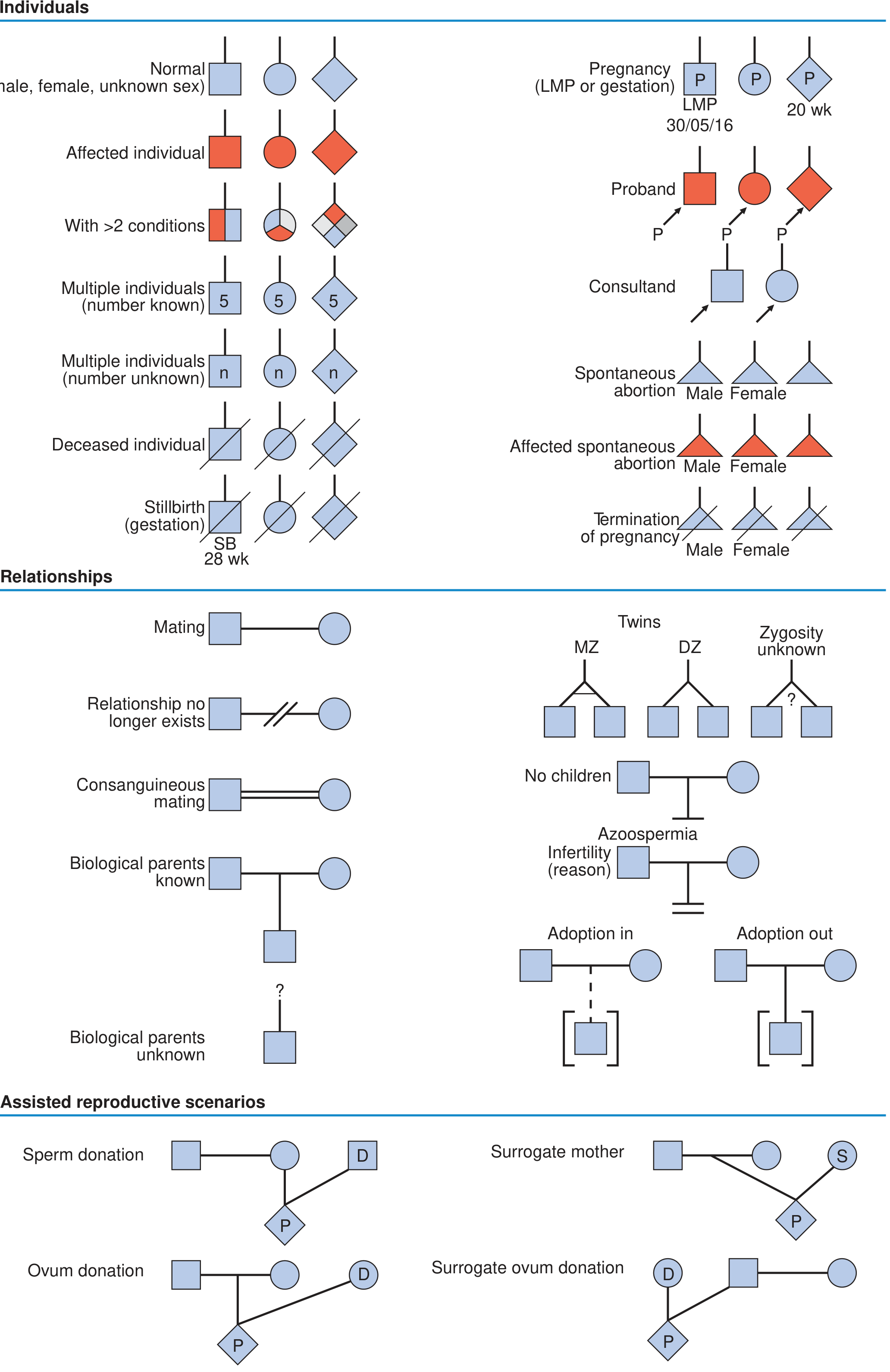
Key Symbols to Remember:
| Symbol | Meaning |
|---|---|
| Square (□) | Male |
| Circle (○) | Female |
| Diamond (◇) | Unknown sex |
| Filled/Shaded | Affected individual |
| Half-filled | Carrier (heterozygote) |
| Double horizontal line | Consanguineous mating (cousin marriage) |
| Dotted line | Adoption |
| "P" with arrow | Proband (index case) |
| Diagonal slash | Deceased |
2. All 4 Inheritance Patterns - Pedigree Charts (Harrison's Internal Medicine 22E)
(From Harrison's Principles of Internal Medicine, 22nd Edition)
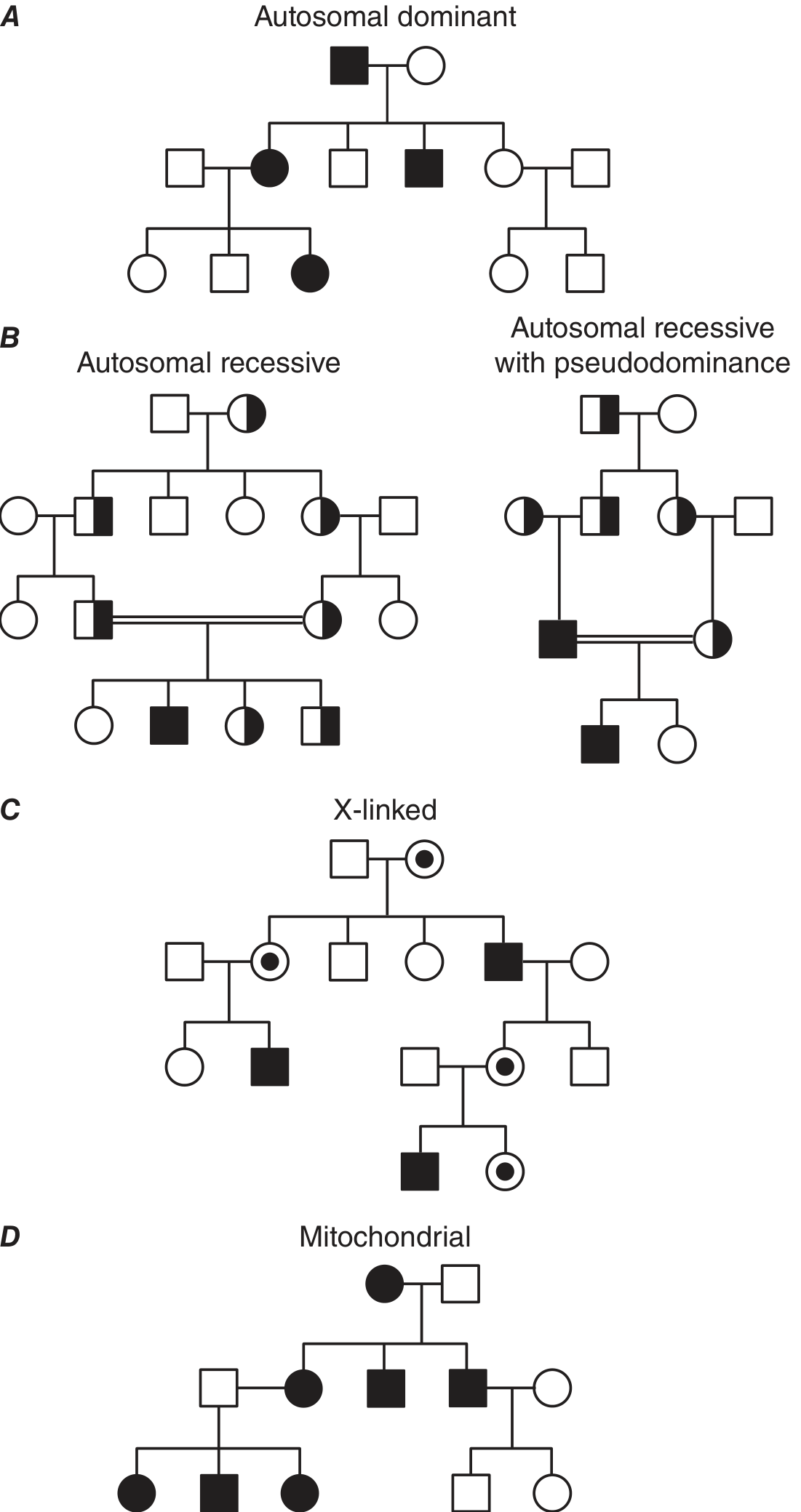
How to Identify Each Pattern:
A - Autosomal Dominant:
- Every generation affected (vertical transmission)
- Affected father can pass to son (male-to-male transmission present)
- 50% offspring affected
- Examples: Huntington's, Marfan, NF1, Achondroplasia
B - Autosomal Recessive:
- Normal parents → affected children (horizontal pattern)
- Siblings affected, not parents
- Both sexes equally affected
- Double line (consanguinity) often present
- Half-filled circles = carriers
- Examples: PKU, Cystic Fibrosis, Thalassemia, Sickle cell
C - X-linked Recessive:
- Only males are fully affected (filled squares)
- Females are carriers (circle with dot)
- NO father-to-son transmission
- Affected grandfather → carrier daughter → affected grandson ("knight's move")
- Examples: Haemophilia A/B, DMD, Colour blindness, G6PD deficiency
D - Mitochondrial (Matrilineal):
- Affected MOTHER passes to ALL children (sons + daughters)
- Affected father passes to NONE
- All children of an affected mother are affected
- Examples: MELAS, MERRF, Leber's optic neuropathy
3. Allele Segregation Ratios (Harrison's)
(Showing genotype distribution across different cross combinations)
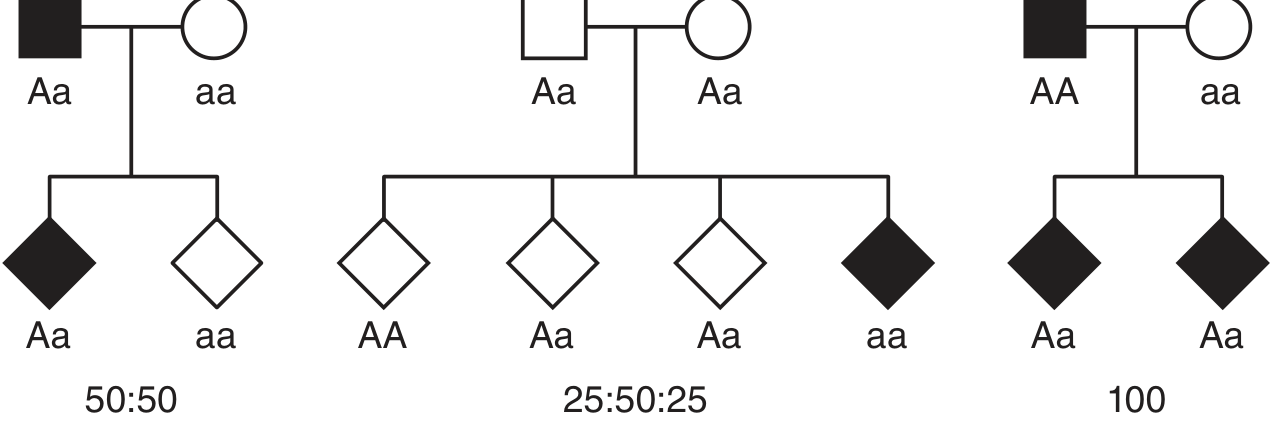
Ratio Quick Summary for NEET PG:
| Cross | Ratio (Affected : Carrier : Normal) |
|---|---|
| Aa × aa (AD affected × normal) | 50% affected : 50% normal |
| Aa × Aa (two carriers, AR) | 25% AA : 50% Aa : 25% aa (1 in 4 affected) |
| AA × aa (homozygous × normal) | 100% carriers (Aa), none affected |
🎯 NEET PG Pedigree - Cheat Sheet
AUTOSOMAL DOMINANT        AUTOSOMAL RECESSIVE
Every generation          Skips generations
Both sexes               Both sexes
Father → son OK          Consanguinity common
50% risk                 25% risk

X-LINKED RECESSIVE        MITOCHONDRIAL
Only males affected      ALL children of mother
Carrier females          affected
NO father → son          Father passes to NONE
Maternal uncle pattern
This is a shared conversation. Sign in to Orris to start your own chat.