
Anatomy of ear
Reading File
Now let me search the medical library for ear anatomy content in parallel:
Finding Sources
Finding Sources
Searching the Web
anatomy of the ear external middle inner ear structures
Good results. Now let me read the key textbook sections in parallel:
Reading File
Reading File
Reading File
Loading Image
Now let me get more detailed content on the middle ear, inner ear, and temporal bone from the textbooks:
Reading File
Finding Sources
Finding Sources
Reading File
Finding Sources
I have rich content from the textbook. Let me now read the tympanic membrane and inner ear sections:
Reading File
Reading File
I now have excellent content. Let me fetch a couple of the key textbook images and read the middle ear and inner ear sections:
Loading Image
Reading File
I now have comprehensive content from the textbooks. Let me compile the full answer:
Anatomy of the Ear
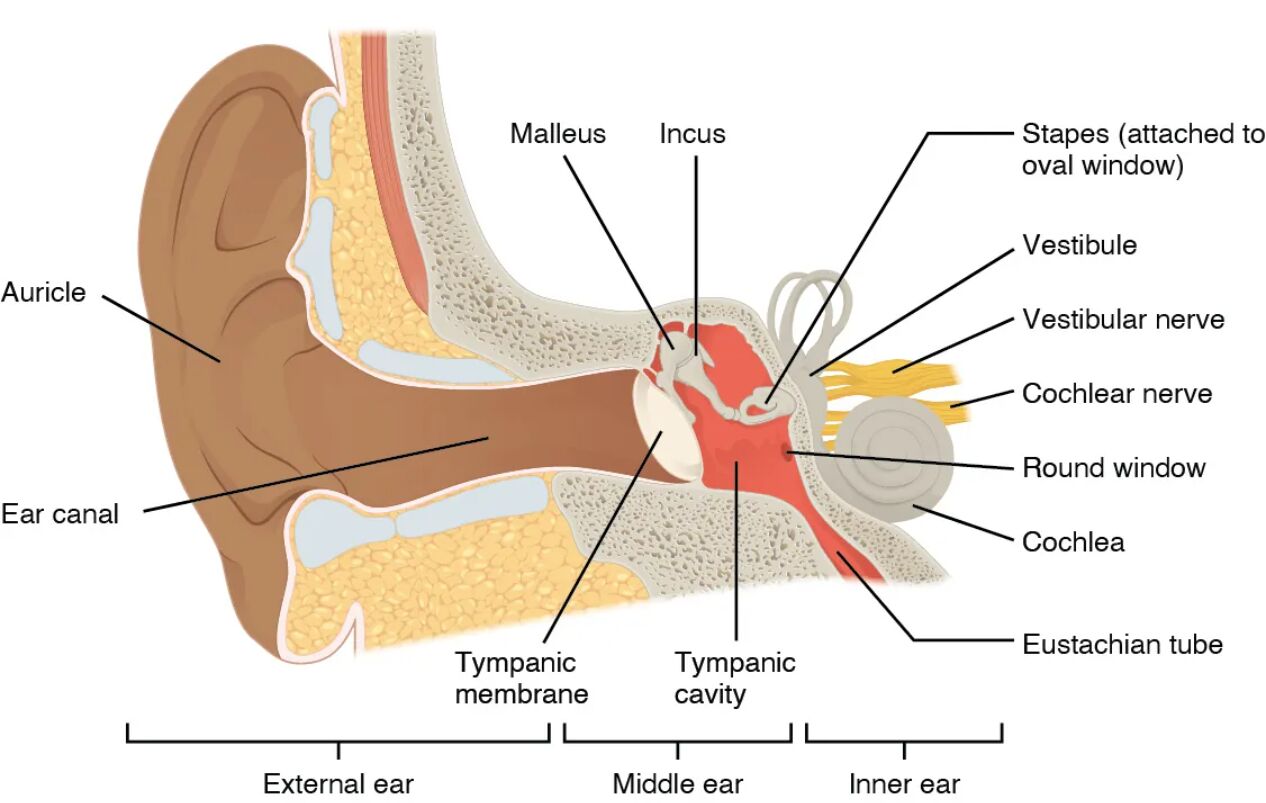
The ear is divided into three main parts: the external ear, middle ear, and inner ear. Each has distinct structures and functions in hearing and balance.
1. External Ear
The external ear captures sound waves and funnels them toward the tympanic membrane. It consists of:
Auricle (Pinna)
- A funnel-shaped cartilaginous structure covered by keratinizing squamous epithelium over a framework of elastic cartilage with perichondrium
- Intricate ridges and depressions include the helix, antihelix, tragus, antitragus, concha, and lobule
- Sebaceous glands and hair follicles are present in the subcutaneous layer; adipose tissue is restricted to the cartilage-free lobule
- Blood supply: branches of the posterior auricular and superficial temporal arteries
- Innervation: auriculotemporal nerve (V3), great auricular nerve (C2/C3), lesser occipital nerve, auricular branch of the vagus (Arnold's nerve), and facial nerve (VII)
External Auditory Canal (EAC)
- Extends from the lateral surface of the tympanic membrane (TM) to the external auditory meatus; approximately 2.5 cm long in adults
- Lateral one-third: cartilaginous skeleton with hair follicles, sebaceous glands, and apocrine glands. Cerumen (earwax) forms here - a hydrophobic, slightly acidic (pH 6.0-6.5) substance
- Medial two-thirds: surrounded by bone (tympanic part of the temporal bone), covered by thin squamous epithelium tightly adherent to bone - no glands or hair follicles
- The isthmus (bony-cartilaginous junction) is the narrowest point of the canal
- Fissures of Santorini: transverse slits in the cartilaginous canal - a pathway for spread of infection or neoplasm to surrounding soft tissue
- Foramen of Huschke: a defect in the anterior bony canal from incomplete ossification that allows disease spread to the deep lobe of the parotid gland
- Self-cleansing mechanism: squamous epithelium migrates centrifugally from the TM toward the cartilaginous portion, carrying debris outward
2. Tympanic Membrane (Eardrum)
The TM forms the medial wall of the EAC and much of the lateral wall of the middle ear space. Key features:
- A four-layered concave membrane connected centrally to the manubrium of the malleus and peripherally to the tympanic sulcus
- Two fibrous layers: an outer radiate layer inserting onto the malleus manubrium, and an inner circular layer arranged circumferentially at the periphery
- These integrate peripherally into the annular ligament anchoring the TM into the bony tympanic sulcus
- Pars tensa: the larger, thicker lower segment (has two fibrous layers)
- Pars flaccida (Shrapnell membrane): the smaller, thinner superior segment above the mallear folds; lacks a fibrous layer - clinically significant as the site of retraction pockets and cholesteatoma formation
- Umbo: the central depression where the tip of the malleus manubrium attaches
- Mallear stria: the line of the manubrium visible through the membrane
- Cone of light: a bright otoscopic reflection anteroinferior to the umbo
- Innervation: outer surface - primarily auriculotemporal nerve (V3), with contributions from CN VII and vagal auricular branch; inner surface - tympanic branch of CN IX (Jacobson's nerve)
3. Middle Ear
The middle ear is an air-filled space in the temporal bone, derived embryologically from the first pharyngeal pouch. It is spatially divided into three regions relative to the tympanic annulus:
- Hypotympanum: below the TM level
- Mesotympanum: the central space just medial to the TM; extends from the Eustachian tube (ET) opening anteriorly to the facial nerve posteriorly
- Epitympanum (attic): superior compartment; separated from the mesotympanum by the ossicular chain and mucosal folds
Ossicular Chain
The three smallest bones in the body transmit vibrations from the TM to the oval window:
| Ossicle | Key features |
|---|---|
| Malleus | Handle (manubrium) embedded in TM; head articulates with incus |
| Incus | Body articulates with malleus; long process connects to stapes; most vulnerable ossicle - single nutrient vessel, no collateral circulation |
| Stapes | Footplate covers the oval window; two crura and a head |
Muscles of the Middle Ear
- Tensor tympani: originates in the semicanal superior to the ET; inserts on the manubrium of the malleus; pulls the malleus medially to tense the TM (innervated by CN V3)
- Stapedius: originates in the pyramidal eminence; inserts on the stapes; the smallest skeletal muscle in the body; dampens loud sounds - acoustic reflex (innervated by CN VII)
Eustachian (Pharyngotympanic) Tube
- Connects the middle ear to the nasopharynx; angled approximately 45 degrees
- Proximal one-third: bony (petrous bone); distal two-thirds: fibrocartilaginous, collapsed at rest
- Opens during swallowing/yawning by contraction of tensor veli palatini (CN V3)
- The bony-cartilaginous junction is its narrowest point
- The internal carotid artery is closely related to its medial wall at the tympanic opening
Other Middle Ear Structures
- Chorda tympani: branch of CN VII carrying taste from anterior 2/3 of tongue; crosses the middle ear between malleus and incus; exits through the petrotympanic fissure
- Promontory: bulge on the medial wall overlying the basal turn of the cochlea; crossed by Jacobson's nerve (CN IX)
- Oval window (fenestra vestibuli): covered by the stapes footplate
- Round window (fenestra cochleae): allows pressure relief from cochlear fluid
- Facial nerve (CN VII): runs in the fallopian canal through the middle ear above the oval window - may be dehiscent here
4. Inner Ear (Labyrinth)
The inner ear is housed within the petrous part of the temporal bone. It consists of:
Bony Labyrinth
A series of fluid-filled (perilymph) bony cavities:
- Vestibule: central chamber containing the oval and round windows; houses the utricle and saccule
- Semicircular canals (3): superior (anterior), posterior, and lateral - detect angular acceleration
- Cochlea: a spiral structure (~2.75 turns); divided into scala vestibuli (above), scala media (cochlear duct), and scala tympani (below); connected at the apex by the helicotrema
Membranous Labyrinth
Suspended within the bony labyrinth; filled with endolymph (high K+, low Na+):
- Utricle and saccule: otolith organs in the vestibule that detect linear acceleration and head position (gravity)
- Semicircular ducts: inside the semicircular canals; each has an ampulla containing the crista ampullaris (detects rotational acceleration)
- Cochlear duct (scala media): contains the organ of Corti - the actual hearing organ, with inner and outer hair cells resting on the basilar membrane
Key Features of the Cochlea
- Basilar membrane: tonotopic organization - high frequencies encoded at the base, low frequencies at the apex
- Organ of Corti: hair cells with stereocilia in contact with the tectorial membrane; inner hair cells (single row) are the primary sensory cells; outer hair cells (3 rows) amplify signals
- Reissner's membrane: separates scala vestibuli from scala media
- Stria vascularis: maintains endolymph composition
Internal Auditory Canal (IAC)
- Contains CN VII (facial nerve) and CN VIII (vestibulocochlear nerve - divided into cochlear, superior vestibular, and inferior vestibular branches)
- The fundus of the IAC has separate foramina for each division (identified at surgery as cochlear, inferior vestibular, superior vestibular, and facial nerve openings)
5. Temporal Bone
The temporal bone houses all middle and inner ear structures. It has four embryologically distinct parts:
- Squamous part: lateral wall of the middle cranial fossa
- Mastoid part: contains air cells; site of mastoid antrum (connected to middle ear)
- Petrous part: pyramid-shaped; houses the labyrinth and IAC
- Tympanic part: forms the anterior and inferior walls of the bony EAC
Summary Table
| Region | Key Structures | Function |
|---|---|---|
| External ear | Auricle, EAC | Capture and conduct sound |
| Tympanic membrane | Pars tensa, pars flaccida | Convert sound waves to vibration |
| Middle ear | Ossicles (malleus, incus, stapes), ET, tensor tympani, stapedius | Impedance matching; amplify vibration |
| Inner ear | Cochlea (hearing), vestibule + semicircular canals (balance) | Transduce vibration/movement to neural signals |
Sources:
- Cummings Otolaryngology Head and Neck Surgery, Chapter 126 (Temporal Bone, External Ear, and Middle Ear Anatomy), p. 2443-2450
- Gray's Anatomy for Students, p. 1096
- Cummings Otolaryngology, Chapter on External Ear Diseases, p. 2648
Here is a great video covering the external and middle ear anatomy in detail:
This is a shared conversation. Sign in to Orris to start your own chat.