
natural history of disease as per k park
Reading File
The natural history of disease, as described by K. Park, refers to the course a disease takes from its earliest beginning to its final outcome (recovery, disability, or death) without any medical intervention. It forms the basis for understanding levels of prevention.
Searching sources...
Finding Sources
Finding Sources
Park's Textbook is in the library. Now let me read the full section.
Reading File
Reading File
I need to read the actual pathogenesis phase content. Let me read the section right after line 3614.
Reading File
Now let me also fetch the key diagram from Park's - the natural history of disease figure.
Loading Image
Finding Sources
I now have all the content needed for a comprehensive answer directly from Park's Textbook. Here is the full explanation:
Natural History of Disease - K. Park
(Park's Textbook of Preventive and Social Medicine, p. 46-47)
The natural history of disease refers to the way a disease evolves over time from the earliest stage of its development until it resolves - with recovery, disability, or death - in the absence of any medical intervention. The concept was described by Leavell & Clark and forms the foundation for understanding the three levels of prevention.
Disease results from a complex interaction between Man (Host), Agent, and Environment - the epidemiological triad.
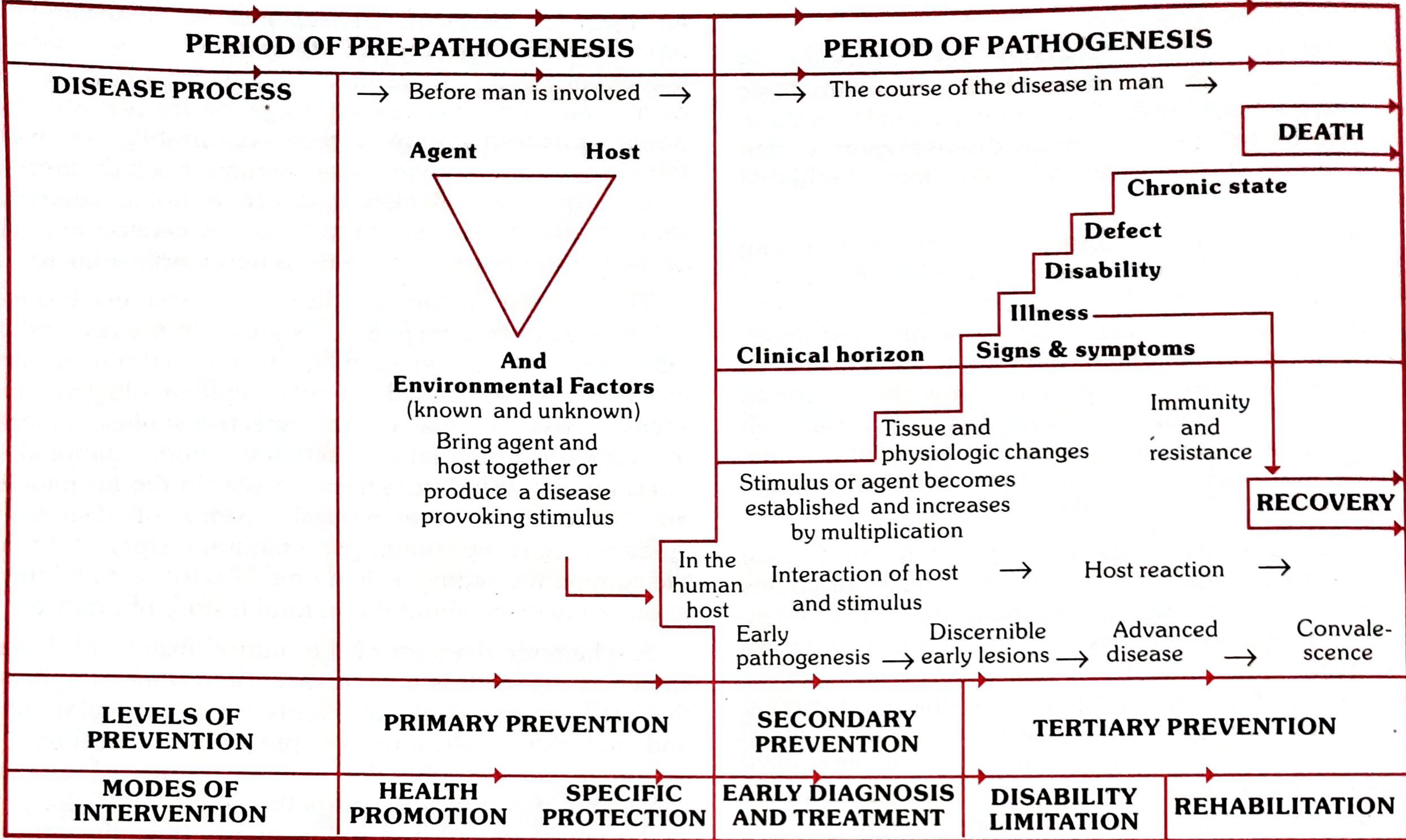
The Two Phases
Phase 1: Prepathogenesis Phase
- This is the period before the disease process begins in man. The disease agent has not yet entered the host.
- The factors that favour interaction between agent and host already exist in the environment.
- This situation is called "man in the midst of disease" or "man exposed to the risk of disease".
- Potentially, all of us are in the prepathogenesis phase of many diseases at any given time (both communicable and non-communicable).
- The three interacting factors - Agent, Host, and Environment - form the epidemiological triad. Their combined interaction (not mere presence) initiates the disease process.
Levels of Prevention applicable: Primary Prevention (Health Promotion + Specific Protection)
Phase 2: Pathogenesis Phase
This begins when the disease agent enters the susceptible host. It has two sub-phases:
A. Early Pathogenesis
- The agent establishes itself and multiplies (or the stimulus increases).
- Tissue and physiological changes begin - initially below the clinical horizon (not detectable clinically).
- In chronic diseases (e.g., coronary heart disease, hypertension, cancer), this early phase is called the presymptomatic phase - no manifest disease is yet present.
B. Late Pathogenesis (Discernible Early Lesions → Advanced Disease → Convalescence)
- The disease crosses the clinical horizon - signs and symptoms appear.
- By the time symptoms appear, the disease is already well advanced.
- The disease then progresses through:
- Illness (signs and symptoms)
- Disability
- Defect
- Chronic state
- Final outcomes: Recovery, Disability (defect/chronic state), or Death
In infectious diseases, the host's reaction to infection is not always predictable - it may be clinical or subclinical, typical or atypical, or the host may become a carrier (with or without having had clinical disease, e.g., diphtheria, hepatitis B).
Levels of Prevention applicable:
- Early pathogenesis: Secondary Prevention (Early Diagnosis and Treatment)
- Late pathogenesis / outcomes: Tertiary Prevention (Disability Limitation + Rehabilitation)
Levels of Prevention (Leavell & Clark)
| Level | Phase | Mode of Intervention |
|---|---|---|
| Primary Prevention | Prepathogenesis | Health Promotion + Specific Protection |
| Secondary Prevention | Early Pathogenesis | Early Diagnosis and Treatment |
| Tertiary Prevention | Late Pathogenesis | Disability Limitation + Rehabilitation |
Key Concepts to Remember
- Clinical horizon: The threshold below which disease is not clinically detectable. Early lesions exist below this level, which is why screening is important.
- Presymptomatic phase: Used specifically for chronic diseases - the stage where pathological changes are present but no symptoms yet.
- Incubation period: In infectious diseases, the time between entry of agent and appearance of disease.
- Agent is defined as "a substance, living or non-living, or a force, tangible or intangible, the excessive presence or relative lack of which may initiate or perpetuate a disease process."
- Agent types include: biological, nutrient, physical, chemical, mechanical, absence/insufficiency of a factor necessary to health, and social agents.
Source: Park's Textbook of Preventive and Social Medicine (ISBN 9789382219163), Chapter 1, pp. 46-47. Leavell & Clark model, originally from "Preventive Medicine for the Doctor in His Community," McGraw-Hill.
This is a shared conversation. Sign in to Orris to start your own chat.