
Lymphoma in HIV patients with MTB Negative and CD 4 count more than 200
lymphoma HIV "CD4 count" immunocompromised
Lymphoma in HIV Patients: MTB Negative, CD4 Count >200
Why Lymphoma Still Occurs at CD4 >200?
"Even in the face of effective ART, the overall rate of lymphoma in the HIV-infected population remains elevated, even in those with normal CD4+ T-cell counts. Most of the lymphomas that arise in patients with preserved CD4 T-cell counts are not associated with EBV or HHV8."
- Class switching
- Somatic hypermutation via Activation-Induced Cytidine Deaminase (AID)
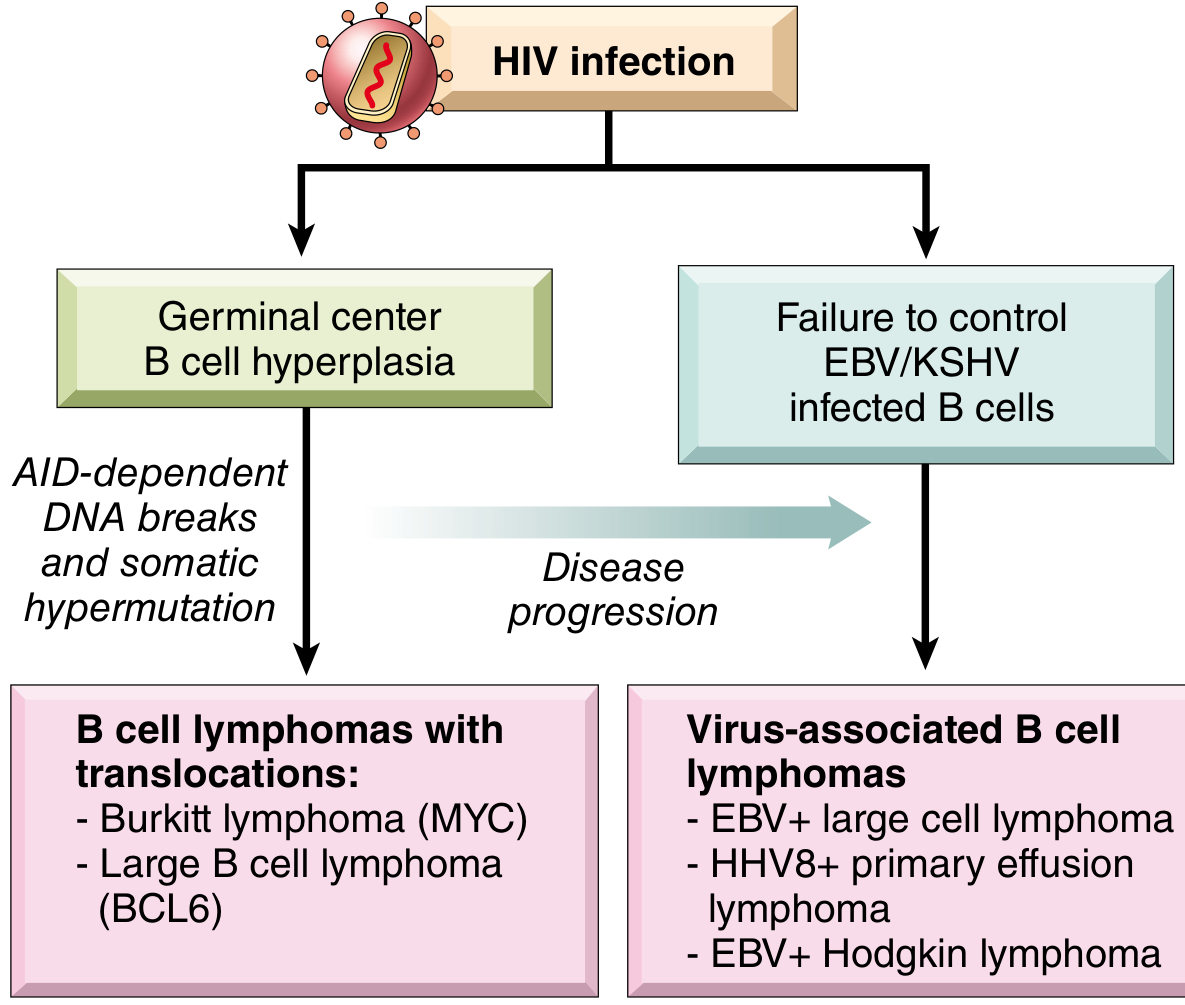
Types of Lymphoma Most Likely at CD4 >200 (MTB Negative)
| Lymphoma Type | CD4 Threshold | EBV/HHV8 | Key Features |
|---|---|---|---|
| Systemic DLBCL (immunoblastic) | Can occur at CD4 >200 (mean ~226/μL) | Often EBV- | ~60% of HIV lymphomas; extranodal common |
| Burkitt's Lymphoma | Relatively preserved CD4 | 50% EBV+ | c-MYC translocation t(8;14); most common in age 10-19 |
| Hodgkin Lymphoma | Variable; some at CD4 >200 | EBV+ (Reed-Sternberg cells) | 30-fold higher risk vs general population |
Harrison's Principles (22nd Ed., 2025): "Systemic lymphoma is seen at earlier stages of HIV infection than primary CNS lymphoma. In one series the mean CD4+ T cell count was 226/μL."
Two Pathogenic Mechanisms (Robbins & Cotran)
- Occurs early in HIV infection
- AID-dependent DNA breaks → oncogene translocations
- Produces Burkitt lymphoma (MYC translocation) and DLBCL (BCL6 translocation)
- These are EBV/HHV8-negative - more typical in patients with preserved immunity
- T-cell depletion removes EBV/KSHV surveillance
- Activated EBV-infected B-cell clones proliferate and acquire mutations
- Produces EBV+ large B-cell lymphoma, HHV8+ Primary Effusion Lymphoma (PEL), and EBV+ Hodgkin lymphoma
- More typical at lower CD4 counts
Clinical Presentation (Harrison's 22E)
- >80% present with extranodal disease (CNS, gut, orbit, lungs, bone marrow)
- B symptoms (fever, night sweats, weight loss) in ~80% of cases
- Oral cavity involvement (immunoblastic lymphoma of hard palate) is characteristic
- Ann Arbor stage is typically advanced (Stage III-IV) at presentation
- Performance status is often poor
Why MTB Negative Matters Here
- AIDS-related systemic lymphoma (especially DLBCL, Burkitt) - most likely
- Hodgkin lymphoma - do not miss; significantly elevated risk
- Multicentric Castleman disease (HHV8-associated; can mimic lymphoma)
- Primary effusion lymphoma (PEL) - presents as pleural/peritoneal effusions
Summary Table
| Feature | Detail |
|---|---|
| Incidence | ~10% of AIDS patients develop lymphoma; 10-20x general population risk |
| Most common type | DLBCL (immunoblastic) - 60% of HIV lymphomas |
| CD4 at systemic lymphoma diagnosis | Mean ~226/μL |
| CD4 at CNS lymphoma diagnosis | Median ~50/μL |
| EBV association | >50% of all HIV lymphomas; 40% per Henry's Clinical Diagnosis |
| Burkitt's incidence increase | >1000-fold vs general population |
| Hodgkin lymphoma increase | ~30-fold vs general population |
| Effect of ART | Reduced incidence but risk remains elevated even with normal CD4 |
- Robbins, Cotran & Kumar Pathologic Basis of Disease (10th Ed.), pp. 244-245 - on B-cell lymphoma pathogenesis and CD4-independent mechanism
- Harrison's Principles of Internal Medicine (22nd Ed., 2025), p. 1657 - on types, CD4 thresholds, and CNS vs systemic lymphoma
- Henry's Clinical Diagnosis and Management by Laboratory Methods - HIV-associated lymphomas section
This senario in the patient who is taking ART more than 2 years
lymphoma HIV "antiretroviral therapy" "immune reconstitution"
PMID: 40647389
Lymphoma in HIV Patient on ART >2 Years, CD4 >200, MTB Negative
The Core Paradox: Why Lymphoma Despite ART?
"Although efficiently managed by cART, chronic HIV infection remains associated with a high incidence of malignant lymphomas."
"Even in the face of effective ART, the overall rate of lymphoma in the HIV-infected population remains elevated, even in those with normal CD4+ T-cell counts."
Mechanism 1: Persistent Germinal Center Dysregulation (Most Important at CD4 >200 on ART)
- Profound germinal center B-cell hyperplasia
- Chronic AID (Activation-Induced Cytidine Deaminase) activity
- Error-prone somatic hypermutation and class switching → oncogene translocations (MYC, BCL6)
- EBV-negative, HHV8-negative
- Burkitt lymphoma (MYC translocation) or DLBCL germinal-center subtype (BCL6)
- More likely at relatively preserved CD4 counts
Goldman-Cecil Medicine: "Although the risk for HIV-associated Burkitt lymphoma increases with advancing immunodeficiency, it may be seen in patients with relatively preserved CD4 cell counts. Antiretroviral therapy reduces but does not eliminate the risk for Burkitt lymphoma in HIV-1-infected persons."
Mechanism 2: Immune Reconstitution and Unmasking (IRIS-Type Lymphoma)
Mechanism 3: Ongoing Chronic Immune Activation
- Persistent microbial translocation from the gut → chronic systemic inflammation
- Elevated IL-6, IL-10 (B-cell growth factors)
- Residual immune dysregulation
Which Lymphoma Type Is Most Likely?
| Lymphoma Type | Why on ART with CD4 >200 | EBV/HHV8 | Key Feature |
|---|---|---|---|
| Burkitt Lymphoma | Germinal center dysregulation; c-MYC translocation; occurs at preserved CD4 | 50% EBV+ | Fastest-growing tumor; t(8;14); B symptoms + rapid mass |
| DLBCL (Systemic) | Most common; germinal center or activated B-cell subtype | Variably EBV+ | Mean CD4 ~226/μL at diagnosis; extranodal common |
| Hodgkin Lymphoma | PARADOXICALLY MORE COMMON on ART - rises with immune reconstitution | EBV+ (Reed-Sternberg) | Mixed cellularity subtype; "paradox of ART" |
| Multicentric Castleman Disease (MCD) | Incidence has INCREASED in ART era | HHV8+ | Not true lymphoma but mimics it; fever, LAD, hepatosplenomegaly |
| Primary Effusion Lymphoma (PEL) | Rare; lower CD4; HHV8+EBV coinfection | EBV + HHV8 | Effusions without mass; less likely at CD4 >200 |
The ART-Era Paradox for Hodgkin Lymphoma
Harrison's 22E: Hodgkin lymphoma does not share the dramatic decrease seen with other AIDS-defining conditions in the ART era. In fact, it may increase as CD4 recovers, because the inflammatory microenvironment around Reed-Sternberg cells depends on reconstituted immune effector cells.
Harrison's: "The incidence of AIDS-associated systemic lymphomas has not experienced a dramatic decrease as a consequence of the widespread use of effective ART."
Harrison's on MCD: "While the incidence of Kaposi's sarcoma has decreased, the incidence of multicentric Castleman's disease has increased in the setting of ART."
Clinical Presentation on ART
| Feature | Detail |
|---|---|
| B symptoms | Fever, night sweats, weight loss >10% - present in ~80% |
| Extranodal disease | >80% at presentation - GI tract (~25%), bone marrow (~20%), liver/lung (~10%), CNS (~33%) |
| Rapid lymphadenopathy | Especially cervical, mediastinal, or retroperitoneal |
| Oral cavity mass | Hard palate immunoblastic lymphoma - characteristic in HIV |
| Unexplained LDH elevation | Tumor burden marker |
| CNS symptoms | Headache, focal deficits, seizures - suggest primary CNS lymphoma (but CNS lymphoma usually CD4 <100) |
Diagnostic Approach
MTB negative + CD4 >200 + on ART >2 years + lymphadenopathy/mass
                        ↓
         Lymphoma must be ACTIVELY excluded
                        ↓
    1. Excisional biopsy (preferred over FNA)
       → Histology + immunophenotype (CD20, CD10, BCL6, MUM1, Ki-67)
       → EBV (EBER in-situ hybridization)
       → HHV8 (if effusion or suspected MCD/PEL)
       → FISH for MYC, BCL2, BCL6 (double/triple hit lymphoma)
    2. Staging CT chest/abdomen/pelvis (PET-CT preferred)
    3. Bone marrow biopsy
    4. LP if any neurological symptoms (CSF EBV PCR if CNS lesion)
    5. HIV viral load + CD4 count (confirm ART efficacy)
    6. Serum LDH, uric acid, beta-2 microglobulin
Management on ART
| Lymphoma | Regimen | Notes |
|---|---|---|
| DLBCL | R-CHOP (rituximab + cyclophosphamide + doxorubicin + vincristine + prednisone) | First-line for CD20+ tumors |
| DLBCL (high-grade) | R-EPOCH (rituximab + etoposide + prednisone + vincristine + doxorubicin) | Preferred for high-grade/MYC-rearranged |
| Burkitt | Intensive regimens (CODOX-M/IVAC or DA-EPOCH-R) | Medical emergency; doubling time 24-48h |
| Primary CNS Lymphoma | High-dose methotrexate-based (NOT R-CHOP - poor BBB penetration) | + Radiation (palliative) |
| Hodgkin Lymphoma | ABVD or BEACOPP | Continue ART throughout |
KJ Lee's Otolaryngology: "The standard treatment consists primarily of chemotherapy with concurrent ART. The outcomes have improved in the ART era, with 3-year overall survival approaching 50% for all comers."
Harrison's 22E: "Response rates as high as 72% with a median survival of 33 months and disease-free intervals up to 9 years have been reported." Concerns about bone marrow toxicity overlap between ART and chemotherapy are mitigated by avoiding myelosuppressive antiretrovirals (e.g., zidovudine/AZT) during chemotherapy.
Prognosis Determinants in This Patient
- Age >60 years
- Advanced stage (III/IV)
- Elevated LDH
- Poor performance status (ECOG >1)
- More than one extranodal site
- Low CD4 at time of lymphoma diagnosis (despite being on ART)
- CD4 >200 (better immune reserve)
- Already on ART >2 years (viral suppression likely)
- MTB negative (no competing infectious burden)
- More likely to tolerate full-dose chemotherapy
Key Takeaway Points
- ART does not eliminate lymphoma risk - it reduces but does not abolish it; germinal center dysregulation from prior HIV infection persists
- Burkitt lymphoma and DLBCL are the most likely diagnoses at CD4 >200 on long-term ART - both often EBV-negative
- Hodgkin lymphoma paradoxically increases with immune reconstitution on ART
- Multicentric Castleman Disease incidence has risen in the ART era and mimics lymphoma
- Concurrent ART + chemotherapy is standard; avoid myelosuppressive ARVs (AZT) during chemo
- Outcomes are better in the ART era vs. pre-ART, with survival approaching that of HIV-negative lymphoma patients
- Robbins, Cotran & Kumar Pathologic Basis of Disease (10th Ed.), p. 244 - pathogenesis of B-cell lymphoma in HIV
- Harrison's Principles of Internal Medicine (22nd Ed., 2025), pp. 1656-1658 - lymphoma types, CD4 thresholds, treatment outcomes
- Goldman-Cecil Medicine (International Ed.) - Burkitt lymphoma on ART
- KJ Lee's Essential Otolaryngology - management regimens and survival data
- Dolcetti R et al., Cancers 2025 - PMID 40647389 - oncogenic pathways and therapeutic opportunities in ART-era HIV lymphoma
Find me some official case report based on this senario because i also want to make one case report of my patients
lymphoma HIV "antiretroviral therapy" "CD4" case report
Burkitt lymphoma HIV "ART" "preserved CD4" case report
case report lymphoma HIV patient on ART CD4 above 200 tuberculosis negative published journal
PMID: 39321241
PMID: 37744454
PMID: 34666791
PMID: 33350777
DLBCL HIV "on ART" "CD4" lymphoma case report
PMID: 35837199
"diffuse large B cell lymphoma" HIV "antiretroviral" case
plasmablastic lymphoma HIV ART "CD4" case report
PMID: 38586647
PMID: 40026931
PMID: 39651017
Published Case Reports Matching Your Scenario
⭐ MOST RELEVANT - Near-Perfect Match
1. HIV + Hodgkin Lymphoma with PRESERVED CD4 on Long-term ART (China, 2023)
- 58-year-old male, 4-year HIV history, on effective ART
- Developed Hodgkin's lymphoma + skeletal TB simultaneously
- CD4 was NOT decreased at time of lymphoma/TB diagnosis - directly contradicts the usual assumption
- Received 4 cycles of chemotherapy while continuing ART; CD4 actually increased after chemotherapy
- Key conclusion: "CD4+ T cell count may be insufficient to predict the risk of HIV-related disease, especially lymphoproliferative disorders"
2. Hodgkin's Lymphoma AFTER Starting ART - First Indian Case Report (India, 2024)
- HIV patient who developed lymphoma AFTER starting ART (immune reconstitution)
- Mixed cellularity classical Hodgkin's lymphoma - EBV-driven
- Treated with ABVD regimen concurrently with ART
- Reported as first such case from India - high publication relevance for Indian clinicians
- Your case (similar geography, similar scenario) would add to this small literature
3. EBV+ DLBCL in HIV - Spontaneous Regression with ART Alone (Malaysia, 2024)
- HIV+ patient with EBV+ DLBCL
- Shows the direct effect of ART on lymphoma biology - lymphoma regressed with cART alone (no chemo needed)
- Demonstrates how immune reconstitution via ART can itself be therapeutic
- Excellent precedent for your case's ART duration context
- Free full text available
4. Double-Hit DLBCL in HIV + Previous TB (India, 2024)
- HIV+ male, initially diagnosed with pulmonary TB, started ART
- Returned months later with DLBCL (gastric/extranodal) - TB and lymphoma sequential in same patient
- Despite cART being started early, still developed aggressive double-hit DLBCL
- Very similar clinical timeline to your patient - TB excluded/treated, then lymphoma develops
- Indian journal, open access
5. Relapsed DLBCL + Extrapulmonary TB in HIV Simultaneously (USA, 2025)
- HIV + DLBCL + TB co-existing - their diagnostic challenge mirrors your MTB-negative workup
- Highlights: IGRA has low sensitivity for TB in HIV patients (your MTB-negative result is therefore reliable)
- Emphasizes ART adherence as key to achieving DLBCL remission
- 2025 publication - very current
6. Burkitt Lymphoma + HIV + TB (Romania, 2020)
7. Primary CNS Lymphoma in HIV on HAART - Long-term Remission (Switzerland, 2021)
Summary Table for Quick Reference
| # | PMID | Lymphoma Type | CD4 at Lymphoma Dx | ART Status | TB | Journal | Year |
|---|---|---|---|---|---|---|---|
| 1 | 37744454 | Hodgkin Lymphoma | NOT decreased | On ART (4 yr) | Yes (skeletal) | Open Life Sci | 2023 |
| 2 | 39321241 | Hodgkin (Mixed Cell) | Low pre-ART | Post-ART | Not mentioned | Indian J Public Health | 2024 |
| 3 | 38586647 | EBV+ DLBCL | Not specified | Newly started ART | No | Cureus | 2024 |
| 4 | 39651017 | Double-hit DLBCL | AIDS-stage | On cART | Prior TB | Cureus | 2024 |
| 5 | 40026931 | Relapsed DLBCL | On ART | On ART | Extrapulm TB | Cureus | 2025 |
| 6 | 33350777 | Burkitt Lymphoma | Low (38/μL) | Not on ART | Active PTB | Medicine | 2020 |
| 7 | 34666791 | Primary CNS Lymphoma | Low (116/μL) | Started on Dx | No | AIDS Res Ther | 2021 |
For Writing Your Own Case Report
- HIV on ART >2 years (not a new diagnosis)
- CD4 >200 (preserved immunity - uncommon for lymphoma)
- MTB negative (ruling out the most common confounder in HIV lymphadenopathy)
- Lymphoma development despite apparent immune control