
Pleuroparenchymal fibroelastosis full details for md exams 10 marks answer
Reading File
Searching sources...
Finding Sources
Finding Sources
Searching PubMed
pleuroparenchymal fibroelastosis
Good - I have three textbook sources. Let me read all the relevant sections in parallel.
Reading File
Reading File
Reading File
Excellent - very rich data. Let me now read the remaining sections for histopathology, diagnosis criteria, treatment, and prognosis.
Reading File
Reading File
Let me get the treatment/prognosis section from Fishman's as well, and check Goldman-Cecil for any exam-relevant points:
Reading File
Finding Sources
Reading File
Loading Image
Loading Image
I now have comprehensive data from three authoritative textbooks (Murray & Nadel, Fishman's, Goldman-Cecil) plus recent PubMed reviews. Let me compile the full MD exam answer.
Pleuroparenchymal Fibroelastosis (PPFE)
A Rare Idiopathic Interstitial Pneumonia - Complete 10-Mark Answer
1. Definition and Historical Background
Pleuroparenchymal fibroelastosis (PPFE) is a rare, upper zone-predominant fibrotic lung disease characterized by visceral pleural thickening and subpleural parenchymal fibrosis with prominent elastosis.
- The term "PPFE" was first coined by Frankel in 2004, describing five patients with a previously uncategorized fibrotic pattern.
- It closely resembles Pulmonary Upper Lobe Fibrosis (PULF) described by Amitani et al. in 1992 - both are now accepted as the same entity.
- Formally recognized as an independent rare Idiopathic Interstitial Pneumonia (IIP) by the ATS/ERS consensus statement in 2013.
- Accounts for approximately 6-8% of all ILDs, though the true incidence is unknown due to lack of formal diagnostic criteria and frequent misdiagnosis.
2. Classification
PPFE falls under the Rare IIPs category in the ATS/ERS 2013 classification of Idiopathic Interstitial Pneumonias (alongside Idiopathic LIP).
It can be:
| Type | Description |
|---|---|
| Idiopathic PPFE | No identifiable cause; most common form |
| Secondary PPFE | Associated with specific conditions (see Associations below) |
3. Etiology and Associated Conditions
The etiology is largely unknown. Secondary causes and associations include:
Transplantation:
- Hematopoietic stem cell transplantation (HSCT) - most common secondary cause; resembles chronic graft-versus-host disease
- Lung transplantation
Drugs/Chemotherapy:
- Alkylating agents: carmustine, cyclophosphamide
- Amiodarone
- Bleomycin
Autoimmune/Connective Tissue Diseases:
- Rheumatoid arthritis (RA)
- Systemic sclerosis / primary Sjogren's syndrome
- Ankylosing spondylitis, ulcerative colitis
Infections:
- Recurrent pulmonary infections (strong history in most patients)
- Aspergillus, Mycobacterium avium intracellulare
Genetic:
- Familial cases described (sibling pairs), suggesting genetic predisposition
- Mutations in telomere-regulating genes (TERT - telomere reverse transcriptase; TERC - telomerase RNA) identified; associated with more progressive disease
Environmental:
- Aluminosilicate dust, asbestos exposure implicated
- No association with cigarette smoking (a key distinguishing point)
4. Epidemiology
- Age of presentation: highly variable, 8 to 87 years; bimodal distribution - smaller peak in the 3rd decade, larger peak in the 6th decade
- No sex predilection overall (some reports show female predominance especially in young patients)
- Mean time from symptom onset to diagnosis: 2-3 years
- Most patients are non-smokers with a history of recurrent pulmonary infections
5. Clinical Features
Symptoms:
- Progressive dyspnea on exertion (most common)
- Cough (may or may not be present)
- Weight loss (worsens with disease progression)
Physical Examination:
- Often normal in early disease
- Platythorax (flat chest): characteristic finding - reduced anteroposterior diameter of the thorax, visible as deepening of the suprasternal notch. Ratio of AP to transverse diameter is abnormally low. May worsen over time.
- Crackles appear when PPFE extends beyond upper zones, or when coexisting UIP/NSIP/HP is present
- Clubbing: in less than 25% of patients
Complications:
- Spontaneous pneumothorax and pneumomediastinum - can be asymptomatic and recurrent; occur in both idiopathic and secondary forms
6. Laboratory Features
- No diagnostic laboratory tests exist for PPFE
- Elevated KL-6 (Krebs von den Lungen-6) antigen in some patients
- Elevated Surfactant Protein D (SP-D) in some
- Elevated urinary desmosine (a cross-link marker of elastin) found in biopsy-proven PPFE - not yet validated for clinical use
7. Pulmonary Function Tests (PFTs)
- Restrictive ventilatory defect: reduced TLC, decreased FVC, increased FEV1/FVC ratio
- Decreased DLCO
- FVC may decline rapidly, especially in those with telomere gene mutations
- A key distinguishing feature: decrease in FVC out of proportion to DLCO (in early disease, the main defect is pleural fibrosis - extrapulmonary restriction)
- Early stages may show hypercapnia with a normal A-a oxygen gradient (because the early defect is extrapulmonary/pleural restriction, not parenchymal gas exchange impairment)
- Residual volumes may be reduced; mixed ventilatory defects also possible
- Platythorax contributes to ventilation-perfusion mismatch as disease progresses
8. Radiological Features
Chest X-Ray:
- Early disease: may be normal, or show bilateral irregular thickening of apices
- With progression: reticular and nodular opacities in upper lung fields + bilateral hilar opacities
- Lateral view: narrowed AP dimension (platythorax)
- Upward retraction of hila due to upper lobe volume loss
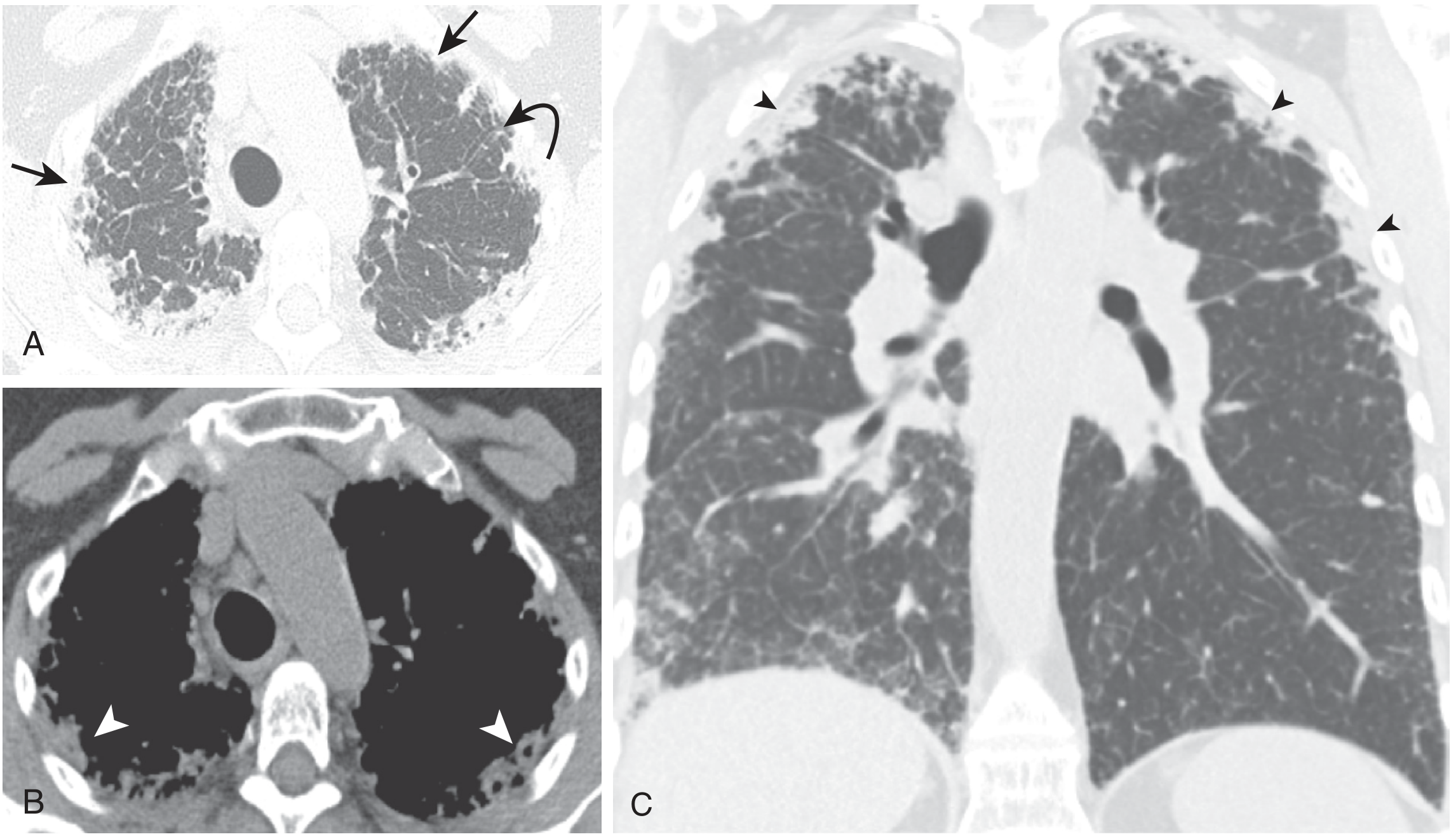
HRCT (Diagnostic Hallmark):
CT findings (Reddy et al. 2012 diagnostic criteria for definitive PPFE):
- Upper lobe pleural thickening with subpleural fibrosis (required)
- Limited lower lobe involvement (required)
- Dense subpleural consolidations with traction bronchiectasis and architectural distortion - bilaterally in upper lobes
- Thickening of the pleura adjacent to subpleural fibrotic changes
- Sharp/clear delineation between areas of fibrosis and normal lung (characteristic)
- Volume loss with upward hilar retraction
- Cysts and bullae may be present
- Coexistent lower lobe changes in UIP-like or NSIP-like pattern are increasingly reported
Key CT images from Murray & Nadel (Figure 90.12):
9. Histopathological Features
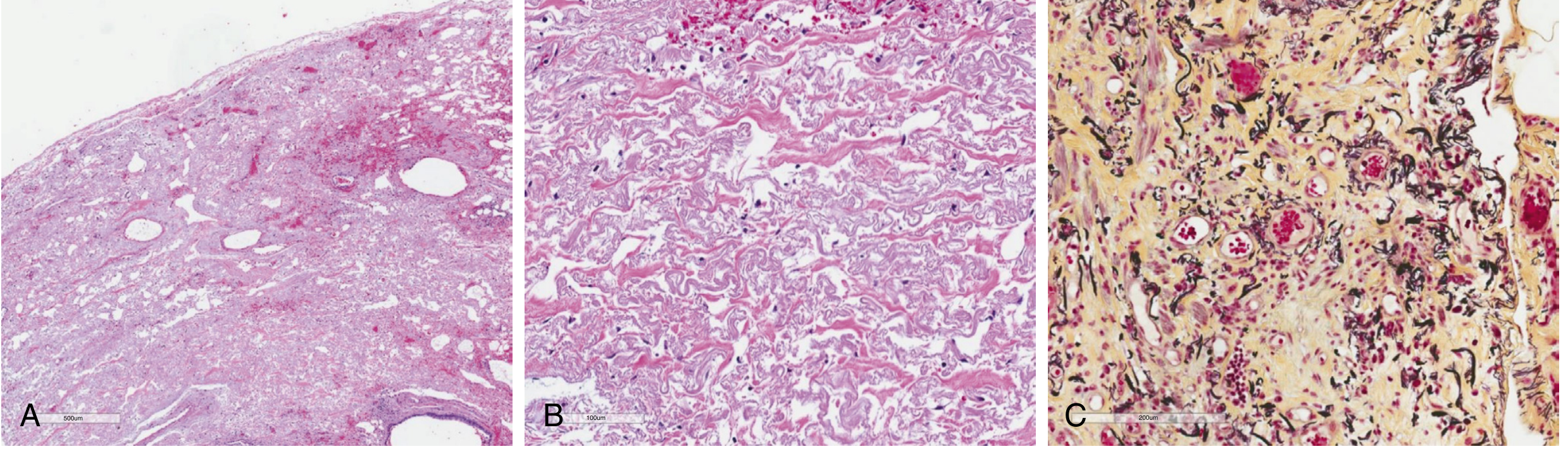
The triad of histopathological findings:
- Visceral pleural fibrosis - dense collagenous fibrosis of the visceral pleura, upper zone predominant (but all zones may be involved histologically even when not apparent on CT)
- Subpleural intra-alveolar fibrosis and elastosis (IAFE) - fibrosis of subpleural lung with septal elastosis
- Elastic fiber deposition - disordered elastic fibers with intervening collagen within alveolar septa
Key histological characteristics:
- Sharp delineation between involved subpleural region and normal lung parenchyma (homogeneous fibroelastosis)
- Rare fibroblastic foci may be present at the leading edge adjacent to normal parenchyma
- Upper lobe-predominant fibrotic and elastotic changes
- IAFE is not exclusive to PPFE (can also be seen in paraquat toxicity, radiation injury, ARDS, apical cap)
Special stains:
- H&E: Pink collagenous fibrous tissue with disordered elastic fibers
- Pentachrome (Movat) stain: mature collagen stains yellow; irregular, fragmented elastic fibers stain black
10. Diagnosis
A multidisciplinary approach is the gold standard, involving clinicians, radiologists, and pathologists with ILD expertise.
Diagnostic approach:
- Clinical history + CT findings are often sufficient for confident diagnosis
- Transbronchial biopsy or transthoracic (CT-guided) biopsy: used when clinical/imaging data are insufficient; non-surgical sampling is preferred
- Surgical lung biopsy (SLB): can be used but is often avoided due to complication risk, especially in secondary PPFE
Differential Diagnosis includes:
- Apical cap (localized fibrotic lesion vs. bilateral PPFE)
- Sarcoidosis (upper lobe predominance but different CT pattern)
- HP (can coexist)
- UIP/IPF (predominantly lower lobe)
- Post-radiation/paraquat changes
Biomarkers: KL-6, SP-D may be elevated but are nonspecific.
11. Treatment
No proven effective treatment exists for PPFE.
- Corticosteroids and immunosuppressive therapy: generally not beneficial - a case series of 12 patients showed prednisone (with or without additional immunosuppression) had no beneficial effect
- Antifibrotic drugs (pirfenidone, nintedanib): currently under investigation; no established evidence yet
- Pleurodesis: may be considered for recurrent pneumothorax
- Lung transplantation: may be required in severe, progressive disease; however, PPFE can recur post-transplant, and secondary PPFE from transplantation itself is recognized
- Supportive care: oxygen therapy, pulmonary rehabilitation
Key exam point: Standardization of diagnostic criteria and prospective research are urgently needed in this disease. - Murray & Nadel
12. Prognosis and Clinical Course
- Progressive disease in most patients
- In a series of 52 patients with idiopathic PPFE diagnosed after multidisciplinary discussion: 5-year mortality was 42%
- In patients with coexisting IIP (especially lower lobe UIP): more rapidly progressive course
- FVC decline is especially marked in patients with telomere gene abnormalities
- Some experience an indolent course; others have rapidly progressive and often fatal disease
- Recurrent pneumothorax is associated with higher morbidity
Summary Table for Quick Revision
| Feature | Key Points |
|---|---|
| Classification | Rare IIP (ATS/ERS 2013) |
| Pathology | Visceral pleural fibrosis + IAFE + elastosis; upper zone predominant |
| CT hallmark | Bilateral upper lobe subpleural consolidation + pleural thickening + sharp demarcation from normal lung |
| Key physical sign | Platythorax (flat chest) |
| PFT pattern | Restrictive; FVC drop out of proportion to DLCO; early hypercapnia with normal A-a gradient |
| Complications | Spontaneous/recurrent pneumothorax |
| Secondary causes | HSCT, lung Tx, alkylating agents, amiodarone, RA, Sjogren's, telomere gene mutations |
| Smoking | NOT associated (important negative) |
| Treatment | No proven therapy; steroids ineffective; lung Tx in severe cases |
| Prognosis | 5-year mortality ~42%; worse with coexisting UIP or telomere mutations |
| Stain | Movat pentachrome - collagen (yellow), elastin (black) |
| Biomarkers | KL-6, SP-D elevated; urinary desmosine (experimental) |
Sources:
- Murray & Nadel's Textbook of Respiratory Medicine (Chapters 90 & 112)
- Fishman's Pulmonary Diseases and Disorders (Chapter 55)
- Goldman-Cecil Medicine (Rare Interstitial Pneumonias)
- Recent reviews: Cottin V et al., Curr Opin Pulm Med 2022 [PMID 35855575]; Yamakawa H et al., J Clin Med 2024 [PMID 38999241]; Ishii H et al., Expert Rev Respir Med 2025 [PMID 40289399]
This is a shared conversation. Sign in to Orris to start your own chat.