Systemic and pulmonary hypertension from Oxford

Reading File
Finding Sources
Finding Sources
Finding Sources
Finding Sources
Finding Sources
Finding Sources
Finding Sources
Finding Sources
Finding Sources
Reading File
Reading File
Finding Sources
Finding Sources
Reading File
Reading File
Reading File
Reading File
Reading File
Reading File
Reading File
Searching Images

pulmonary hypertension classification WHO groups pathophysiology

Reading File
Searching Images

systemic hypertension blood pressure management antihypertensive drugs

Reading File
I now have comprehensive content from Braunwald's Heart Disease. I should note that the library does not contain an "Oxford" textbook specifically, but I have excellent content from Braunwald's Heart Disease and Fuster & Hurst's The Heart - the premier cardiology textbooks. Let me compile the comprehensive response now.

Note: The medical library does not contain an Oxford textbook (e.g., Oxford Handbook of Clinical Medicine or Oxford Textbook of Medicine). The content below is drawn from Braunwald's Heart Disease and Fuster & Hurst's The Heart - the two most authoritative cardiology references available, which cover these topics in greater depth than Oxford handbooks.

Systemic and Pulmonary Hypertension

SYSTEMIC HYPERTENSION

Definition and Global Burden

Elevated blood pressure is the single largest contributor to the global burden of disease and global mortality. In high-SDI countries it accounts for:
  • 45% of stroke deaths
  • 49% of ischaemic heart disease deaths
  • 17% of all global deaths
The age-standardised mean SBP worldwide is 129.4 mmHg in males and 125.8 mmHg in females. In 2019, the prevalence of high BP (SBP ≥140 or DBP ≥90 mmHg) was approximately 28% in both sexes, responsible for 235 million DALYs and 10.8 million deaths annually.
(Fuster & Hurst's The Heart, p. 52)

Epidemiology

  • Hypertension is the most common cardiovascular risk factor in older adults, with prevalence ~70% in those aged ≥75 years
  • It has the greatest population-attributable risk for CHD, cerebrovascular disease, and peripheral arterial disease
  • Over 70% of older adults presenting with MI, stroke, acute aortic syndromes, or heart failure have pre-existing hypertension
  • Hypertension is the most prevalent antecedent of heart failure, especially HFpEF, and of chronic kidney disease
  • After age 70, isolated systolic hypertension (ISH) accounts for >90% of all hypertension cases

Risk Factors and Associations

Hypertension development is strongly associated with:
  • High-sodium diet
  • Low physical activity
  • Low fruit and vegetable intake
  • Obesity
  • Excessive alcohol use
  • Socioeconomic factors (in high-SDI countries, lower socioeconomic groups and younger individuals are most likely to be untreated)
(Braunwald's Heart Disease)

Key Landmark Trials

TrialPopulationInterventionKey Result
HYVET≥80 years, SBP ≥160Indapamide to target 150/8039% ↓ fatal stroke, 21% ↓ all-cause mortality, 64% ↓ HF
SPRINT≥75 years, SBP >130Target SBP 120 vs 14034% ↓ CV events, 33% ↓ mortality
Based on SPRINT findings, the 2017 ACC/AHA Guidelines recommend a target BP ≤130 mmHg for adults ≥75 years.

Management

Non-pharmacological (first-line for mild HTN):
  • Aerobic exercise
  • Reduced body weight
  • Reduced sodium and alcohol intake
  • Stress reduction and smoking cessation
  • DASH diet (Dietary Approaches to Stop Hypertension)
Pharmacological - Four major first-line drug classes:
  1. Diuretics (thiazides/thiazide-like, e.g., indapamide)
  2. ACE inhibitors (ACEI)
  3. Angiotensin receptor blockers (ARB)
  4. Calcium channel blockers (CCB)
  • ~Two-thirds of older adults require 2 or more drugs to reach target BP
  • Combination therapy allows lower individual doses, reduced side effects, additive organ protection
  • In the elderly: start low, go slow; check standing BP (orthostatic hypotension risk)
  • In CHD patients: avoid excessive lowering of DBP below 60-65 mmHg (impairs coronary flow)
Special considerations:
  • Post-cardiac transplant: CCBs and ACEIs commonly used; calcineurin inhibitor (CNI) use leads to refractory hypertension in 92% within 5 years
  • Chronic kidney disease is worsened by CNI-mediated nephrotoxicity; target BP control is especially important
(Braunwald's Heart Disease, p. 353; Fuster & Hurst)

PULMONARY HYPERTENSION

Definition

Pulmonary hypertension (PH) is defined hemodynamically as mean pulmonary artery pressure (mPAP) ≥25 mmHg at rest. The updated definition requires mPAP >20 mmHg with pulmonary vascular resistance (PVR) >3 Wood Units.
Hemodynamic subtypes:
  • Isolated post-capillary PH: mPAP ≥25, PAWP >15, PVR ≤3 WU (passive pulmonary venous congestion)
  • Combined pre- and post-capillary PH: mPAP ≥25, PAWP >15, PVR >3 WU (structural arterial remodeling superimposed)
  • Pre-capillary (PAH): mPAP ≥25, PAWP ≤15, PVR >3 WU

WHO Clinical Classification (5 Groups)

GroupAetiology
1 - PAHIdiopathic, hereditary (BMPR2), drug/toxin-induced, associated (CTD, HIV, portal HTN, CHD, schistosomiasis)
2 - Left Heart DiseaseHFrEF, HFpEF, valvular disease
3 - Lung Disease/HypoxiaCOPD, ILD, sleep disordered breathing
4 - CTEPHChronic thromboembolic disease
5 - Unclear/MultifactorialHaematologic, systemic, metabolic disorders

Group 1: Pulmonary Arterial Hypertension (PAH)

Epidemiology and Natural History

  • Prevalence: approximately 15-52 per million population
  • Incidence: 2.4-7.1 cases per million per year
  • Female:male ratio ~1.7:1 (though men present with more severe disease, especially before age 45)
  • NIH registry (pre-treatment era): 1-, 3-, 5-year survival - 68%, 48%, 34% respectively
  • Modern era (multi-drug therapy): 3-year survival now approaches 84%
(Braunwald's Heart Disease, p. 996-998)

Subtypes of PAH

Idiopathic PAH (iPAH): Most common subtype
Hereditary PAH:
  • BMPR2 variant most common genetic risk factor - found in 70% of familial PAH and 10% of sporadic iPAH
  • BMPR2 causes: PA smooth muscle cell proliferation, endothelial dysfunction, apoptosis-resistance, dysregulated cellular metabolism
  • Other genes: ACVRL1, ENG (associated with hereditary haemorrhagic telangiectasia), EIF2AK4 (PVOD)
SSc-PAH (systemic sclerosis):
  • Most common CTD-associated PAH
  • Prevalence: at least 24 per million; affects 12-20% of SSc patients
  • Leading cause of death in SSc, mortality 4x greater than iPAH
  • RV dysfunction occurs at much lower afterload due to intrinsic RV cardiomyocyte fibrosis
Infectious causes:
  • Schistosomiasis: most common cause of pre-capillary PH in developing countries (200-300 million infected worldwide); eggs transported to pulmonary vasculature causing granulomatous remodeling
  • HIV: 0.46% of consecutive HIV+ patients have PAH by RHC; viral load >500 copies/mL and CD4 <200 cells/μL increase risk
Congenital Heart Disease: Large L→R shunts can cause pulmonary vascular remodeling (Eisenmenger syndrome); 72% of long-term CHD-PAH children in Dutch registry

Pathology

All forms of persistent PH involve pathogenic vascular remodeling:
  • Hypertrophic concentric muscularisation
  • Fibrotic and microthrombotic effacement of distal pulmonary arterioles
  • Plexogenic vasculopathy (pathognomonic for PAH): focal dense lesions with endothelial proliferation, microchannel networks, irregular SMC orientation in glomeruoid pattern - seen in iPAH, certain CHD-PAH, HIV-PAH, Schistosomiasis-PAH
  • PVOD: obliteration of small pulmonary veins by sclerotic/fibrous thickening; biallelic EIF2AK4 mutation
  • CTEPH: organised clot with heavily fibrotic intimal/medial lesions; webbing, dearborisation, collateralisation

Pathobiology

PAH involves dysregulated signalling between:
  • Pulmonary artery endothelial cells, smooth muscle cells, pericytes, and adventitial fibroblasts
Key molecular mechanisms:
  • Warburg effect: preferential lactic acid synthesis even under oxygen-rich conditions
  • Apoptosis-resistance in SMCs
  • Post-transcriptional regulation of pro-fibrotic proteins
  • Epigenetic events
  • T-cell (Treg cell) dysfunctional self-tolerance
(Braunwald's Heart Disease, p. 1000-1001)

Systemic Manifestations of PH

Chronic RV dysfunction impacts nearly all organ systems via impaired cardiac output:
  • Renal failure (acute or chronic exacerbation)
  • Leaky bowel syndrome (gut oedema)
  • Volitional muscle atrophy including diaphragmatic weakness
  • Cognitive impairment
  • Hepatic congestion from elevated right atrial pressure
  • Neurohumoral overactivation: elevated catecholamines, secondary hyperaldosteronism
  • Depression, diabetes mellitus, metabolic syndrome as tertiary consequences
  • Thrombocytopenia in ~20% of PAH patients
  • Thyroid dysfunction in ~25% of iPAH
(Braunwald's Heart Disease, p. 997-998)

Clinical Presentation

Symptoms (nonspecific - median 2+ year delay to diagnosis):
  • Dyspnoea on exertion (most common)
  • Fatigue, weakness
  • Abdominal distension, lower limb oedema
  • Bendopnea (dyspnoea on bending)
  • Syncope, chest pain - high-risk presentations indicating PAH emergency (severely impaired CO or RV ischaemia)
Physical Examination:
  • Loud or paradoxical P2 (accentuated pulmonic closure)
  • Right-sided S3
  • RV heave/lift
  • ↑ Jugular venous pressure
  • Pulsatile liver
  • Cor pulmonale (end-stage): systemic hypotension, cool extremities, mental status changes

PAH vs. PVOD - Key Distinguishing Features

FeaturePAHPVOD
GeneticsAutosomal dominant (BMPR2)Autosomal recessive (EIF2AK4)
Prevalence~15/million1-2/million
GenderFemale predominance (~2:1)No gender predominance
Acquired risk factorsAnorexigens, Dasatinib, interferon, methamphetaminesChemotherapy (alkylating agents)
DLCONormal or mildly ↓Markedly ↓↓
Resting PaO2Normal or mild ↓Markedly ↓↓
Vasoreactivity~5% in iPAH (predicts CCB response)~5% (does NOT predict CCB response)

Management of PAH

Supportive Care

  • Loop diuretics: attenuate pulmonary vascular congestion
  • Supplemental oxygen: reduces hypoxic pulmonary vasoconstriction
  • Potassium-sparing diuretics (spironolactone, eplerenone): ~1/3 of trial patients; inhibit aldosterone-mediated pulmonary vascular injury
  • Digoxin: increases CO ~10% in RV failure; attenuates adverse catecholamine effects
  • Vaccination: influenza and pneumococcal (recommended, though not evidence-based in PAH specifically)
  • Anticoagulation: no longer recommended routinely

Exercise

Prescription exercise is proven but underused in PAH.

High-Risk / Emergency: Parenteral Prostacyclin

Indications:
  • NYHA FC IV
  • Cardiogenic shock (signs of impaired perfusion, cardiac index <2.1 L/min/m²)
  • Syncope
  • Chest pain (RV ischaemia or LMCA compression)
For positive vasoreactivity test: high-dose calcium channel antagonist therapy

Initial Treatment of Treatment-Naïve PAH

The AMBITION trial established upfront dual oral combination therapy as standard:
  • Ambrisentan (selective endothelin receptor type-A antagonist) + Tadalafil (PDE-5 inhibitor) vs. monotherapy
  • At median 517 days: composite endpoint (death, hospitalisation, disease progression) occurred in:
    • 18% - combination
    • 34% - ambrisentan monotherapy
    • 28% - tadalafil monotherapy
  • 50% relative risk reduction with combination therapy
Three drug classes available:
  1. Endothelin receptor antagonists (ERA): ambrisentan, bosentan, macitentan
  2. PDE-5 inhibitors: sildenafil, tadalafil
  3. Prostacyclin pathway: epoprostenol (IV), iloprost (inhaled), selexipag (oral)
Upfront triple therapy is considered in highly selected patients. Monotherapy is reasonable only in clinically stable patients or favourable prognosis.

Therapeutic Escalation and End-Stage Disease

  • Low threshold to escalate (dose uptitration or sequential addition of new drug class) in progression or failure
  • Referral for bilateral lung transplant when suboptimal response to therapy
    • 5-year post-transplant survival: up to 75% in PAH (improving)
    • Limited by donor lung availability
  • Bridging measures: RV assist device, VA-ECMO
  • Balloon atrial septostomy / percutaneous Potts shunt: palliative right-to-left shunt for non-transplant candidates

Genetic Counselling

Patients with idiopathic, familial, anorexigen-associated PAH, or PVOD/PCH should be offered genetic testing - results guide family screening.
(Braunwald's Heart Disease, Chapter 88, p. 1008-1012)

Summary Comparison

FeatureSystemic HypertensionPulmonary Hypertension (PAH)
DefinitionSBP ≥130-140 / DBP ≥80-90 mmHgmPAP >20 mmHg + PVR >3 WU
Prevalence~28% globally15-52 per million
Primary pathologySystemic vascular resistance ↑Pulmonary vascular remodeling, RV failure
Key complicationsStroke, MI, HF, CKDCor pulmonale, RV failure, end-organ hypoperfusion
1st-line drugsDiuretics, ACEI, ARB, CCBERAs, PDE-5i, prostacyclins
Target BP<130/80 mmHg (≤130 in elderly)Reduce PVR, maintain CO
PrognosisModifiable with treatmentImproved but still limited; 84% 3-year survival

Sources: Braunwald's Heart Disease: A Textbook of Cardiovascular Medicine (10th ed.), Chapter 88 (Pulmonary Hypertension) and Chapter on Geriatric Cardiology; Fuster & Hurst's The Heart (15th ed.), Chapter 1 (Global Burden of Cardiovascular Disease)
Note on "Oxford" textbook: The medical library does not contain an Oxford title (e.g., Oxford Handbook of Clinical Medicine, Oxford Textbook of Cardiology). The content above is sourced from Braunwald's Heart Disease - widely considered the most comprehensive cardiology reference available. If you meant a specific Oxford publication, please let me know and I can search further.

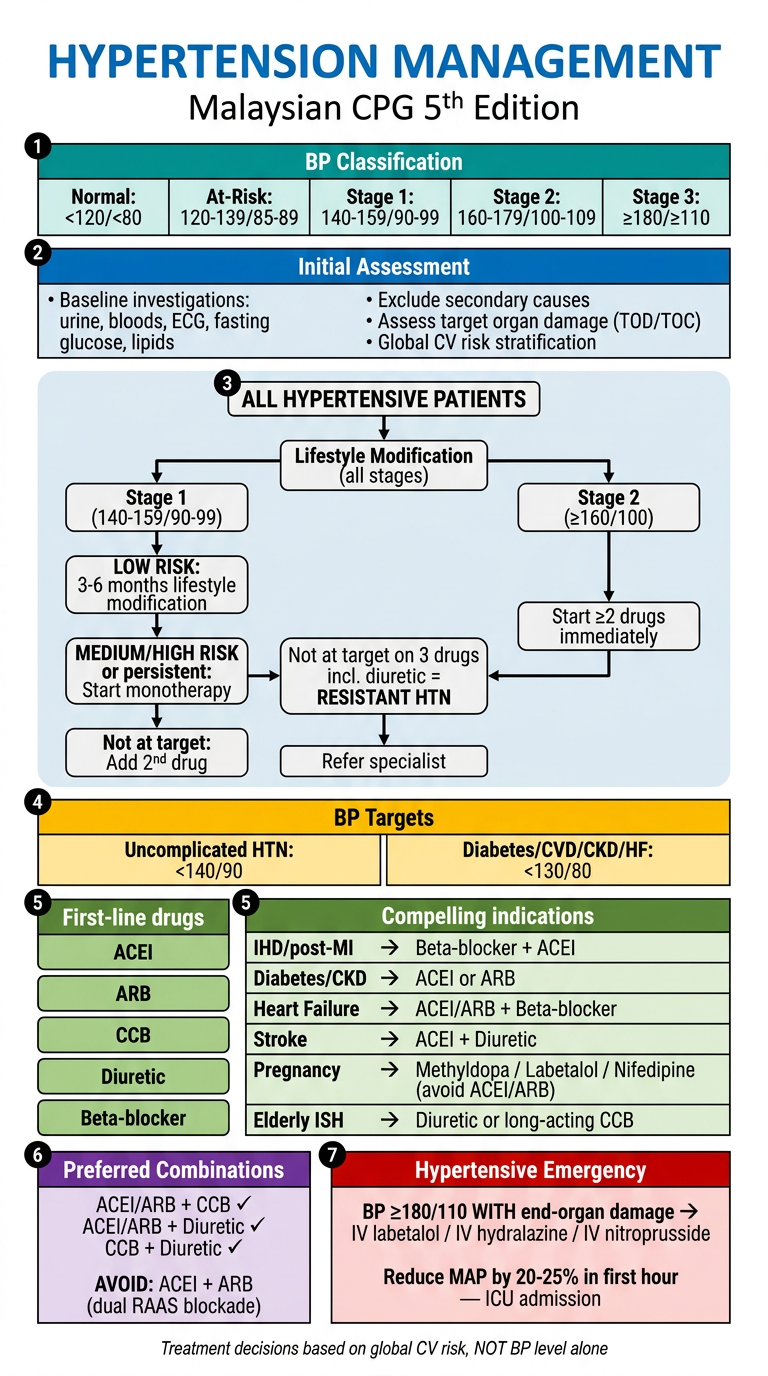
Hypertension management based on Malaysian cpg

Searching the Web

Malaysian CPG hypertension management 2023 guidelines Ministry of Health Malaysia

Searching the Web

Malaysia CPG hypertension 6th edition 2023 blood pressure targets antihypertensive treatment algorithm

Reading Web Page

https://www.e-mfp.org/issues/2011v6n1/hypertension.html

Reading Web Page

https://www.acadmed.org.my/index.cfm?menuid=67

Searching the Web

Malaysian CPG hypertension 5th edition 2018 full summary classification treatment targets compelling indications

Reading Web Page

https://mpsypc.com.my/news/2018-management-of-hypertension-5…

I now have comprehensive content from the Malaysian CPG on Hypertension (5th Edition 2018, and references to the 6th Edition 2026). Let me compile the full response.

Hypertension Management - Malaysian CPG (5th Edition 2018 / 6th Edition 2026)

Note on editions: The publicly available edition is the 5th Edition (2018), published by the Malaysian Society of Hypertension and MOH Malaysia. A 6th Edition (2026) has been referenced in the 2026 ACS CPG but is not yet fully in the public domain. The content below reflects the 5th Edition with key updates noted.

1. Definition

Hypertension = persistent elevation of SBP ≥140 mmHg and/or DBP ≥90 mmHg
"At-risk" blood pressure (5th Ed 2018 update):
  • SBP 120-139 and/or DBP 85-89 mmHg - should be treated in certain high-risk groups
(Note: the 4th Edition used "pre-hypertension" as SBP 120-139 / DBP 80-89)

2. Classification of Blood Pressure

CategorySBP (mmHg)DBP (mmHg)
Normal<120<80
At-risk / Pre-HTN120-13985-89
Stage 1 HTN140-15990-99
Stage 2 HTN160-179100-109
Stage 3 HTN≥180≥110
Blood pressure measurement: validated electronic (digital) BP sets preferred over mercury sphygmomanometers (new in 5th Ed).

3. Epidemiology in Malaysia

  • Prevalence of hypertension in Malaysians aged ≥18 years: 35.3% (NHMS 2015), up from 33.6% in 2011
  • For every 2 diagnosed patients, there are 3 undiagnosed patients (unchanged since 2011)
  • Only 44.6% of treated patients achieved BP control in 2015 (improved from 34.7% in 2011)
  • Hypertension is largely a silent disease - BP must be measured at every chance encounter

4. Initial Assessment

Baseline Investigations

  • Urine analysis (protein, blood, glucose)
  • Serum electrolytes, urea, creatinine
  • Fasting blood glucose
  • Lipid profile (total cholesterol, HDL, LDL, TG)
  • ECG
  • Fundoscopy (for target organ damage)

Secondary Causes to Exclude

CauseClue
Primary aldosteronismHypokalaemia, resistant HTN
Renovascular diseaseYoung patient, abdominal bruit
Chronic kidney diseaseElevated creatinine, proteinuria
PhaeochromocytomaParoxysmal HTN, headache, sweating
Cushing syndromeTruncal obesity, striae
Obstructive sleep apnoeaSnoring, obesity, daytime sleepiness
Coarctation of aortaYoung, radio-femoral delay
Thyroid diseaseClinical features

Target Organ Damage (TOD) / Complication (TOC)

TODTOC
LVH (ECG/echo)Heart failure
RetinopathyRenal failure
ProteinuriaMI, stroke, PVD
Microalbuminuria

5. Cardiovascular Risk Stratification

A new "Intermediate" risk category was introduced in the 5th Edition (2018). The CV risk guides treatment urgency:
Risk10-year CV event riskManagement
Low<10%Lifestyle changes only
Intermediate10-15%(New in 5th Ed) - intensified lifestyle + consider drug therapy
Medium10-20%Drug treatment + lifestyle changes
High20-30%Drug treatment + lifestyle changes
Very High>30%Immediate drug treatment + lifestyle changes
Risk factors considered:
  • Smoking
  • Total cholesterol >6.5 mmol/L
  • Family history of premature CVD
  • TOD/TOC
  • Diabetes mellitus
  • Previous MI, stroke, or clinical atherosclerosis
Key principle: Treatment decisions should be based on global vascular risk, NOT on the level of BP alone.

6. Blood Pressure Treatment Targets

Patient GroupTarget BP
Uncomplicated hypertension<140/90 mmHg
Diabetes mellitus<130/80 mmHg
History of CVD (MI, stroke, TIA)<130/80 mmHg
Chronic kidney disease (CKD)<130/80 mmHg
Heart failure<130/80 mmHg
Elderly (≥60 years) without comorbidity<140/90 mmHg
Once target BP is achieved: follow up at 3-6 month intervals

7. Non-Pharmacological Management (All Patients)

Therapeutic lifestyle changes are recommended for all patients with hypertension and at-risk BP. Lifestyle modification alone may suffice in Stage 1, low-risk hypertension:
InterventionExpected BP Reduction
Weight reduction (5-10 kg if overweight)~5-20 mmHg
Sodium restriction (<6g NaCl/day)~2-8 mmHg
DASH diet (fruits, vegetables, low-fat dairy)~8-14 mmHg
Regular aerobic exercise (≥30 min, ≥5 days/week)~4-9 mmHg
Limit alcohol (≤2 drinks/day men; ≤1 drink/day women)~2-4 mmHg
Smoking cessationReduces overall CV risk

8. Pharmacological Management

Principle

Decisions on pharmacological treatment should be based on global vascular risks, NOT on the level of BP per se.
  • Stage 1 HTN with no TOD/TOC: allow 3-6 months of lifestyle modification, review 2-monthly
  • Stage 1 HTN with TOD or ≥1 risk factor: earlier drug initiation
  • Stage 2 HTN: initiate with combination of ≥2 drugs from the outset

First-Line Drug Classes (5th Edition 2018)

In newly diagnosed uncomplicated hypertension with no compelling indications, first-line monotherapy options include:
  1. ACE Inhibitors (ACEIs)
  2. Angiotensin Receptor Blockers (ARBs)
  3. Calcium Channel Blockers (CCBs)
  4. Diuretics (thiazides / thiazide-like, e.g., hydrochlorothiazide, indapamide)
  5. Beta-blockers (re-included in 5th Ed based on newer meta-analyses; particularly effective in patients <60 years)
Beta-blockers were reinstated as first-line options in 2018 (had been removed from the 4th Edition)

Effective Antihypertensive Combinations

CombinationComment
ACEI + CCBPreferred
ARB + CCBPreferred
ACEI + DiureticEffective
ARB + DiureticEffective
CCB + DiureticEffective
CCB + Beta-blockerEffective
ACEI + ARBNOT recommended (dual RAAS blockade - increased risk of AKI, hyperkalaemia)
ACEI + Beta-blockerLess preferred as initial combination

9. Compelling Indications - Drug Choice

ConditionPreferred Drug(s)Avoid
Ischaemic heart disease / post-MIBeta-blocker, ACEI/ARB
Heart failure with reduced EFACEI/ARB, Beta-blocker, SpironolactoneCCBs (non-dihydropyridine)
Diabetes mellitusACEI or ARB (renoprotective)
CKD with proteinuriaACEI or ARB
Stroke / TIA (secondary prevention)ACEI + diuretic combination
Isolated systolic HTN (elderly)Diuretic or long-acting CCB
PregnancyMethyldopa, Labetalol, NifedipineACEIs, ARBs (contraindicated)
Benign prostatic hypertrophyAlpha-blocker
Atrial fibrillation (rate control)Beta-blocker or non-DHP CCB
MigraineBeta-blocker

10. Treatment Algorithm

ALL HYPERTENSIVE PATIENTS
        ↓
Lifestyle modification + Investigate for secondary causes + Assess CV risk
        ↓
     Stage 1                              Stage 2
  (140-159/90-99)                      (≥160/100)
        ↓                                    ↓
  LOW risk: 3-6 months               Start ≥2 drugs immediately
  lifestyle modification              (ACEI/ARB + CCB or diuretic)
        ↓
  Still uncontrolled or
  MEDIUM/HIGH/VERY HIGH risk:
  Start monotherapy
  (ACEI / ARB / CCB / Diuretic / Beta-blocker)
        ↓
  Not at target on monotherapy:
  Add a 2nd drug (combination therapy)
        ↓
  Not at target on 2 drugs:
  Add a 3rd drug
        ↓
  BP still >140/90 on ≥3 drugs (including diuretic) at optimal doses
  → RESISTANT HYPERTENSION

11. Resistant Hypertension

Definition: BP >140/90 mmHg despite 3 or more antihypertensive drugs at optimal doses, including a diuretic.

Before labelling as resistant, exclude:

  • Medication non-compliance (most common cause)
  • White coat / isolated office hypertension (ABPM or home BP monitoring)
  • Pseudo-resistance (incorrect BP measurement technique)

True resistant HTN - investigate for:

  • Secondary hypertension (primary aldosteronism, renovascular disease, phaeochromocytoma)
  • Excessive sodium intake
  • Alcohol
  • Drug interactions (NSAIDs, sympathomimetics, oral contraceptives, liquorice)
  • CKD / nephrosclerosis
  • Loss of aortic distensibility

Management of Resistant HTN:

  • Add spironolactone (25-50 mg/day) - most evidence for add-on therapy
  • Consider alpha-blocker (doxazosin) or centrally acting agent (clonidine, methyldopa)
  • Refer to specialist
  • Consider device-based therapy (renal denervation) in selected cases

12. Special Populations

Elderly (≥60 years)

  • Target: <140/90 mmHg (not <130/80 unless diabetic/CKD)
  • Start with low dose; titrate slowly
  • Beware orthostatic hypotension - check standing BP
  • Prefer long-acting agents once daily
  • Isolated systolic HTN: thiazide diuretic or long-acting dihydropyridine CCB

Diabetes Mellitus

  • Target: <130/80 mmHg
  • First choice: ACEI or ARB (renoprotective, reduce microalbuminuria)
  • Avoid thiazide diuretics in high doses (worsen glucose tolerance)
  • Avoid beta-blockers in brittle T1DM (mask hypoglycaemic symptoms)

Chronic Kidney Disease (CKD)

  • Target: <130/80 mmHg (especially with proteinuria)
  • First choice: ACEI or ARB
  • Monitor K+ and creatinine closely (especially if eGFR <45)
  • Avoid ACEI + ARB combination (dual RAAS blockade)

Hypertension in Pregnancy

  • Gestational HTN / pre-eclampsia: target <150/100 mmHg
  • Severe HTN (≥170/110): IV labetalol or IV hydralazine acutely; oral labetalol, methyldopa, or nifedipine for maintenance
  • Contraindicated in pregnancy: ACEIs, ARBs, direct renin inhibitors

Hypertensive Urgency and Emergency

UrgencyEmergency
BPSevere (≥180/110)Severe + acute TOD
End-organ damageAbsentPresent (brain, heart, kidney, eye)
ManagementOral therapy; gradual reduction over 24-48hIV agents; reduce MAP by 20-25% in first hour
SettingCan manage outpatientICU/HDU admission required
IV agents for hypertensive emergency:
  • IV labetalol
  • IV hydralazine
  • IV nitroprusside (aortic dissection, hypertensive encephalopathy)
  • IV glyceryl trinitrate (GTN) - acute pulmonary oedema, ACS

13. Key Malaysian-Specific Notes

  • 6th Edition CPG (2026) is now the current reference (cited in ACS CPG 2026) but not yet publicly downloadable; likely contains updated BP targets aligned with contemporary evidence
  • The 5th Edition CPG full document is available from the Academy of Medicine of Malaysia
  • The Malaysian CPG aligns more closely with ESC/ESH 2018 guidelines (HTN threshold ≥140/90) rather than the stricter ACC/AHA 2017 threshold (≥130/80) for the general population ≥60 years without comorbidity
  • Control rates in Malaysia remain suboptimal - only 44.6% of treated patients achieved target BP (2015 data), underscoring the importance of combination therapy and adherence

Sources: Malaysian CPG Management of Hypertension, 5th Edition (2018), Malaysian Society of Hypertension / MOH Malaysia; 4th Edition (2013), WHO repository; ACS CPG 1st Edition 2026, MOH Malaysia (citing 6th Ed Hypertension CPG 2026); Academy of Medicine Malaysia CPG listing

Create a hypertension treatment flowchart/poster for clinical practice

Generating Image

A professional clinical hypertension management flowchart poster based on Malaysian CPG guidelines. Clean medical design with a white background and organized sections using colored boxes and arrows. Title at top: "HYPERTENSION MANAGEMENT" with subtitle "Malaysian CPG 5th Edition" Section 1 - BP Classification table (teal header): Normal: <120/<80 | At-Risk: 120-139/85-89 | Stage 1: 140-159/90-99 | Stage 2: 160-179/100-109 | Stage 3: ≥180/≥110 Section 2 - Initial Assessment (blue box): • Baseline investigations: urine, bloods, ECG, fasting glucose, lipids • Exclude secondary causes • Assess target organ damage (TOD/TOC) • Global CV risk stratification Section 3 - Treatment Decision Flowchart (central, with arrows): ALL HYPERTENSIVE PATIENTS → Lifestyle Modification (all stages) ↓ Split into two paths: LEFT PATH - Stage 1 (140-159/90-99): → LOW RISK: 3-6 months lifestyle modification → MEDIUM/HIGH RISK or persistent: Start monotherapy → Not at target: Add 2nd drug RIGHT PATH - Stage 2 (≥160/100): → Start ≥2 drugs immediately Both paths converge at: → Not at target on 3 drugs incl. diuretic = RESISTANT HTN → Refer specialist Section 4 - BP Targets (yellow/orange boxes): Uncomplicated HTN: <140/90 | Diabetes/CVD/CKD/HF: <130/80 Section 5 - Drug Choice (green boxes, 2 columns): First-line drugs (5 boxes): ACEI | ARB | CCB | Diuretic | Beta-blocker Compelling indications table: IHD/post-MI → Beta-blocker + ACEI Diabetes/CKD → ACEI or ARB Heart Failure → ACEI/ARB + Beta-blocker Stroke → ACEI + Diuretic Pregnancy → Methyldopa / Labetalol / Nifedipine (avoid ACEI/ARB) Elderly ISH → Diuretic or long-acting CCB Section 6 - Preferred Combinations (purple): ACEI/ARB + CCB ✓ | ACEI/ARB + Diuretic ✓ | CCB + Diuretic ✓ AVOID: ACEI + ARB (dual RAAS blockade) Section 7 - Hypertensive Emergency (red box): BP ≥180/110 WITH end-organ damage → IV labetalol / IV hydralazine / IV nitroprusside Reduce MAP by 20-25% in first hour — ICU admission Footer note: "Treatment decisions based on global CV risk, NOT BP level alone"

Hypertension Management Flowchart - Malaysian CPG
Here is your clinical hypertension management poster based on the Malaysian CPG 5th Edition (2018). It covers:
  • BP classification from normal to Stage 3
  • Treatment decision flowchart split by stage and CV risk
  • BP targets by patient group (<140/90 uncomplicated; <130/80 for DM/CVD/CKD/HF)
  • First-line drug classes (ACEI, ARB, CCB, Diuretic, Beta-blocker)
  • Compelling indications matched to preferred agents
  • Preferred drug combinations and what to avoid (ACEI + ARB)
  • Hypertensive emergency management pathway
  • The key principle: "Treat based on global CV risk, not BP level alone"
If you'd like a downloadable version (PDF/PPTX), a version in Bahasa Malaysia, or a more focused sub-section (e.g., just the drug algorithm or the special populations chart), let me know and I can generate that for you.
This is a shared conversation. Sign in to Orris to start your own chat.