
Neostigmin vs sugammadex 10 mark answer
I'll read the medical library skill first, then research this topic thoroughly.
Searching sources...
Reading File
Now let me search the medical library for neostigmine vs sugammadex content in parallel:
Finding Sources
Finding Sources
Excellent results. Now let me read the key sections from Barash and Miller's in parallel:
Reading File
Reading File
Excellent content. Let me now read more detailed sections on both drugs - neostigmine mechanism and sugammadex details:
Reading File
Reading File
Let me read more on adverse effects comparison, dosing details, and special situations:
Reading File
Reading File
I now have extensive, detailed information from the top anesthesia textbooks. Let me compose the comprehensive 10-mark answer:
Neostigmine vs. Sugammadex - Reversal of Neuromuscular Blockade (10 Marks)
1. Introduction
Residual neuromuscular blockade (RNMB) after surgery is a clinically significant problem - occurring in approximately 40% of patients when standard reversal practices are not optimized. Two fundamentally different pharmacological approaches are available for reversing non-depolarizing neuromuscular blockade (NDNMB):
- Neostigmine - an anticholinesterase (indirect mechanism)
- Sugammadex - a selective relaxant binding agent (encapsulation/direct mechanism)
(Barash Clinical Anesthesia, 9e)
2. Mechanisms of Action
Neostigmine (Anticholinesterase)
Neostigmine inhibits acetylcholinesterase, the enzyme that degrades acetylcholine (ACh) at the neuromuscular junction. This leads to accumulation of ACh, which competes with the NDNMB at the post-synaptic nicotinic receptor (alpha subunits). The net effect is displacement of the blocker and restoration of neuromuscular transmission.
- It does NOT eliminate the NMBD from the body; it merely shifts the competition in favor of ACh.
- Because neostigmine also inhibits muscarinic receptors (salivation, bradycardia, bronchospasm, increased GI motility), it must always be co-administered with an anticholinergic (atropine or glycopyrrolate).
- Neostigmine also has intrinsic neuromuscular blocking properties via excess ACh depolarization, particularly dangerous if administered when the block has already fully recovered.
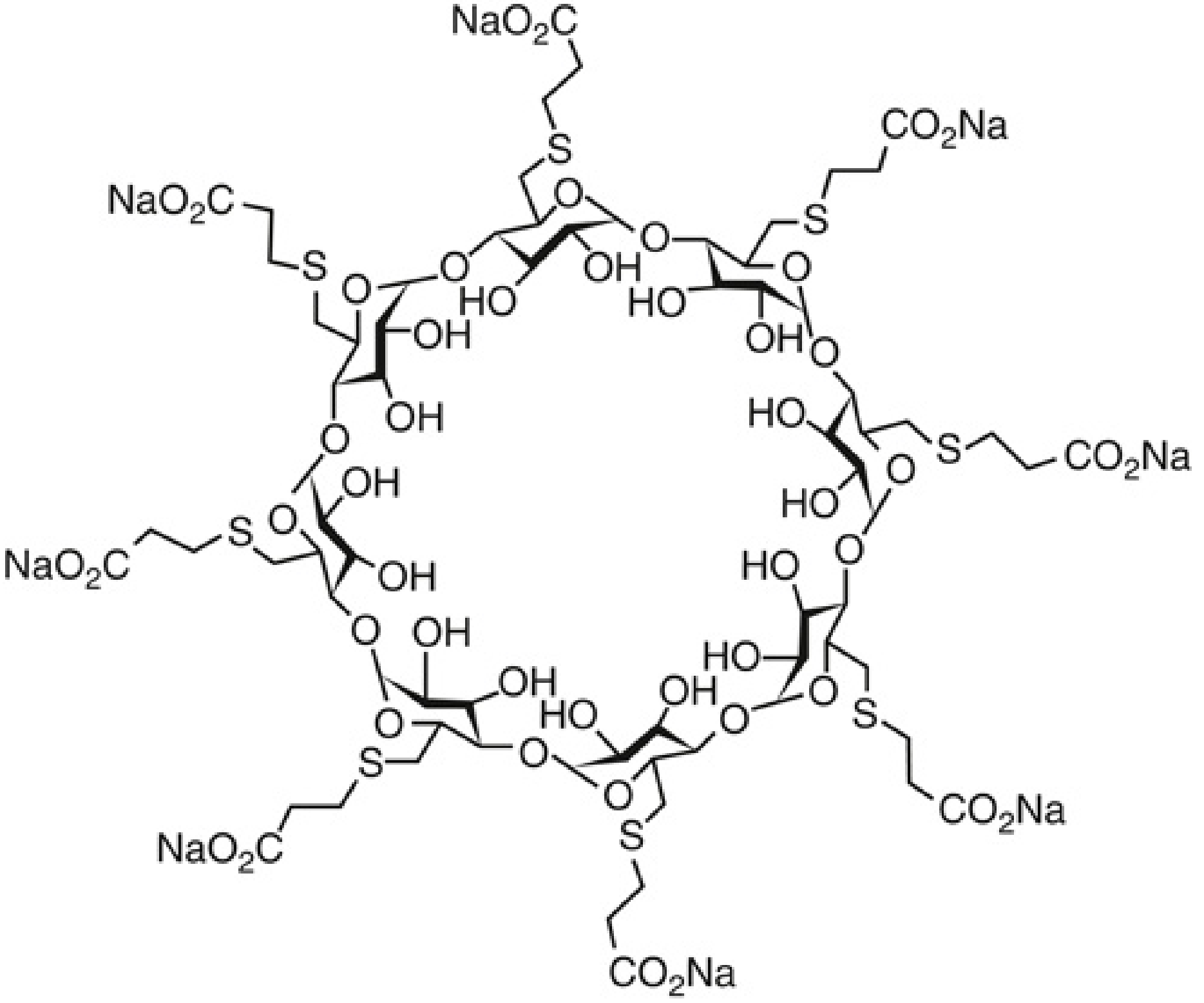
Sugammadex (Selective Relaxant Binding Drug - SRBA)
Sugammadex is a modified gamma-cyclodextrin (a doughnut-shaped oligosaccharide molecule) that directly and irreversibly encapsulates aminosteroid NMBDs - particularly rocuronium (highest affinity) and vecuronium (lower affinity). The drug-drug complex is pharmacologically inert and is excreted renally as an intact complex.
- It creates a concentration gradient - free plasma sugammadex binds free plasma NMBD, driving dissociation of NMBD from receptors → receptor occupancy falls → block reverses.
- No muscarinic side effects. No need for an anticholinergic.
- Does NOT work for benzylisoquinolinium relaxants (cisatracurium, atracurium) - only for steroidal agents.
(Miller's Anesthesia, 10e)
3. Dosing
Neostigmine
| Depth of Block | Dose |
|---|---|
| Moderate block (TOF count 1-3) | 50-70 mcg/kg IV |
| Minimal block (TOF count 4, no fade) | 15-30 mcg/kg IV |
| Maximum dose | 70 mcg/kg (ceiling effect) |
- Must wait for at least TOF ratio >0.2 (advanced spontaneous recovery) before administration.
- Administering at deeper block levels does not hasten reversal and may delay it.
- Has a ceiling effect - increasing the dose beyond 70 mcg/kg does not improve reversal but worsens muscarinic side effects.
Sugammadex
| Depth of Block | Dose |
|---|---|
| Minimal block (TOF ratio 0.4-0.9) | 2 mg/kg IV |
| Moderate block (TOF count ≥2, deep) | 4 mg/kg IV |
| Profound/immediate reversal (post-intubation) | 16 mg/kg IV |
- Can be given at any depth of block, including profound and immediate post-intubation reversal.
- 4 mg/kg reverses rocuronium-induced block (0.6 mg/kg) to TOF ratio ≥0.9 in <4 minutes.
- 16 mg/kg given 3 minutes after rocuronium 1.2 mg/kg achieves full reversal in <3 minutes - the "can't intubate, can't oxygenate" rescue scenario.
(Miller's Anesthesia, 10e; Morgan & Mikhail, 7e)
4. Speed of Reversal
| Parameter | Neostigmine | Sugammadex |
|---|---|---|
| Time to TOF ratio ≥0.9 (moderate block) | 16-22 minutes (highly variable) | 1.1-3 minutes |
| Deep block reversal | Not possible/unreliable | Yes (4 mg/kg) |
| Profound block reversal | Not applicable | Yes (16 mg/kg) |
| Predictability | Highly variable (13.9-143.3 min range) | Rapid and predictable |
- In a landmark comparison, reversal of rocuronium block with sugammadex was significantly faster than reversal of cisatracurium block with neostigmine.
- Even when four TOF responses are present, neostigmine may require up to 143 minutes to achieve TOF ratio 0.9 in some patients - demonstrating extreme unpredictability.
(Miller's Anesthesia, 10e)
5. Adverse Effects
Neostigmine - Side Effects
| System | Effect |
|---|---|
| Cardiovascular | Bradycardia, arrhythmias (muscarinic) |
| Respiratory | Bronchospasm, increased secretions (contraindicated in active asthma) |
| GI | Nausea/vomiting, increased peristalsis, risk of anastomotic leak |
| Neuromuscular | Paradoxical weakness if given when block fully recovered (TOF ≥0.9) |
| Salivary | Excessive salivation |
- Requires co-administration of atropine (0.02 mg/kg) or glycopyrrolate to counteract muscarinic effects. This adds the risk of atropine-related tachycardia, arrhythmias, and urinary retention.
- Patients with asthma are at higher risk of bronchospasm.
Sugammadex - Side Effects
| System | Effect |
|---|---|
| Allergic/Anaphylaxis | Rare but documented (0.3%) - including severe anaphylaxis |
| Re-paralysis | Theoretical if dose insufficient; rare clinically |
| Hormonal contraceptives | May reduce efficacy of progesterone-based oral contraceptives |
| Bradycardia | Rare, usually mild and transient |
| Renal | Caution/avoid in severe renal failure (CrCl <30 mL/min) |
- No muscarinic side effects. No need for anticholinergic drugs.
- Advantageous in patients with pulmonary disease, cardiovascular disease, and in procedures requiring full muscle relaxation until late (e.g., laparoscopic surgery).
(Miller's Anesthesia, 10e)
6. Special Situations
| Situation | Preferred Agent | Reason |
|---|---|---|
| Asthma / COPD | Sugammadex | No muscarinic bronchospasm |
| Cardiac disease (bradycardia) | Sugammadex | No cholinergic cardiovascular effects |
| "Can't intubate, can't oxygenate" | Sugammadex 16 mg/kg | Rapid reversal of rocuronium allows re-intubation |
| Deep/profound neuromuscular block | Sugammadex | Neostigmine ineffective at deep block |
| Benzylisoquinolinium NMBD (cisatracurium) | Neostigmine | Sugammadex not effective |
| Severe renal failure | Neostigmine preferred | Sugammadex-rocuronium complex accumulates renally |
| Neonates/Pediatrics | Neostigmine (established) | Sugammadex being studied; use cautiously |
| Re-blocking after reversal | Benzylisoquinoliniums (e.g., cisatracurium) | Steroidal NMBDs may be impaired after sugammadex |
(Miller's Anesthesia, 10e; Morgan & Mikhail Clinical Anesthesiology, 7e)
7. Monitoring Requirements
- Both agents require neuromuscular monitoring (peripheral nerve stimulator or quantitative acceleromyography) for optimal use.
- For neostigmine: TOF ratio must be >0.2 before administration; quantitative monitoring preferred to avoid giving to fully-recovered patients.
- For sugammadex: Although it can theoretically be given at any depth, depth-based dosing (2/4/16 mg/kg) requires twitch monitoring for optimal dosing and cost-effectiveness.
- Clinical assessment alone (head lift, hand grip, tongue protrusion) is unreliable - cannot confirm TOF ratio ≥0.9.
8. Summary Comparison Table
| Feature | Neostigmine | Sugammadex |
|---|---|---|
| Class | Anticholinesterase | Selective relaxant binding agent (cyclodextrin) |
| Mechanism | Inhibits AChE → ↑ACh at NMJ | Encapsulates/chelates steroidal NMBDs |
| Target NMBDs | All non-depolarizing agents | Only aminosteroids (rocuronium, vecuronium) |
| Depth at which usable | Minimal block only (TOF count 4) | Any depth including profound |
| Speed | 16-22 min (variable) | 1-3 min (predictable) |
| Ceiling effect | Yes (70 mcg/kg max) | No ceiling (dose-dependent) |
| Anticholinergic needed | Yes (atropine/glycopyrrolate) | No |
| Cardiovascular effects | Bradycardia, arrhythmias | Minimal |
| Pulmonary effects | Bronchospasm, ↑secretions | None |
| GI effects | ↑Peristalsis, N/V | Minimal |
| Renal failure | Safe | Avoid if CrCl <30 mL/min |
| Cost | Inexpensive | Expensive |
| Anaphylaxis risk | Low | Rare but possible |
| Contraceptive interaction | No | Yes (progesterone-based OCP) |
9. Clinical Verdict
Sugammadex represents a paradigm shift in neuromuscular reversal: it is faster, more predictable, works at any depth of block, avoids muscarinic side effects, and eliminates the need for anticholinergics. It is the agent of choice when using rocuronium or vecuronium, particularly in patients with pulmonary/cardiovascular disease or when deep/immediate reversal is required (e.g., "can't intubate, can't oxygenate" rescue).
Neostigmine remains clinically relevant for reversing benzylisoquinolinium NMBDs (which sugammadex cannot reverse), in severe renal impairment, and in resource-limited settings given its significantly lower cost. It should only be used when TOF ratio >0.2, with appropriate anticholinergic cover, and with neuromuscular monitoring.
Sources: Miller's Anesthesia, 10e (Chapter 24); Barash Clinical Anesthesia, 9e (Chapter on Reversal of NMB); Morgan & Mikhail's Clinical Anesthesiology, 7e
This is a shared conversation. Sign in to Orris to start your own chat.