
Dengu Fever PFL
Reading File
"PFL" likely means Problem-based / Feature List or Pathology Feature List — a structured summary of key features. Let me search the medical library comprehensively for Dengue Fever.
Finding Sources
Finding Sources
Searching PubMed
"dengue fever"[MeSH Terms] AND management
Good sources found. Let me pull the core content from Harrison's, Tintinalli's, Jawetz, and the comprehensive nephrology text simultaneously.
Reading File
Reading File
Reading File
Reading File
Now let me get Harrison's dedicated dengue section and Tintinalli's management/treatment content.
Finding Sources
Reading File
Now let me pull from Harrison's dedicated dengue section, Robbins Pathology, Andrews' Dermatology, and Rosen's Emergency for the full clinical picture.
Reading File
Reading File
Reading File
Reading File
Excellent content collected. Let me also fetch the dengue rash image and the AKI mechanism diagram, plus get the Red Book (pediatric) and Washington Manual management content.
Loading Image
Reading File
I now have comprehensive content from multiple authoritative sources. Let me compile the full Problem Feature List (PFL) for Dengue Fever.
Dengue Fever — Problem Feature List (PFL)
1. Definition
Dengue fever is an acute febrile illness caused by dengue virus (DENV), a flavivirus transmitted primarily by Aedes aegypti (and less commonly Aedes albopictus and Aedes polynesiensis) mosquitoes. Four antigenically distinct serotypes exist: DENV-1, DENV-2, DENV-3, DENV-4. — Jawetz Medical Microbiology 28E; Red Book 2021
2. Epidemiology
| Feature | Detail |
|---|---|
| Global burden | ~400 million infections/year; ~100 million symptomatic; ~40,000 deaths from severe dengue |
| Distribution | Endemic in >100 countries; Southeast Asia, Western Pacific, Central/South America, India, Cuba |
| Vector | Day-biting Aedes aegypti mosquito; adapts to urban peridomestic environments |
| Transmission | Human → mosquito → human (no direct human-to-human); rare vertical, blood transfusion, organ transplant, breastfeeding routes |
| Risk factors | Tropical regions (>20°C), uncontrolled urbanization, lack of sanitation, crowding, water storage |
| Secondary infection risk | Prior infection with one serotype → cross-protection lasts 1–3 years, then reinfection with different serotype → severe disease |
— Robbins Pathology 2024; Andrews' Diseases of the Skin; Harrison's 22E
3. Pathogenesis
| Mechanism | Detail |
|---|---|
| Antibody-dependent enhancement (ADE) | Key mechanism of severe dengue: subneutralizing cross-reactive antibodies from a prior infection enhance DENV entry into macrophages via Fc receptors → amplified viral replication → cytokine storm |
| Cytokine cascade | Release of vasoactive mediators, procoagulants, IL, TNF-α, ET-1 → increased vascular permeability |
| Plasma leakage | Endothelial injury → extravasation into interstitial spaces (pleural effusion, ascites, hemoconcentration) |
| Thrombocytopenia | Bone marrow suppression + platelet destruction + consumptive coagulopathy |
| DHF serotype predilection | DENV-2 reinfection most likely to cause severe disease |
— Robbins Pathology 2024; Jawetz 28E; Comprehensive Clinical Nephrology 7E
4. Clinical Classification (WHO 2009)
Group A — Dengue Without Warning Signs
- Fever + ≥2 of: nausea/vomiting, rash, aches/pains (myalgia, arthralgia, retro-orbital pain, headache), leukopenia, positive tourniquet test
Group B — Dengue With Warning Signs
Any of the following during or after defervescence:
- Abdominal pain or tenderness
- Persistent vomiting
- Clinical fluid accumulation (ascites, pleural effusion)
- Mucosal bleeding
- Lethargy or restlessness
- Liver enlargement >2 cm
- Rapid decline in platelet count + rising hematocrit
Group C — Severe Dengue (previously DHF/DSS)
At least one of:
- Severe plasma leakage → shock (DSS) or fluid accumulation with respiratory distress
- Severe bleeding
- Severe organ involvement: AST/ALT ≥1000 IU/L, impaired consciousness, heart/organ failure
— Red Book 2021; Rosen's Emergency Medicine
5. Clinical Phases
| Phase | Timing | Features |
|---|---|---|
| Febrile phase | Days 1–3 (up to 7) | Abrupt high fever, severe myalgia/arthralgia (breakbone fever), headache, retro-orbital pain, facial flushing, injected oropharynx, macular/morbilliform rash, leukopenia, petechiae |
| Critical phase | Days 3–7 | Defervescence; ↑ vascular permeability → plasma leakage; hemoconcentration; thrombocytopenia nadir; warning signs appear; duration ~24–48 hrs |
| Recovery/Convalescent phase | Days 7–10 | Hemodynamic stabilization, reabsorption of leaked fluids, risk of fluid overload, bradycardia, fine convalescent rash |
6. Symptoms & Signs
Constitutional
- Abrupt onset high fever (38–40°C); may follow "saddleback" biphasic pattern (fever defervesces ~day 3, returns days 5–8)
- Severe myalgia, arthralgia, deep bone pain ("breakbone fever")
- Retro-orbital pain (characteristic)
- Headache, anorexia, nausea, vomiting
- Facial flushing, facial erythema
Skin (Andrews' Diseases of the Skin)
- ~50% develop rash; eruption most commonly begins days 3–5 as fever defervesces
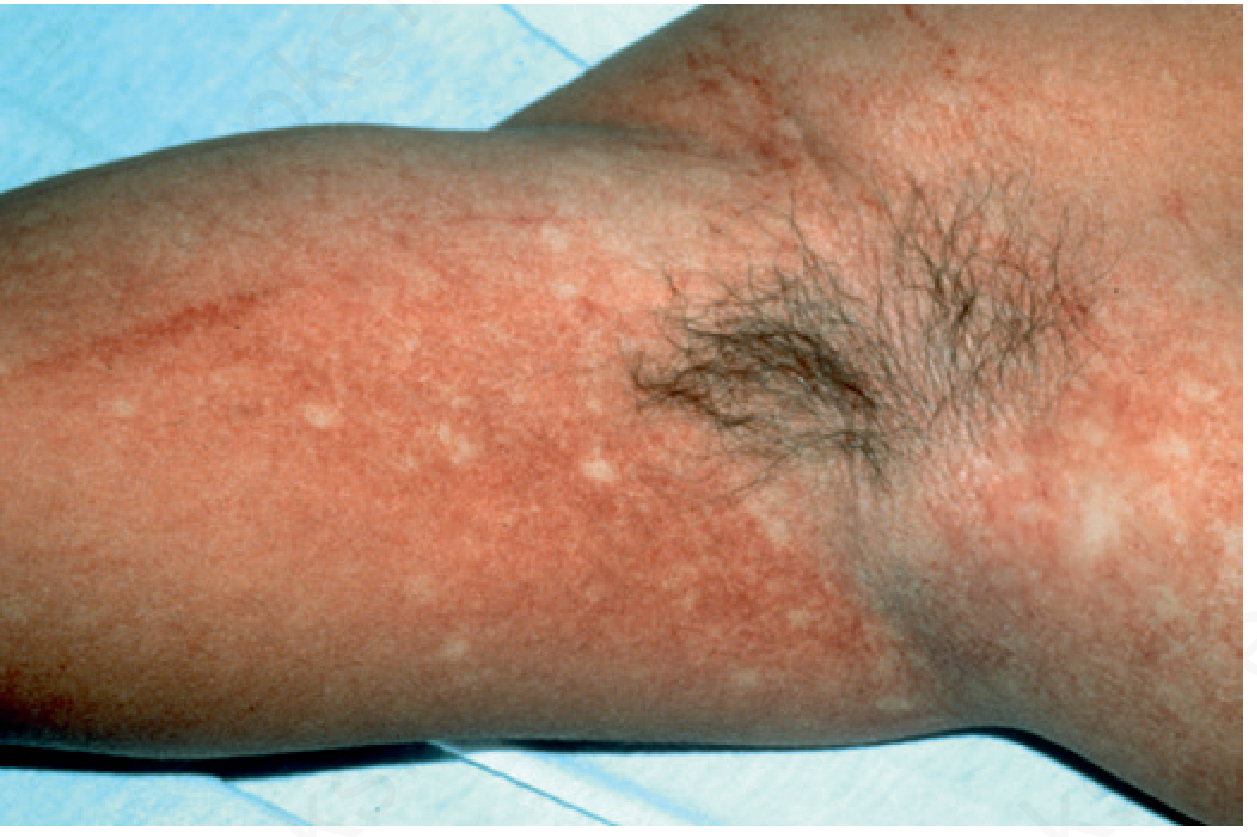
- Macular or morbilliform rash, typically generalized; characteristic "islands of white in a sea of red" — confluent erythema sparing small islands of normal skin
- Distribution: generalized (50%), extremities only (30%), trunk (20%)
- Asymptomatic or mildly pruritic
- Petechiae present; linear petechiae after BP cuff application (Fig. 19.42)
- Tourniquet test (Hess test): BP cuff inflated 5 min → ≥10 petechiae/square inch = positive (suggests dengue)
Hemorrhagic Features (Severe Dengue)
- Epistaxis, purpura, petechiae, ecchymosis
- Gingival bleeding, mucosal hemorrhage
- Pleural effusions, ascites
- Marked thrombocytopenia
Less Common Manifestations
- Myocarditis, pancreatitis, hepatitis
- Hemophagocytic lymphohistiocytosis (HLH)
- Neurologic: acute meningoencephalitis, post-dengue ADEM
- AKI (1–30% of cases): via endothelial injury, rhabdomyolysis, hemolysis (especially in G6PD deficiency), acute tubular necrosis, glomerulonephritis with immune complex deposition
7. Laboratory Findings
| Test | Finding |
|---|---|
| CBC | Leukopenia (characteristic); thrombocytopenia (platelets <100,000 in 50%); elevated hematocrit (hemoconcentration in DHF) |
| LFTs | Elevated AST/ALT (avg ~3× normal); severe dengue: AST/ALT ≥1000 IU/L |
| Coagulation | Prolonged PT/PTT in DHF (DIC picture) |
| Urinalysis | Proteinuria (sometimes nephrotic range), hematuria in AKI |
8. Diagnosis
| Method | Timing | Notes |
|---|---|---|
| NS1 antigen test | Days 1–5 (febrile phase) | Detects viral nonstructural protein 1; rapid bedside test |
| RT-PCR | Days 1–5 | Rapid identification + serotyping; most sensitive early |
| IgM ELISA | From day 5–6 | Often negative early; confirmatory by day 6 |
| IgG ELISA | From day 7 | Useful for secondary infection (elevated IgG even early) |
| Paired serology | Acute + convalescent (2–3 weeks apart) | 4× rise in titer = definitive confirmation |
| Virus isolation | Difficult; mosquito cell line inoculation + nucleic acid assay | Research/reference labs |
⚠️ Cross-reactivity of IgG with other flaviviruses (Zika, yellow fever, West Nile) complicates serology.
9. Differential Diagnosis
| Condition | Distinguishing Feature |
|---|---|
| Malaria | Must exclude first; has periodicity, splenomegaly, parasitemia on smear |
| Chikungunya | Similar rash + fever, but more persistent arthritis |
| Zika | Milder, teratogenic; similar vector |
| Influenza | No rash, no tourniquet positivity |
| Measles | Koplik spots, prodromal cough/coryza/conjunctivitis |
| Rubella | Lymphadenopathy + rash, milder |
| West Nile fever | Lymphadenopathy (absent in dengue) |
| Leptospirosis | Weil's disease; conjunctival suffusion, jaundice, renal failure |
| Rickettsial infections | Eschar, respond to doxycycline |
| Meningococcemia | Petechial rash indistinguishable; check CSF if meningism |
10. Management
Dengue Without Warning Signs (Group A)
- Outpatient management
- Rest, oral fluids, antipyretics
- Acetaminophen (paracetamol) ONLY for pain/fever
- ⛔ NSAIDs and aspirin are contraindicated — worsen bleeding tendency
- Monitor for warning signs; return precautions
Dengue With Warning Signs (Group B)
- Hospital admission for monitoring
- IV fluid replacement (isotonic crystalloid)
- Serial CBC, hematocrit, vital signs
- Watch for clinical deterioration during critical phase (days 3–7)
Severe Dengue (Group C — DHF/DSS)
- ICU admission
- Aggressive IV fluid resuscitation (guided by hematocrit/clinical response)
- Blood product transfusions for hemorrhagic sequelae (packed RBCs, platelets, FFP as indicated)
- Organ support as indicated
- ⚠️ Corticosteroids: evaluated in low-quality studies — evidence inconclusive; not currently recommended
- No specific antiviral agents approved
— Rosen's Emergency Medicine; Tintinalli's Emergency Medicine; Red Book 2021
11. Complications
| Complication | Notes |
|---|---|
| Dengue Shock Syndrome (DSS) | DHF + circulatory collapse; mortality >10% if untreated |
| Dengue Hemorrhagic Fever (DHF) | Plasma leakage, hemorrhage, thrombocytopenia, fever 2–7 days |
| Acute Kidney Injury | 1–30% incidence; via endothelial injury, rhabdomyolysis, hemolysis (G6PD), ATN, GN |
| Hepatic failure | ALT/AST >1000 IU/L; rare fulminant hepatitis |
| Neurologic | Encephalitis, ADEM |
| Myocarditis | Rare |
| Fluid overload | Risk during recovery phase from IV fluid given during critical phase |
12. Immunity & Vaccine
| Concept | Detail |
|---|---|
| Serotype-specific immunity | Lifelong protection against the infecting serotype; cross-protection against other serotypes lasts 1–3 years only |
| Secondary infection risk | Reinfection with a different serotype → ADE → higher risk of severe dengue |
| Vaccines | Available (e.g., Dengvaxia/CYD-TDV) — only recommended for seropositive individuals (prior dengue exposure); vaccinating seronegatives risks ADE and more severe disease upon natural infection |
13. Prevention
- Vector control: eliminate standing water breeding sites (peridomestic water storage)
- Mosquito nets, repellents (DEET), protective clothing
- Aedes biting peak: daytime (dawn and dusk)
- Novel biocontrol: Wolbachia-infected mosquitoes reduce dengue transmission by 95–97% (Colombia trial) — Robbins Pathology 2024
- Screen travelers returning from endemic regions presenting with fever within 2 weeks
Key Sources: Harrison's Principles of Internal Medicine 22E (2025) | Tintinalli's Emergency Medicine | Rosen's Emergency Medicine | Jawetz Medical Microbiology 28E | Robbins & Cotran Pathologic Basis of Disease | Andrews' Diseases of the Skin | Red Book 2021 | Comprehensive Clinical Nephrology 7E
This is a shared conversation. Sign in to Orris to start your own chat.