
Developmant of kidney 5m answer
Reading File
Now let me search the medical library for kidney development content in parallel.
Finding Sources
Finding Sources
Excellent results. Now let me read the most relevant sections in parallel - from Langman's Medical Embryology and Brenner & Rector's Kidney (the most authoritative sources for a 5-mark embryology answer).
Reading File
Reading File
Reading File
I have rich content. Let me also read the Langman's section on metanephros and ureteric bud more carefully, plus fetch the key developmental diagram.
Reading File
Reading File
I now have comprehensive content. Let me fetch the key developmental diagram from Langman's for visual support.
Loading Image
Loading Image
I now have all the content needed for a thorough 5-mark answer. Here is the complete answer:
Development of the Kidney
Source: Langman's Medical Embryology | Campbell-Walsh-Wein Urology | Brenner & Rector's The Kidney
Origin
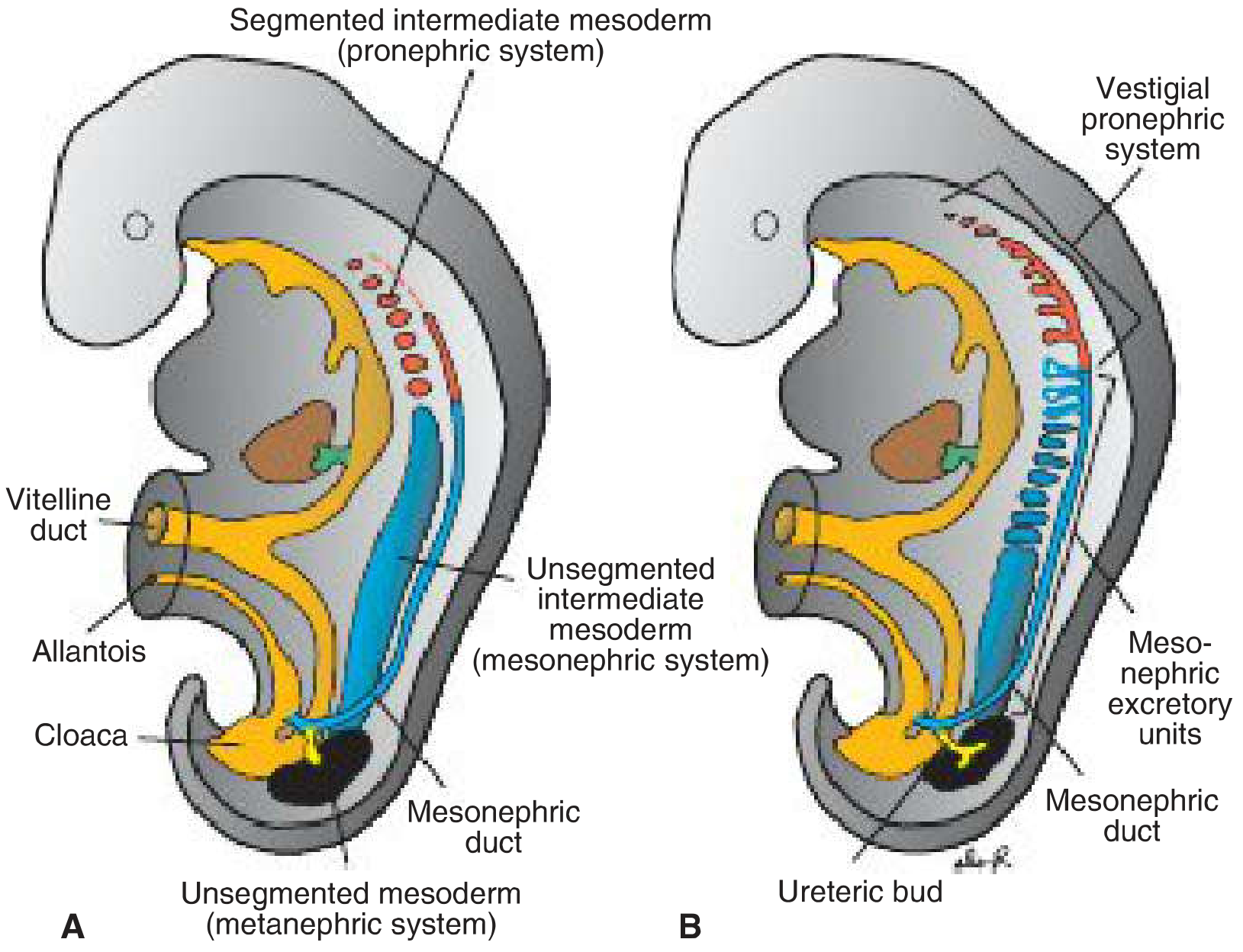
All three sets of embryonic kidneys develop from the intermediate mesoderm, which forms bilateral longitudinal ridges called the nephrogenic cords. These bulge from the posterior wall of the coelomic cavity to produce the paired urogenital ridges.
Three Successive Kidneys
Three pairs of excretory organs appear in craniocaudal sequence:
1. Pronephros (Week 3-4)
- Appears at the end of the 3rd week in the cervical region
- Represented by 7-10 solid cell groups (nephrotomes) - vestigial and non-functional in humans
- Completely degenerates by the end of the 4th week
- Its duct - the pronephric duct - persists and is taken over as the mesonephric (Wolffian) duct
2. Mesonephros (Week 4 - Month 2)
- Derived from intermediate mesoderm of the upper thoracic to upper lumbar (L3) segments
- First excretory tubules appear early in the 4th week as the pronephros regresses
- Tubules form S-shaped loops, acquire glomeruli, and develop Bowman's capsule - forming renal corpuscles
- Laterally, each tubule drains into the mesonephric (Wolffian) duct, which extends caudally to join the cloaca
- By the middle of the 2nd month, the mesonephros forms a large paired ovoid organ
- Cranial tubules degenerate first; by the 4th month most have disappeared
- Remnants in males: efferent ductules of testis, epididymis, vas deferens
- Remnants in females: epoophoron and paroophoron (within the broad ligament)
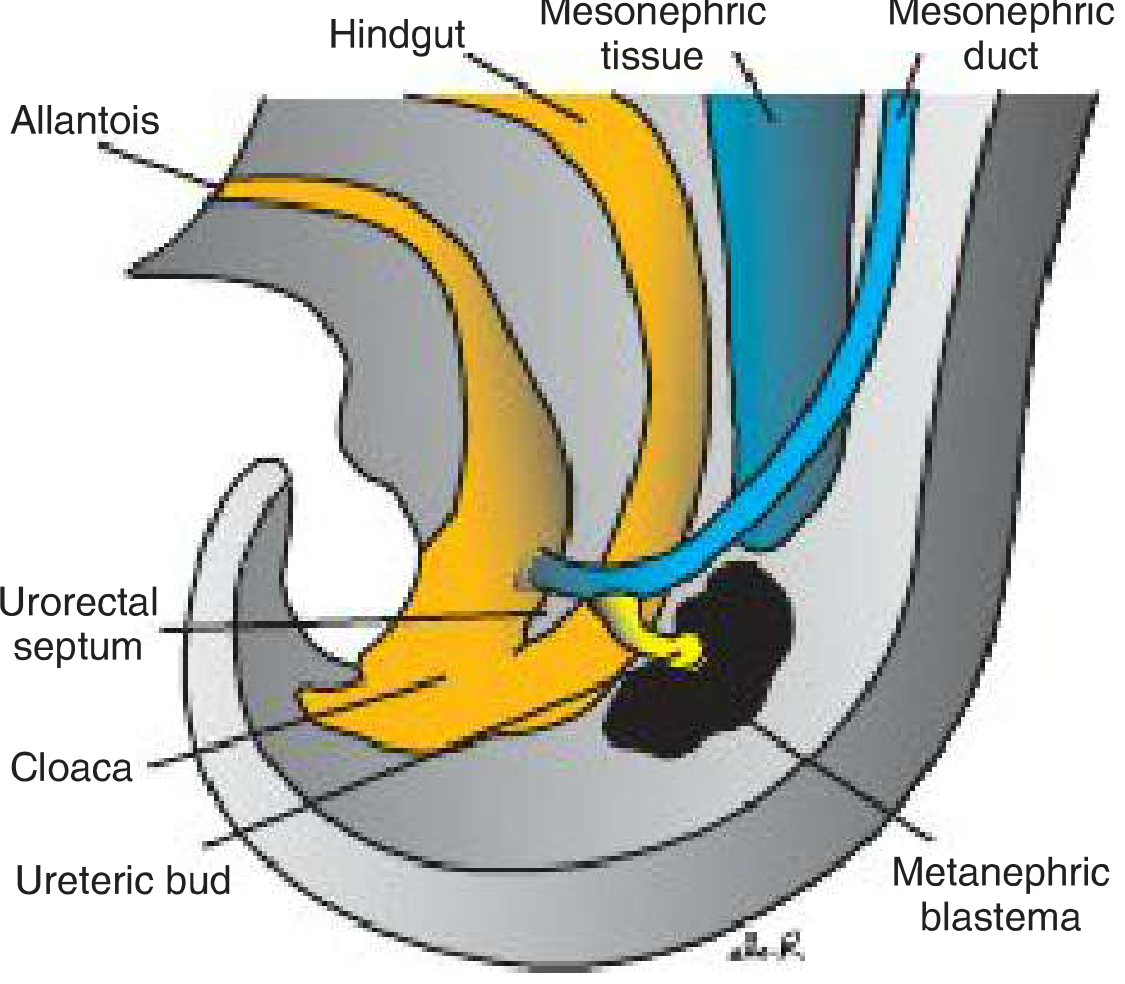
3. Metanephros (Week 5 onwards) - The Permanent Kidney
- Begins developing around week 5 in the sacral region
- Has two components that interact by reciprocal induction:
a) Ureteric Bud (Metanephric Diverticulum)
- An outgrowth from the mesonephric duct near its entrance into the cloaca
- Elongates cranially and penetrates the metanephric mesenchyme (blastema)
- Undergoes dichotomous branching - first into cranial and caudal divisions (future major calyces)
- Each calyx buds further; 12 or more generations of tubules form by end of 5th month
- 2nd-order branches absorbed → minor calyces; 5th and subsequent generations elongate → renal pyramids
- Gives rise to: ureter, renal pelvis, major and minor calyces, collecting ducts (~1-3 million)
b) Metanephric Mesenchyme (Blastema)
- Caps the ureteric bud distally
- Induced by the ureteric bud to undergo mesenchymal-to-epithelial transition (MET)
- Forms vesicles → S-shaped bodies → nephrons
- Each nephron: glomerulus + Bowman's capsule + proximal tubule + loop of Henle + distal tubule
- Distal tubule opens into the collecting duct system derived from the ureteric bud
Key Diagram
Ascent of the Kidney
- The metanephros initially lies in the sacral region
- As the embryo grows, the kidneys appear to ascend to their final lumbar position (actually due to differential growth of the lumbar and sacral regions)
- Blood supply is acquired at progressively higher levels from the aorta
- The hilum, initially facing anteriorly, rotates medially ~90° during ascent
- Failure of rotation = malrotated kidney; failure of ascent = pelvic kidney
Nephron Endowment
- Full complement of nephrons reached by 36 weeks of gestation (no new nephrons form postnatally)
- Humans average ~1 million nephrons per kidney (range variable)
- Reduced nephron number at birth raises risk for hypertension and chronic kidney disease in adult life
Summary Table
| Kidney | Region | Week | Fate |
|---|---|---|---|
| Pronephros | Cervical | 3-4 | Completely degenerates; duct retained |
| Mesonephros | Thoracic-L3 | 4 - 4th month | Mostly degenerates; remnants form genital structures |
| Metanephros | Sacral | 5 onwards | Permanent kidney |
This is a shared conversation. Sign in to Orris to start your own chat.