
Can you make notes on hydatid cyst of liver
Reading File
Finding Sources
Finding Sources
Good findings. Now let me read the main sources in parallel — Sabiston (surgery), Goldman-Cecil (medicine), and Sleisenger & Fordtran (GI/liver).
Reading File
Reading File
Reading File
Excellent — rich content from three major sources. Let me read the Sabiston section more fully (management/PAIR/surgery) and also the Sleisenger continuation, plus fetch key images.
Reading File
Reading File
Reading File
I now have comprehensive content. Let me also fetch the key ultrasound image from Sabiston and the CT image from Sleisenger.
Loading Image
Loading Image
Loading Image
I now have everything needed for comprehensive notes. Here are the complete notes on Hydatid Cyst of the Liver:
Hydatid Cyst of the Liver (Hepatic Echinococcosis)
1. Aetiology & Causative Organisms
Hydatid disease (echinococcosis) is a zoonosis caused by the larval stage of the tapeworm Echinococcus. Three species are clinically relevant:
| Species | Disease | Features |
|---|---|---|
| E. granulosus | Cystic echinococcosis | Most common; well-defined fluid-filled cysts |
| E. multilocularis | Alveolar echinococcosis | Highly invasive; solid masses mimicking carcinoma; mortality ~90% if untreated |
| E. vogeli | Polycystic echinococcosis | Intermediate aggressiveness; polycystic lesions |
2. Epidemiology
- Endemic in sheep-raising regions: Mediterranean Europe, Middle East, Africa, Far East, South America, Australia, New Zealand
- Dogs are the definitive host; sheep are the major intermediate host (also yaks, goats, camels)
- Humans are accidental intermediate hosts — no human-to-human transmission
- Diagnosed equally in males and females; average age ~45 years
3. Life Cycle & Pathogenesis
Dog (definitive host)
↓ eggs shed in feces
Contaminated food/water/vegetables
↓ ingested by humans
Small intestine → eggs hatch → oncospheres released
↓ penetrate intestinal mucosa
↓ enter bloodstream/lymphatics
Liver (70%) > Lungs (20%) > Kidney, Spleen, Brain, Bone
↓ vesiculation
Hydatid cyst develops
Cyst wall structure (3 layers):
- Outer adventitial (pericyst) — host-derived fibrous capsule; can calcify
- Middle ectocyst (laminated layer) — acellular, gelatinous outer worm-derived membrane
- Inner endocyst (germinal layer) — inner worm-derived germinal membrane; produces brood capsules and daughter cysts
Key contents:
- Brood capsules — small intracystic masses in which scoleces (future worm heads) develop
- Daughter cysts — true replicas of the mother cyst
- Hydatid sand — freed brood capsules + scoleces floating in hydatid fluid
- Scolex contains a rostellum with 20–50 hooklets and 4 suckers
4. Clinical Features
Symptoms (largely asymptomatic until complications occur)
- Abdominal pain (most common)
- Dyspepsia, vomiting
- Urticarial rash, pruritus (hypersensitivity)
Signs
- Hepatomegaly (most frequent sign; usually right lobe)
- Palpable mass
- Jaundice (~8%) — biliary obstruction
- Fever (~8%) — secondary infection
Complications
| Complication | Details |
|---|---|
| Rupture into biliary tree | Most common rupture site; → cholangitis, biliary obstruction, jaundice |
| Bacterial superinfection | Mimics pyogenic abscess (up to 20% of hepatic cases) |
| Free rupture into peritoneum | → disseminated echinococcosis, anaphylaxis |
| Rupture into pleura/bronchi | → dyspnea, hemoptysis |
| Rupture into pericardium | Rare but life-threatening |
| Portal hypertension | Rare |
| Budd-Chiari syndrome | Rare |
| Pancreatitis | Rare |
Eosinophilia is not a feature unless the cyst ruptures
5. Imaging
Ultrasound (first-line — most widely used)
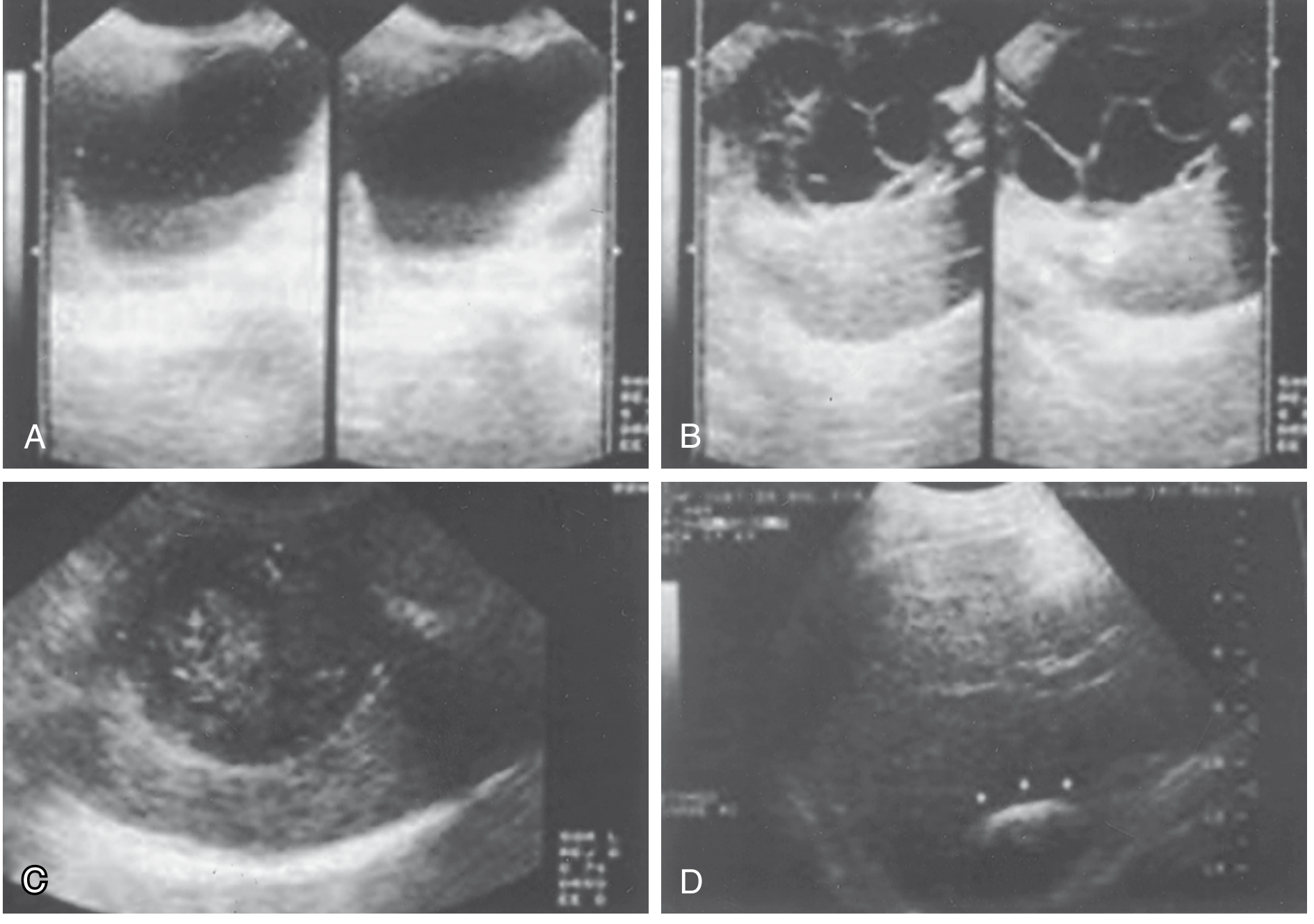
Gharbi classification (also WHO-IWGE classification) stages cysts from simple unilocular to calcified.
Diagnostic US features:
- Well-circumscribed cyst with budding signs on the membrane
- Free-floating hyperechoic hydatid sand
- Rosette pattern — daughter cysts present
- Eggshell calcification — highly suggestive
CT / MRI
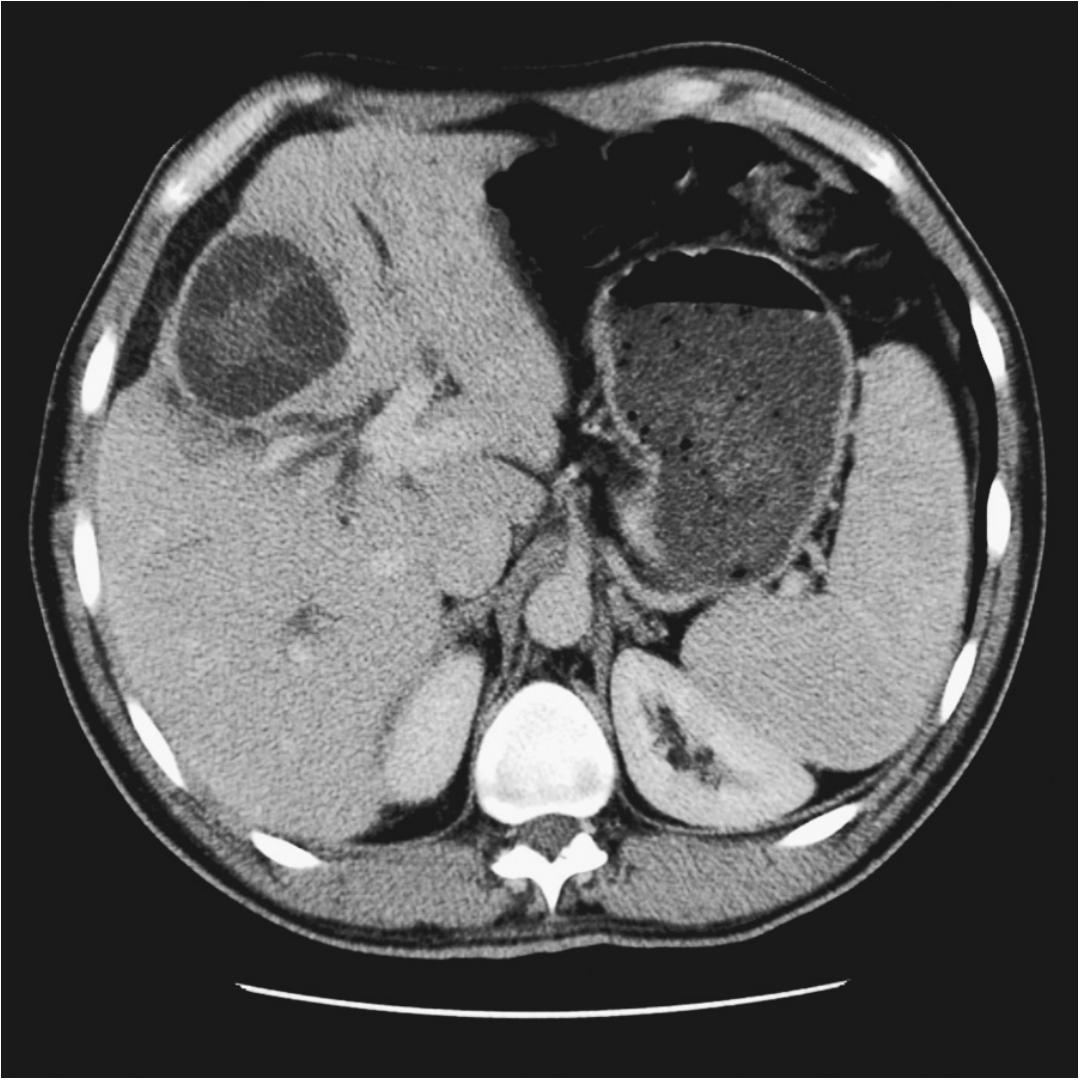
- Avascular cysts with ring enhancement
- Multiple daughter cysts with intracystic septations
- Peripheral focal calcifications
- Fluid density varies with proteinaceous debris
- Better than US for extrahepatic disease and hepatic anatomic relationships
ERCP / PTC
- Indicated when biliary involvement is suspected
Plain X-ray
- Ring-like calcifications visible in up to one-fourth of hepatic cysts (E. granulosus)
6. Laboratory / Serology
| Test | Details |
|---|---|
| ELISA | Best serologic test; sensitivity 84–90% |
| Weinberg reaction | Older complement fixation test; up to 38% false-negative rate |
| Eosinophilia | Only present if cyst ruptures; otherwise absent |
| Routine bloods | Usually normal LFTs; leukocytosis if infected |
| Casoni skin test | Nonspecific; no longer recommended |
| Cyst fluid analysis | Detection of protoscolices or acid-fast hooklets confirms diagnosis |
All serologic tests are plagued by low sensitivity and specificity; imaging is more reliable
7. Gross Pathology
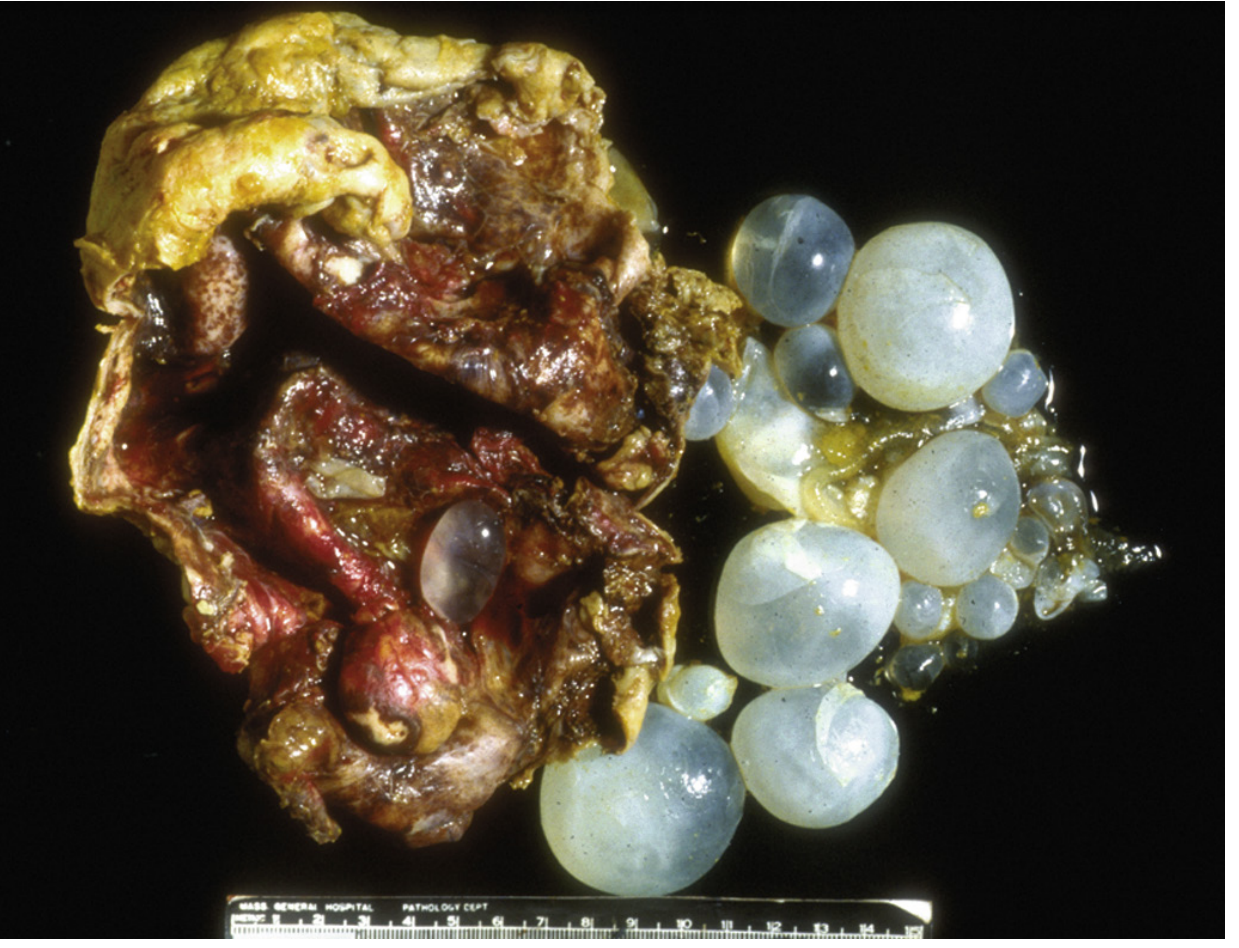
- ~75% located in the right lobe of the liver
- ~75% are solitary
- Slow, spherical growth pattern
- Degenerating cysts: vacuolation of membranes → calcification of wall (calcification does not always imply the cyst is dead)
8. Treatment
General Principles
- Most cysts should be treated
- Conservative management is appropriate for small, asymptomatic, densely calcified cysts in elderly patients
- Preoperative albendazole is recommended to reduce spillage risk; steroids and epinephrine should be on standby for anaphylaxis
A. Surgery (Gold Standard)
Preparation:
- Pack off the abdomen to prevent spillage (anaphylaxis + dissemination risk)
- Aspirate through a closed suction system
- Flush with scolicidal agent (hypertonic saline is standard)
Surgical options:
| Approach | Procedure |
|---|---|
| Conservative | Unroofing → drainage/evacuation, marsupialization, omentoplasty |
| Radical | Total pericystectomy, partial hepatectomy (formal resection without entering cyst) |
| Laparoscopic | Drainage and unroofing; encouraging results in selected cases |
| Biliary involvement | Suture closure of bile duct communication; major biliary repair; postoperative ERCP |
- Radical and conservative approaches are equally effective
- Recurrence rate: 1–20% (generally ≤5% at experienced centres)
- Calcified cysts need not be removed
B. PAIR (Percutaneous Minimally Invasive)
Puncture → Aspiration → Injection (scolicidal agent) → Re-aspiration
- Previously contraindicated; now accepted in highly selected patients
- Two small RCTs show similar success rates to surgery (both limited by small sample sizes)
- Best for uncomplicated cysts; requires concomitant antihelminthic cover
C. Medical Therapy (Antihelminthics)
| Drug | Dose |
|---|---|
| Albendazole (preferred) | 10 mg/kg/day in 2 divided doses × 28 days; repeat 3–4 cycles with 2-week breaks between cycles |
| Mebendazole | Alternative; higher doses required |
- Effective at shrinking cysts in E. granulosus; complete disappearance in <50%
- Used preoperatively to reduce spillage risk
- Monotherapy (without drainage/resection) reserved for:
- Widely disseminated disease
- Poor surgical candidates
9. E. multilocularis vs E. granulosus — Key Differences
| Feature | E. granulosus (Cystic) | E. multilocularis (Alveolar) |
|---|---|---|
| Cyst type | Well-defined fluid-filled cysts | Solid invasive masses |
| Appearance | Unilocular/multilocular cysts | Alveoli-like microvesicles |
| Growth pattern | Expansile | Infiltrative ("invasion" of parenchyma) |
| CT | Calcified cysts, daughter cysts | Scattered calcified necrotic tissue |
| Mimics | Simple hepatic cyst, abscess | Cirrhosis, hepatocellular carcinoma |
| Prognosis | Good with treatment | Poor; mortality ~90% without treatment |
| Surgery | Usually curative | Curative in only ~1/3; often inoperable at diagnosis |
| Medical | Albendazole effective | Long-term albendazole indefinitely (if inoperable) |
10. Key Points Summary
- Caused by E. granulosus (most common), a tapeworm whose definitive host is the dog
- Humans are accidental intermediate hosts infected via fecally contaminated food
- Liver is most commonly affected (70%), followed by lungs (20%)
- Cyst wall: pericyst (host) / ectocyst (outer worm) / endocyst (germinal, inner worm)
- Largely asymptomatic until complications develop
- Most dangerous complication: free rupture → anaphylaxis
- Most common rupture site: biliary tree → cholangitis
- Ultrasound is the primary imaging tool; rosette sign and eggshell calcification are pathognomonic
- ELISA is best serology (84–90% sensitive); Casoni test is obsolete
- Treatment: Surgery ± preoperative albendazole is the mainstay; PAIR for selected cases
- Hypertonic saline is the standard scolicidal agent used intraoperatively
Sources: Sabiston Textbook of Surgery, p. 1891–1892 | Sleisenger & Fordtran's GI and Liver Disease, p. 1589 | Goldman-Cecil Medicine, p. 1599–1600 | Jawetz Melnick & Adelberg's Medical Microbiology
This is a shared conversation. Sign in to Orris to start your own chat.