
Significance of tattoo mark in forensic medicine. short notes 5 marks
Reading File
Quick Answer: Tattoo marks are permanent skin markings made by injecting pigment into the dermis. In forensic medicine, they help identify unknown or decomposed bodies, reveal personal history, group affiliations, and can indicate the manner/time of injury (especially in gunshot wounds). They are also studied to determine age, occupation, and social habits.
Searching sources...
Finding Sources
Finding Sources
I have three excellent forensic medicine textbook sources. Let me read them all in parallel.
Reading File
Reading File
Reading File
I now have rich content from three major forensic medicine textbooks. Let me also fetch the tattoo image from a decomposed body for visual aid, and read the Parikh's remaining content.
Reading File
Loading Image
Excellent - I now have comprehensive content from three major forensic medicine textbooks. Here is the complete short note:
Significance of Tattoo Marks in Forensic Medicine
Definition and Mode of Production
Tattoo marks are designs made by multiple small puncture wounds through the skin using needles or an electric vibrator dipped in coloring matter, depositing dye into the upper dermis. They may be:
- Voluntary - deliberately imprinted with pigments (Indian ink/carbon - black; cinnabar/vermilion - red; indigo/Prussian blue - blue; chromic acid - green)
- Involuntary - e.g., gunpowder tattooing around firearm entry wounds
(Essentials of Forensic Medicine & Toxicology, 36th ed.; Parikh's Textbook of Medical Jurisprudence)
Medicolegal Significance
1. Identification (Most Important)
Tattoos are permanent, durable marks highly valuable in identifying:
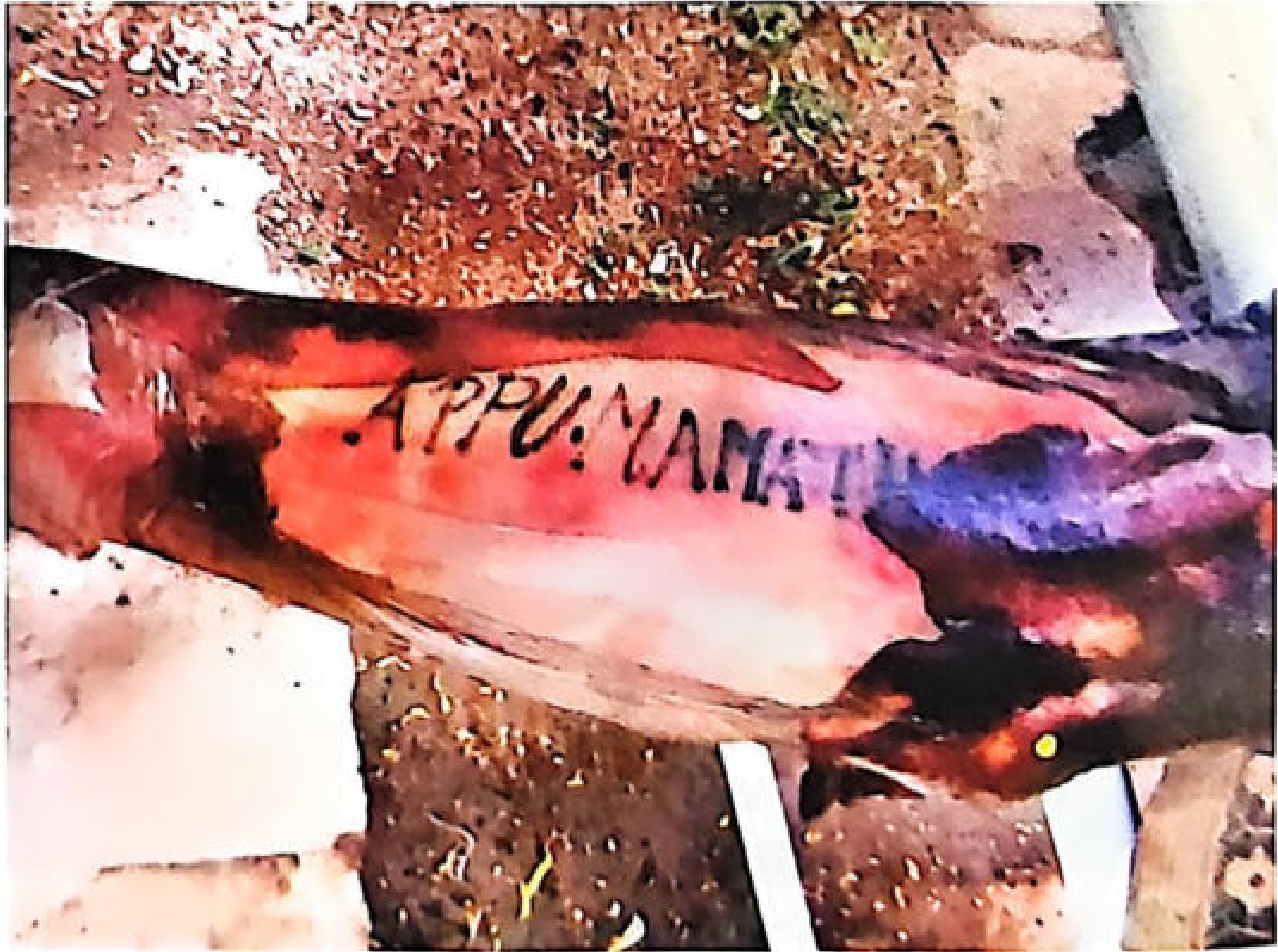
- Unknown or unidentified bodies - especially in decomposed, mutilated, or burned bodies
- Name of person, relatives, spouse, or friends written as part of the design
- Date of birth, marriage, or service entry
- Bodies recovered from water - after removing loose epidermis, the tattoo on the dermis can be photographed
Tattoo marks seen in a decomposed body - the name "APPU NAMA" remains legible even after putrefaction:
2. Race / Nationality
- Extensive tattooing of the chest and limbs is common among Japanese
- Tribal communities use characteristic patterns
3. Religion
- Design of Hanuman, Lord Krishna (Hindu), Cross or Christ (Christian), etc. indicate religious affiliation
4. Profession / Occupation
- Coal miners leave involuntary tattoo marks (carbon dust) on hands and face
- Certain criminal gangs have specific emblem tattoos identifying membership
5. Behavioural Characteristics / Social Habits
- Erotic tattoos suggest sexual deviation
- Blue bird design on the extensor surface of the thumb web - associated with homosexuality
- Number 13 inside the lower lip - associated with drug pushers
- Tattoos over injection sites (antecubital fossa) - used by drug addicts to conceal needle marks
- Tattoos on genitalia or excessive sex-oriented designs suggest sexually deviant orientation
6. Social Status / Political Conviction
- In India, tattooing is more common in the lower socioeconomic class
- Political symbols (cow and calf, sword and sickle) may indicate political affiliations
7. Mental Makeup
- The nature of the design (flower, obscene figure, idol) reflects the personality and inclinations of the individual
Permanency and Durability
- Most permanent when dye is deposited into the dermis (may last a lifetime)
- Fading occurs if pigment is in the subepithelial layer, on exposed parts (sunlight), or on areas of constant friction (hands) - may fade in 8-10 years
- Vermilion and ultramarine may disappear after ~10 years
Recognition of Faded/Old Tattoos
| Technique | Use |
|---|---|
| UV lamp | Reveals faded tattoos |
| Infrared photography | Old tattoos become readily visible |
| High-contrast photography | Latent marks on decomposed skin |
| Computer image enhancement | Digital analysis |
| Removing epidermis | In decomposed bodies - wipe with moist cloth to expose dermis |
- Lymph nodes near a tattoo mark always show a deposit of the pigment used - helpful even when the skin tattoo has faded
Attempts to Conceal / Obliterate Tattoos
Artificial obliteration strongly suggests the person is trying to conceal identity - a significant forensic clue. Methods include:
- Dermabrasion (leaves scar)
- Application of caustic substances or CO₂ snow (leaves scar)
- Electrolysis
- Surgical excision with skin grafting (less obvious scar)
- Laser beams (destroys pigment without structural damage - most modern method)
Note: Chronic eczema may cause tattoo designs to disappear; confluent smallpox can obliterate them in children.
Complications (Medicolegal Relevance)
Tattoo marks can cause or transmit:
- Sepsis / local infection
- Syphilis, leprosy, tuberculosis
- Hepatitis B and C
- HIV/AIDS
- Keloid formation, ulcers
Key Forensic Points to Record
When describing a tattoo mark at autopsy or examination, note:
- Anatomical situation (location on body)
- Size
- Color
- Design (sketch or photograph - more reliable than written description)
- Possible origin (tattooist, gang, country)
"The possibility of the same emblem in the same situation in more than one person due to the same tattooist executing the design must be kept in mind." - Parikh's Textbook
Sources: Essentials of Forensic Medicine and Toxicology (36th ed., 2026) | Parikh's Textbook of Medical Jurisprudence, Forensic Medicine and Toxicology | P.C. Dikshit Textbook of Forensic Medicine and Toxicology
This is a shared conversation. Sign in to Orris to start your own chat.