
Fibromyalgia
Fibromyalgia
fibromyalgia diagnosis treatment
fibromyalgia tender points diagram
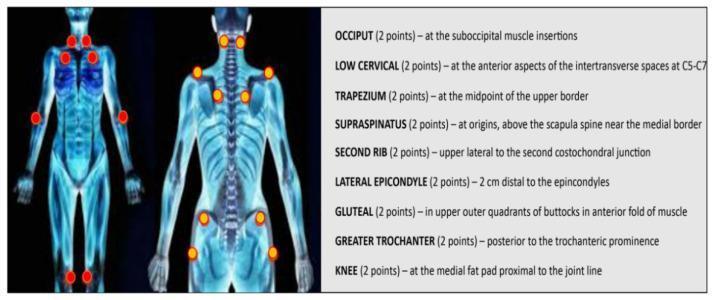
Anatomical diagram and infographic illustrating the 18 specific tender points used in the diagnosis of fibromyalgia, as defined by the 1990 American College of Rheumatology (ACR) criteria. The image features two stylized human silhouettes—one anterior and one posterior—with bilateral orange/red dots marking the location of the tender points. The points are distributed across the body including: suboccipital muscle insertions (occiput), low cervical intertransverse spaces (C5-C7), midpoint of the upper trapezius border, supraspinatus origins above the scapular spine, second costochondral junctions, 2 cm distal to the lateral epicondyles, upper outer quadrants of the gluteal muscles, posterior to the greater trochanteric prominence, and the medial fat pad of the knee proximal to the joint line. A text panel on the right provides a structured list of these nine bilateral pairs, totaling 18 points, with brief anatomical descriptions for each site. This educational material is designed for clinical training in rheumatology and physical examination techniques.
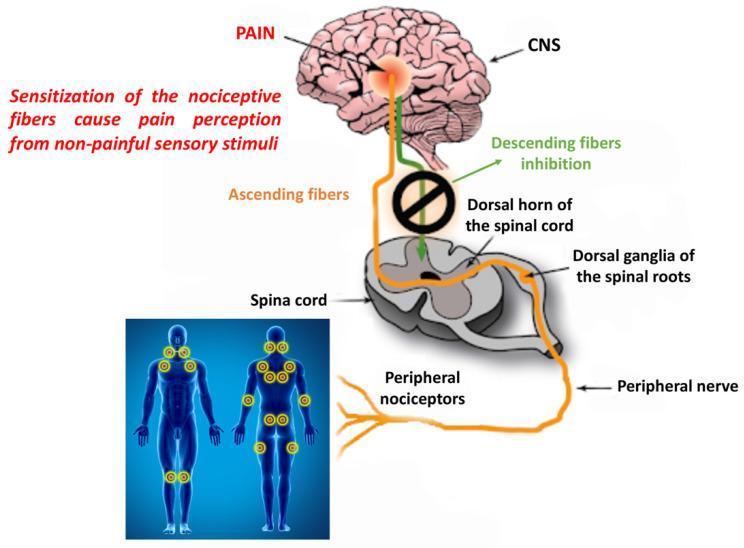
A medical illustration depicting the pathophysiology of central sensitization and pain processing pathways, specifically in the context of fibromyalgia. The graphic features a neuroanatomical diagram of the ascending and descending pain pathways alongside human figures marking tender point locations. The ascending pathway (orange line) begins at peripheral nociceptors, travels through the peripheral nerve to the dorsal ganglia of the spinal roots, enters the dorsal horn of the spinal cord, and terminates in the brain (CNS), where 'PAIN' perception occurs. A descending inhibitory pathway (green line) is shown originating in the brain but is intersected by a black prohibition symbol, indicating 'Descending fibers inhibition' failure or dysfunction. An inset image displays anterior and posterior human silhouettes with yellow circles marking 18 classic fibromyalgia tender points, including the neck, chest, elbows, hips, and knees. Text annotations explain that sensitization of nociceptive fibers causes pain perception from non-painful sensory stimuli, illustrating the concepts of hyperalgesia and allodynia.
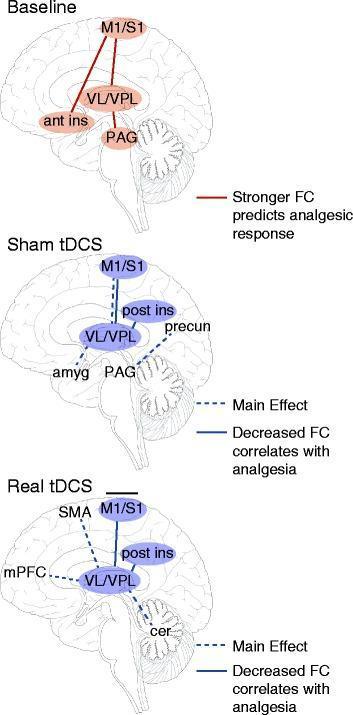
A comparative anatomical diagram of the human brain illustrating functional connectivity (FC) changes in patients with fibromyalgia across three conditions: Baseline, Sham transcranial Direct Current Stimulation (tDCS), and Real tDCS. The diagrams utilize sagittal brain outlines to map regions of interest including the primary motor/somatosensory cortex (M1/S1), thalamic nuclei (VL/VPL), anterior/posterior insula (ant/post ins), periaqueductal gray (PAG), amygdala (amyg), and cerebellum (cer). At baseline, red solid lines indicate that stronger FC between M1/S1, VL/VPL, ant ins, and PAG predicts a better analgesic response. Under the Sham tDCS condition, dashed blue lines represent a main effect of connectivity changes, while solid blue lines show decreased FC correlating with analgesia between the thalamus and posterior insula/M1. In the Real tDCS condition, distinct pathways of decreased FC are shown between the VL/VPL thalamus and the medial prefrontal cortex (mPFC), supplementary motor area (SMA), and cerebellum, highlighting the neural mechanisms of neuromodulation-induced pain relief.
Fibromyalgia
Definition
Epidemiology
-
Chronic widespread pain affects 4-12% of the general population at any given time
-
Fibromyalgia prevalence estimates range from 2-20% across various studied populations
-
Occurs ~1.5x more often in women than men (though not exclusively a female condition)
-
Prevalence is consistent across countries, ethnicities, and cultures
-
Particularly prevalent in those with comorbid inflammatory rheumatic diseases (RA, OA)
-
Goldman-Cecil Medicine, p. 2887; Firestein & Kelley's Textbook of Rheumatology, p. 598
Pathophysiology
Central Mechanisms (Primary)
- Failure of descending inhibitory pain pathways (dysfunctional diffuse noxious inhibitory control)
- Heightened activity in ascending nociceptive pathways
- Altered functional connectivity in key brain regions (thalamus, insula, prefrontal cortex, periaqueductal gray)
- Results in hyperalgesia (exaggerated pain to painful stimuli) and allodynia (pain from normally non-painful stimuli)
Peripheral Mechanisms (Contributing)
- Autoantibodies binding to Fc receptors on peripheral sensory neurons
- Autoantibodies directed against satellite cells in dorsal root ganglia, increasing nociceptor sensitivity
- Widespread small fiber neuropathy in some subpopulations
Pain Mechanism Classification
| Feature | Fibromyalgia (Nociplastic) | Nociceptive | Neuropathic |
|---|---|---|---|
| Cause | CNS/systemic problem | Inflammation/damage | Nerve damage/entrapment |
| Distribution | Widespread, diffuse | Well-localized | Dermatomal/stocking-glove |
| Key features | Allodynia, fatigue, "fibro fog" | Activity-related | Lancinating, numbness |
- Goldman-Cecil Medicine, p. 2888
Clinical Features
Core Symptoms
- Widespread musculoskeletal pain - both sides of body, above and below waist, axial involvement
- Sleep disturbance - non-restorative sleep, alpha-wave intrusion into deep sleep
- Diurnal fatigue - often profound, worsened by overexertion
- Cognitive dysfunction ("fibro fog") - impaired memory, concentration, word-finding
- Mood disturbance - depression and anxiety are common comorbidities
Associated Symptoms & Comorbidities
-
Irritable bowel syndrome
-
Tension/migraine headaches
-
Paresthesias and stiffness (without true neurological deficit)
-
Hyperacusis, photosensitivity, chemical sensitivity
-
Pelvic pain, urinary urgency (interstitial cystitis overlap)
-
Temporomandibular disorder
-
Raynaud phenomenon
-
Firestein & Kelley's Textbook of Rheumatology, p. 598
Diagnosis
ACR 2010/2016 Criteria (Current)
- Widespread Pain Index (WPI): number of body areas painful in the past week (out of 19 areas)
- Symptom Severity Scale (SSS): rates fatigue, waking unrefreshed, cognitive symptoms, and somatic symptoms (0-12)
- Diagnosis requires: WPI ≥7 + SSS ≥5 or WPI 4-6 + SSS ≥9
- Symptoms must be present at similar level for ≥3 months
- No other disorder sufficiently explains the pain
Central Sensitization - Pain Pathway Diagram
Treatment
Non-Pharmacological (First Line)
- Aerobic exercise - the single most evidence-based intervention; even modest exercise significantly reduces pain and fatigue
- Cognitive-behavioral therapy (CBT) - addresses catastrophizing and sleep hygiene
- Patient education - explaining the central sensitization mechanism reduces distress and improves outcomes
- Sleep hygiene - treating non-restorative sleep is key
- Multidisciplinary pain programs
Pharmacological
| Drug | Class | Mechanism | Notes |
|---|---|---|---|
| Duloxetine (Cymbalta) | SNRI | ↑ serotonin + norepinephrine | Also treats comorbid depression |
| Milnacipran (Savella) | SNRI | ↑ norepinephrine > serotonin | Higher norepinephrine selectivity |
| Pregabalin (Lyrica) | α2δ ligand | ↓ calcium channel activity, ↓ excitatory neurotransmission | Also improves sleep |
- Tricyclic antidepressants (amitriptyline, cyclobenzaprine) - low-dose, improve sleep
- Gabapentin - similar mechanism to pregabalin, off-label
- Tramadol - weak opioid + SNRI; modest evidence (avoid strong opioids)
- Low-dose naltrexone - emerging evidence for anti-inflammatory/glial modulation effect
What to Avoid
- Strong opioids - worsen central sensitization over time (opioid-induced hyperalgesia)
- NSAIDs/corticosteroids - no meaningful benefit for nociplastic pain
- Excessive investigation and surgery based on pain complaints alone
Prognosis
Recent Evidence (2024-2026)
- A 2025 systematic review (PMID 40576703) found the Mediterranean diet may reduce fibromyalgia symptoms through anti-inflammatory and low-antigenic properties - a promising lifestyle adjunct.
- A 2025 meta-analysis (PMID 40053352) confirmed very high prevalence of depression and anxiety among adults with chronic pain conditions including fibromyalgia, reinforcing the need for integrated psychological care.
Epi