
Cancers in occupational hazard in psm
Reading File
Occupational cancers in PSM (Preventive & Social Medicine) involve well-known associations between specific workplace carcinogens and target organ malignancies. Let me search the library for comprehensive content.
Searching sources...
Finding Sources
Finding Sources
Found Park's PSM and other relevant sources. Let me read both Park's PSM section and get more details.
Reading File
Finding Sources
Excellent - got the full Park's PSM section. Let me read a bit more of the content that was cut off.
Reading File
I now have all the content needed from Park's PSM. Here is the complete, well-structured answer:
Occupational Cancers - Park's PSM
Occupational cancer is a serious problem in industry. The sites of the body most commonly affected are skin, lungs, bladder, and blood-forming organs.
Historical Note
Percival Pott (1775) was the first to draw attention to cancer - specifically scrotal cancer in chimney sweeps. This was the first documented occupational cancer and linked to polycyclic aromatic hydrocarbons (PAH) in soot/coal tar.
Types of Occupational Cancers
1. Skin Cancer
- Most common - nearly 75% of all occupational cancers are skin cancers
- Causative agents: Coal tar, X-rays, certain oils and dyes (mineral oil, pitch, tar, and related compounds)
- Occupations at risk:
- Gas workers
- Coke oven workers
- Tar distillers
- Oil refiners
- Dye-stuff makers
- Road makers
2. Lung Cancer
- Causative agents:
- Proved carcinogens: Nickel, chromates, asbestos, coal tar (3-4 benzpyrene), radioactive substances, cigarette smoking
- Suspected carcinogens: Arsenic, beryllium, isopropyl oil
- Occupations at risk:
- Gas industry
- Asbestos industry
- Nickel and chromium work
- Arsenic roasting plants
- Mining of radioactive substances (e.g., uranium)
- More than 9/10 lung cancers are attributed to tobacco smoking, air pollution, and occupational exposure combined
3. Cancer of the Bladder
- First noted in the aniline industry in 1895; later noted in the rubber industry
- Mechanism: Caused by aromatic amines, which are metabolized in the body and excreted in urine (hence concentrating in the bladder)
- Bladder carcinogens:
- Beta-naphthylamine
- Benzidine
- Para-amino-diphenyl
- Auramine
- Magenta
- Industries associated:
- Dye-stuffs and dyeing industry
- Rubber industry
- Gas industry
- Electric cable industry
4. Leukaemia
- Causative agents:
- Benzol (benzene) - a dangerous chemical used as a solvent in many industries
- Roentgen rays (X-rays)
- Radioactive substances
- Key point: Leukaemia may appear long after exposure has ceased
Characteristics of Occupational Cancer (Important for MCQs)
- They appear after prolonged exposure
- The period between exposure and development of disease may be as long as 10 to 25 years (latent period)
- The disease may develop even after cessation of exposure
- The average age of incidence is earlier than cancer in general
- The localization of tumours is remarkably constant in any one occupation
Control of Occupational/Industrial Cancer
- Elimination or control of industrial carcinogens (technical measures: closed systems, exclusion of carcinogens)
- Medical examinations (pre-employment and periodic)
- Inspection of factories
- Notification
- Licensing of establishments
- Personal hygiene measures
- Education of workers and management
- Research
Quick Reference Table
| Cancer Type | Key Carcinogen(s) | Key Industry/Occupation |
|---|---|---|
| Skin | Coal tar, PAHs, mineral oils, X-rays | Chimney sweeps, coke oven, gas workers |
| Lung | Asbestos, nickel, chromates, arsenic, uranium | Asbestos industry, nickel/chromium work, uranium mining |
| Bladder | Beta-naphthylamine, benzidine, auramine | Dye industry, rubber industry |
| Leukaemia | Benzene (benzol), radiation | Solvent industries, radiology |
| Scrotal (historical) | Soot/PAH | Chimney sweeps (Percival Pott, 1775) |
Source: Park's Textbook of Preventive and Social Medicine, Chapter on Occupational Health (p. 912)
Plumbism
Plumbism is lead poisoning - a classic occupational and environmental hazard. Let me pull the full content from Park's PSM and supporting textbooks.
Searching sources...
Finding Sources
Finding Sources
Found Park's PSM and forensic medicine sources. Let me read all sections in parallel.
Reading File
Reading File
Reading File
Excellent - rich content from all three sources. Let me read the remaining Park's PSM content and the forensic medicine content that was cut off.
Reading File
Reading File
I have comprehensive content from Park's PSM and forensic medicine textbooks. Let me also read the remaining forensic content on colic, wrist drop, and treatment.
Reading File
I now have everything needed for a comprehensive answer. Let me also fetch the Burtonian line image.
Loading Image
I now have all the content needed for a comprehensive answer on Plumbism.
Plumbism (Lead Poisoning / Saturnism / Saturnine Poisoning)
Lead poisoning is nearly always chronic in occupational settings. It is a notifiable and compensatable disease in India since 1924.
Sources of Exposure / Occupations at Risk
By Inhalation (most common industrial route):
- Manufacture of white lead, lead paint
- Smelting, oxyacetylene ship breaking
- Diamond cutting, file making, car welding & polishing
- Printing (type-setting)
By Ingestion:
- Battery work, plumbing, glazing pottery
- Paint ingestion (children licking toys, walls)
- Food in tinned vessels, ghee in brass/copper-lined tins
- Drinking water from lead pipes/cisterns
- Hair dyes and cosmetics containing lead
Through Skin:
- Only organic lead compounds (especially tetraethyl lead)
- Inorganic compounds are NOT absorbed through intact skin
Mechanism of Toxicity
Lead is stored in bones as triple phosphates (90% of body burden). It:
- Combines with SH-groups of enzymes involved in porphyrin synthesis and carbohydrate metabolism
- Inhibits delta-aminolevulinic acid dehydratase (ALAD) and ferrochelatase - blocking haem synthesis
- Inhibits 5-pyrimidine nucleotidase - causing accumulation of RNA degradation products in RBCs (basophilic stippling)
- Affects membrane permeability - causing potassium leakage from erythrocytes
Blood level 70 μg/100 ml is associated with clinical symptoms. Chronic poisoning results from daily intake of 1-2 mg of lead.
Clinical Features of Chronic Lead Poisoning (Plumbism)
1. Facial Pallor
- Earliest and most consistent sign
- Particularly around the mouth
- Due to vasospasm
2. Anaemia
- Hypochromic anaemia with:
- Polychromasia
- Punctate basophilia (basophilic stippling) - dark blue pinhead spots in RBC cytoplasm
- Reticulocytosis
- Poikilocytosis, anisocytosis
- Nucleated RBCs (sideroblasts)
- Increased mononuclear cells, decreased PMNs and platelets
- Porphyrins excreted in urine: up to 500 μg/day
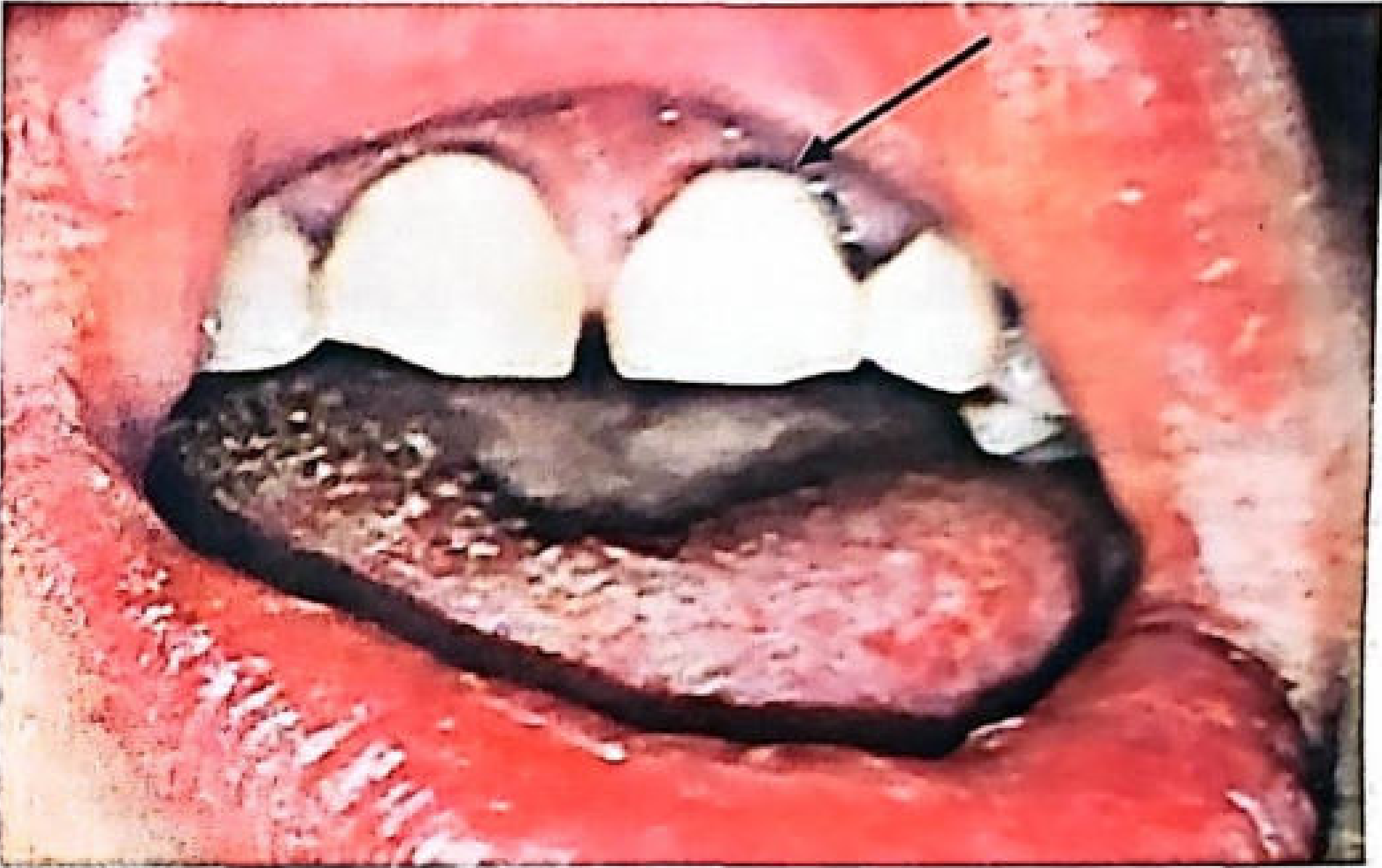
3. Lead Line (Burtonian Line)
- Stippled bluish-black line on gums at the junction with teeth
- Seen in 50-70% of cases
- Due to subepithelial deposition of lead sulphide (formed by action of H₂S from decomposed food)
- Appears within a week of exposure, especially near dirty/carious teeth, upper jaw
- Also seen (less specifically) in: mercury, copper, bismuth, iron, silver poisoning
4. Colic and Constipation
- Usually a later symptom
- Lead colic occurs in 85% of cases
- Involves intestines, ureters, uterus, blood vessels
- Occurs at night; attacks last minutes but recur for days/weeks
- Constipation is usual; diarrhoea or vomiting may occur
5. Lead Palsy (Peripheral Neuropathy)
- Occurs late, seen in < 10% of cases
- Tremors, numbness, hyperesthesia, cramps precede weakness
- Wrist drop (radial nerve) - most classic presentation
- Also: deltoid, biceps, anterior tibial (foot drop)
- Rarely: eye muscles, intrinsic muscles of hand/foot
- Pathology: degeneration of nerve + atrophy of muscles
- More common in adult men
6. Encephalopathy
- Present in some form in almost every case
- More common in children, often associated with tetraethyl lead
- Symptoms: vomiting, headache, insomnia, visual disturbances, irritability, restlessness, delirium, hallucinations, convulsions, coma, death
- 85% have permanent brain damage; death in ~25%
- Usually irreversible
7. Cardiovascular & Renal
- Vascular constriction → hypertension
- Permanent arteriolar degeneration
- Chronic arteriosclerotic nephritis + interstitial nephritis
8. Reproductive
- Menstrual derangements: amenorrhoea, dysmenorrhoea, menorrhagia
- Miscarriage, premature birth
9. Other
- Low IQ in children
- Memory loss, mood disorders
- Muscle and joint pain
Inorganic vs Organic Lead - Key Difference
| Feature | Inorganic Lead | Organic Lead (e.g., tetraethyl lead) |
|---|---|---|
| Route of absorption | Inhalation, ingestion | Skin (also inhalation, ingestion) |
| Main effects | GI (colic, constipation), haematological (anaemia, stippling), peripheral neuropathy (wrist/foot drop), Burtonian line | CNS - insomnia, headache, mental confusion, delirium |
Diagnosis (Park's PSM)
| Test | Finding / Cut-off |
|---|---|
| Coproporphyrin in urine (CPU) | Screening test; normal < 150 μg/L |
| ALA in urine (ALAU) | > 5 mg/L = clearly indicates lead absorption |
| Blood lead level | > 70 μg/100 ml = clinical symptoms |
| Lead in urine | > 0.8 mg/L = lead exposure (normal: 0.2-0.8 mg/L) |
| Basophilic stippling of RBC | Sensitive haematological parameter |
Preventive Measures (Park's PSM)
- Substitution - replace lead compounds with less toxic materials
- Isolation - enclose and segregate processes generating lead dust/fumes
- Local exhaust ventilation - promptly remove fumes and dust
- Personal protection - approved respirators
- Good housekeeping - wet sweeping of floors, benches; keep clean
- Working atmosphere - lead concentration < 2.0 mg per 10 cubic metres of air (permissible limit)
- Periodic examination - urinary lead, blood lead, RBC count, Hb, coproporphyrin test, basophilic stippling
- Personal hygiene - hand-washing before eating; no food in work areas
- Health education - educate workers on risks and protection
Management
- Remove from further exposure
- Saline purge - removes unabsorbed lead from gut
- Ca-EDTA (Calcium disodium versenate) - chelating agent, promotes lead excretion in urine
- d-Penicillamine - chelating agent (effective, oral)
- BAL (British Anti-Lewisite) - used in combination with Ca-EDTA
- DMSA (Dimercaptosuccinic acid) - effective combination
- Peritoneal or haemodialysis (severe cases)
- Symptomatic treatment
Quick MCQ Points
- Plumbism = Lead poisoning = Saturnism/Saturnine poisoning
- Lead: a typical cumulative poison; lead vapour more dangerous than dust
- Notifiable + compensatable in India since 1924
- Wrist drop: radial nerve affected
- Burtonian line: lead sulphide on gum margin
- Basophilic stippling: also seen in arsenic and zinc poisoning
- Tetraethyl lead: absorbed through skin → CNS effects
- Blood lead diagnostic threshold: 70 μg/100 ml
Sources: Park's Textbook of Preventive and Social Medicine (p. 911-912); The Essentials of Forensic Medicine and Toxicology, 36th ed. (p. 515-516); Parikh's Textbook of Medical Jurisprudence
Sickness absenteeism
Sickness absenteeism is a key topic in occupational health under PSM. Let me pull the full content from Park's PSM.
Searching sources...
Finding Sources
Finding Sources
Found it directly in Park's PSM. Let me read the full section now.
Reading File
Now let me also search for the measurement indices/formulae used for sickness absenteeism, which are high-yield for exams.
Finding Sources
Finding Sources
I have all the core content from Park's PSM. Here is the complete answer:
Sickness Absenteeism - Park's PSM
Definition / Importance
Sickness absence is an important health problem in industry. It may seriously impede production with serious cost repercussions - both direct and indirect. As production techniques become more sophisticated, absenteeism tends to increase adverse repercussions.
Absenteeism is a useful index in industry to assess the state of health of workers, and their physical, mental, and social well-being.
Incidence (India)
- India has a working force of about 30 million in registered factories
- Research by the National Productivity Council (NPC) showed:
- Early 1950s: 8-13%
- Recent years: 15-20% or more
- Rate of absenteeism reported: 8 to 10 days per head per year
Causes of Sickness Absenteeism
Causes may not be entirely due to sickness - this is an important point:
(a) Economic Causes
- If the worker is entitled to sick leave with pay, he tends to avail of this privilege by reporting sick
- Workers declare themselves fit or unfit for work at their own choice
(b) Social Causes
- Social and family obligations - weddings, festivals, repair of ancestral house
- Workers from rural areas return to villages during sowing and harvest seasons
(c) Medical Causes
- About 10% of days lost are due to occupational accidents
- Respiratory and alimentary illnesses are important causes
(d) Non-occupational Causes
- Nutritional disorders
- Alcoholism
- Drug addiction
Measurement Indices (High-Yield for Exams)
Sickness absenteeism is measured by the following indices:
| Index | Formula |
|---|---|
| Frequency Rate | (Number of spells of absence × 100) / Average number of workers employed |
| Severity Rate | (Total days lost × 100) / Average number of workers employed |
| Spell Duration | Total days lost / Total number of spells |
| Percentage Time Lost | (Days lost × 100) / (Days worked + Days lost) |
Prevention / Reduction of Sickness Absenteeism
Reduction of sickness absenteeism results in better utilization of resources and maximizing production. Methods include:
- Good factory management and practices
- Adequate pre-placement examination - place workers in jobs suited to their health and capacity
- Good human relations - between management and workers
- Application of ergonomics - fitting the job to the worker
Additional Points for Exam
| Feature | Detail |
|---|---|
| Best index of worker health | Sickness absenteeism rate |
| Most common medical cause | Respiratory and alimentary illnesses |
| Occupational accidents account for | ~10% of days lost |
| Key formula body | National Productivity Council (NPC) |
| Rate in India (early 1950s) | 8-13% |
| Rate in India (recent) | 15-20% or more |
| Days lost per worker per year | 8-10 days |
Key Takeaway (MCQ Anchor)
Sickness absenteeism is NOT always due to sickness - economic, social, and non-occupational factors all contribute. It serves as an index of the health and well-being of the workforce. Prevention rests on good management, pre-placement examination, human relations, and ergonomics.
Source: Park's Textbook of Preventive and Social Medicine, Occupational Health chapter (p. 913-914)
Factory act
The Factories Act 1948 is a high-yield PSM topic. Let me pull the full content from Park's PSM right away.
Searching sources...
Finding Sources
Finding Sources
Found the exact section. Let me read all paragraphs in full.
Reading File
Good content so far. Let me read the rest of the section.
Reading File
Excellent - I now have the complete Factories Act section from Park's PSM. Here is the comprehensive answer:
The Factories Act, 1948 - Park's PSM
Background
- The first Indian Factories Act dates back to 1881
- Revised and amended several times
- Latest amendment: Factories (Amendment) Act, 1987
- Factory laws exist because society has an obligation to protect worker health - the worker is more important than the machine he operates
Other important factory laws in India:
- Employees' State Insurance Act, 1948
- Mines Act
- Plantation Act
- Minimum Wages Act
- Maternity Benefit Act
1. Scope (Definition of Factory)
| Condition | Threshold |
|---|---|
| Where power is used | 10 or more workers |
| Where power is NOT used | 20 or more workers |
- No distinction between perennial and seasonal factories
- 1976 amendment: 'worker' includes contract labour employed in the manufacturing process
- Applies to the whole of India (except J&K at the time of writing)
- State Governments appoint Chief Inspector of Factories + Additional/Joint/Deputy Chief Inspectors
2. Health, Safety and Welfare (Chapters III, IV, IVA & V)
Health Provisions
- Cleanliness, lighting, ventilation
- Treatment of wastes and effluents
- Elimination of dusts and fumes
- Provision of spittoons
- Control of temperature
- Supply of cool drinking water during summer
- Employment of cleaners to keep water closets clean
Space per worker:
| Factory | Minimum Space |
|---|---|
| Factories established after 1948 Act | 500 cu. ft per worker |
| Factories installed before 1948 Act | 350 cu. ft per worker |
| (Space above 14 feet from ground not counted) |
Safety Provisions
- Casing of new machinery
- Devices for cutting off power
- Hoists, lifts, cranes and lifting devices
- Protection of eyes
- Precautions against dangerous fumes, explosive and inflammable substances
- Workers cannot be required to lift/carry loads likely to cause injury
- State Governments prescribe maximum weights for men, women and children
- 1976 amendment (Section 40B): Appointment of Safety Officers in every factory with 1,000 or more workers
Welfare Provisions (Chapter V)
- Washing facilities
- Facilities for storing and drying clothes
- Facilities for sitting
- First-aid appliances
- Shelters, rest-rooms and lunch rooms
Key numeric thresholds:
| Provision | Threshold |
|---|---|
| Canteen must be provided | > 250 workers |
| Crèche must be provided | > 30 women workers (1976 amendment) |
| Welfare Officer must be appointed | ≥ 500 workers |
| Safety Officer must be appointed | ≥ 1,000 workers (1976 amendment) |
3. Employment of Young Persons
- Children below 14 years: Prohibited from employment in any factory
- Persons 15-18 years = Adolescents
- Must be certified by Certifying Surgeons regarding fitness for work
- Allowed to work only between 6 AM and 7 PM
- Restrictions on employment of women and children in dangerous occupations
4. Hours of Work
| Category | Hours/Day | Hours/Week |
|---|---|---|
| Adults | Max 9 hours/day | Max 48 hours/week |
| Adolescents | 4½ hours/day | Reduced accordingly |
| Rest interval | At least ½ hour after 5 hours of continuous work | - |
| Spread-over period (including rest) | Up to 12 hours (1976 amendment; previously 10½ hours) | - |
| Total including overtime | - | Not exceeding 60 hours/week |
5. Leave with Wages
After 12 months of continuous service, every worker is entitled to leave with wages at the following rate:
| Worker | Leave Entitlement | Maximum Accumulation |
|---|---|---|
| Adult | 1 day for every 20 days of work | Up to 30 days |
| Child | 1 day for every 15 days of work | Up to 40 days |
6. Occupational Diseases (Notifiable)
- Factory management must report: specified accidents causing death, serious bodily injury, or occupational diseases
- 1976 amendment added to the list of notifiable diseases:
- Byssinosis
- Asbestosis
- Occupational dermatitis
- Noise-induced hearing loss
- Provision for enquiry in every case of a fatal accident
- Provision for safety and occupational health surveys in factories
7. Employment in Hazardous Processes (Chapter IV-A, 1987 Amendment)
- Site Appraisal Committee: consisting of Chief Inspector + other members (not more than 14) for examination of service conditions in factories involving hazardous processes
Quick Revision Table - Key Numbers
| Number | What it refers to |
|---|---|
| 1881 | First Indian Factories Act |
| 1948 | Current Factories Act |
| 1987 | Latest amendment (hazardous processes) |
| 10 workers | Factory definition (with power) |
| 20 workers | Factory definition (without power) |
| 350 cu ft | Space/worker (old factories, pre-1948) |
| 500 cu ft | Space/worker (new factories) |
| 14 years | Minimum age for factory employment |
| 48 hours | Max working hours per week (adults) |
| 9 hours | Max working hours per day (adults) |
| 60 hours | Max hours/week including overtime |
| ½ hour | Rest after 5 hours continuous work |
| >30 women | Crèche mandatory |
| >250 workers | Canteen mandatory |
| ≥500 workers | Welfare Officer mandatory |
| ≥1000 workers | Safety Officer mandatory |
Source: Park's Textbook of Preventive and Social Medicine, Occupational Health - Legislation chapter (p. 919-920)
This is a shared conversation. Sign in to Orris to start your own chat.