
Diagnosis and treatment of acne with drug dose
Reading File
Now let me search the medical library and PubMed in parallel for comprehensive acne diagnosis and treatment information.
Finding Sources
Searching PubMed
acne vulgaris treatment guidelines
Excellent sources found. Now let me read the key textbook sections in parallel.
Reading File
Reading File
Reading File
Good content found. Let me now get the treatment details with drug doses from Swanson's and Dermatology 5e, plus search for isotretinoin dosing specifically.
Reading File
Reading File
Finding Sources
Now let me get the specific isotretinoin dosing and the Dermatology 5e acne treatment section with drug doses.
Reading File
Reading File
Finding Sources
Excellent. Let me get the Andrews' detailed antibiotic dosing section and Harrison's acne section for complete drug doses.
Reading File
Reading File
Let me read Harrison's treatment section and get the Andrews' oral antibiotic dosing section.
Reading File
Reading File
I now have comprehensive information from multiple authoritative textbooks. Let me also quickly fetch a relevant acne image from Harrison's to include in the response.
Loading Image
I now have all the information needed for a comprehensive, well-sourced answer. Here it is:
Acne Vulgaris: Diagnosis and Treatment with Drug Doses
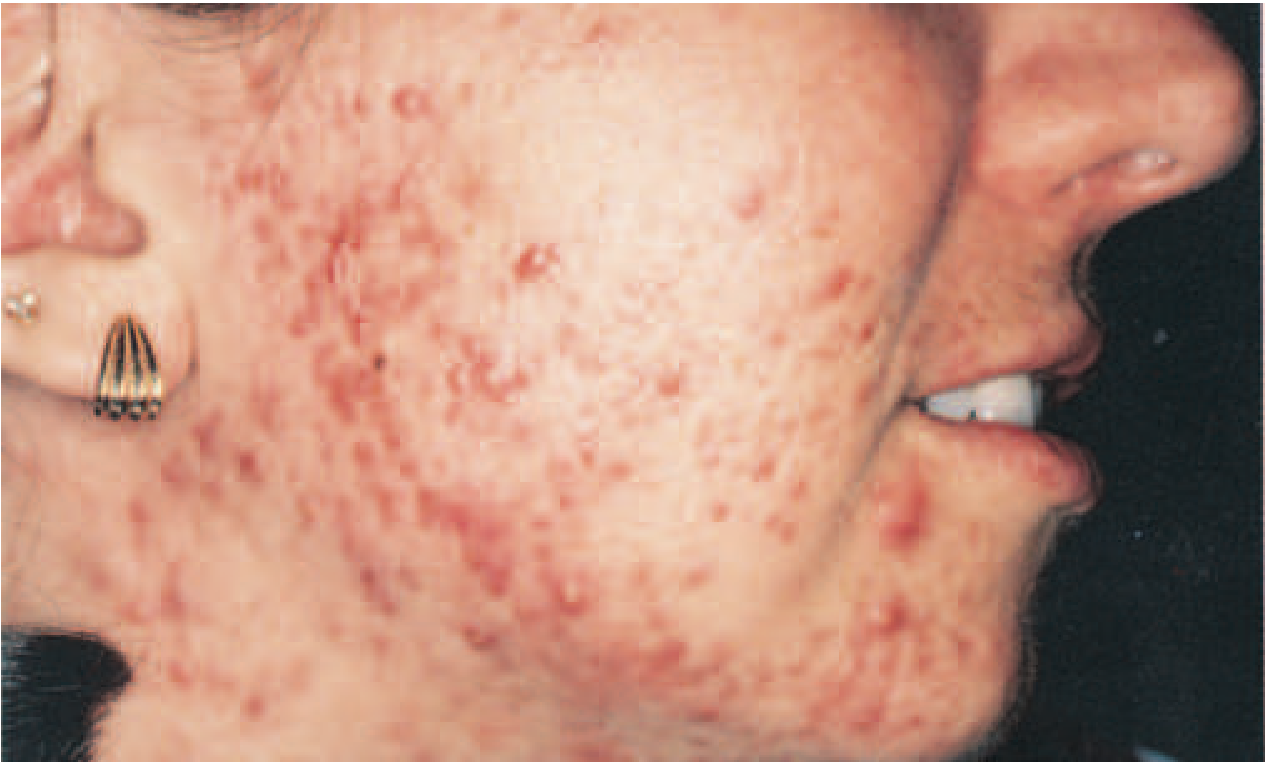
Overview and Epidemiology
Acne vulgaris is the most common dermatological disorder. It is a chronic inflammatory disease of the pilosebaceous units, primarily affecting teenagers and young adults - approximately 85-95% of all teenagers are affected to some degree. It is more common in males but more persistent in women. For 12% of women and 3% of men, it can extend into the mid-40s.
- Swanson's Family Medicine Review
- Harrison's Principles of Internal Medicine 22E
Pathogenesis
Four key factors drive acne:
- Increased sebum production - Androgens (testosterone converted to DHT in skin) stimulate sebaceous gland growth and secretion at puberty
- Follicular hyperkeratinization - Abnormal keratinocyte differentiation blocks the follicular orifice, trapping sebum and forming a microcomedone
- Colonization with Cutibacterium acnes (formerly Propionibacterium acnes) - this gram-positive anaerobe proliferates in the obstructed, lipid-rich lumen where O2 tension is low, generating free fatty acids, hyaluronidase, lipases, proteases, and chemotactic factors, and interacting with toll-like receptors to drive inflammation
- Inflammation - Neutrophils attracted by chemotactic factors release hydrolases that weaken and rupture the follicular wall, causing a foreign-body inflammatory reaction
- Goodman & Gilman's Pharmacological Basis of Therapeutics
- Harrison's Principles of Internal Medicine 22E
Diagnosis / Classification of Lesions
Lesion Types
| Type | Description |
|---|---|
| Closed comedone (whitehead) | 1-2 mm pebbly white papule; follicular orifice blocked; precursor to inflammatory lesions |
| Open comedone (blackhead) | Dilated follicular orifice filled with oxidized, darkened debris; rarely causes inflammatory lesions |
| Papule | Inflammatory lesion |
| Pustule | Inflammatory lesion with pus |
| Nodule | Deep, larger inflammatory lesion |
| Cyst | Large, fluctuant, deep lesion; may scar |
Severity Grading
| Grade | Description |
|---|---|
| Mild | Comedones predominate; few papules/pustules |
| Moderate | More numerous papules and pustules; may have some nodules |
| Severe | Extensive papules, pustules, nodules/cysts; significant scarring potential |
Key distribution: Face (forehead, cheeks, nose, chin), neck, chest, back, trunk, and upper extremities (areas of high sebaceous gland concentration).
Clinical History Points
-
Duration, location, seasonal variation, aggravating factors
-
Previous and current treatments, family history
-
For women: premenstrual flares, menstrual history, oral contraceptive use, screening for PCOS and adrenal tumors
-
Drug history: glucocorticoids, progestin-only OCP, lithium, isoniazid, androgenic steroids, phenytoin, phenobarbital can all trigger or worsen acne
-
Swanson's Family Medicine Review
-
Harrison's Principles of Internal Medicine 22E
Treatment
Treatment targets: normalize follicular keratinization, reduce sebaceous gland activity, reduce C. acnes colonization, and suppress inflammation.
Step-by-Step Approach by Severity
| Severity | Recommended Treatment |
|---|---|
| Comedonal acne | Topical retinoid alone |
| Mild papulopustular | Benzoyl peroxide + topical retinoid, or benzoyl peroxide + topical antibiotic |
| Moderate papulopustular (no scarring) | Benzoyl peroxide + topical retinoid + topical antibiotic |
| Moderate papulopustular (with scarring) - Male | Oral antibiotic (tetracycline/macrolide) + benzoyl peroxide or topical retinoid |
| Moderate papulopustular (with scarring) - Female | Oral antiandrogen contraceptive + benzoyl peroxide + topical antibiotic |
| Severe papulopustular | Oral isotretinoin |
| Nodulocystic / conglobate acne | Oral isotretinoin |
| Acne fulminans | Oral isotretinoin + low-dose oral corticosteroid |
Drug Classes and Doses
1. Topical Retinoids
The mainstay of comedonal and inflammatory acne. They normalize follicular epithelial differentiation, loosen microcomedones, and have anti-inflammatory activity. Applied to entire affected area once daily (tretinoin in the evening to avoid UV inactivation). Beneficial effects take 6-8 weeks or longer.
| Drug | Notes |
|---|---|
| Tretinoin | Prototype; apply once nightly; pregnancy category C |
| Adapalene | Well tolerated, light-stable (morning or evening); efficacy equivalent to lower tretinoin concentrations; pregnancy category C |
| Tazarotene | More potent but more irritating; once nightly or every other night; pregnancy category X - contraceptive counseling mandatory |
| Trifarotene | Newer; FDA-approved for acne vulgaris |
Tip: Start every other night or add a moisturizer to reduce irritation. An apparent initial flare in the first month is expected as deeper lesions are externalized.
- Dermatology 2-Volume Set 5e, Andrews' Diseases of the Skin
2. Benzoyl Peroxide (BPO)
Potent bactericidal agent. C. acnes does not develop resistance to it (unlike antibiotics). Also mildly comedolytic. Applied once or twice daily. Available in concentrations from 2.5% to 10% (water-based, lower strength is least irritating with equivalent efficacy). Concurrent use with antibiotics prevents development of antibiotic resistance. Wash formulations effective for truncal acne if left on for at least 2 minutes. Pregnancy category C.
- Andrews' Diseases of the Skin
3. Topical Antibiotics
Used for mild to moderate inflammatory acne. Always combine with benzoyl peroxide to prevent antibiotic resistance. Never use topical antibiotics as monotherapy.
| Drug | Notes |
|---|---|
| Clindamycin 1% | Gel, solution, lotion; twice daily application; pregnancy category B |
| Erythromycin 2% | Gel, solution; twice daily; pregnancy category B |
| Dapsone 5-7.5% gel | Avoid concurrent BPO (skin discoloration); pregnancy category C |
| Azelaic acid 15-20% | Mild efficacy in inflammatory + comedonal acne; also lightens post-inflammatory hyperpigmentation; pregnancy category B |
- Goodman & Gilman's, Andrews' Diseases of the Skin
4. Oral Antibiotics
Indicated for moderate to severe acne, chest/back acne, or when topical combinations are insufficient. Allow 8-12 weeks to judge efficacy. Start at higher dose, then taper after control is achieved. Limit duration of use; combine with topical BPO to reduce resistance.
Tetracyclines (first-line oral antibiotics)
| Drug | Dose |
|---|---|
| Doxycycline | 50-100 mg once or twice daily depending on severity. Sub-antimicrobial dose: 20 mg twice daily or sustained-release 40 mg once daily (anti-inflammatory without inducing resistance) |
| Minocycline | 50-100 mg once or twice daily. Extended-release formulation available (limits vestibular side effects) |
| Tetracycline | Largely limited in utility now (poor absorption with food/dairy; twice daily dosing) |
| Sarecycline | Newer; narrower spectrum (less GI/vaginal microbiome disruption); less photosensitizing |
Contraindications: Avoid in pregnant women and children under age 9-10 (staining of growing teeth). Avoid in renal impairment. Take with a full glass of water; do not take at bedtime (esophagitis risk).
Adverse effects of minocycline in particular: Vertigo (begin with single evening dose), pigmentation of skin/mucosa/scars/teeth, drug-induced lupus, hypersensitivity syndrome (fever, hepatitis, eosinophilia).
Macrolides (second-line or pregnancy)
| Drug | Dose |
|---|---|
| Erythromycin | 250-500 mg twice daily (increasing resistance limits use) |
| Azithromycin | Pulse dosing used off-label |
Other systemic antibiotics
| Drug | Dose / Notes |
|---|---|
| Amoxicillin | Used when tetracyclines contraindicated (e.g. pregnancy); pregnancy category B |
| Trimethoprim-sulfamethoxazole | Reserved for resistant cases |
- Andrews' Diseases of the Skin, Goodman & Gilman's, Harrison's Principles of Internal Medicine 22E
5. Oral Isotretinoin
The most effective acne therapy - the only drug that targets all four etiologic factors (sebum production, comedogenesis, C. acnes, and inflammation). The only acne therapy that is not open-ended - can induce prolonged remission or "cure." Approximately 40-60% of patients remain acne-free after a single course.
Indications:
- Severe cystic/nodulocystic acne
- Moderate acne with scarring
- Acne unresponsive to combined oral + topical therapy (< 50% improvement after 3 months)
- Relapsing acne after adequate oral treatment
- Acne causing significant psychological distress
Dosing:
| Parameter | Dose |
|---|---|
| Standard dose | 0.5-1 mg/kg/day in 1-2 divided doses |
| Starting dose (to avoid early flare) | 20-40 mg/day, then escalate to 40-80 mg/day |
| Severe truncal acne | Up to 2 mg/kg/day in those who tolerate it |
| Low-dose regimen (adults) | 0.5 mg/kg/day for 1 week in every 4 weeks; or 20 mg/day continuously |
| Cumulative dose target | 120-150 mg/kg total (minimizes relapse); practical calculation: patient's weight (kg) × 3 = number of 40-mg capsules needed for the low end |
A lag period of 1-3 months before onset of therapeutic effect is typical.
Side effects (dose-dependent):
-
Dry skin, cheilitis (very common)
-
Hypertriglyceridemia, elevated LFTs (monitor labs)
-
Teratogenicity (Category X - two negative pregnancy tests required before initiation; monthly pregnancy tests; enrollment in iPLEDGE program mandatory in the US)
-
Possible acne flare in first month (reduce by starting at low dose; if acne fulminans occurs, lower dose or stop and add prednisone)
-
Rare: depression, IBD (evidence contested)
-
Andrews' Diseases of the Skin, Dermatology 2-Volume Set 5e
6. Hormonal Therapy (Women)
| Drug | Notes |
|---|---|
| Combined oral contraceptives | FDA-approved: Ortho Tri-Cyclen, Estrostep, Alesse, Yasmin, Yaz. Reduces androgen-driven sebum production |
| Spironolactone | 25-200 mg/day (typically 50-100 mg/day); effective antiandrogen; safe and durable in women; monitor potassium; avoid in pregnancy |
| Dexamethasone / Prednisone (low-dose) | Used for severe hyperandrogenic states (congenital adrenal hyperplasia) or as adjunct in acne fulminans |
- Swanson's Family Medicine Review, Harrison's Principles of Internal Medicine 22E
7. Topical Antiandrogen
| Drug | Notes |
|---|---|
| Clascoterone 1% cream | FDA-approved; topical androgen receptor antagonist; can be used in both males and females |
8. Second-Line and Adjunct Therapies
- Azelaic acid (topical): Mild-moderate acne; safe in pregnancy (Category B)
- Dapsone gel: Mild-moderate inflammatory acne; particularly in adult women
- Oral zinc (zinc gluconate/sulfate ~30-45 mg elemental zinc/day): Modest anti-inflammatory effect; useful when antibiotics are contraindicated
- Intralesional corticosteroid (triamcinolone 2-5 mg/mL): For individual nodulocystic lesions; reduces inflammation rapidly
- Photodynamic therapy, blue light, blue-red light combinations: Second-line for mild-moderate acne
- Chemical peels (salicylic acid, glycolic acid): Adjunct for comedonal acne
Summary Algorithm
Acne
 ├── Comedonal only           → Topical retinoid
 ├── Mild inflammatory        → BPO + topical retinoid ± topical antibiotic
 ├── Moderate inflammatory    → BPO + topical retinoid + oral antibiotic
 │                              (women: add oral contraceptive or spironolactone)
 ├── Severe / Nodular         → Oral isotretinoin (0.5-1 mg/kg/day)
 └── Acne fulminans           → Isotretinoin + systemic corticosteroid
Recent Evidence
The 2024 AAD Guidelines of Care (PMID 38300170) and the 2026 Updated EuroGuiDerm Guideline (PMID 41847993) confirm the treatment hierarchy above. Recent meta-analyses (PMID 39509291) also support combining isotretinoin with laser/light-based therapies for acne scars, though isotretinoin alone remains the standard for active severe acne.
Sources: Harrison's Principles of Internal Medicine 22E | Andrews' Diseases of the Skin | Dermatology 2-Volume Set 5e | Swanson's Family Medicine Review | Goodman & Gilman's Pharmacological Basis of Therapeutics | J Am Acad Dermatol 2024 (PMID 38300170)
This is a shared conversation. Sign in to Orris to start your own chat.