
Pituitary disorders
Reading File
Pituitary disorders is a broad topic. Let me first clarify what you're looking for before diving deep.
Asking for Preferences
What aspect of pituitary disorders are you interested in? · What is the purpose?
Searching sources...
A comprehensive overview for exam prep - I'll pull from the medical library now across all major pituitary disorder categories simultaneously.
Finding Sources
Finding Sources
Finding Sources
Good results. Now let me read the most comprehensive sources - Robbins Pathology for pituitary adenoma/hypopituitarism, Goldman-Cecil for clinical overview, and Harrison's for clinical details - all in parallel.
Reading File
Reading File
Reading File
Excellent content. Now let me get Harrison's clinical details, the Adams & Victor neurology section on pituitary adenomas, and also search for acromegaly/Cushing/prolactinoma specifics.
Reading File
Finding Sources
Reading File
Now let me get Harrison's prolactinoma and acromegaly sections, and also read the hypothalamic-pituitary axis diagram.
Reading File
Loading Image
Now let me get the prolactinoma and acromegaly clinical details from Harrison's, and also search for Cushing disease specifics.
Reading File
Finding Sources
Excellent content gathered. I now have enough comprehensive material to write a thorough exam-prep overview of all pituitary disorders. Let me compile the full answer.
Pituitary Disorders - Comprehensive Exam Review
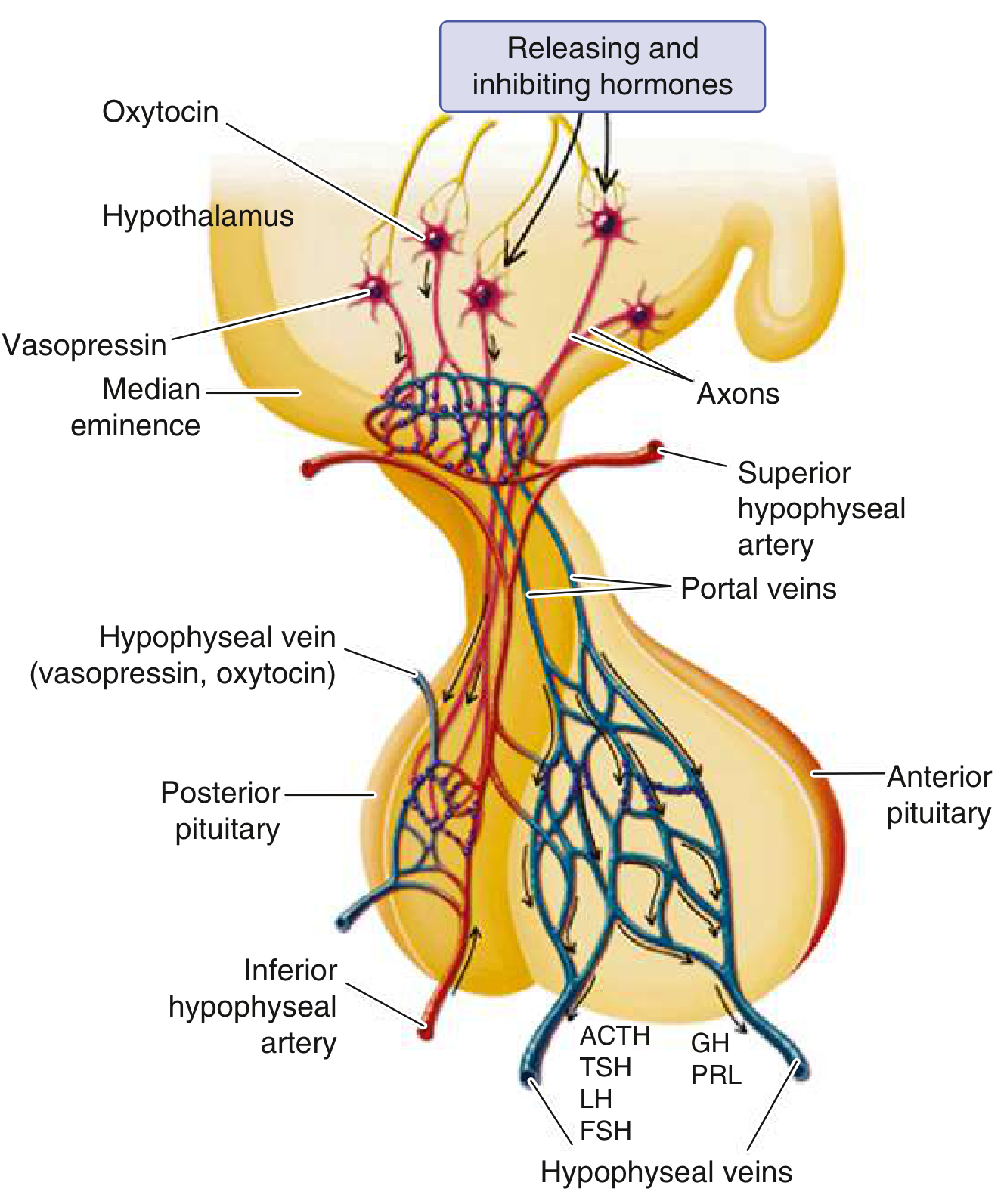
Anatomy & Physiology Recap
The pituitary sits in the sella turcica and has two lobes:
| Lobe | Hormones | Blood Supply |
|---|---|---|
| Anterior (adenohypophysis) | GH, PRL, TSH, ACTH, LH, FSH | Hypophyseal portal venous system (low-pressure) |
| Posterior (neurohypophysis) | ADH (vasopressin), Oxytocin | Direct arterial branches |
The anterior pituitary is the "command center" regulating adrenal, thyroid, and gonads. The posterior pituitary is an extension of hypothalamic neurons - oxytocin and vasopressin are produced in the hypothalamus and transported down axons for storage and release.
Key regulatory principle: Hypothalamic releasing hormones stimulate anterior pituitary secretion; dopamine tonically inhibits prolactin.
I. HYPERPITUITARISM (Excess Hormone Secretion)
Pituitary Adenomas - The Core Concept
The most common cause of hyperpituitarism is an anterior lobe pituitary adenoma (neuroendocrine tumor). Key exam facts:
- Microadenoma = <1 cm | Macroadenoma = >1 cm
- Macroadenomas cause mass effects (especially visual disturbances via optic chiasm compression - bitemporal hemianopia)
- Genetic mutation: GNAS gene mutation causing constitutive activation of stimulatory G protein (one of the more common alterations)
- Morphology: cellular monomorphism + absence of reticulin network are the two distinctive features
- Pituitary carcinomas are exceedingly rare; they extend beyond the sella and metastasize
- Robbins & Kumar Basic Pathology
A. Prolactinoma (Lactotroph Adenoma)
Most common functional pituitary adenoma.
Clinical features:
- Women: amenorrhea, infertility, galactorrhea (the classic triad)
- Men: impotence, loss of libido, infertility (often present late with CNS compression symptoms - headaches, visual defects)
- Galactorrhea associated with amenorrhea is a self-limiting disorder with moderately elevated PRL
Diagnosis:
- PRL >200 µg/L almost invariably indicates a prolactin-secreting adenoma
- PRL <100 µg/L - may be microadenoma, other sellar lesion, or non-neoplastic cause
- MRI should be performed in all patients with hyperprolactinemia
Other causes of hyperprolactinemia to exclude (exam favorite):
- Drugs: dopamine receptor blockers (haloperidol, chlorpromazine, risperidone), metoclopramide, verapamil, opiates, TCAs, SSRIs (fluoxetine), estrogens, cimetidine
- Physiologic: pregnancy, breastfeeding
- Hypothyroidism (TRH stimulates PRL)
- Chronic renal failure, cirrhosis
Treatment:
- Dopamine agonists (cabergoline, bromocriptine) are the mainstay
- Cabergoline (0.5-1.0 mg twice weekly) - achieves normoprolactinemia in ~80% of microadenomas, shrinks ~70% of macroadenomas
- Cabergoline is preferred over bromocriptine (longer-acting, higher D2 affinity, better tolerated)
- Microadenomas: may just monitor if asymptomatic and no fertility desire
- After 2 years of normoprolactinemia with microadenoma - can try withdrawing dopamine agonist (monitor carefully for recurrence)
- ~20% of patients (especially males) are resistant to dopaminergic treatment
- Harrison's Principles of Internal Medicine 22E
B. Somatotroph Adenoma (GH-secreting)
Clinical manifestations:
- Gigantism - if excess GH occurs before epiphyseal closure (children)
- Acromegaly - if excess GH occurs after epiphyseal closure (adults): coarsening of facial features, enlarged hands/feet, prognathism, macroglossia, organomegaly
- Impaired glucose tolerance and diabetes mellitus (GH is insulin-antagonistic)
- Associated with galactorrhea in ~1/3 of patients
- Robbins & Kumar Basic Pathology
C. Corticotroph Adenoma (ACTH-secreting) - "Cushing Disease"
Key distinction:
- Cushing Disease = pituitary ACTH-secreting adenoma (the cause)
- Cushing Syndrome = clinical syndrome from any cause of glucocorticoid excess
Clinical features of Cushing syndrome:
- Central obesity, moon face, buffalo hump
- Striae (purple/red), thin skin, easy bruising
- Proximal muscle weakness, osteoporosis
- Hypertension, hyperglycemia
- Hypokalemia (from mineralocorticoid effects of excess cortisol)
- Hyperpigmentation (from excess ACTH stimulating MSH from same POMC precursor)
Adenoma features: Also produces melanocyte-stimulating hormone (MSH) from the same POMC precursor, causing hyperpigmentation.
- Robbins & Kumar Basic Pathology
D. Other Functional Adenomas
| Adenoma Type | Hormone | Clinical Syndrome |
|---|---|---|
| Thyrotroph | TSH | Secondary hyperthyroidism (rare) |
| Gonadotroph | LH/FSH | Usually nonfunctional clinically; mass effects |
| Null cell | None | Mass effects only |
II. HYPOPITUITARISM
Definition: Deficiency of one or more anterior pituitary hormones. Prevalence: 290-455 cases per million; incidence: 42 cases per million per year. Panhypopituitarism = defect in all pituitary hormone lines.
Causes
| Category | Specific Cause |
|---|---|
| Tumors (most common) | Nonfunctioning macroadenoma compressing normal pituitary |
| Ischemic necrosis | Sheehan syndrome (post-partum), DIC, sickle cell anemia, shock |
| Iatrogenic | Surgery, radiation |
| Inflammation | Sarcoidosis, tuberculosis |
| Trauma | Head injury |
| Metastases | Breast, lung |
| Genetic | Transcription factor mutations (Pit-1, PROP1, TPIT, etc.) |
Sheehan Syndrome (key exam topic): Postpartum pituitary necrosis.
- Mechanism: The anterior pituitary enlarges during pregnancy (increase in prolactin-secreting cells) but portal venous blood supply does NOT increase proportionately. This makes it vulnerable to ischemic injury during obstetric hemorrhage/hypotension.
- Posterior pituitary is protected - receives direct arterial supply - so DI from Sheehan is uncommon
- Panhypopituitarism follows as a result
Clinical Manifestations (by hormone lost)
| Hormone Deficient | Clinical Effect |
|---|---|
| GH | Growth failure in children; fatigue, reduced muscle mass in adults |
| FSH/LH (gonadotropins) | Amenorrhea, infertility (women); impotence, loss of libido, loss of pubic/axillary hair (men) |
| TSH | Secondary hypothyroidism |
| ACTH | Secondary hypoadrenalism (life-threatening if missed) |
| PRL | Failure of postpartum lactation |
| MSH (from ACTH precursor) | Skin pallor (loss of melanocyte stimulation) |
Important: In primary adrenal insufficiency - hyperpigmentation. In secondary (ACTH deficiency from pituitary) - skin pallor. This is a classic distinction.
- Robbins & Kumar Basic Pathology; Goldman-Cecil Medicine; Harrison's
III. POSTERIOR PITUITARY DISORDERS
A. Diabetes Insipidus (DI)
Cause: ADH (vasopressin) deficiency or resistance
| Type | Mechanism | Cause |
|---|---|---|
| Central DI | ADH deficiency | Head trauma, neoplasms, inflammatory disorders, surgery, idiopathic |
| Nephrogenic DI | Renal tubular unresponsiveness to ADH | Genetic, lithium, hypercalcemia |
Clinical features:
- Polyuria (large volumes of dilute urine, low specific gravity)
- Polydipsia
- Increased serum Na and osmolality
- Risk of life-threatening dehydration if unable to drink
Key test: Water deprivation test + ADH response (central DI responds to exogenous ADH; nephrogenic does not)
B. SIADH (Syndrome of Inappropriate ADH Secretion)
Cause: ADH overproduction
Common causes:
- Ectopic ADH from malignant neoplasms - particularly small cell carcinoma of the lung (most classic)
- Non-neoplastic pulmonary diseases
- CNS injury/hypothalamic damage
- Drugs (SSRIs, carbamazepine, etc.)
Clinical features:
- Hyponatremia (dilutional) - the dominant feature
- Cerebral edema and neurologic dysfunction
- Normal or slightly increased total body water
- Blood volume stays normal - no peripheral edema (key distinguishing feature)
- Robbins & Kumar Basic Pathology
IV. CRANIOPHARYNGIOMA
A distinct, separate entity - not an adenoma but an important pituitary-region tumor for exams.
- Derived from remnants of Rathke's pouch
- Suprasellar location, often with calcification (visible on CT)
- Bimodal age distribution: children (5-15 yrs) and adults (45-60 yrs)
- Clinical effects: hypopituitarism, visual field defects (chiasm), hydrocephalus
- Adamantinomatous type (children) - contains cholesterol-rich "machine oil" fluid and calcification
- Papillary type (adults) - associated with BRAF V600E mutation
V. EMPTY SELLA SYNDROME
- Sella filled with CSF; pituitary is compressed against its wall
- Primary (defect in diaphragma sellae) or secondary (post-surgery/radiation/infarction)
- Usually asymptomatic but can cause mild hypopituitarism
- Hyperprolactinemia can occur due to stretch on pituitary stalk
Quick Summary Table (High-Yield for Exams)
| Condition | Key Hormone | Classic Presentation | Treatment |
|---|---|---|---|
| Prolactinoma | ↑ PRL | Amenorrhea + galactorrhea (F); impotence (M) | Cabergoline/bromocriptine |
| Acromegaly | ↑ GH | Enlarged acral parts, DM, coarse features | Surgery (transsphenoidal) |
| Cushing disease | ↑ ACTH | Central obesity, striae, hyperglycemia | Surgery |
| Hypopituitarism | ↓ multiple | Depends on deficient hormone; ACTH loss = most dangerous | Hormone replacement |
| Sheehan syndrome | ↓ multiple | Post-partum failure to lactate | Hormone replacement |
| Central DI | ↓ ADH | Polyuria, polydipsia, ↑ Na | Desmopressin (DDAVP) |
| SIADH | ↑ ADH effect | Hyponatremia, ↓ serum osmolality | Fluid restriction; treat cause |
| Craniopharyngioma | Mass effect | Visual field defect + hypopituitarism + calcification on CT | Surgery |
Exam Mnemonics & High-Yield Points
- "Bitemporal hemianopia" = always think pituitary/suprasellar lesion (optic chiasm compression)
- PRL >200 µg/L = prolactinoma until proven otherwise
- Sheehan = postpartum + can't breastfeed + amenorrhea (failure of all anterior pituitary)
- SIADH + small cell lung cancer = classic pair
- Acromegaly in adults, gigantism in children (same adenoma, different epiphyseal status)
- Cushing Disease vs Syndrome: Disease = pituitary; Syndrome = any cause
- Skin pallor in hypopituitarism (↓ MSH) vs hyperpigmentation in Addison's (↑ ACTH/MSH)
- Central DI responds to DDAVP; nephrogenic does not
- Cabergoline preferred over bromocriptine for prolactinoma (longer half-life, better efficacy)
- GNAS mutation in somatotroph adenomas (constitutive Gs activation → ↑ cAMP → ↑ GH)
Sources: Robbins & Kumar Basic Pathology; Goldman-Cecil Medicine; Harrison's Principles of Internal Medicine 22E; Robbins Cotran Pathologic Basis of Disease
This is a shared conversation. Sign in to Orris to start your own chat.