
In spinal anesthesia how to do sensitisation of receptors
Reading File
Searching sources...
The question is about "sensitisation of receptors" in the context of spinal anesthesia - this likely refers to the sensitization of nociceptors/pain receptors (central sensitization, peripheral sensitization) as they relate to spinal anesthesia mechanisms, or possibly receptor sensitization as a concept in neuraxial pharmacology. Let me search the library.
Finding Sources
Finding Sources
Finding Sources
Finding Sources
Reading File
Reading File
Reading File
Reading File
Reading File
I now have rich content from multiple authoritative anesthesia textbooks. Let me also get the Morgan & Mikhail content on modulation and the Barash content on spinal cord mechanisms, and fetch the nociceptive pathways diagram.
Reading File
Loading Image
I now have comprehensive content. Let me compile the full, detailed answer on sensitization of receptors in the context of spinal anesthesia/pain pathways.
Sensitization of Receptors in Spinal Anesthesia (Pain Pathways)
In the context of spinal anesthesia and pain physiology, "sensitization of receptors" refers to the phenomenon where nociceptors (pain receptors) and spinal cord neurons become hyperexcitable following tissue injury or inflammation - lowering their activation threshold and amplifying pain signals. This is directly relevant to why spinal anesthesia is beneficial: it interrupts these sensitization pathways at the neuraxial level.
Below is the complete picture:
1. What Are Nociceptors?
Primary afferent nociceptors are the specialized pain receptors involved. They are carried by:
- Aδ fibers - small diameter, myelinated, conduct sharp/fast pain
- C fibers - unmyelinated, conduct slow/burning/aching pain
These fibers innervate skin, deep somatic tissues, and viscera. They respond to intense mechanical distortion, heat, intense cold, acidic pH, and chemical irritants (ATP, serotonin, bradykinin, histamine). The key receptor mediating heat/acid pain is TRPV1 (transient receptor potential vanilloid 1), activated by capsaicin, heat, and acidic pH.
- Harrison's Principles of Internal Medicine 22E, p. 136-137
2. Peripheral Sensitization
Definition: When intense, repeated, or prolonged stimuli are applied to damaged or inflamed tissue, the threshold for activating primary afferent nociceptors is lowered, and the firing frequency is increased for all stimulus intensities.
Mediators that Cause Peripheral Sensitization:
| Mediator | Source |
|---|---|
| Bradykinin (BK) | Plasma proteins/injured tissue |
| Prostaglandins (PGs) | Arachidonic acid cascade |
| Leukotrienes | Immune cells |
| Nerve Growth Factor (NGF) | Fibroblasts, mast cells |
| Substance P | Nociceptor terminals (neurogenic inflammation) |
| CGRP | Nociceptor terminals |
| Protons (H+) / ATP | Damaged cells |
| Proinflammatory cytokines | Macrophages, mast cells |
Mechanism:
These inflammatory mediators activate intracellular signal transduction in nociceptors, leading to:
- Increased production of ion channels
- Increased transport of channels to the membrane
- Increased membrane insertion of voltage-gated and chemically-gated ion channels (especially NaV1.8, TRPV1, P2X3)
This results in lower threshold for activation by mechanical, thermal, and chemical stimuli.
Key channels involved:
-
TRPV1 (capsaicin/heat/proton-sensitive) - opens with inward Na+/Ca2+ current
-
P2X3 (ATP-gated purinergic receptor)
-
NaV1.8 (voltage-gated Na+ channel) - amplifies depolarization into action potentials
-
Harrison's Principles of Internal Medicine 22E, p. 136
-
Miller's Anesthesia 10e, p. 6825
Silent nociceptors: A large proportion of Aδ and C fibers innervating viscera are completely insensitive in normal tissue but become sensitive to mechanical stimuli in the presence of inflammatory mediators (BK, PGs, leukotrienes, low pH). This explains why diseased viscera become exquisitely painful.
3. Central Sensitization (Spinal Cord Level)
When peripheral nociceptors are repeatedly stimulated (as in inflammation or surgery), they sensitize spinal cord dorsal horn neurons. This is the central component, and it is the primary site where spinal anesthesia acts.
Three Key Mechanisms of Central Sensitization:
(as described in Morgan & Mikhail's Clinical Anesthesiology 7e)
- Wind-up - progressive increase in dorsal horn neuron output in response to persistent nociceptor excitation (mediated by NMDA receptors)
- Dorsal horn neuron receptive field expansion - neurons respond to inputs from wider areas
- Hyperexcitability of flexion reflexes
How Central Sensitization Develops:
The central terminals of nociceptors release:
- Glutamate (fast, excitatory) → activates NMDA receptors on second-order neurons
- Substance P and CGRP → activate NK1 (neurokinin) receptors → slower, longer-lasting excitation
- Neurotrophic factors → activate tyrosine kinase receptors
Repeated nociceptor stimulation triggers activity-dependent plasticity in spinal neurons. Later, transcription-dependent plasticity occurs with expression of genes coding for:
- NMDA receptors
- COX-2
- Ca2+ and Na+ channels
- Cytokines and chemokines (from neurons and glial cells)
- Neuropeptides and transmitters
This leads to physical rearrangement of neuronal circuits (apoptosis, nerve growth/sprouting) in both peripheral and central nervous systems.
- Miller's Anesthesia 10e, p. 6825-6826
The nociceptive pathway (spinal cord to cortex):
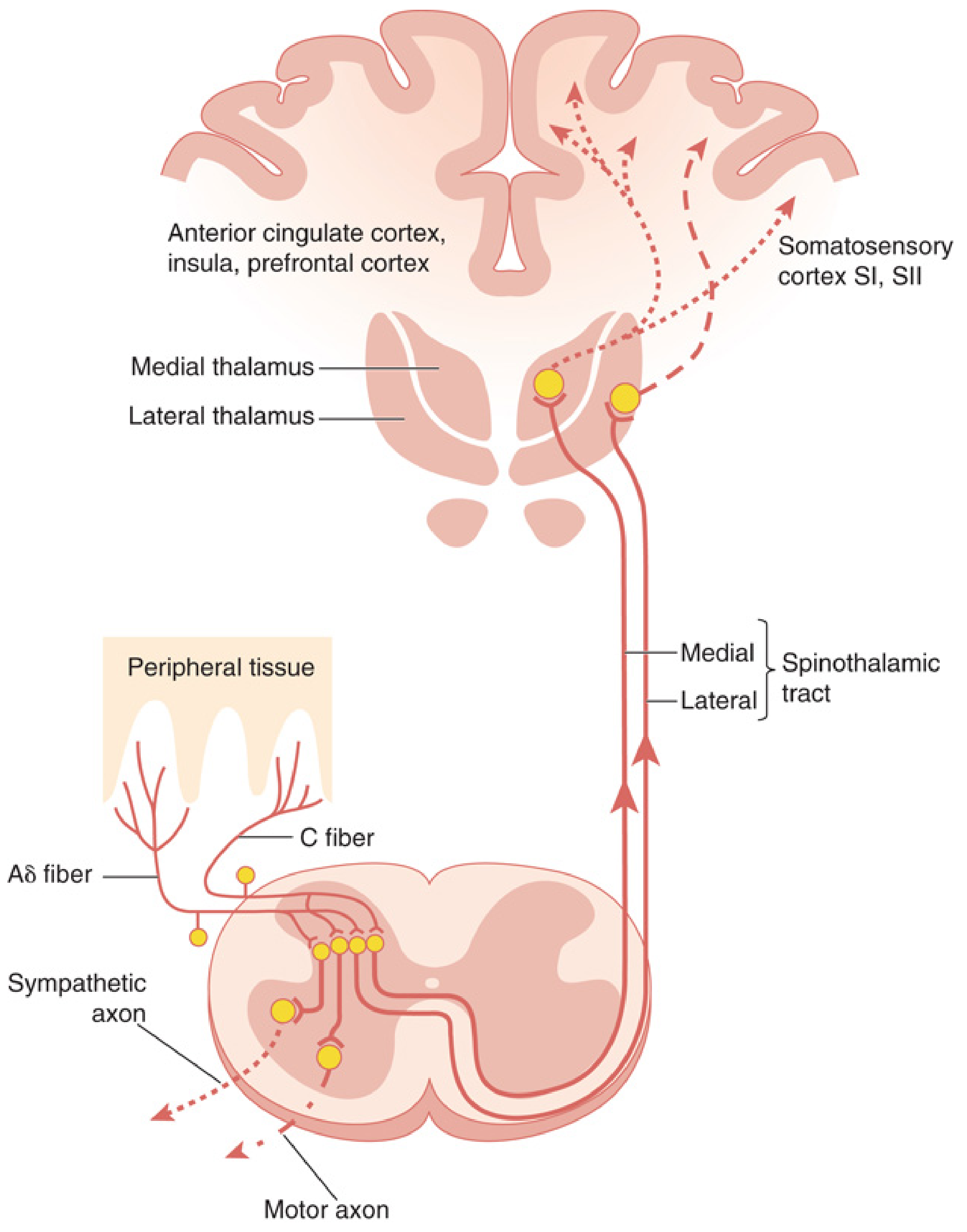
4. Clinical Consequences of Sensitization
| Phenomenon | Definition |
|---|---|
| Hyperalgesia | Increased pain intensity in response to the same noxious stimulus (e.g., pinprick causes severe pain) |
| Allodynia | Normally innocuous stimuli produce pain (e.g., light touch causes pain) |
| Referred pain | Convergence of visceral and somatic inputs onto single spinal neurons causes pain to be felt at a distant site |
Classic example: Sunburned skin - a gentle slap or warm shower produces severe pain due to peripheral and central sensitization.
5. How Spinal Anesthesia Interrupts/Prevents Sensitization
Spinal anesthesia works by blocking this sensitization cascade at the neuraxial level:
-
Local anesthetics injected intrathecally block voltage-gated Na+ channels in the nerve roots, preventing transmission of nociceptive signals into the dorsal horn
-
By blocking afferent input, spinal anesthesia prevents central sensitization from being established - there is no "wind-up" if signals never reach the dorsal horn
-
Pre-emptive analgesia concept: infiltration or neuraxial block before surgical incision decreases nociceptor sensitization, conduction, and results in decreased postoperative pain and analgesic requirements
-
Ketamine (used as adjuvant in spinal/epidural): decreases NMDA receptor-mediated "wind-up" - an elementary form of CNS sensitization
-
Spinal opioids activate opioid receptors in the dorsal horn, inhibiting transmission from sensitized nociceptors
-
Campbell-Walsh Urology, p. Regional Anesthesia section
-
Barash Clinical Anesthesia 9e, Pharmacodynamics section
-
Morgan & Mikhail's Clinical Anesthesiology 7e, p. 1965
Summary Table
| Level | Process | Mediators | Result |
|---|---|---|---|
| Peripheral terminal | Peripheral sensitization | BK, PGs, NGF, cytokines | Lowered threshold, increased firing |
| Spinal dorsal horn | Central sensitization / wind-up | Glutamate (NMDA), Substance P (NK1) | Hyperexcitability, allodynia, hyperalgesia |
| Supraspinal | Pain perception & modulation | Descending inhibitory/facilitatory pathways | Amplification or suppression |
| Spinal anesthesia | Interrupts afferent input | Local anesthetics block NaV | Prevents sensitization from establishing |
The key concept is that sensitization is not just increased sensation - it is a pathological change in receptor and neuronal excitability driven by inflammatory mediators and synaptic plasticity. Spinal anesthesia is one of the most effective interventions because it cuts the afferent limb of this sensitization cascade entirely.
This is a shared conversation. Sign in to Orris to start your own chat.