
Explain me muscles of upper and lower limbs.
Reading File
Now let me search the medical library for muscles of the upper and lower limbs simultaneously.
Finding Sources
Finding Sources
Reading File
Reading File
Reading File
Finding Sources
Reading File
Finding Sources
Finding Sources
Finding Sources
Finding Sources
Finding Sources
Reading File
Loading Image
Loading Image
Loading Image
Now I have comprehensive information from the textbooks. Let me compile the full, well-organized answer.
Muscles of the Upper and Lower Limbs
Sources: Gray's Anatomy for Students; THIEME Atlas of General Anatomy and Musculoskeletal System
UPPER LIMB
The muscles of the upper limb are organized into functional-topographical groups: shoulder girdle, shoulder joint, arm, forearm, and hand. The arm and forearm are each divided into anterior (flexor) and posterior (extensor) compartments by intermuscular septa, bones, and fascia.
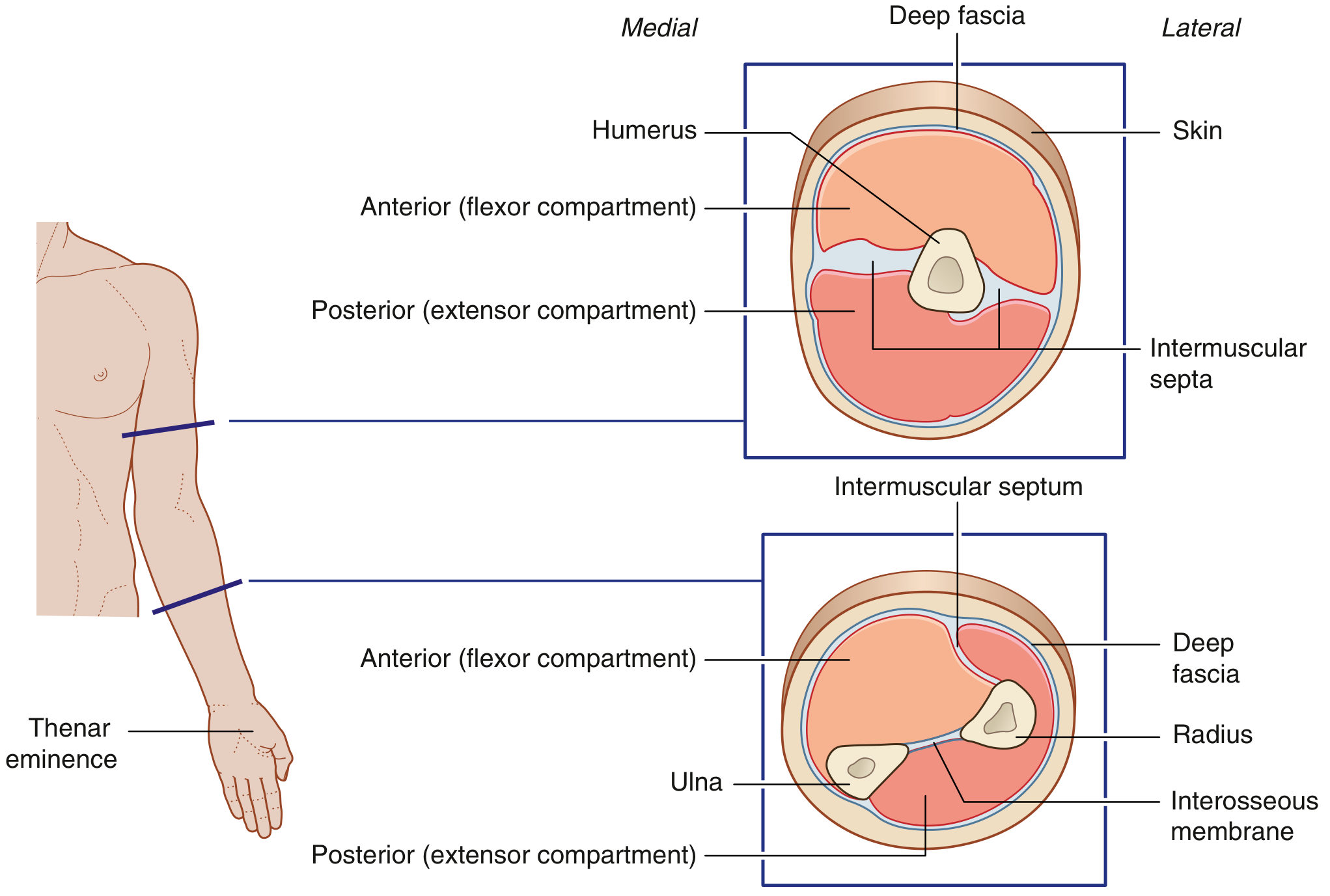
1. Muscles of the Shoulder Girdle
These muscles move and stabilize the scapula and clavicle relative to the trunk.
Muscles that migrated from the head:
- Trapezius
- Sternocleidomastoid
- Omohyoid
Posterior trunk/shoulder girdle muscles:
- Rhomboid major and minor - retract the scapula
- Levator scapulae - elevates the scapula
Anterior trunk/shoulder girdle muscles:
- Subclavius
- Pectoralis minor - protracts and depresses the scapula
- Serratus anterior - protracts the scapula, holds it against the thorax ("winging" occurs on palsy)
2. Muscles of the Shoulder Joint (Acting on the Humerus)
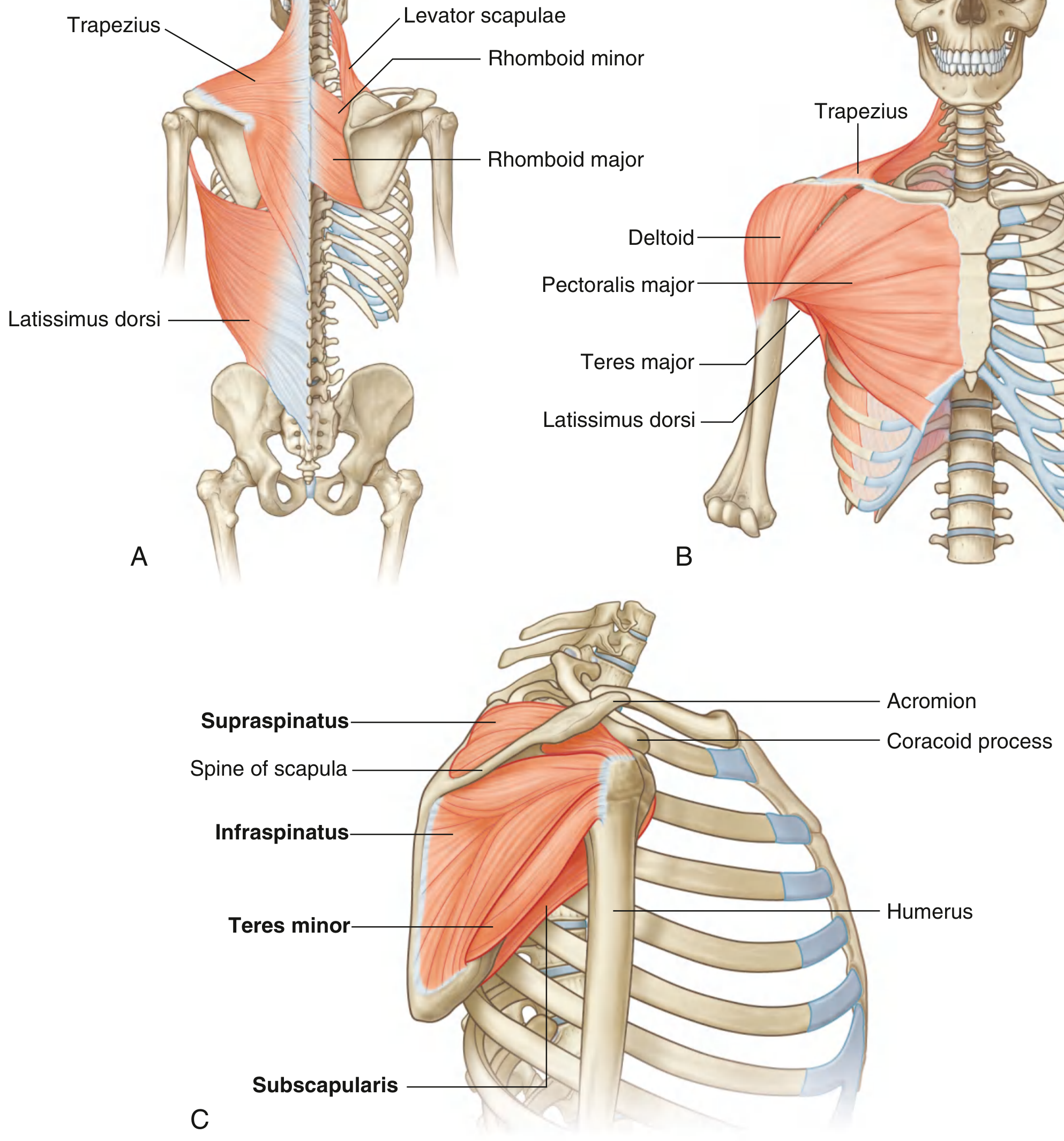
The Rotator Cuff (SITS) - the four muscles that wrap the glenohumeral joint and provide dynamic stability:
| Muscle | Action | Nerve |
|---|---|---|
| Supraspinatus | Initiates abduction (0-15°) | Suprascapular n. |
| Infraspinatus | External rotation | Suprascapular n. |
| Teres minor | External rotation | Axillary n. |
| Subscapularis | Internal rotation | Upper/lower subscapular n. |
Other shoulder joint muscles:
- Deltoid - main abductor of shoulder (middle fibers), flexion (anterior), extension (posterior)
- Pectoralis major - flexion, adduction, medial rotation
- Latissimus dorsi - extension, adduction, medial rotation
- Teres major - adduction, medial rotation
- Coracobrachialis - flexion and adduction
3. Muscles of the Arm
Separated into two compartments by the humerus and intermuscular septa.
Anterior compartment (flexors of the elbow):
| Muscle | Origin | Action | Nerve |
|---|---|---|---|
| Biceps brachii | Coracoid process + supraglenoid tubercle | Elbow flexion, supination | Musculocutaneous |
| Brachialis | Anterior humerus | Elbow flexion (prime mover) | Musculocutaneous |
| Coracobrachialis | Coracoid process | Shoulder flexion/adduction | Musculocutaneous |
Posterior compartment (extensors of the elbow):
| Muscle | Action | Nerve |
|---|---|---|
| Triceps brachii (3 heads: long, medial, lateral) | Elbow extension | Radial n. |
| Anconeus | Assists elbow extension | Radial n. |
4. Muscles of the Forearm
Anterior compartment (flexors - median and ulnar nerves):
Superficial layer:
- Pronator teres - pronation + weak elbow flexion
- Flexor carpi radialis - wrist flexion, radial deviation
- Palmaris longus - weak wrist flexion (absent in ~15%)
- Flexor carpi ulnaris - wrist flexion, ulnar deviation
- Flexor digitorum superficialis - flexes middle phalanges of fingers 2-5
Deep layer:
- Flexor digitorum profundus - flexes distal phalanges (median + ulnar)
- Flexor pollicis longus - flexes distal phalanx of thumb (median)
- Pronator quadratus - pronation (median)
Posterior compartment (extensors - radial nerve):
Superficial:
- Extensor carpi radialis longus and brevis
- Extensor digitorum - extends fingers 2-5
- Extensor digiti minimi - extends little finger
- Extensor carpi ulnaris
Deep:
- Supinator - supination
- Abductor pollicis longus
- Extensor pollicis brevis and longus
- Extensor indicis
5. Intrinsic Muscles of the Hand
Thenar muscles (act on thumb - median nerve):
- Abductor pollicis brevis
- Flexor pollicis brevis
- Opponens pollicis - opposition of thumb
Hypothenar muscles (act on little finger - ulnar nerve):
- Abductor digiti minimi
- Flexor digiti minimi brevis
- Opponens digiti minimi
Other intrinsic hand muscles:
- Lumbricals (1st and 2nd - median; 3rd and 4th - ulnar) - flex MCP, extend IP joints
- Dorsal interossei (4) - abduct fingers (DAB), ulnar nerve
- Palmar interossei (3) - adduct fingers (PAD), ulnar nerve
- Adductor pollicis - adducts thumb, ulnar nerve
LOWER LIMB
The lower limb is specialized for weight-bearing and bipedal locomotion, making its muscles much more massive and powerful than their upper limb counterparts. The hip and gluteal muscles are particularly large because they support and stabilize the entire body weight.
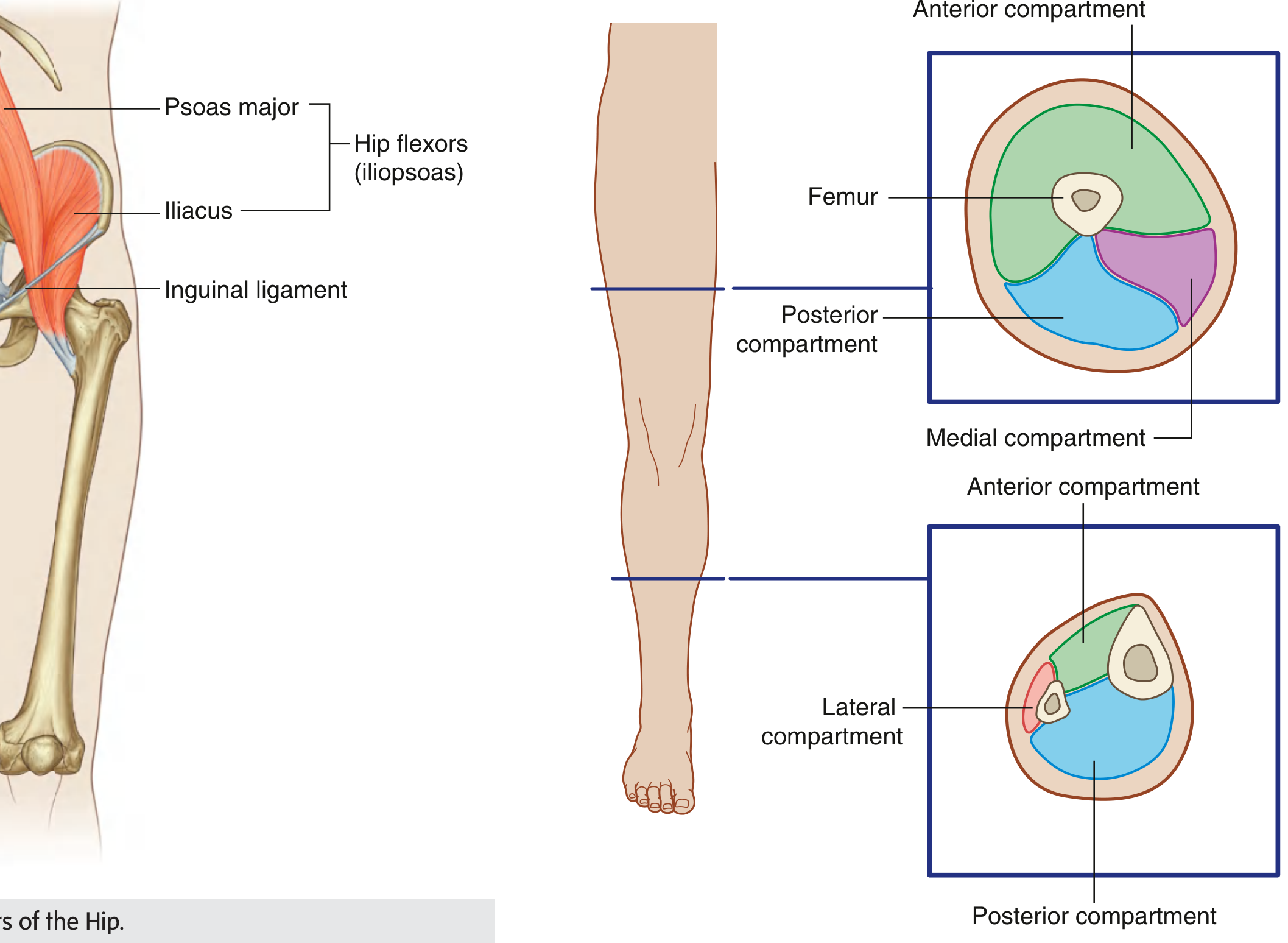
1. Hip and Gluteal Muscles
Inner hip muscles (Iliopsoas):
- Psoas major - arises from lumbar vertebrae (L1-L5)
- Iliacus - arises from iliac fossa
- Together they form the iliopsoas, the most powerful hip flexor. Supplied by femoral nerve (L2-L4) and direct branches (L1-L3).
Outer hip / Gluteal muscles:
| Muscle | Action | Nerve |
|---|---|---|
| Gluteus maximus | Hip extension, lateral rotation | Inferior gluteal (L5-S2) |
| Gluteus medius | Hip abduction, stabilizes pelvis | Superior gluteal (L4-S1) |
| Gluteus minimus | Hip abduction, medial rotation | Superior gluteal (L4-S1) |
| Tensor fasciae latae | Hip flexion, abduction, medial rotation | Superior gluteal (L4-S1) |
| Piriformis | Lateral rotation | Sacral plexus (L5-S2) |
| Obturator internus | Lateral rotation | Sacral plexus |
| Gemelli (superior + inferior) | Lateral rotation | Sacral plexus |
| Quadratus femoris | Lateral rotation | Sacral plexus |
Adductor group (medial compartment of thigh, act mainly on hip):
- Obturator externus, Pectineus, Adductor longus, Adductor brevis, Adductor magnus, Adductor minimus, Gracilis
- Innervated by the obturator nerve (L2-L4); also femoral nerve for pectineus
2. Muscles of the Thigh
The thigh has three compartments:
Anterior compartment - Knee extensors (femoral nerve L2-L4):
| Muscle | Notes |
|---|---|
| Quadriceps femoris | The large extensor; 4 heads - rectus femoris, vastus lateralis, vastus medialis, vastus intermedius |
| Sartorius | Longest muscle in the body; flexes, abducts, laterally rotates thigh; also flexes knee |
Posterior compartment - Hamstrings (sciatic nerve L5-S2):
The hamstrings extend the hip and flex the knee.
| Muscle | Notes |
|---|---|
| Biceps femoris | Has a long and short head |
| Semimembranosus | Also medially rotates the tibia |
| Semitendinosus | Long tendon, medially rotates tibia |
3. Muscles of the Leg
The leg has three compartments:
Anterior compartment - Dorsiflexion and toe extension (deep fibular/peroneal nerve):
- Tibialis anterior - dorsiflexion + inversion
- Extensor digitorum longus - extends toes 2-5, dorsiflexion
- Extensor hallucis longus - extends big toe, dorsiflexion
- Fibularis tertius
Lateral compartment - Eversion (superficial fibular nerve):
- Fibularis (peroneus) longus - eversion + plantar flexion
- Fibularis (peroneus) brevis - eversion
Posterior compartment - Plantar flexion (tibial nerve):
Superficial (Triceps surae - the most powerful plantar flexors):
- Gastrocnemius (medial and lateral heads) - plantarflexion + knee flexion
- Soleus - plantarflexion only
- Plantaris - weak assistant
Gastrocnemius + Soleus = Triceps surae → insert via the Achilles/calcaneal tendon
Deep:
- Tibialis posterior - plantarflexion + inversion, supports medial arch
- Flexor digitorum longus - flexes toes 2-5, plantarflexion
- Flexor hallucis longus - flexes big toe, plantarflexion
- Popliteus - unlocks the knee (laterally rotates femur on fixed tibia)
4. Intrinsic Muscles of the Foot
Dorsal surface:
- Extensor digitorum brevis
- Extensor hallucis brevis
Plantar surface (three compartments):
Medial:
- Abductor hallucis
- Flexor hallucis brevis
Lateral:
- Abductor digiti minimi
- Flexor digiti minimi brevis
- Opponens digiti minimi
Central:
- Flexor digitorum brevis
- Adductor hallucis (transverse and oblique heads)
- Quadratus plantae
- Four lumbricals
- Three plantar interossei
- Four dorsal interossei
The intrinsic foot muscles provide dynamic support for the longitudinal arch and fine-tune toe movements during walking.
Key Innervation Summary
| Region | Key Nerve | Muscles |
|---|---|---|
| Shoulder girdle | Accessory (CN XI) | Trapezius |
| Arm (anterior) | Musculocutaneous (C5-C7) | Biceps, brachialis, coracobrachialis |
| Arm (posterior) | Radial (C5-C8) | Triceps, anconeus |
| Forearm (anterior) | Median + ulnar nerves | Flexors, pronators |
| Forearm (posterior) | Radial nerve | Extensors, supinator |
| Hand (thenar) | Median nerve | Thenar muscles, lumbricals 1+2 |
| Hand (hypothenar) | Ulnar nerve | Hypothenar, interossei, lumbricals 3+4 |
| Hip flexors | Femoral (L2-L4) | Iliopsoas, sartorius, rectus femoris |
| Hip extensors | Inferior gluteal (L5-S2) | Gluteus maximus |
| Hip abductors | Superior gluteal (L4-S1) | Gluteus medius/minimus, TFL |
| Thigh (anterior) | Femoral nerve | Quadriceps |
| Thigh (posterior) | Sciatic nerve | Hamstrings |
| Thigh (medial) | Obturator nerve | Adductors |
| Leg (anterior) | Deep fibular nerve | Dorsiflexors |
| Leg (lateral) | Superficial fibular nerve | Everters |
| Leg (posterior) | Tibial nerve | Plantar flexors |
Sources: THIEME Atlas of General Anatomy and Musculoskeletal System (ISBN 9781626237186); Gray's Anatomy for Students (ISBN 9780323934237)
This is a shared conversation. Sign in to Orris to start your own chat.