
Hello to all Anatomy imp questions : Dural sinus venous Facial nerve Layers of the scalp Triangles -4 Cavernous sinus Deep servical fascia Bells palsy Black eye Dangerous layer of scalp
Reading File
Now I'll search the textbook library for all these topics in parallel.
Finding Sources
Finding Sources
Finding Sources
Finding Sources
Finding Sources
Finding Sources
Now let me read the most relevant sections in parallel:
Finding Sources
Finding Sources
Finding Sources
Finding Sources
Now let me read the key textbook sections in parallel:
Reading File
Reading File
Reading File
Reading File
Reading File
Reading File
Now let me read the facial nerve section and Bell's palsy, deep cervical fascia additional content, and scalp layers:
Reading File
Reading File
Reading File
Searching the Web
layers of scalp SCALP mnemonic dangerous layer anatomy
Now let me also read the facial nerve branches and Bell's palsy content, plus the triangles sections:
Reading File
Reading File
Searching the Web
Bell's palsy facial nerve LMN UMN difference forehead sparing anatomy
I now have comprehensive information from all sources. Let me compile the complete answer.Here is your complete, exam-ready anatomy guide covering all the topics you listed:
📚 Anatomy - Important Questions: Head & Neck
1. LAYERS OF THE SCALP (Mnemonic: S-C-A-L-P)
| Layer | Full Name | Key Features |
|---|---|---|
| S | Skin | Thickest skin of body; contains hair follicles, sebaceous glands |
| C | Connective tissue (dense) | Highly vascular - bleeds profusely when cut; arteries DON'T retract (tethered) |
| A | Aponeurosis (Galea aponeurotica / epicranial) | Connects frontalis to occipitalis; tough fibrous layer |
| L | Loose areolar connective tissue | THE DANGEROUS LAYER (see below) |
| P | Pericranium (Periosteum of skull) | Firmly adherent to outer surface of skull bones |
Note: The first 3 layers (S, C, A) move together as a unit - lacerations here gape widely.
2. DANGEROUS LAYER OF THE SCALP
The 4th layer - Loose Areolar Connective Tissue is called the "Danger Area" of the scalp.
Why is it dangerous?
- It contains emissary veins - these are valveless veins
- They connect extracranial scalp veins → diploic veins → intracranial dural venous sinuses
- Because there are no valves, infection can spread retrogradely from the scalp into the cranial cavity
- This can cause meningitis, cavernous sinus thrombosis, cerebral venous thrombosis
- Pus and blood accumulate freely in this loose plane (subgaleal hematoma, subgaleal abscess)
- In surgery: provides an easy plane for scalp flap elevation
3. DURAL VENOUS SINUSES
Definition: Valveless venous channels formed between the periosteal and meningeal layers of the dura mater; lined with endothelium; rigid walls (cannot collapse).
Key Sinuses and Their Anatomy:
| Sinus | Location / Course | Drains To |
|---|---|---|
| Superior Sagittal Sinus | Runs in superior border of falx cerebri from front to back | Confluence of sinuses |
| Inferior Sagittal Sinus | Runs in inferior free border of falx cerebri | Straight sinus |
| Straight Sinus | Junction of falx cerebri + tentorium cerebelli; receives the great cerebral vein (of Galen) | Confluence of sinuses |
| Confluence of Sinuses | At internal occipital protuberance - all major sinuses meet here | Transverse sinuses |
| Transverse Sinus | Runs laterally from confluence → sigmoid sinus | Sigmoid sinus |
| Sigmoid Sinus | S-shaped course along posterior-inferior petrous bone → jugular foramen | Internal jugular vein |
| Cavernous Sinus | Either side of sella turcica / pituitary gland | Via inferior petrosal sinus → IJV; via superior petrosal sinus → sigmoid sinus |
| Superior Petrosal Sinus | Runs along superior border of petrous temporal bone | Connects cavernous sinus → sigmoid sinus |
| Inferior Petrosal Sinus | Along inferior border of petrous temporal bone | Connects cavernous sinus → internal jugular vein |
| Occipital Sinus | Root of falx cerebelli | Foramen magnum → marginal sinus |
| Sphenoparietal Sinus | Along lesser wing of sphenoid | Superior sagittal sinus → cavernous sinus |
(Color Atlas of Human Anatomy Vol. 2)
4. CAVERNOUS SINUS
Location: On each side of the sella turcica (pituitary gland)
Structures INSIDE the cavernous sinus:
- Internal Carotid Artery (with its sympathetic plexus)
- CN VI (Abducens nerve) - most medially placed cranial nerve in the sinus
Structures in the LATERAL WALL (from top to bottom):
- CN III (Oculomotor nerve)
- CN IV (Trochlear nerve)
- CN V1 (Ophthalmic division of trigeminal)
- CN V2 (Maxillary division of trigeminal)
Mnemonic for lateral wall (top to bottom): "O TOM CAT" - Oculomotor, Trochlear, Ophthalmic, Maxillary | Carotid Artery (with) Abducens, Trailing inside
Connections of Cavernous Sinus:
- Receives blood from superior ophthalmic vein (via angular/facial vein) - this is the route of spread for "Danger Triangle of Face" infections
- Communicates with opposite cavernous sinus via intercavernous sinuses
- Drains via inferior petrosal sinus → internal jugular vein
- Drains via superior petrosal sinus → sigmoid sinus
Clinical: Cavernous Sinus Thrombosis / Cavernous Sinus Syndrome
- Features: ophthalmoplegia (CN III, IV, VI), periorbital pain/numbness (CN V1/V2), proptosis, chemosis
- Causes: Tolosa-Hunt syndrome (idiopathic inflammation), pituitary apoplexy, carotid-cavernous fistula, metastases, angioinvasive fungal infection (mucormycosis)
5. FACIAL NERVE (CN VII)
Functional Components:
| Component | Function |
|---|---|
| Special Visceral Efferent (SVE) | Muscles of facial expression, stapedius, stylohyoid, posterior digastric |
| General Visceral Efferent (GVE) | Lacrimal gland (via GSPN + pterygopalatine ganglion); submandibular + sublingual glands (via chorda tympani + submandibular ganglion) |
| Special Sensory (SVA) | Taste - anterior 2/3 tongue (chorda tympani); palate + tonsil (via GSPN) |
| General Somatic Afferent (GSA) | Skin of EAC + conchal auricle |
Course of the Facial Nerve:
Intracranial: Nucleus in pons → exits brainstem at the cerebellopontine angle with CN VIII → enters internal acoustic meatus (IAM)
In Temporal Bone (via Fallopian Canal):
- Labyrinthine segment - shortest, narrowest, no epineurium; adjacent to geniculate ganglion
- Geniculate ganglion - gives off Greater Superficial Petrosal Nerve (GSPN) - tears, nasal glands
- Tympanic (horizontal) segment - passes over the oval window niche; most common site of congenital dehiscence
- Second genu - at pyramidal eminence; gives off Nerve to Stapedius
- Mastoid (vertical) segment - gives off Chorda Tympani (taste + submandibular/sublingual secretion)
Extracranial (exits stylomastoid foramen):
- Gives off nerve to posterior auricular muscles, posterior belly of digastric, and stylohyoid
- Enters parotid gland and divides into:
Terminal Branches (Mnemonic: "Two Zombies Bit My Cat"):
- T - Temporal
- Z - Zygomatic
- B - Buccal
- M - Marginal mandibular
- C - Cervical
(Cummings Otolaryngology)
6. BELL'S PALSY
Definition: Acute, idiopathic, unilateral lower motor neuron (LMN) facial nerve palsy - a diagnosis of exclusion
Cause: Thought to be due to reactivation of HSV-1 (herpes simplex virus) causing inflammation and edema of the facial nerve, particularly at the labyrinthine segment (the narrowest, most vulnerable point within the fallopian canal)
Key Clinical Features:
- Sudden onset unilateral facial paralysis (develops over 1-3 days)
- Forehead paralysis (cannot raise eyebrow on affected side) - distinguishes it from UMN lesion
- Inability to close the eye (risk of exposure keratopathy)
- Loss of nasolabial fold
- Drooling from corner of mouth
- Hyperacusis (nerve to stapedius affected - stapedius dampens loud sounds)
- Loss of taste on anterior 2/3 of tongue (chorda tympani)
- Reduced lacrimation (GSPN affected)
UMN vs LMN Facial Palsy - KEY DISTINCTION:
| Feature | UMN (e.g., stroke) | LMN (e.g., Bell's palsy) |
|---|---|---|
| Forehead | SPARED (bilateral cortical representation) | PARALYZED (all branches affected) |
| Eye closure | Intact | Impaired (lagophthalmos) |
| Lower face | Paralyzed | Paralyzed |
| Cause | Contralateral stroke, tumor | Bell's palsy, Ramsay Hunt, otitis media, parotid tumor |
Why is the forehead spared in UMN lesions? The frontalis (forehead) muscle receives corticobulbar fibers from both cerebral hemispheres. A unilateral upper motor neuron lesion only removes input from one side, so the contralateral hemisphere still drives forehead movement.
Treatment of Bell's Palsy:
- Oral corticosteroids (prednisolone) - within 72 hours of onset (Grade A evidence)
- Antivirals (acyclovir/valacyclovir) - often added alongside steroids
- Eye care - lubricating drops, eye patch at night to prevent corneal damage
- Most cases (>80%) recover spontaneously within 3 months
7. TRIANGLES OF THE NECK
The neck is divided by the sternocleidomastoid (SCM) muscle into anterior and posterior triangles.
POSTERIOR TRIANGLE
Boundaries:
- Anterior: Posterior border of SCM
- Posterior: Anterior border of Trapezius
- Inferior: Middle 1/3 of Clavicle
- Roof: Investing layer of deep cervical fascia
- Floor: Prevertebral fascia
Subdivided by the inferior belly of Omohyoid into:
- Occipital triangle (upper, larger)
- Omoclavicular (subclavian) triangle (lower, smaller)
Key contents: Spinal accessory nerve (CN XI), brachial plexus roots, external jugular vein, transverse cervical artery, suprascapular artery
ANTERIOR TRIANGLE
Boundaries:
- Lateral: Anterior border of SCM
- Medial: Midline of neck
- Superior: Inferior border of mandible
Divided by the digastric and omohyoid into 4 sub-triangles:
| Sub-triangle | Boundaries | Key Contents |
|---|---|---|
| Submental (unpaired) | Anterior bellies of both digastrics + hyoid | Submental lymph nodes, small veins |
| Submandibular (digastric) | Lower border of mandible + both bellies of digastric | Submandibular gland, facial artery/vein, CN XII (hypoglossal), CN VII marginal mandibular |
| Carotid | Superior belly of omohyoid + posterior belly of digastric + anterior border of SCM | Common/internal/external carotid arteries, IJV, CN X (vagus), carotid sinus, CN IX, CN XI, CN XII |
| Muscular (strap muscle) | Midline + superior belly of omohyoid + anterior border of SCM | Strap muscles, thyroid, trachea, esophagus |
(Gray's Anatomy for Students; Fischer's Mastery of Surgery)
8. DEEP CERVICAL FASCIA
Three main layers:
A. Superficial (Investing) Layer
- Envelopes: Trapezius, SCM, strap muscles, masseter, pterygoids, temporalis, submandibular gland, parotid gland
- Attachments: Superior - mandible + zygomatic arch; Inferior - clavicle, acromion, spine of scapula; Anterior - hyoid
- Forms roof of both anterior and posterior triangles
- Splits anteroinferiorly to form the suprasternal space of Burns (contains anterior jugular venous arch)
- Forms stylomandibular ligament (separates parapharyngeal and submandibular spaces)
B. Middle (Pretracheal/Visceral) Layer
- Muscular division: Strap muscles (sternohyoid, sternothyroid, thyrohyoid, omohyoid)
- Visceral division: Pharynx, larynx, trachea, esophagus, thyroid, parathyroid, buccinator
- Forms buccopharyngeal fascia (anterior border of retropharyngeal space)
- Extends from skull base → mediastinum (infection can spread downward)
- Invests thyroid gland as the pretracheal fascia
C. Deep (Prevertebral) Layer
- Envelopes: Paraspinous muscles, cervical vertebrae, scalene muscles
- Extends from skull base → coccyx (prevertebral layer)
- Has two sub-layers: prevertebral and alar layers
- Alar fascia lies between prevertebral and middle layers; covers cervical sympathetic trunk
D. Carotid Sheath
- Contains: Common carotid artery, internal jugular vein, vagus nerve (CN X)
- Made of contributions from all 3 layers of deep cervical fascia
- Called "The Lincoln Highway of the Neck" - rapid conduit for spread of infection to thorax
DANGER SPACE:
The "Danger Space" (Space 4) lies between the alar fascia and prevertebral fascia. Infection here can track rapidly from the skull base to the posterior mediastinum - hence "danger space." (K.J. Lee's Essential Otolaryngology)
9. BLACK EYE (Periocular Haematoma)
A black eye = haematoma (focal blood collection) and/or periocular ecchymosis (diffuse bruising) with oedema around the eye. It is the most common blunt eyelid/forehead injury.
Appears innocuous but MUST exclude serious causes:
- Trauma to the globe or orbit - examine the globe before lids become oedematous; do NOT apply pressure on the globe before confirming its integrity; use CT/MRI/bedside USS if suspected
- Orbital roof fracture - especially if associated with subconjunctival haemorrhage without a visible posterior limit
- Basal skull fracture - bilateral periocular haematomas ("Panda eyes" or "Raccoon eyes") - the blood tracks forward through the floor of the anterior cranial fossa
- Blowout fracture of orbital floor/medial wall - may cause diplopia (entrapment of inferior/medial rectus), subcutaneous emphysema
Key rule: Bilateral black eyes WITHOUT direct periorbital trauma = Basal skull fracture until proven otherwise
(Kanski's Clinical Ophthalmology)
Quick Revision Summary
| Topic | Core Memory Point |
|---|---|
| Scalp layers | S-C-A-L-P mnemonic |
| Dangerous layer | Layer 4 - Loose areolar - valveless emissary veins |
| Dural sinuses | Confluence at internal occipital protuberance; all ultimately drain to IJV |
| Cavernous sinus | CN III, IV, V1, V2 in wall; ICA + CN VI inside |
| Facial nerve | 5 terminal branches: Temporal, Zygomatic, Buccal, Marginal mandibular, Cervical |
| Bell's palsy | LMN + idiopathic + forehead paralyzed + treat within 72h with steroids |
| UMN vs LMN | UMN = forehead SPARED; LMN = forehead PARALYZED |
| Neck triangles | Anterior (4 sub) + Posterior (2 sub, divided by omohyoid) |
| Deep cervical fascia | 3 layers: Investing, Pretracheal, Prevertebral + Carotid sheath |
| Danger space | Between alar + prevertebral fascia → spreads to mediastinum |
| Black eye | Exclude basal skull fracture (panda eyes), orbital fracture, globe injury |
Sources: Color Atlas of Human Anatomy Vol. 2, Cummings Otolaryngology, Gray's Anatomy for Students, K.J. Lee's Essential Otolaryngology, Bradley & Daroff's Neurology, Fischer's Mastery of Surgery, Scott-Brown's Otorhinolaryngology, Kanski's Clinical OphthalmologyAll 9 topics covered in depth from authoritative medical textbooks. Here's a quick roadmap to what's above:
- Layers of the Scalp - S-C-A-L-P mnemonic with clinical significance of each layer
- Dangerous Layer - 4th layer (loose areolar), valveless emissary veins, route of infection to meninges
- Dural Venous Sinuses - All named sinuses, their courses and drainage patterns, all ultimately draining to the internal jugular vein
- Cavernous Sinus - Contents (ICA + CN VI inside; CN III, IV, V1, V2 in wall), connections, and clinical syndromes
- Facial Nerve - Full course through temporal bone (5 segments), all branches and their functions, terminal branches mnemonic
- Bell's Palsy - LMN palsy, HSV-1 etiology, forehead involvement (vs. UMN stroke), treatment within 72 hours
- Triangles of the Neck - Anterior (4 subdivisions) + Posterior (2 subdivisions), boundaries and key contents
- Deep Cervical Fascia - 3 layers + carotid sheath, the "danger space" (alar-prevertebral), spread of infection
- Black Eye - Clinical approach, must-not-miss diagnoses (panda eyes = basal skull fracture)
Scalp detail
Reading File
Searching the textbook library for detailed scalp anatomy now.
Searching sources...
Finding Sources
Finding Sources
Reading File
Reading File
Reading File
Reading File
Finding Sources
Finding Sources
Reading File
Finding Sources
Finding Sources
Reading File
Reading File
Loading Image
Now let me also fetch the nerve supply and lymph drainage diagrams:
Loading Image
Loading Image
Loading Image
All the data and diagrams are ready. Here is the complete detailed scalp anatomy guide:
🧠 The Scalp - Detailed Anatomy
Extent / Boundaries of the Scalp
The scalp covers the calvaria (dome of skull) and extends:
- Anteriorly: Superciliary arches (supraorbital margins)
- Posteriorly: External occipital protuberance + superior nuchal lines
- Laterally: Zygomatic arches + external acoustic meatus
Layers of the Scalp - S.C.A.L.P.
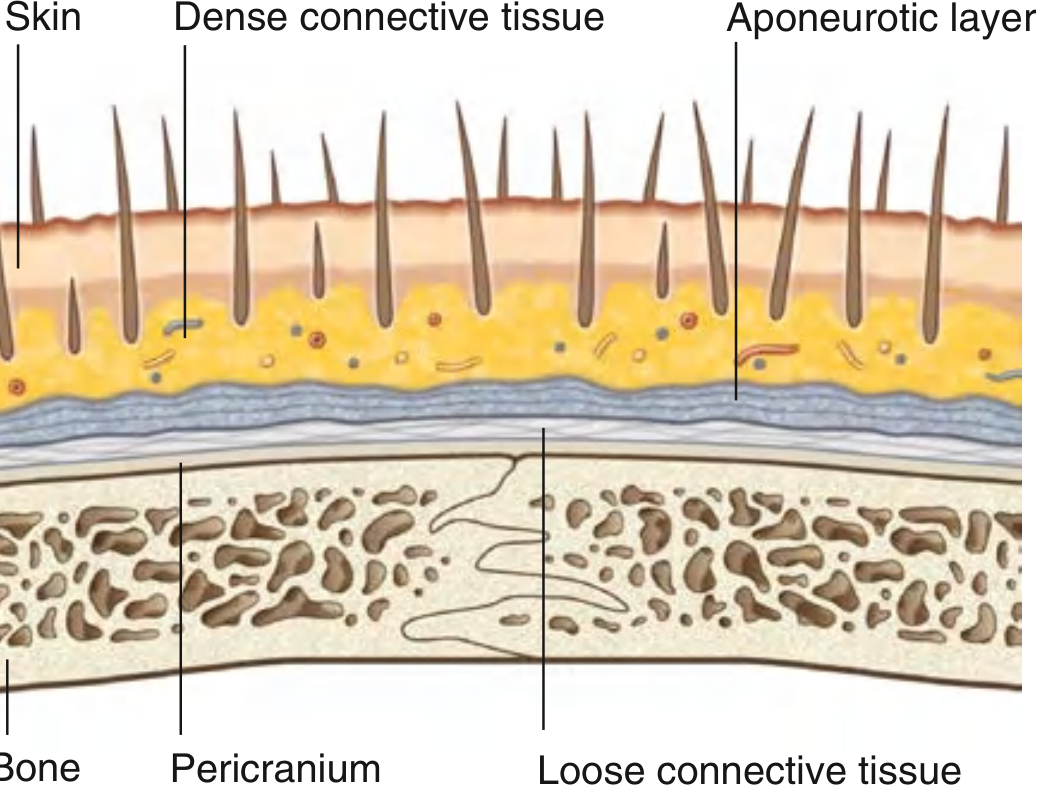
Layer 1 - S = Skin
- Thickest skin in the body: 3 mm (vertex) to 8 mm (occiput)
- Contains hair follicles, sebaceous glands, sweat glands
- Functions as barrier against external environment and pathogens
- Endocrine function: synthesis of Vitamin D
Layer 2 - C = Connective Tissue (Dense)
- Also called superficial fascia or subcutaneous tissue
- Most vascular layer - contains arteries, veins and nerves of the scalp
- The dense fibrous septa tether the vessels in this layer - so when cut, vessels CANNOT retract
- This is the main reason scalp lacerations bleed profusely - arteries remain held open by surrounding fibrous tissue
- Also, in the erect position, venous pressure is extremely low, so most bleeding is arterial
Exam Point: Bleeding from scalp wounds is predominantly arterial - vessels don't retract because they are tethered by the fibrous connective tissue.
Layer 3 - A = Aponeurotic Layer (Galea Aponeurotica / Epicranial Aponeurosis)
- The galea aponeurotica is a flat, tough, fibrous tendon connecting two muscles:
- Anteriorly: Frontalis muscle (frontal belly of occipitofrontalis)
- Posteriorly: Occipitalis muscle (occipital belly of occipitofrontalis)
- Laterally, the galea blends with the SMAS (Superficial Musculo-Aponeurotic System) of the face and temporoparietal fascia
The Occipitofrontalis Muscle:
- Frontal belly - attached to skin of eyebrows; moves upward across forehead; wrinkles forehead and raises eyebrows
- Occipital belly - arises from lateral superior nuchal line and mastoid process
- Motor supply:
- Frontal belly → Temporal branch of CN VII (facial nerve)
- Occipital belly → Posterior auricular branch of CN VII
Exam Point: The first 3 layers (S + C + A) are tightly bound together and move as a single unit - called the "Scalp Proper." This is the tissue torn away in "scalping" injuries.
Layer 4 - L = Loose Areolar Connective Tissue (LACT)
⚠️ THE DANGEROUS LAYER / DANGER ZONE OF SCALP
Why "dangerous?"
-
Contains emissary veins - these are valveless veins connecting:
- Scalp veins → Diploic veins → Intracranial dural venous sinuses
- No valves = retrograde flow possible → infection spreads from scalp to meninges
- Can cause: meningitis, subdural empyema, cavernous sinus thrombosis
-
Loose consistency - pus and blood can accumulate freely and spread widely across the whole skull in this plane
-
Allows movement - the scalp proper (layers 1-3) slides freely over the pericranium through this layer
-
Surgical plane - used for elevation of scalp flaps in craniofacial/neurosurgery (relatively avascular plane)
Layer 5 - P = Pericranium (Periosteum)
- Periosteum of the outer surface of the calvaria
- Firmly adherent to bones but can be stripped from the bone surface
- Firmly attached at suture lines - this is why subperiosteal collections (e.g., cephalohematoma) do NOT cross suture lines
- Provides a small amount of blood supply to the outer skull
Comparison of Scalp Space Pathologies
| Condition | Layer / Space | Crosses Suture Lines? | Notes |
|---|---|---|---|
| Caput Succedaneum | Layer 2 (connective tissue) | YES | Edema/hematoma in SQ tissue; neonatal head molding during delivery |
| Subgaleal Hematoma | Layer 4 (loose areolar tissue) | YES | Large, dangerous; can extend widely over whole calvaria; life-threatening blood loss in neonates |
| Cephalohematoma | Subperiosteal (deep to Layer 5) | NO | Contained by periosteum at suture lines; takes weeks to resolve |
Mnemonic (Neonatal scalp collections from superficial to deep): Capt Succedaneum (C for connective tissue) → Subgaleal (S for subaponeurotic) → Cephalohematoma (C for subperiosteal - Cranium)
Arterial Supply of the Scalp
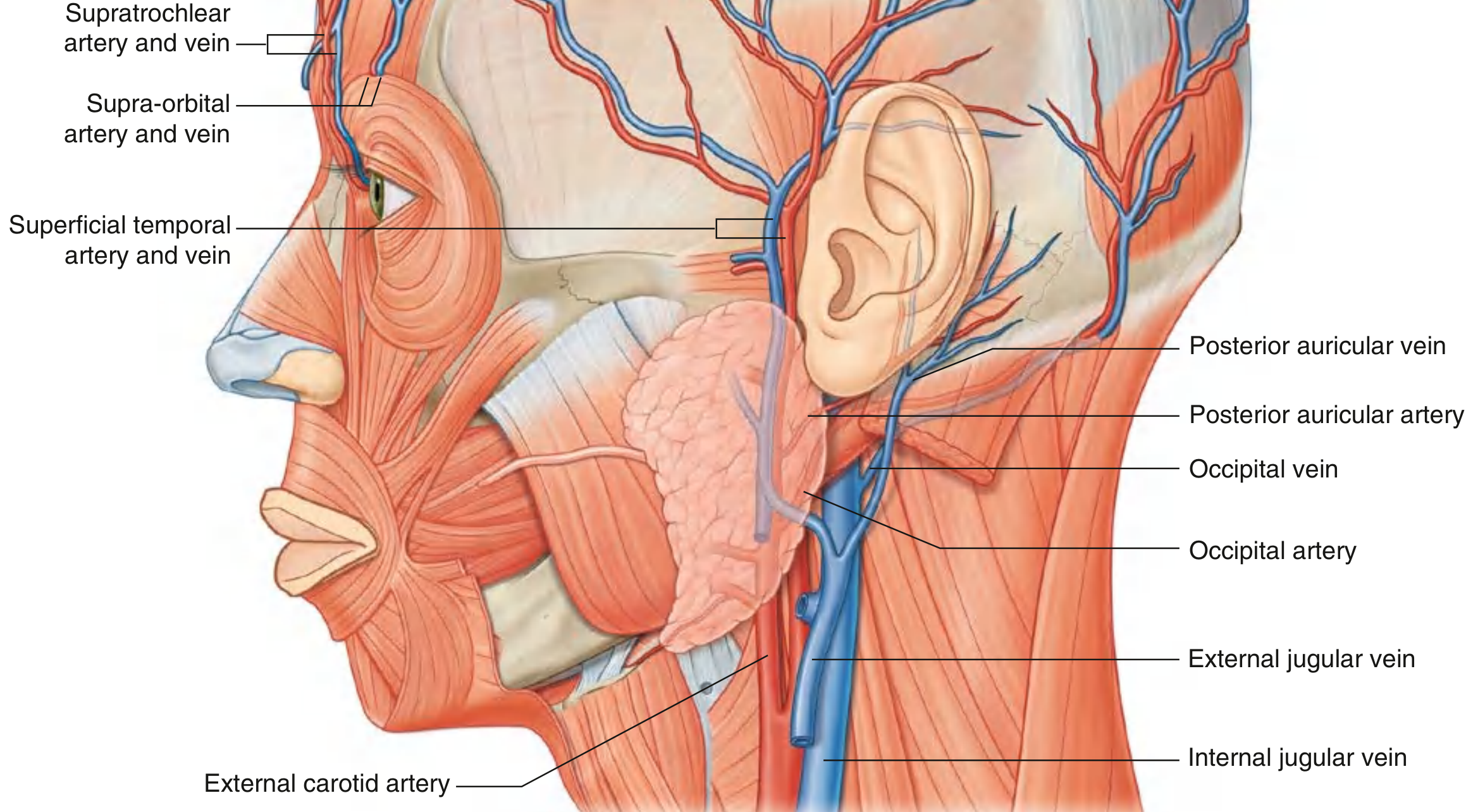
Two main sources: External Carotid Artery (ECA) + Internal Carotid Artery (ICA via ophthalmic artery)
| Artery | Origin | Region Supplied |
|---|---|---|
| Supratrochlear artery | Ophthalmic a. (ICA) | Anterior forehead near midline |
| Supra-orbital artery | Ophthalmic a. (ICA) | Anterior scalp to vertex |
| Superficial temporal artery | Terminal branch of ECA | Entire lateral scalp (largest supply); palpable anterior to ear/tragus |
| Posterior auricular artery | ECA (posterior) | Scalp posterior to the ear |
| Occipital artery | ECA (posterior) | Posterior scalp (large area) |
Exam Tip: The scalp arteries anastomose freely with each other and across the midline - this is why scalp flaps survive even when based on one arterial pedicle, and why scalp bleeding is hard to control.
Anatomical Rule: All scalp vessels run in Layer 2 (dense connective tissue) and approach from the periphery upward toward the vertex.
Venous Drainage of the Scalp
Follows the same pattern as arteries (companion veins):
- Supratrochlear + Supra-orbital veins → angular vein → facial vein
- Superficial temporal vein → retromandibular vein
- Posterior auricular vein → tributary of retromandibular vein
- Occipital vein → suboccipital venous plexus
Additionally, all scalp veins communicate with intracranial dural sinuses via emissary veins through Layer 4 (the dangerous layer).
Nerve Supply (Sensory Innervation)
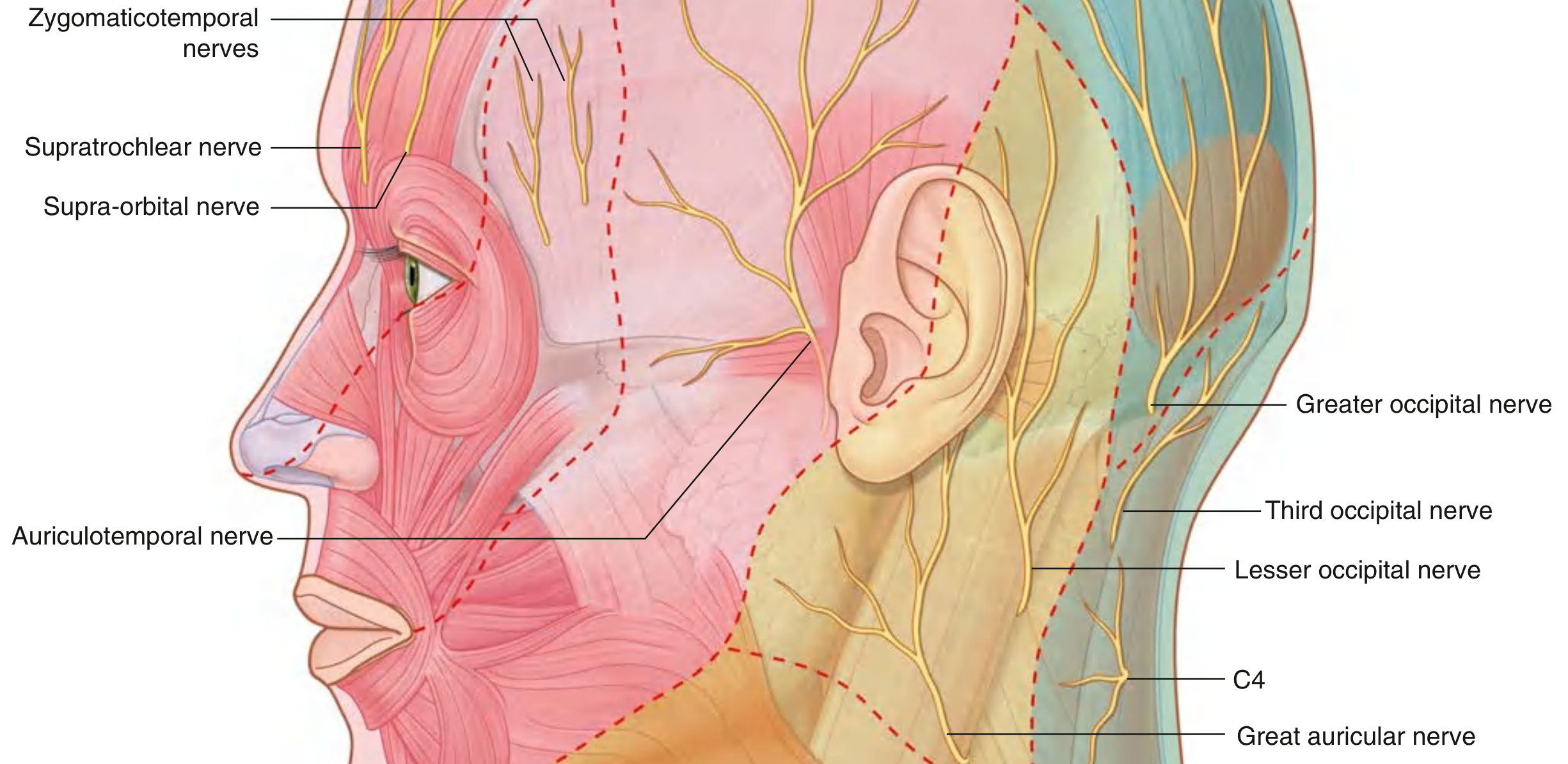
Dividing line: A line from the posterior ear → vertex → opposite posterior ear
- Anterior to this line → Trigeminal Nerve (CN V) branches
- Posterior to this line → Cervical Nerve branches (C2, C3)
Anterior (Trigeminal - CN V):
| Nerve | Branch of | Area Supplied |
|---|---|---|
| Supratrochlear | CN V1 (ophthalmic) | Medial forehead near midline |
| Supra-orbital | CN V1 (ophthalmic) | Forehead to vertex |
| Zygomaticotemporal | CN V2 (maxillary) | Small anterior temple area |
| Auriculotemporal | CN V3 (mandibular) | Temporal scalp + anterior to ear to near vertex |
Posterior (Cervical Nerves C2, C3):
| Nerve | Origin | Area Supplied |
|---|---|---|
| Greater Occipital nerve | Posterior ramus of C2 | Large posterior scalp up to vertex - MOST IMPORTANT |
| Lesser Occipital nerve | Anterior ramus of C2 (cervical plexus) | Posterior and superior to ear |
| Great Auricular nerve | Anterior rami of C2+C3 (cervical plexus) | Small area posterior to ear |
| Third Occipital nerve | Posterior ramus of C3 | Small lower posterior scalp area |
Motor Supply:
- Occipitofrontalis muscle → CN VII (facial nerve)
- Frontal belly → Temporal branches of CN VII
- Occipital belly → Posterior auricular branch of CN VII
Lymphatic Drainage of the Scalp
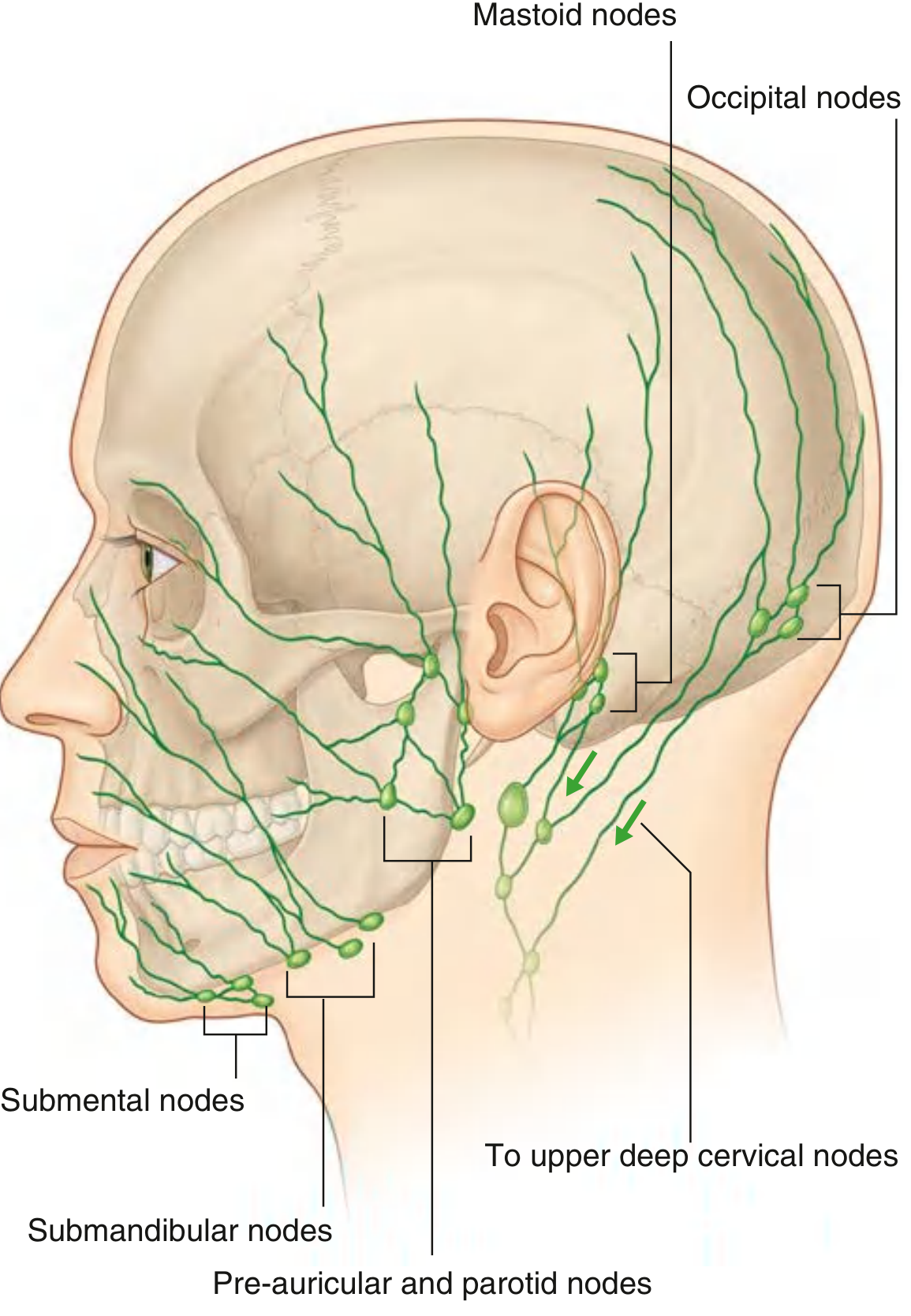
Lymphatics follow the arterial distribution pattern, draining to a "ring" of nodes around the base of the skull:
| Region of Scalp | Primary Nodes | Secondary Nodes |
|---|---|---|
| Posterior scalp (occiput) | Occipital nodes | Upper deep cervical nodes |
| Posterior to vertex | Mastoid nodes (retroauricular) | Upper deep cervical nodes |
| Anterior to vertex / temporal | Pre-auricular and parotid nodes | Upper deep cervical nodes |
| Forehead | Submandibular nodes (via facial artery) | Deep cervical nodes |
All eventually drain to the upper deep cervical lymph nodes.
Clinical Summary - Exam High Yield Points
| Point | Detail |
|---|---|
| Scalp mnemonic | S-C-A-L-P |
| Scalp proper | First 3 layers (S+C+A) move together |
| Profuse bleeding | Due to dense CT holding vessels open + arterial bleed |
| Dangerous layer | Layer 4 (Loose areolar) - valveless emissary veins |
| Emissary veins | Scalp → diploic veins → dural sinuses (no valves!) |
| Infection spread | Layer 4 → meningitis, cavernous sinus thrombosis |
| Cephalohematoma | Subperiosteal - does NOT cross suture lines |
| Subgaleal hematoma | Layer 4 - DOES cross suture lines - massive blood loss |
| Caput succedaneum | Layer 2 - crosses sutures - resolves fast |
| Sensory nerve | Anterior = CN V; Posterior = C2, C3 |
| Most important posterior nerve | Greater occipital nerve (C2 posterior ramus) |
| Motor to scalp muscles | CN VII (facial nerve) |
| Arterial supply | 5 arteries: 2 from ICA (ophthalmic), 3 from ECA |
| Veins | Drain to emissary veins → dural sinuses |
| Lymph drainage | Ring of nodes at skull base → deep cervical nodes |
Sources: Gray's Anatomy for Students, Scott-Brown's Otorhinolaryngology, Roberts & Hedges' Clinical Procedures in Emergency Medicine, Rosen's Emergency Medicine
Scalp
Could you clarify what aspect of the scalp you'd like me to focus on?
Asking for Preferences
What do you want on the scalp?
This is a shared conversation. Sign in to Orris to start your own chat.