
Type 1 diabetes symptoms diagnosis treatment
I'll invoke the medical library skill first as required for medical queries.
Searching sources...
Reading File
Now I'll run parallel searches across the library and PubMed simultaneously.
Finding Sources
Searching PubMed
"type 1 diabetes"[MeSH Terms] AND management
Good results. Now I'll read the most clinically comprehensive sources in parallel - Washington Manual (treatment), Henry's (diagnosis), and Immunology (pathophysiology).
Reading File
Reading File
Reading File
Searching PubMed
"type 1 diabetes" AND treatment
The Washington Manual section I read was about perioperative management. Let me get the main T1DM symptoms/diagnosis/treatment section and also search for clinical symptoms and management paragraphs.
Finding Sources
Finding Sources
Excellent sources identified. Now let me read the key clinical sections in parallel - Rosen's Emergency Medicine (symptoms), Goldman-Cecil (clinical manifestations/diagnosis), Lippincott Pharmacology (treatment), and Miller's Anesthesia (diagnostic criteria).
Reading File
Reading File
Reading File
Reading File
I have rich content. Let me also read the Goldman-Cecil treatment section and fetch the key diagram image, and get the insulin therapy details from Lippincott.
Reading File
Reading File
I now have comprehensive information from multiple authoritative sources. Let me also fetch the key diagram image showing beta-cell mass decline over time, and get the Goldman-Cecil treatment continuation (insulin pumps, monitoring, etc.).
Reading File
Loading Image
Loading Image
I now have comprehensive, well-sourced content to write a detailed answer. Let me compile everything.
Type 1 Diabetes Mellitus (T1DM)
Pathophysiology
Type 1 diabetes (previously called insulin-dependent diabetes) accounts for approximately 5-10% of all diabetes cases, with a peak onset at 11-12 years of age, though it can occur at any age. It is caused by autoimmune destruction of the insulin-producing beta (β) cells in the islets of Langerhans in the pancreas, resulting in absolute insulin deficiency.
The disease process involves multiple immune mechanisms:
- CD4+ Th1 cells reactive to islet antigens (including insulin)
- Cytotoxic T lymphocyte (CTL)-mediated lysis of islet cells
- Local production of cytokines (TNF and IL-1) damaging islet cells
- Autoantibodies against islet cells and insulin
The pathological lesion seen in the islets is called insulitis (cellular necrosis with lymphocytic infiltration of CD4+ and CD8+ T cells). Critically, 90% or more of islets must be destroyed before clinical manifestations appear, explaining the long preclinical phase.
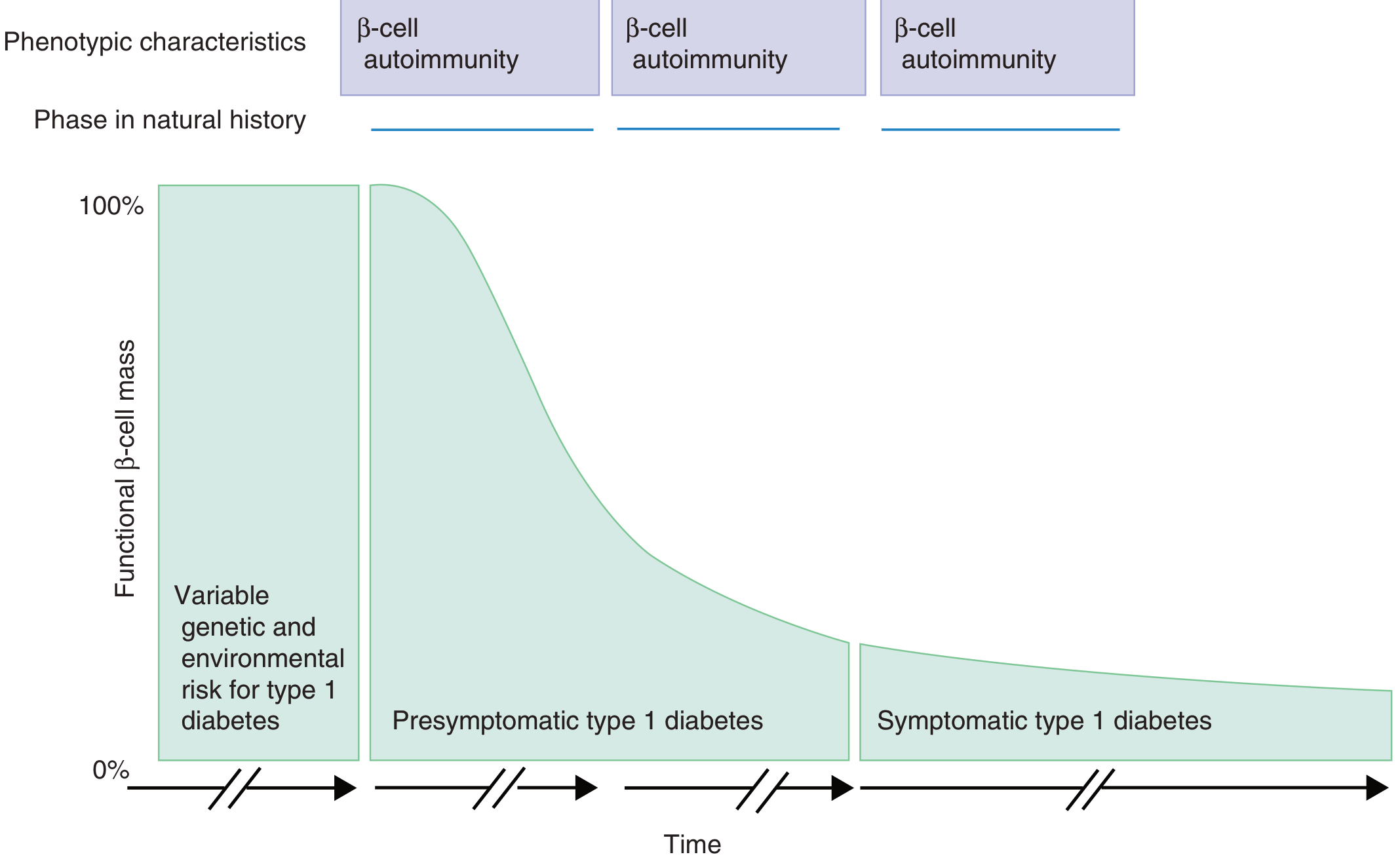
The diagram above shows how β-cell autoimmunity occurs long before symptoms appear. Clinical disease emerges only when functional β-cell mass falls near zero. (Goldman-Cecil Medicine)
Genetic factors: 90-95% of Caucasians with T1DM carry HLA-DR3 or DR4 (or both), vs. ~40% of healthy subjects. HLA-DQ alleles may be the actual disease-associated genes. Non-HLA genes - including insulin gene promoter polymorphisms and IL-2/CD25 polymorphisms - also contribute. Environmental triggers such as coxsackievirus B4 infection have been implicated.
Symptoms
The classic presentation is in a lean patient younger than 40 (often a child, adolescent, or young adult). Onset can be abrupt:
| Symptom | Mechanism |
|---|---|
| Polyuria | Osmotic diuresis from hyperglycemia |
| Polydipsia | Response to fluid losses |
| Polyphagia | Cells unable to use glucose; starvation signal |
| Weight loss | Catabolism of fat and protein (no insulin anabolism) |
| Fatigue | Impaired cellular glucose uptake |
| Blurred vision | Osmotic changes in the lens |
In some cases the disease first presents as diabetic ketoacidosis (DKA) - this is more common in children under age 5 and in low/middle-income countries, where 13-80% of first T1DM presentations worldwide are DKA. At the time of clinical diagnosis, about 10-20% of the original β-cell mass may still be functional.
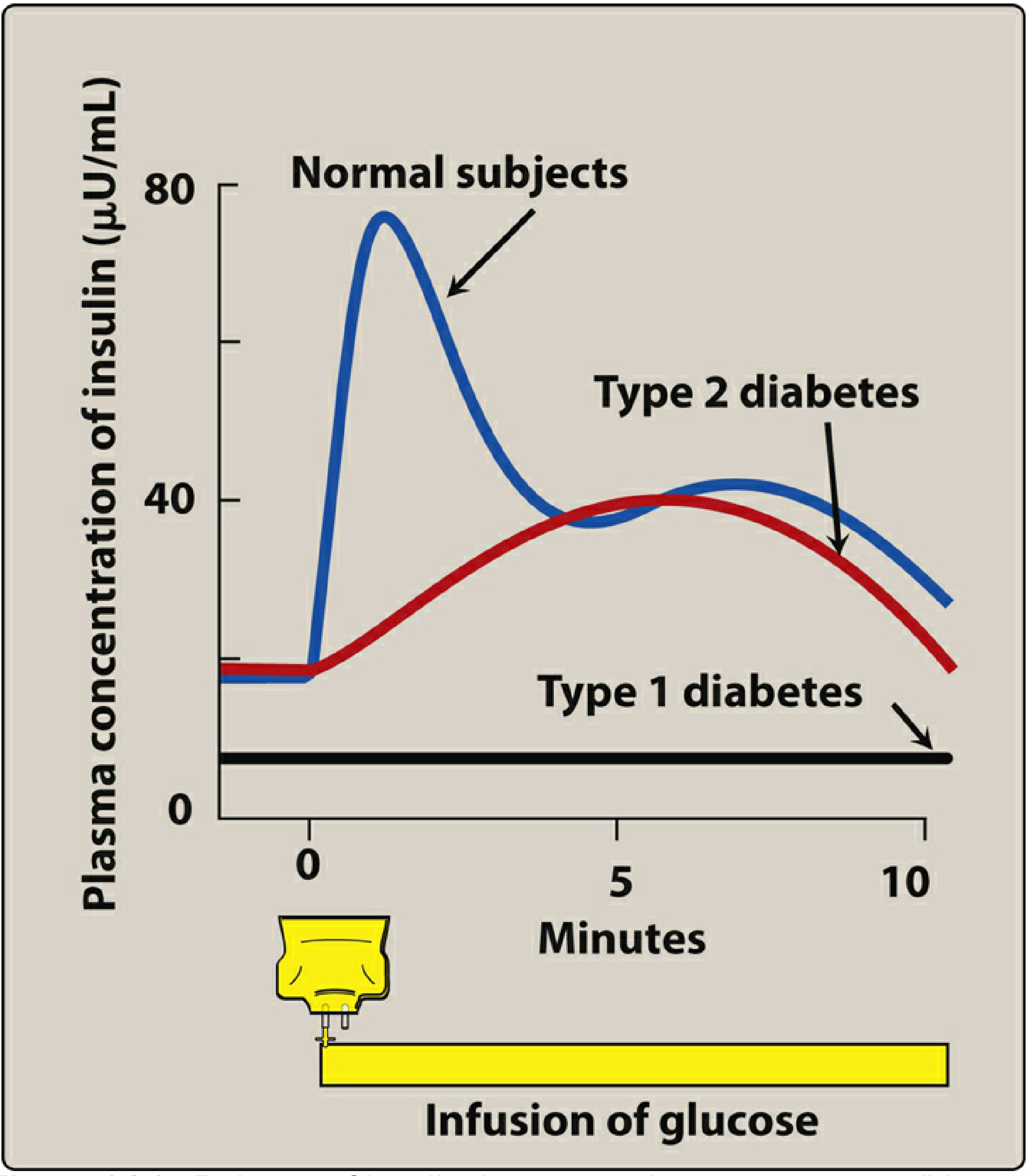
Type 1 diabetes produces essentially zero insulin response to a glucose load (flat black line). In normal subjects (blue), there is a sharp first-phase release within minutes. (Lippincott Illustrated Reviews: Pharmacology)
Chronic Complications
Long-standing hyperglycemia leads to:
- Macrovascular: Atherosclerosis, coronary artery disease, peripheral artery disease
- Microvascular: Diabetic retinopathy, nephropathy, peripheral neuropathy
- Other: Foot ulcers, recurrent infections, skin lesions, autonomic neuropathy
Diagnosis
The ADA diagnostic criteria for diabetes (any type) are:
| Criterion | Threshold |
|---|---|
| Random plasma glucose + symptoms | ≥200 mg/dL |
| Fasting plasma glucose (8-hour fast) | ≥126 mg/dL (confirmed on repeat) |
| 2-hour post-75g OGTT | ≥200 mg/dL |
| HbA1c | ≥6.5% |
If symptoms are absent, any single abnormal glucose result must be confirmed by repeat testing. - Miller's Anesthesia, 10e
Distinguishing T1DM from T2DM
Several markers help:
- Pancreatic autoantibodies - present in T1DM; markers include:
- Anti-GAD65 (glutamic acid decarboxylase) - highest sensitivity (91%) as single screening marker
- Anti-insulin (IAA) - more common in young children
- Anti-IA-2 (tyrosine phosphatase)
- Anti-ZnT8 (zinc transporter 8)
- Detection of ≥2 autoantibodies significantly increases prediction of T1DM development
- C-peptide - very low or undetectable in T1DM (reflects absent endogenous insulin)
- Clinical profile: Lean, young, prone to ketosis, absolute insulin requirement
"The presence or absence of anti-GAD65 or other antibodies is sometimes helpful to distinguish between type 1 and type 2 diabetes and to guide appropriate treatment if the diagnosis is in doubt." - Goldman-Cecil Medicine
"Honeymoon Phase"
After starting insulin, many patients experience weeks to months of easily controlled hyperglycemia due to partial remaining β-cell function. This fades as autoimmune destruction continues.
LADA (Latent Autoimmune Diabetes in Adults)
In some adults, T1DM follows a more indolent course and may initially be misdiagnosed as T2DM until progressive insulin deficiency reveals the T1DM phenotype.
Treatment
Core Principle
All patients with T1DM require exogenous insulin - without it, they will develop DKA. The goal is to maintain glucose in the physiologic range and prevent short- and long-term complications.
Glycemic Targets (ADA):
- HbA1c < 7% (most non-pregnant adults)
- Fasting glucose: 80-130 mg/dL
- Post-prandial glucose: <180 mg/dL
- Time-in-range (CGM): >70% of time between 70-180 mg/dL
Insulin Regimens
Total daily dose: 0.3-1.0 unit/kg/day for adults, with ~half given as basal and the remainder split as pre-meal boluses.
Insulin Types
| Type | Examples | Onset | Duration | Use |
|---|---|---|---|---|
| Rapid-acting analogues | Lispro, Aspart, Glulisine | 10-20 min | 3-5 hr | Mealtime bolus |
| Regular (short-acting) | Regular human insulin | 30-60 min | 6-8 hr | Mealtime |
| Intermediate-acting | NPH | 1-2 hr | 12-18 hr | Background |
| Long-acting analogues | Glargine, Detemir, Degludec | 1-2 hr | 20-24+ hr | Basal |
Basal-bolus regimen (multiple daily injections, MDI) is the standard - long-acting insulin once or twice daily, plus rapid-acting insulin before each meal. Prandial doses are adjusted using an insulin-to-carbohydrate ratio plus a correction factor (e.g., 1 unit of rapid insulin per 15g carbohydrate, with 1 unit correcting ~50 mg/dL of excess glucose).
Insulin Pump (Continuous Subcutaneous Insulin Infusion, CSII)
Insulin pumps deliver rapid-acting insulin via a subcutaneous catheter at a programmed variable basal rate, with on-demand boluses. Benefits vs. MDI:
- Reduces HbA1c by 0.3-0.5%
- Reduces severe hypoglycemia
- More flexible lifestyle
- Programmable basal rate variability (especially useful for the dawn phenomenon)
Sensor-augmented pumps (with CGM integration) reduce HbA1c by -0.4 to -0.6% and reduce hypoglycemia compared to MDI.
Closed-loop / Automated Insulin Delivery (AID) systems combine real-time CGM with an insulin control algorithm that automatically adjusts insulin delivery - the "artificial pancreas."
Monitoring
- HbA1c every 3 months - reflects average glucose over prior 3 months
- Self-monitoring blood glucose (SMBG) - fingerstick before meals and at bedtime
- Continuous glucose monitors (CGMs) - interstitial glucose every 5 minutes, glucose trend arrows, alarms for hypo/hyperglycemia
- Urine/capillary ketones - check when glucose is unexpectedly elevated; moderate/large ketones (≥2+ or >1.5 mmol/L) signal impending DKA
Additional Management
- DKA management: IV fluids, insulin infusion, electrolyte replacement (especially potassium)
- Hypoglycemia treatment: 15-20g fast-acting carbohydrate (glucose tablets, juice) for mild episodes; glucagon injection or IV dextrose for severe episodes
- Screening for complications: Annual ophthalmology exam, urine albumin/creatinine ratio, lipid panel, blood pressure monitoring, foot exam
- Immunotherapy (emerging): Teplizumab (anti-CD3 antibody) was approved in 2022 to delay onset of clinical T1DM in at-risk individuals with 2+ autoantibodies - this represents a new disease-modifying approach. A 2025 Lancet review outlines further emerging therapies including beta-cell replacement and antigen-specific immunotherapy.
- Multidisciplinary care: Endocrinologist, diabetes educator, dietitian, and - for pediatric patients - pediatric diabetes team
Sources: Rosen's Emergency Medicine, 9e | Goldman-Cecil Medicine, International Edition | Lippincott Illustrated Reviews: Pharmacology | Miller's Anesthesia, 10e | Henry's Clinical Diagnosis and Management by Laboratory Methods | Cellular and Molecular Immunology
This is a shared conversation. Sign in to Orris to start your own chat.