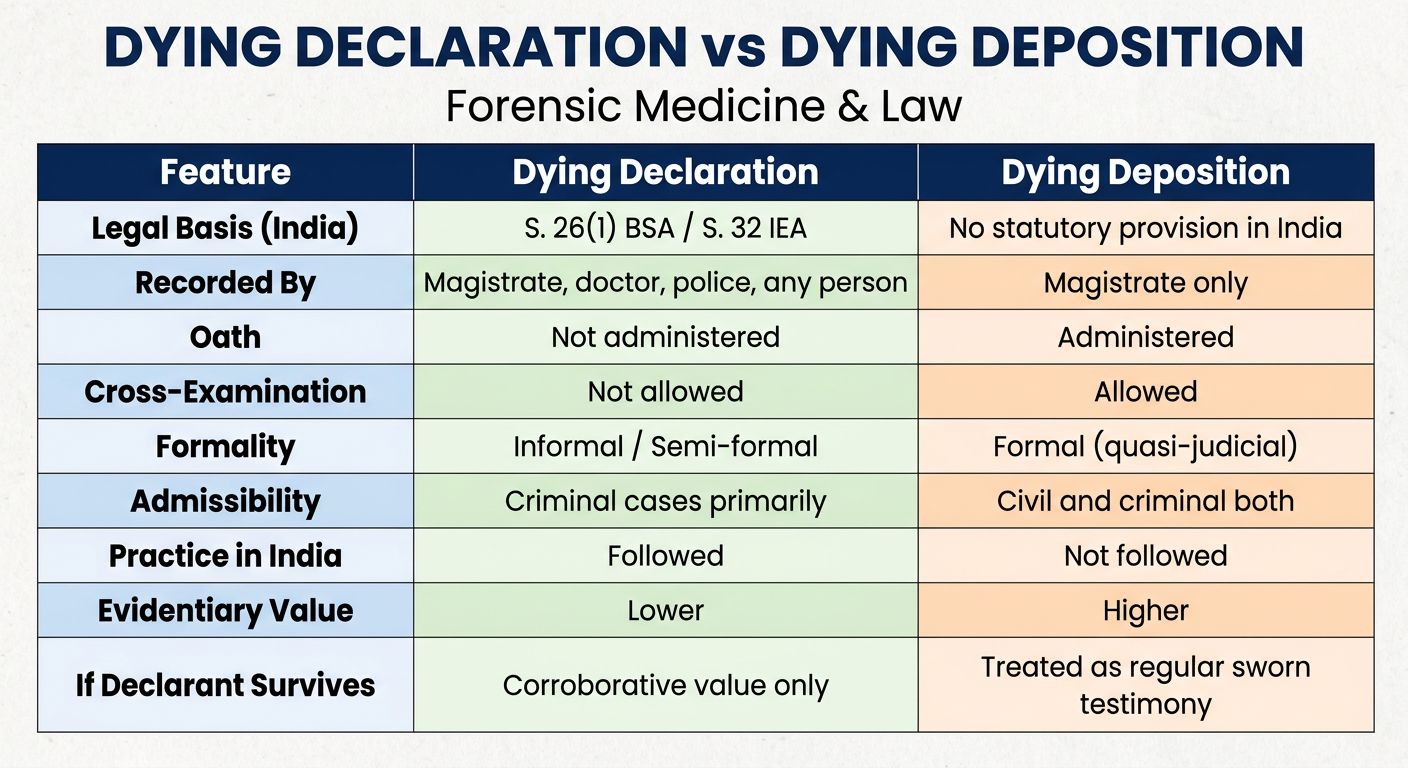
Dying declaration vs dying deposition
dying declaration vs dying deposition forensic medicine law differences
https://lawbhoomi.com/difference-between-dying-declaration-a…
Dying Declaration vs. Dying Deposition
Dying Declaration
- Definition: A written or oral statement (leterm mortem - "words said before death") made by a dying person regarding the cause or circumstances of their death. Governed by Section 26(1), BSA (formerly S. 32, Indian Evidence Act).
- Who records it: Ideally an Executive Magistrate. If no time, a doctor records it in the presence of two witnesses. Can also be recorded by police, village headman, or any authorized person (but evidential value is lower).
- Oath: NOT administered - based on the belief that a dying person tells the truth.
- Cross-examination: NOT possible.
- Pre-requisites: Doctor must certify the person is conscious and of sound mind (compos mentis) before recording.
- Procedure: Recorded in the declarant's own words; no leading questions; read back for signature/thumb impression.
- Admissibility: Admissible even if the declarant was NOT expecting death at the time. If the declarant survives, it is not admitted as evidence but has corroborative value.
- Scope: Primarily admissible in criminal cases (e.g., dowry death, homicide).
- Sent to: Magistrate in a sealed cover; produced at trial.
- Evidentiary weight: Moderate - considered relevant but weaker than sworn testimony.
Dying Deposition
- Definition: A formal statement made on oath by a dying person, recorded by a magistrate in the presence of the accused or their lawyer.
- Who records it: A magistrate only - no one else can record it.
- Oath: Administered - the person is sworn in.
- Cross-examination: Allowed - the accused or their lawyer may cross-examine.
- Procedure: Formal, quasi-judicial process conducted in a courtroom or under magistrate supervision.
- Admissibility: Admissible in both civil and criminal cases.
- Practice in India: Not followed in India (as noted in Reddy's textbook and legal practice).
- Evidentiary weight: Higher than a dying declaration due to oath and cross-examination.
Comparison Table
| Feature | Dying Declaration | Dying Deposition |
|---|---|---|
| Legal basis (India) | S. 26(1) BSA / S. 32 IEA | No statutory provision in India |
| Recorded by | Magistrate, doctor, police, any person | Magistrate only |
| Oath | Not administered | Administered |
| Cross-examination | Not allowed | Allowed |
| Formality | Informal/semi-formal | Formal (quasi-judicial) |
| Admissibility | Criminal cases primarily | Civil and criminal both |
| Practice in India | Followed | Not followed |
| Evidentiary value | Lower | Higher |
| Requires expectation of death | Not required (if conscious and lucid) | Not required |
| If declarant survives | Corroborative value only | Treated as regular sworn testimony |
Key Memory Tip
Declaration = No oath, no cross-exam, anyone can record - used in India. Deposition = Oath + cross-exam, magistrate only - used in UK/common law countries, not India.
Make the comparative table in photo format
A clean, professional comparison table titled "Dying Declaration vs Dying Deposition" with the following rows and three columns (Feature | Dying Declaration | Dying Deposition): Title: DYING DECLARATION vs DYING DEPOSITION Subtitle: Forensic Medicine & Law Row 1: Legal Basis (India) | S. 26(1) BSA / S. 32 IEA | No statutory provision in India Row 2: Recorded By | Magistrate, doctor, police, any person | Magistrate only Row 3: Oath | Not administered | Administered Row 4: Cross-Examination | Not allowed | Allowed Row 5: Formality | Informal / Semi-formal | Formal (quasi-judicial) Row 6: Admissibility | Criminal cases primarily | Civil and criminal both Row 7: Practice in India | Followed | Not followed Row 8: Evidentiary Value | Lower | Higher Row 9: If Declarant Survives | Corroborative value only | Treated as regular sworn testimony Use a dark navy blue header row with white bold text. Alternate row colors between white and light blue. Left column in bold dark text. Middle column (Dying Declaration) with a light green tint. Right column (Dying Deposition) with a light orange tint. Clean modern font, well-spaced rows, subtle borders, professional medical/legal study card style.